

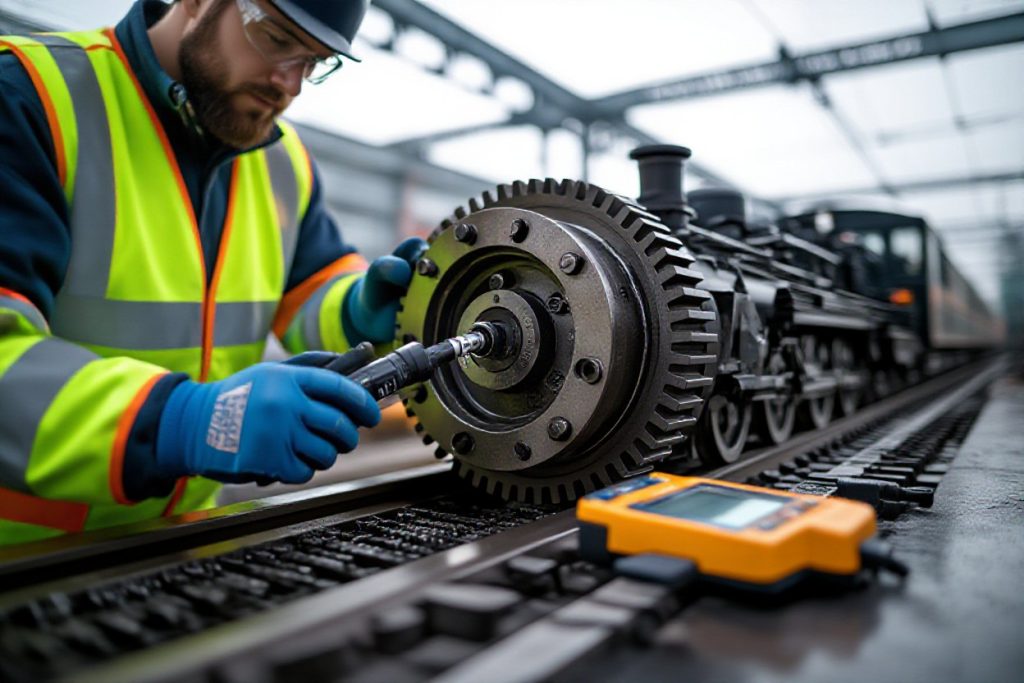
What the Heck is Traction Gear Anyway?
Your biggest headache is unplanned downtime from failing traction gears. You lose revenue, schedules slip, and sourcing the right spare feels like gambling. You need clear checks, reliable parts, and inspection routines that actually work. Below are fast, actionable steps you can use right away.
- Set inspection intervals by operating hours, not calendar dates.
- Use borescope checks before full disassembly.
- Add vibration monitoring to early-fault detection.
- Keep a calibrated magnetic particle kit on-site.
- Stock critical spares from trustworthy exporters like Mikura International.
- Require material certificates with every gear delivery.
- Create a simple damage-photo log for trend tracking.
Defining Traction Gear
There’s this late-night call I got from a yard foreman once, gears whining and a train stuck on a grade, and you feel that sinking pit in your stomach. You want to know what actually failed, right? That story shows how visible problems can hide deeper gear issues.
Traction gear means the gearbox, pinions, and final drives that transmit motor torque to wheels. You deal with gears, shafts, bearings, housings, and seals. They take huge loads, intermittent shocks, and heat. Your parts choices affect performance, life, and maintenance needs.
| Component | Function | Typical Concern |
|---|---|---|
| Pinion | Initial torque transfer | Tooth chipping, micro-pitting |
| Gear set | Speed reduction | Wear, misalignment |
| Final drive housing | Support and sealing | Cracks, oil leaks |
“Mikura International inspects each traction gear batch and provides full traceability.”
Why It Matters for Locomotives
Gear damage ruins schedules, raises fuel use, and can cascade into axle failures, and you pay dearly for that. Ever had a single failed gear hold up an entire consist? It happens, and it hurts margins and reputation.
The traction gear directly affects tractive effort, efficiency, and ride quality. If gears wear or misalign, your motors run hotter and consume more energy. Your maintenance window shrinks and costs climb. You need inspection data to act early.
| Inspection Method | What It Finds | When to Use |
|---|---|---|
| Visual | Cracks, oil leaks, pitting | Daily walkarounds |
| Borescope | Tooth faces without disassembly | Quarterly or before overhaul |
| Magnetic particle | Surface and near-surface cracks | After impact events |
| Ultrasonic | Subsurface defects | Annual deep inspection |
| Vibration analysis | Misalignment and pitting signatures | Continuous monitoring |
Practical tips you can use right now:
- Log borescope photos with timestamps for trend analysis.
- Match replacement gears to OEM specs and material certificates.
- Use vibration baselines to spot gradual tooth damage.
- Prioritize magnetic particle tests after shock events.
- Keep a vendor-approved parts list and reorder points.
Before you commit to a spare parts order the biggest pain is sudden traction gear failure and long downtime. You lose schedule slots, budgets blow out, and crews scramble at odd hours. You need inspection data that’s reliable, clear, and fast to act on. Downtime costs you real money.
- Set clear inspection intervals tied to operating hours and mileage.
- Prioritize critical axles and pinion teeth for early checks.
- Use a mix of visual and instrument checks to reduce misses.
- Log findings in a single system for trend spotting.
- Train on common defect signatures, not just procedures.
- Order replacement parts with lead times in mind.
- Use vendors like Mikura International for consistent part quality.
What Are the Common Inspection Methods?
| Method | Sensitivity | Typical Findings | Cost per Inspection |
|---|---|---|---|
| Visual | Low | Wear, leaks, loose fasteners | Low |
| Vibration Analysis | Medium-High | Imbalance, misalignment, bearing faults | Medium |
| Ultrasonic Testing | High | Cracks, internal flaws | Medium-High |
| Magnetic Particle | High (surface cracks) | Surface and near-surface cracks | Medium |
“Mikura International recommends combining methods for best coverage.”
Visual Inspections – The First Line of Defense
Defense starts with you walking the bogie, running your eyes along gears and shafts. You can catch oil seepage, chipped teeth, and loose bolts fast.
It’s simple, fast, and inexpensive. But it won’t find hidden cracks or early bearing defects. So you use it to flag parts for deeper testing.
Vibration Analysis – Does It Really Work?
If you want earlier warnings this method pays off. You mount accelerometers or use handheld sensors at key bearing points. The signal patterns tell you imbalance, misalignment, and bearing wear.
It takes some skill to read spectra, and trend data matters more than a single snapshot. You’ll see peaks and harmonics – those tell stories.
Line data over weeks or months separates transient events from real faults. Trending vibration amplitude against speed gives you actionable thresholds.
Ultrasonic Testing – Sounds Fancy, Right?
Analysis with an ultrasonic probe will find internal cracks that visual checks miss. You scan teeth roots, root radii, and weld zones for high-frequency echoes.
It’s fast for spot checks and good for post-event failure digs. You still need calibration blocks and trained techs to avoid false positives.
Vibration coupling often indicates where to focus your ultrasonic scans. Use vibration trends to target ultrasonic inspections and save time.
Magnetic Particle Inspection – How It Works
Inspection uses magnetic fields and particles to reveal surface cracks. You magnetize the gear area, apply particles, and watch the pattern concentrate at flaws.
It’s especially useful after repairs, during overhaul, or when fatigue cracking is suspected. It’s inexpensive and clear when done right.
First prep the surface properly. Paint, oil, and scale hide defects. Clean thoroughly, then apply wet or dry particles for best visibility.
| When to Use | Best For | Action |
|---|---|---|
| Visual | Daily rounds, leak detection | Mark parts for deeper testing |
| Vibration | In-service monitoring | Schedule maintenance before failure |
| Ultrasonic | Internal flaws, post-event | Confirm crack presence |
| Magnetic Particle | Surface cracks, welds | Verify repair integrity |
- Tip: Combine visual, vibration, and ultrasonic for best fault coverage.
- Tip: Keep a 12-month vibration trend per locomotive set.
- Tip: Use magnetic particle for components after heavy cyclic loading.
Final practical point – you’re buying spare parts to avoid downtime. Align inspection outputs with procurement lead times. If the test says a gear needs replacement within three weeks, you should already have a Po approved. Mikura International can supply matched gears with documented inspection history to cut that gap.
The Pros and Cons of Each Method
Unlike most overcomplicated guides, you can cut traction gear failures by choosing the right inspection mix. You face downtime, unexpected failures, and spare parts delays. You need clear choices, fast. This chapter gives practical trade-offs so you can pick methods that lower risk and cost.
- You can reduce surprise breakdowns by matching method to fault type.
- You should schedule vibration checks when bearings heat up or hum.
- You can use ultrasonic for hidden cracks early on.
- You should pair visual checks with topology data for better coverage.
- You can save budget by using oil analysis to prioritize deeper tests.
Pros and Cons at a Glance
| Method | Pros / Cons |
|---|---|
| Visual Inspection | Pro: Fast, low cost. Con: Misses subsurface defects. |
| Vibration Analysis | Pro: Early fault detection. Con: Needs baseline and expert analysis. |
| Ultrasonic Testing | Pro: Finds internal cracks. Con: Surface prep and couplant needed. |
| Magnetic Particle Inspection | Pro: High sensitivity to surface flaws. Con: Limited to ferrous parts. |
| Oil Analysis | Pro: Trends wear and contamination. Con: Indirect, needs interpretation. |
| Thermal Imaging | Pro: Quick hotspot mapping. Con: Can’t identify root mechanical faults. |
| Borescope / Endoscopy | Pro: Inspect internal geometry without disassembly. Con: Limited field of view. |
| Eddy Current Testing | Pro: Good for cracks near surface on nonferrous parts. Con: Sensitive to geometry. |
| Dye Penetrant | Pro: Cheap and simple for open cracks. Con: Not for subsurface defects. |
| Laser Alignment | Pro: Prevents misalignment wear. Con: Requires precision fixtures. |
Visual Inspections – Easy, But Is It Enough?
With visual checks you get instant feedback. You can spot broken fasteners, oil leaks, misalignment and scorched gear teeth right away. You save time and money when you catch obvious defects before they bite you during service.
But visual alone won’t find hairline subsurface cracks or early bearing distress. You need to layer methods. Pair visuals with oil analysis or vibration trending and you get far better coverage without huge cost increases.
Vibration Analysis – Seriously Effective or Overrated?
On paper vibration analysis finds imbalance, misalignment, and bearing wear early. You can quantify defects and track progression. For traction motors and gearboxes, it often gives the earliest measurable sign of trouble.
Yet you need good baselines and skilled analysts. False positives happen. And you’ll pay for sensors, data loggers, and trending software. So it’s powerful, but you must use it right and regularly.
Another big win is condition-based maintenance. You can plan part buys and shop visits. Mikura International can help you match replacement schedules to vibration trends, so you avoid rush orders and long delays.
Ultrasonic Testing – What’s Good and What’s Not?
Pros: ultrasonic testing locates internal flaws you can’t see. It spots cracks, porosity, and inclusions inside gear teeth and axle journals. For traction gear, it finds faults long before components fail.
It’s relatively fast and portable. You can inspect large gears in-situ without full teardown. But technique matters – probe angle, coupling, and scan coverage all change your detection odds.
Good ultrasonic programs include calibrated reference blocks and documented buy-back criteria. Train your team, document findings, and correlate results to vibration and oil data for a solid inspection strategy.
Magnetic Particle Inspection – Worth the Hype?
Magnetic particle testing is superb for surface and near-surface cracks on ferrous traction components. You’ll get clear indications on welds, shafts, and gear roots. It’s visual and easy to interpret with training.
However it won’t work on nonferrous alloys. Surface prep, demagnetization, and environmental controls add time. You also need strict process control to avoid missed indications.
Understanding application limits will save you money. Use magnetic particle for shafts and gear roots, but pair it with ultrasonic for deeper flaws. Mikura International recommends inspection matrices that mix methods by part type and risk level.

My Take on Choosing the Right Inspection Method
When Many assume a quick visual check will catch every traction gear fault, that’s a common misconception. You can’t spot subsurface pitting or early-stage fatigue with sight alone. So you need methods that give repeatable data, not just a thumbs up. Want fewer surprises and less downtime? Of course you do.
- Prioritize inspection methods that detect the failure modes you see most often.
- Match method sensitivity to part criticality and service hours.
- Factor in inspection frequency versus lifecycle cost.
- Train your crew on one or two methods well, rather than many poorly.
- Use condition trends, not one-off checks, to trigger repairs.
- Lean on suppliers for test specimens and validation-Mikura International helps with parts and technical guidance.
- Document results so you can prove the decision to auditors and operations.
| Method | Detects | Relative Cost | Best Use |
|---|---|---|---|
| Visual | Surface defects, oil leaks | Low | Daily walk-arounds, quick triage |
| Ultrasonic | Subsurface cracks, material loss | Medium | Fatigue-prone gears, periodic checks |
| Magnetic Particle | Surface and near-surface cracks | Medium | Worn shafts, gear teeth edges |
| Eddy Current | Surface cracks, conductivity changes | Medium-High | Thin components, speedy scanning |
| Thermography | Friction hotspots, lubrication failures | Low-Medium | Running inspections, bearings, couplings |
Factors to Consider When Selecting
You might think cost is the only thing that matters. It isn’t. The real decision mixes detection capability, downtime, and the kinds of failures you actually see on your locomotives. Pick methods that align with those failure modes and your skill set.
- Failure mode coverage – what faults occur most on your traction gears?
- Detection depth – surface only, or subsurface too?
- Downtime impact – can the locomotive be inspected live?
- Training needs – how fast can your team be competent?
- Equipment and consumables – buy versus rent versus outsource.
- Data and traceability – digital records help trend analysis.
Any method you pick should be validated against your real-world failures and fit your maintenance plan.
Aligning Inspection Methods with Your Budget
You don’t have to pick the most expensive tech to get reliable results. Start with a hybrid approach: frequent low-cost checks and periodic high-sensitivity tests. That combo stretches budget and catches problems early. Want an example? Mix daily visual rounds with quarterly ultrasonic scans.
Inspection budgets often sink when parts lead times are long or spares are scarce. Use suppliers who can back up inspections with quick-turn genuine spares. Mikura International exports quality locomotive parts and can help you pair inspection choices to available spares, cutting total lifecycle cost and downtime. Now
Tips for a Successful Inspection Process
Now you face the same headache every quarter: unexpected traction-gear failures, rushed repairs, and runaway spare-part costs. If your inspection timing is off or records are fuzzy, you buy wrong parts, wait days, and lose revenue. You need a repeatable process that keeps your fleet rolling and costs predictable.
- Set fixed windows for high-risk gear checks to cut surprise failures.
- Use condition-based triggers from vibration and oil analysis.
- Keep a curated spares list tied to inspection outcomes.
- Calibrate and log tools before each shift.
- Train technicians on wear patterns for traction gears.
- Use simple KPIs: time-to-detect, time-to-repair, parts lead time.
- Document each inspection in a searchable record.
- Work with a trusted exporter like Mikura International for fast parts supply.
| Approach | When to Use | Benefits |
|---|---|---|
| Scheduled Inspections | Regular fleet cycles | Predictable workload, easier parts planning |
| Condition-Based Inspections | After alarm or anomaly | Targets problems early, reduces unnecessary checks |
“Mikura International sees fleets reduce emergency buys by up to 30% with disciplined inspections and parts planning.”
Planning Your Inspection Schedule
While standing beside a sidelined locomotive you wonder why the crack wasn’t caught sooner, you can change that. Start by mapping each traction-gear assembly to a risk score. Use past failure data and hours-in-service to rank priorities. It’s not rocket science, it’s common sense and discipline.
While you’ll want to inspect often, don’t overdo it and burn crews out. Mix scheduled cycles with condition triggers. That gives you coverage and saves labor. And keep spare-part lead times in the calendar so you don’t wait, because parts delays kill uptime.
Involving Your Team – Why It’s a Must
With one technician spotting a tiny tooth wear pattern, you avoided a costly breakdown last winter, and that tells you something. Get frontline techs in the plan early. Ask them what tests actually work in the yard and what tools slow them down.
With short, focused training sessions you’ll up detection rates fast – people respond to simple, practical tips. Use shift handovers to highlight trends. Give techs ownership of small checks and reward accurate reporting, it builds trust and better data.
To make this stick, run small audits and review sessions monthly. Keep feedback loops tight and fix paperwork pain points quickly. When your crew sees inspection wins, they buy in and you get fewer surprises.
Any missed inspection step can double your downtime and costs.

Step-by-Step Guide to Visual Inspections
The biggest headache you face is missed defects that cause lead-time delays and costly downtime. You need repeatable inspections, quick decisions, and reliable suppliers. This short guide gives clear, practical steps you can apply today to cut inspection time and raise fault detection rates, so your spares buying works better.
- Standardize a checklist you use every time.
- Train your team on what good and bad look like.
- Use photos to build a defect library for comparison.
- Inspect under consistent lighting and angles.
- Log findings in a shared system right away.
- Escalate any uncertainty to engineering quickly.
- Match part numbers and serials before ordering.
Inspection Steps and Guidance
| Step | What you check and how |
| 1. Preparation | Verify documentation, service history, and OEM part specs. Have tools, flashlight, mirror, and camera ready. Set safety lockout and secure the traction motor area. |
| Key Areas to Focus On | Clearly start at the traction motor casing and bearings, then follow the drivetrain path. You check seals, fasteners, and coupling alignment first. Clearly inspect brushes, commutators, slip rings and cooling ducts. You want to spot wear, burns, pitting, corrosion, scoring or loose hardware. |
| Common Red Flags to Watch Out For | Areas where paint flaking, seepage, or fresh metal shavings appear often mean deeper faults. You should flag vibration marks and uneven wear immediately. To decide fast, use these quick rules: cracked insulation, heat discoloration, and persistent oil leaks mean stop and escalate. You won’t gamble with traction parts. |
| 4. Measurement & Documentation | Record serials, torque readings, and clear photos of defects and orientation. Keep one photo per view and a short note for each defect. |
| 5. Decision & Procurement | Classify defects: repairable, replaceable, or emergency. For replacements, match OEM specs and use trusted suppliers like Mikura International. |
| Quick Checklist | Bearings: play, noise, sealing. Couplings: alignment and wear. Cooling: blockage and corrosion. Electrical: discoloration and cracked insulation. Fasteners: torque and missing parts. |
| Tip from the field | “A single photo beats ten words.” Use time-stamped photos. They save disputes and speed approvals. |
| Why Mikura helps | Mikura International is a top exporter of locomotive and marine engine parts. You get traceable spares and consistent part specs. |

What Happens If You Skip Inspections?
You worry about unplanned downtime and surprise procurement costs. It hits your budget and your delivery commitments hard, and you end up scrambling for parts. You need predictable lead times and reliable spares, not firefighting. This paragraph nails that pain and points you to practical fixes.
- Set a fixed inspection calendar and stick to it.
- Use condition-based triggers, like vibration thresholds.
- Keep a 12-month forecast of common spare parts.
- Pre-qualify alternate suppliers through Mikura International.
- Stock wear items with the highest MTBF first.
- Document failures and update maintenance procedures.
- Train staff on quick visual and borescope checks.
The Risks of Overlooking Traction Gear
Assuming you skip traction-gear checks, wear accelerates quietly. Bearings and gears degrade faster than you expect. That leads to higher friction, heat, and sudden failure.
You lose traction reliability, and your fleet availability drops. One bad gearbox can ripple into schedule losses. You end up paying overtime, rush freight, and premium parts.
| Metric | Skipped Inspections | Regular Inspections |
|---|---|---|
| Annual failure rate | 8-12% | 2-4% |
| Average downtime per failure | 48-72 hours | 8-24 hours |
| Average repair cost per event | $25,000 | $6,000 |
Real Case Studies and What They Teach Us
On one regional fleet, missed inspections let micro-pitting spread across traction gears. Operators thought minor noise was tolerable. It wasn’t – and the repairs cost way more than timely part swaps.
- Case 1 – Fleet A: 30 locomotives. Missed 2 inspection cycles. Result – 6 gear failures in 12 months. Downtime total 360 hours. Repair spend $180,000.
- Case 2 – Fleet B: 18 locomotives. Switched to condition monitoring. Result – 1 gearbox failure in 12 months. Downtime 16 hours. Spare cost $7,500.
- Case 3 – Urban haul: 45 locomotives. No spare strategy. Result – parts flown in urgently. Logistics premium 42% of part cost.
A follow-up program saved Fleet A real money. They adopted periodic borescope checks, and Mikura International supplied pre-matched gear sets. Failures dropped quickly, and uptime improved within one quarter.
- Follow-up Data – Fleet A: After fixes, failures fell from 6 to 1. Downtime cut from 360 to 48 hours. Annual repair spend down 68%.
- Supply Impact – Lead time before plan: 14 days average. With prepped stock: 48 hours average.
- ROI Snapshot – Inspection program cost recovered in 4 months via avoided repairs.
Summing up
Considering all points, comparing quick visual checks to ultrasonic testing shows you different strengths and limits. You use visual for routine spotting – it’s fast and cheap. And you’ll lean on vibration and thermography for early wear detection. But what ties it all together is method mix, frequency, and data.
Prioritize the right mix of methods for your traction gears.
So, schedule inspections by risk – more often for high-load units. Want fewer breakdowns? Train your crew, log trends, and act on anomalies fast. You can set thresholds from vibration, oil analysis, and borescope images. Buy genuine spare parts and consult Mikura International for parts and technical support. Uptime wins.
FAQ
Most sourcing managers face sudden traction gear failures that halt operations. Inspections vary by team and tools, so wear often goes unnoticed until it gets bad. You want reliable methods, clear data, and faster decisions to buy the right spare parts. This FAQ helps fix that.
- Prioritize critical gear with condition-based checks.
- Use simple visual templates to get consistent results.
- Add vibration and oil analysis for early fault detection.
- Keep inspection records tied to serial numbers.
- Set minimum spare-stock levels based on failure rates.
- Work with one trusted supplier for certified parts.
Q: What visual inspection methods reliably detect traction gear issues?
A: Many assume a quick visual check will spot everything. It won’t. Visual inspection is the first line of defense. It finds tooth scoring, broken teeth, rust, poor lubrication, and misalignment.
So what should you do on each stop? Use a short checklist and stick to it. Do it the same way every time – consistency beats random looks.
- Tooth profile check – compare to baseline or drawing.
- Surface pitting and scoring – use good light and a 10x loupe.
- Backlash and runout – measure with gauges.
- Lubrication condition – colour, metal particles, viscosity.
- Bearing play – hand and dial-check under load conditions.
Quick tip – photograph the same areas each inspection. Photos build trend evidence fast.
Q: Which non-destructive testing methods are best for locomotive traction gears?
A: Some think NDT is expensive window-dressing. It isn’t always. NDT gives early warnings you can act on, and methods fit different budgets.
Pick the method that matches the failure mode you expect. Want subsurface cracks? Go ultrasonic. Worried about small surface cracks? Use dye penetrant or magnetic particle testing.
| Method | Best for | Pros | Cons |
|---|---|---|---|
| Visual + Magnification | Surface wear | Cheap, fast | Misses subsurface flaws |
| Dye Penetrant | Surface cracks | Low cost, simple | Needs cleaning, not for porous surfaces |
| Magnetic Particle | Surface and near-surface cracks | Fast, reliable on ferrous gears | Only for magnetic materials |
| Ultrasonic Testing | Subsurface defects, pitting | Deep detection, quantitative | Requires skilled operators |
| Eddy Current | Surface and near-surface | Good for thin sections | Skin-depth limits |
| Vibration & Oil Analysis | Early fault trends | Non-invasive, continuous | Needs baseline and trend analysis |
Combine methods. Visual plus vibration and oil analysis catches many issues early. Add targeted ultrasonic if trends look bad.
Q: How should I set up a traction gear inspection program and buy spare parts smartly?
A: It’s often believed inspection programs are box-ticking exercises. They shouldn’t be. A risk-based program cuts downtime and lowers spare part costs.
Start by mapping critical assets and failure modes. Then assign inspection types and frequencies by risk level. Data guides spares stocking and ordering.
- Classify gears by mission-critical status and failure impact.
- Define inspection methods per class – visual, vibration, NDT.
- Set sampling frequency – daily, weekly, monthly, or condition-based.
- Record results with serial numbers and photos.
- Trigger spare orders when wear exceeds defined thresholds.
Procurement tips for sourcing managers:
- Keep a preferred supplier list and standard part numbers.
- Negotiate agreed lead times and emergency replenishment.
- Require traceable material certificates and inspection reports.
- Stock critical spares based on MTBF and lead time math.
In-house vs outsourced inspections:
| Approach | When to use | Trade-off |
|---|---|---|
| In-house | High frequency, basic checks | Lower cost, needs training |
| Outsourced specialist | Advanced NDT, audits | Higher cost, expert reports |
“Data beats guesswork every time,” says a sourcing lead at Mikura International.
Need parts fast? Mikura International supplies certified traction gears and quick global delivery. Use inspection data to place smarter orders and avoid costly downtime.