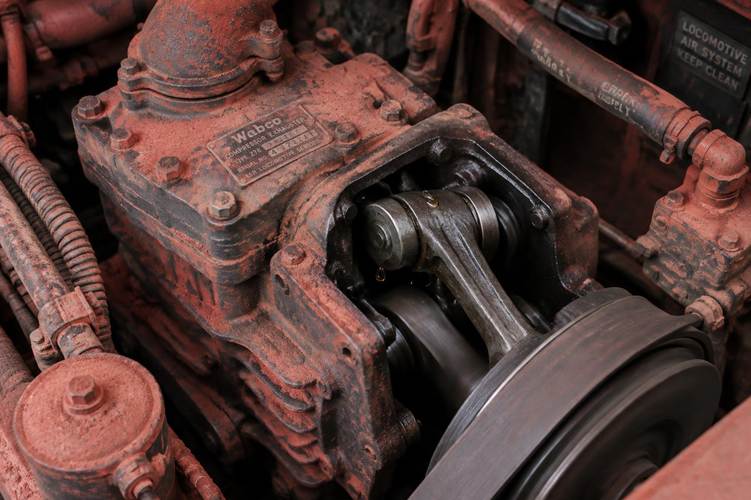
WABCO Exhauster Maintenance: What and Why It Really Matters

WABCO Exhauster Maintenance: What and Why It Really Matters

WABCO exhauster maintenance involves isolating the locomotive, venting stored vacuum, preventing contamination, and checking the unit’s ability to build and hold vacuum for safe brake operation. You inspect filters, valves, seals, bearings, clearances, pipework, mounts, and couplings for wear, leaks, overheating, or misalignment. You reassemble with correct lubricants, seals, torque settings, and alignment, then verify vacuum recovery, leakage, vibration, temperature, and current draw before return to service. The key steps are outlined below.

What Does WABCO Exhauster Maintenance Involve?

WABCO exhauster maintenance on locomotives focuses on reliability, braking safety, and air‑vacuum system integrity. It involves systematic inspection of the exhauster, associated pipework, and control valves to ensure dependable vacuum generation for train brake systems and auxiliary functions. Maintenance regimes are usually aligned with mileage or operating hours, plus additional checks after abnormal events such as oil contamination or overheating.

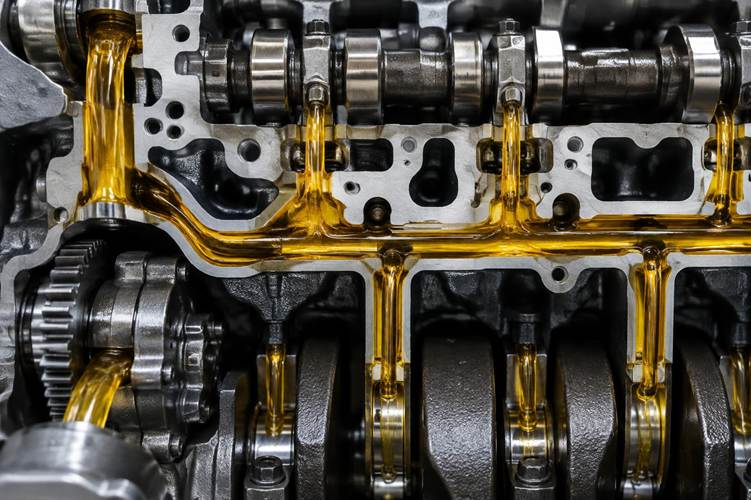
Core tasks include cleaning and inspecting filters, inlet screens, and non‑return valves, then checking clearances in the rotating assembly. Technicians examine bearings, seals, and crankshaft journals for wear, oil leaks, or overheating marks, followed by lubrication and torque checks on critical fasteners. Any out‑of‑tolerance component is repaired or replaced using approved WABCO procedures and calibrated tools.

Functional testing completes exhauster maintenance. Engineers verify vacuum build‑up time, steady‑state vacuum levels, vibration, noise, and temperature. Finally, they confirm proper integration with the locomotive brake control system and document all measurements for trend monitoring.

Key Takeaways

  • WABCO exhauster maintenance ensures reliable locomotive vacuum generation for consistent brake operation, safety, and fleet availability.
  • Maintenance timing depends on duty severity, running hours, brake use, contamination, overheating, and observed vacuum performance issues.
  • Work begins with lockout, vacuum venting, safe access, contamination control, calibrated tools, and visual inspection before disassembly.
  • Key tasks include cleaning filters, checking valves and pipework, inspecting seals, bearings, rotor clearances, housings, leaks, vibration, and lubrication.
  • Reassembly requires correct seals, lubricants, torque, alignment, bench or locomotive testing, vacuum verification, and full maintenance documentation.

Understanding WABCO Exhauster Maintenance on Locomotives

prevent weak vacuum brake

You rely on the WABCO exhauster to generate vacuum for dependable locomotive brake operation. You can’t treat WABCO exhauster maintenance as optional, because weak vacuum affects stopping performance, safety, and uptime. Plan inspections by mileage, operating hours, duty severity, and abnormal events like overheating or oil contamination.

What the WABCO exhauster actually does on a locomotive

When a locomotive operates with vacuum or dual brake regimes, the WABCO exhauster creates the controlled vacuum needed for reliable train brake operation. You rely on the wabco locomotive exhauster to evacuate air from the train pipe, brake cylinders, and connected vacuum equipment within specified limits.

It supports braking functions by working with compressors, reservoirs, and brake control valves:

  • It maintains vacuum for service brake release and controlled brake application.
  • Supplies vacuum demand for parking brake circuits and selected auxiliary systems.
  • It interfaces with reservoirs and controls so pressure and vacuum remain balanced.

During WABCO exhauster maintenance, you confirm this interface stays stable under load. If vacuum generation drifts, brake response can change, so you treat performance checks as safety-critical locomotive work.

Why exhauster maintenance is critical for rail safety and uptime

As vacuum performance degrades, a WABCO exhauster can delay brake release and reduce braking consistency. You may see slow vacuum build-up, unstable train pipe vacuum, or repeated brake drag after release. Each symptom narrows safety margins because the locomotive brake system can’t respond as predictably under load.

Effective wabco exhauster maintenance helps you protect stopping distance, timetable adherence, and fleet availability. If bearings, seals, valves, or internal clearances deteriorate, the exhauster works harder and generates less usable vacuum. That raises heat, vibration, and failure risk during service. You don’t just risk a component outage; you risk delayed departures, restricted operation, and brake performance concerns. By treating exhauster condition as safety-critical, you support reliable brake release, consistent control, and fewer unscheduled locomotive failures.

Typical maintenance intervals and service strategies

Reliable brake performance depends on maintenance timing, not only repair quality. You should plan WABCO exhauster maintenance around duty severity, not calendar dates alone. Running hours, brake application frequency, dust, humidity, and heat all affect wear rates.

  • Use light servicing for routine checks, filter cleaning, leak detection, lubrication, and vibration review.
  • Schedule intermediate inspections when vacuum build-up slows, noise rises, or oil contamination appears.
  • Apply wabco exhauster overhaul procedures at defined hour limits, after overheating, or during fleet rebuilds.

You’ll protect brake system integrity by matching service depth to operating risk. Heavy freight, steep gradients, and stop-start passenger service need tighter intervals. Track findings across locomotives, then adjust cycles using failure trends. Mikura International supports this strategy with compliant parts and practical technical guidance.

Preparations, Safety, and Tooling for WABCO Exhauster Work

lockout isolate verify tooling

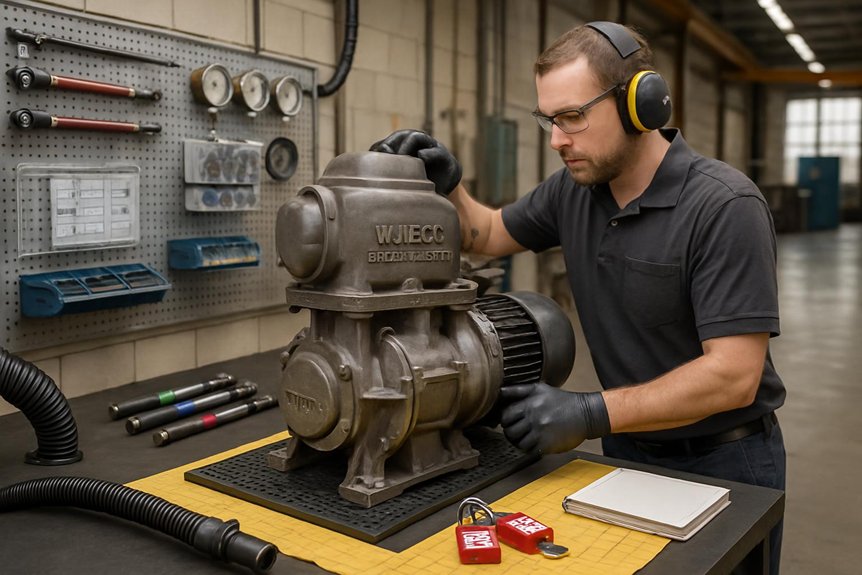
You start WABCO exhauster maintenance by locking out the locomotive, isolating vacuum and electrical energy, and securing safe access. You’ll need calibrated tools, test equipment, WABCO documentation, and accurate maintenance records before any disassembly. You should complete visual checks and preliminary functional tests to confirm faults, protect brake safety, and avoid unnecessary teardown.

Lockout, isolation, and safe access on locomotives

Before any WABCO exhauster maintenance begins, secure the locomotive against movement, isolate electrical supplies, and lock out all relevant brake control circuits. You’re protecting people, equipment, and brake availability during locomotive vacuum brake system maintenance.

  • Apply handbrakes, wheel scotches, and depot movement protection before opening any access panels.
  • Isolate battery feeds, control relays, and exhauster motor circuits, then fit personal lockout tags.
  • Vent vacuum reservoirs, pipework, and exhauster lines slowly, confirming zero stored pressure before loosening joints.

You should also verify safe access around hot surfaces, rotating parts, and underframe obstructions. Don’t rely on cab indications alone; prove isolation locally where possible. Keep tags in place until all guards, covers, and pipe connections are restored, then remove them under your site’s release procedure only.

Special tools, test equipment, and documentation

Once the locomotive is isolated, gather the calibrated tools and documents that make WABCO exhauster maintenance traceable and repeatable. You’ll need torque wrenches for fastener control, dial gauges for runout checks, and feeler gauges for clearances. Use certified vacuum gauges to confirm brake-system vacuum values, and vibration meters to capture rotating-group condition.

Keep the current WABCO manuals, locomotive maintenance instructions, and inspection checklists at the job location. These documents define limits, tightening sequences, test points, and acceptance criteria. Don’t rely on memory or old notes during WABCO locomotive exhauster work.

Before starting, verify calibration dates and record tool serial numbers. That discipline supports audits, warranty reviews, and safer locomotive vacuum brake system maintenance across aging fleets. It also strengthens procurement decisions when parts need replacement later.

Visual and preliminary functional checks before disassembly

After the locomotive is secured and tools are verified, inspect the WABCO exhauster while it remains installed. This early step in WABCO exhauster maintenance helps you find visible faults before disturbing evidence or creating new risks.

Check the unit cold first, then during a controlled run if permitted.

  • Inspect housings, pipe joints, seals, and drain points for oil leaks or contamination.
  • Check mounting bolts, brackets, guards, and couplings for looseness, fretting, or misalignment.
  • Listen for abnormal noise, feel for vibration, and scan for temperature hotspots.

Run a quick vacuum performance check at the locomotive gauges or calibrated test points. Confirm vacuum build-up time and steady vacuum against site limits. If readings drift, stop and record findings before disassembly. That protects brake reliability and supports overhaul decisions.

Step‑by‑Step WABCO Exhauster Service Tasks

controlled exhauster inspection and cleaning

You’ll start WABCO exhauster maintenance with controlled disassembly, thorough cleaning, and clear component identification and inspect the rotor, bearings, and seals for wear, heat damage, leakage, and clearance issues. You’ll then service valves, filters, and pipework to protect locomotive vacuum brake system performance.

Disassembly, cleaning, and component identification

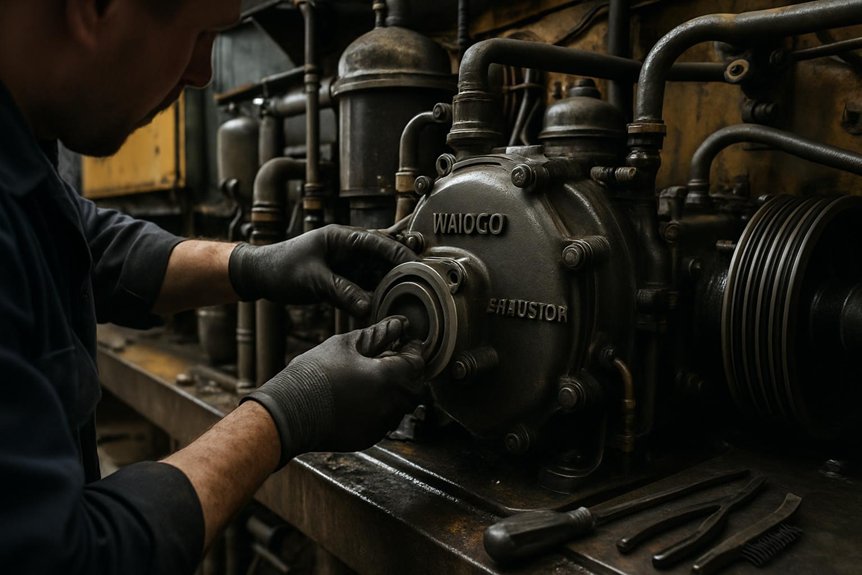
Before dismantling begins, isolate the locomotive, apply brake and electrical lockout, and confirm the exhauster can’t rotate or receive control pressure. You then remove the WABCO locomotive exhauster carefully, supporting its weight and protecting pipe faces from impact.

  • Drain oil into a clean container, label it, and note contamination, water, or metallic debris.
  • Mark housing, cover, rotor, and pipe orientations before loosening fasteners or lifting assemblies.
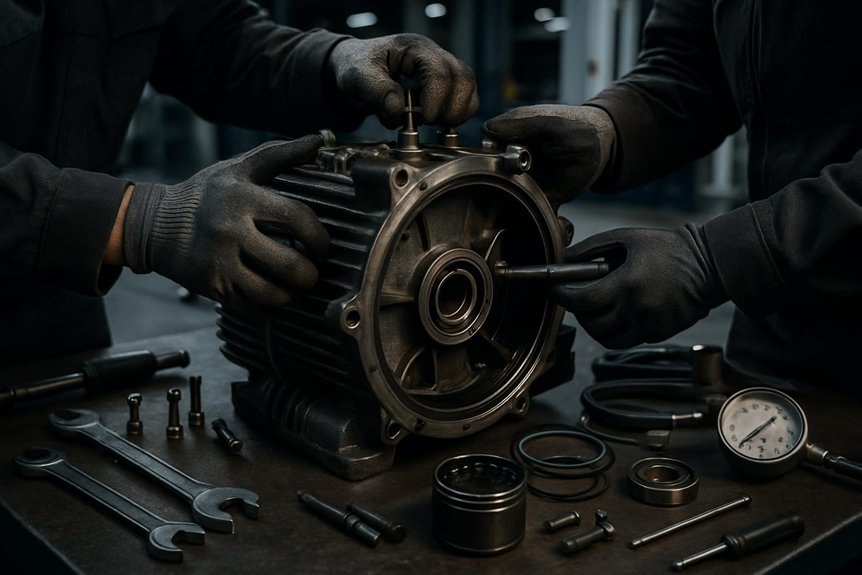
  • Bag small parts by location, tag shims and dowels, and keep matched components together.

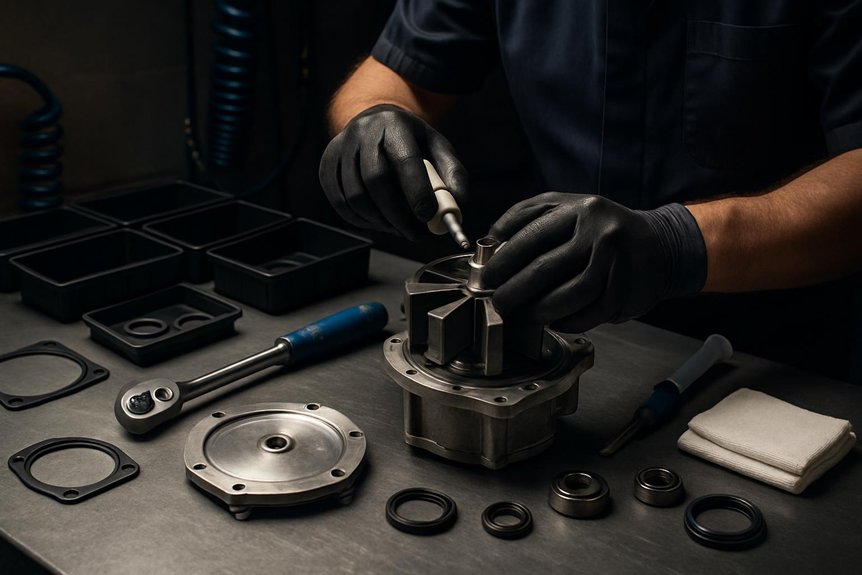
Clean external dirt before opening casings, so grit doesn’t enter working areas. During WABCO exhauster maintenance, use approved solvents, lint-free cloths, and capped ports. You’re not inspecting wear here; you’re preserving traceability for later WABCO exhauster overhaul procedures and reliable locomotive vacuum brake system maintenance records.

Detailed inspection of rotor, bearings, and seals

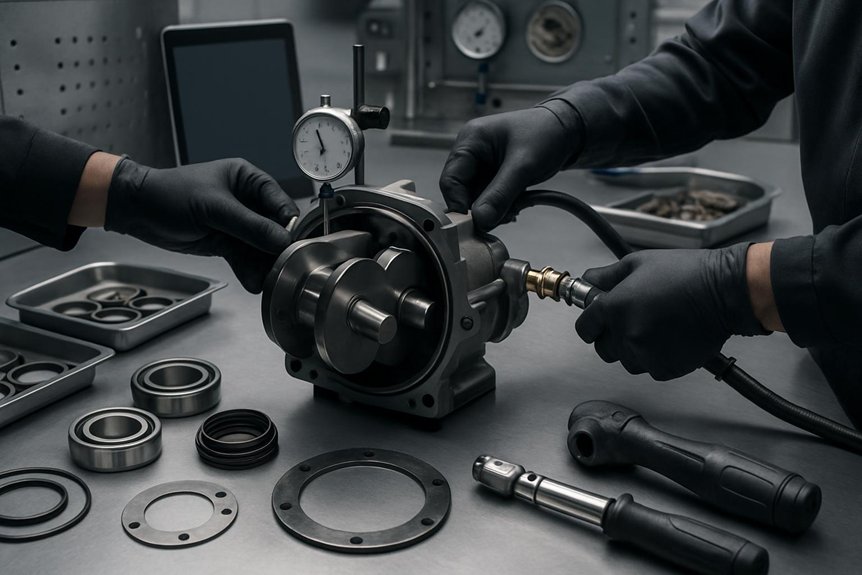
With the exhauster opened and parts identified, inspect the rotating group before any reassembly decisions. Measure rotor clearances against WABCO exhauster maintenance limits, using calibrated gauges and clean reference faces. Excess clearance reduces vacuum output; tight spots can cause rubbing and overheating.

Check bearing play by hand and with indicators where specified. You’re looking for roughness, looseness, heat discoloration, or lubricant breakdown. Inspect rotor surfaces, journals, and housing contact areas for scoring, pickup, or fretting. Use approved crack-detection methods on stressed sections, because fatigue cracks can propagate under locomotive vibration.

Examine seals for hardening, cuts, lip wear, and incorrect seating. Failed seals can allow oil ingress into the vacuum brake system or vacuum loss. Record every measurement before approving reuse, repair, or replacement.

Valve, filter, and pipework maintenance

Because flow restriction can mimic exhauster wear, start this stage by servicing the inlet filters, check valves, and non-return valves. Isolate the locomotive, apply lockout, and confirm zero stored vacuum before opening any line.

  • Remove inlet filters and screens, then clean or replace them if they’re oil-soaked, torn, or blocked.
  • Strip check valves and non-return valves, checking springs, seats, and discs for sticking, corrosion, or leakage.
  • Inspect vacuum pipes, flanges, and gaskets for scale, dents, loose joints, and hidden leakage paths.

You should also verify pipe alignment before tightening joints. Misalignment can load housings and create repeat failures. Record defects, replaced parts, and test results in your WABCO exhauster maintenance file. Good documentation supports brake reliability, audit readiness, and procurement planning.

Reassembly, Testing, and Lifecycle Management

torque verified bench tested checked on loco

You reassemble the WABCO exhauster to WABCO specifications, then verify torque, alignment, lubrication, and sealing integrity then confirm safe brake performance through bench tests and on-locomotive vacuum checks before release. You also document results, manage approved spares, and support procurement decisions for reliable WABCO exhauster maintenance.

Reassembly, torqueing, and alignment to WABCO specs

After inspection and cleaning, reassembly must follow WABCO exhauster maintenance specifications without shortcuts. You protect brake reliability by controlling lubrication, sealing, torque, and alignment from the first fit-up.

  • Apply the specified lubricant to bearings, journals, and moving interfaces. Don’t mix grades or over-lubricate rotating parts.
  • Install gaskets and seals dry or dressed only as WABCO guidance allows. Confirm lips, ports, and drain paths face correctly.
  • Tighten housing, cover, and mounting bolts in the required sequence with calibrated torque tools.

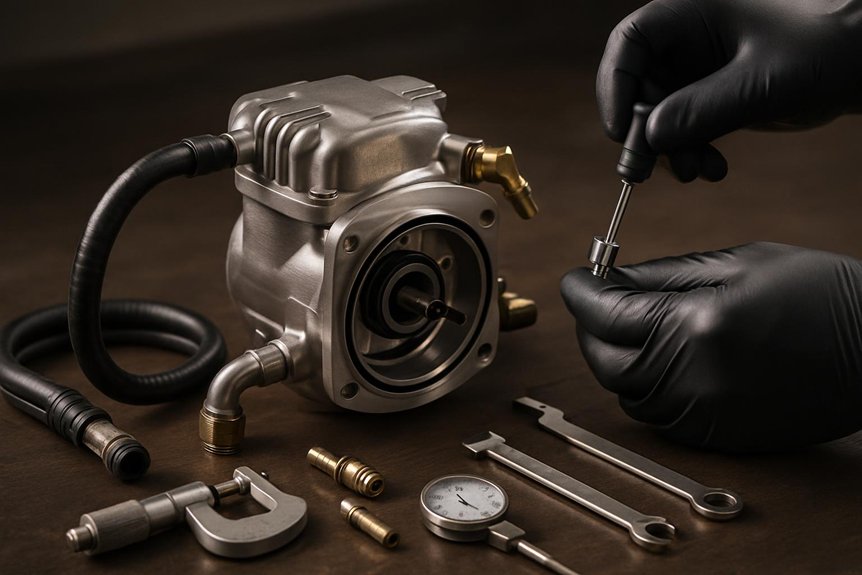
Before final mounting, check shaft alignment and coupling position against WABCO locomotive exhauster limits. You should confirm the exhauster sits squarely on its locomotive mounting pads, without twist or soft foot. Correct fitment prevents vibration, seal wear, and unsafe vacuum brake system faults.

Bench tests and on‑locomotive performance verification

Before returning the WABCO exhauster to service, verify performance under controlled bench conditions and on the locomotive. On the test stand, you measure vacuum build-up time against WABCO exhauster maintenance limits. Confirm ultimate vacuum, leakage rate, current draw, vibration, and noise under stable load. These readings prove the rotating group, seals, valves, and drive alignment are working safely.

After installation, repeat checks during locomotive trial runs. Isolate the area, follow lockout release steps, and keep personnel clear of rotating equipment. You should confirm vacuum recovery after brake applications, monitor temperature, and listen for abnormal bearing or vane noise. Compare current draw with baseline values to catch drag or misalignment. If results drift, stop testing and investigate before release. This final verification protects brake reliability.

Documentation, spares, and procurement considerations

Every WABCO exhauster maintenance event should produce a clear technical record, not just a service sign-off. You should log measured clearances, vacuum performance, vibration, temperatures, torque values, contamination, and observed failure modes. This data strengthens WABCO exhauster maintenance decisions across your locomotive fleet.

  • Record replaced bearings, seals, valves, filters, gaskets, and housings with part numbers and batch details.
  • Compare repeat failures against duty cycles, routes, overhaul intervals, and locomotive vacuum brake system maintenance history.
  • Use trends to set minimum spares levels and prevent safety-critical stockouts.

Procurement teams can then evaluate OEM parts against approved alternatives with evidence, not guesswork. You’ll protect brake reliability, control lifecycle cost, and support audit requirements. Mikura International helps you align WABCO locomotive exhauster spares with overhaul procedures and operational risk.

Frequently Asked Questions

How Is Exhauster Maintenance Prioritized During Locomotive Fleet Overhaul Planning?

You prioritize WABCO exhauster maintenance by risk, service duty, brake performance data, and fleet availability and then review vacuum build-up times, leaks, overheating, vibration, oil contamination, and prior failures. You schedule overhaul work with brake system inspections to reduce downtime and don’t defer units showing slow recovery or abnormal noise. Use calibrated tools, approved parts, and clear records so you can protect safety, control lifecycle cost, and support procurement decisions.

What Records Best Support WABCO Exhauster Audit Compliance?

Like a black box for reliability, your best audit records include dated WABCO exhauster maintenance sheets, lockout confirmations, inspection findings, calibrated tool references, torque values, parts traceability, and test results. You should record vacuum build-up time, steady vacuum level, vibration, temperature, and brake integration checks. Keep overhaul reports, nonconformance notes, approvals for OEM or qualified parts, and technician sign-offs. These records prove safety compliance, support procurement decisions, and control lifecycle costs.

When Should Procurement Choose Overhaul Kits Instead of Individual Spares?

You should choose overhaul kits when wear affects multiple WABCO exhauster components, downtime windows are tight, or audit traceability matters. Kits reduce missed parts, support matched seals, bearings, gaskets, and valves, and simplify procurement approvals. You’ll control lifecycle cost better during scheduled WABCO exhauster maintenance or overhaul procedures. Use individual spares only for isolated, verified defects where inspection data confirms the rotating group, housing, and pneumatic interfaces remain within limits.

How Do Operating Environments Affect WABCO Exhauster Service Intervals?

Like a telegraph in a digital cab, harsh environments shorten WABCO exhauster maintenance intervals. You’ll inspect sooner when locomotives face dust, heat, humidity, salt air, heavy gradients, or long idle periods. These conditions accelerate bearing wear, seal hardening, oil contamination, corrosion, and valve sticking. You shouldn’t rely only on mileage. Track vacuum build-up time, temperature, vibration, and noise trends. Mikura International helps you align intervals with duty cycle and safety risk.

Can Mikura International Support Sourcing for Obsolete WABCO Exhauster Parts?

Yes. You can rely on Mikura International to support sourcing for obsolete WABCO exhauster parts. We help you identify superseded part numbers, verify drawings, and match components to locomotive vacuum brake requirements. You’ll get practical guidance on OEM, approved replacement, or engineered alternatives. We don’t guess on safety-critical parts. We check fit, material suitability, documentation, and traceability, so your WABCO exhauster maintenance stays compliant and dependable.

How to Make WABCO Exhauster Performance Really Awesome Now

How to Make WABCO Exhauster Performance Really Awesome Now

Boost WABCO exhauster performance by proving the pump is actually weak first. Isolate the train pipe with blanking plates, close section cocks, and test vacuum build-up on a calibrated gauge. If the unit passes, find leaks in hoses, reservoirs, cocks, or brake valves. If it fails, clean ports, strainers, and oilways, check vanes and clearances, restore correct lubrication, and verify cut-in/cut-out settings. Next, you’ll see how to confirm faults before tuning.

Key Takeaways

  • Confirm true exhauster weakness by isolating train pipe leaks, hoses, reservoirs, cocks, and driver’s brake valve losses.
  • Track maximum vacuum, evacuation time, recovery time, current, temperature, vibration, and noise against healthy baseline records.
  • Clean ports, strainers, oilways, filters, and suction passages to restore airflow before attempting any adjustment.
  • Check worn vanes, scored housings, rotor clearances, lubrication condition, blocked filters, and sticking non-return valves.
  • Verify improvement with timed evacuation, ultimate vacuum, load signature, and brake release recovery tests using calibrated gauges.

Understanding WABCO Exhauster Performance in Locomotives

locomotive wabco exhauster diagnostics

You use a WABCO exhauster to evacuate the train pipe and maintain vacuum brake readiness. Track WABCO exhauster performance through target vacuum, evacuation time, duty cycle, current draw, vibration, and leakage trends. You’ll diagnose brake behaviour better when you match exhauster type, condition, and control response to locomotive vacuum brake system demands.

What a WABCO exhauster does in a locomotive vacuum brake system

When a locomotive uses vacuum braking, the WABCO exhauster creates and maintains the vacuum that keeps the train brake pipe and reservoirs ready for control. You depend on this vacuum to hold brakes released across coaching or freight stock.

  • It evacuates air from the train pipe, building the working vacuum.
  • Replenishes vacuum losses from leakage, valve movement, and brake operations.
  • It supports reservoirs, so each vehicle has stored vacuum for brake response.
  • It helps you diagnose weak wabco exhauster performance when release feels slow.

When you admit air through the driver’s brake valve, vacuum falls and brakes apply. When you restore vacuum, brake cylinders release. If the exhauster can’t evacuate fast enough, you’ll see delayed release, uneven train response, and avoidable timetable risk.

Key performance parameters engineers should track

How should you judge WABCO exhauster performance in daily locomotive service? Track numbers that reveal vacuum creation, recovery, and endurance in the locomotive vacuum brake system. Use calibrated gauges and logs; don’t rely on feel.

ParameterWhat you measureDiagnostic meaning
Maximum vacuumStable peak vacuumShows sealing and pump health
Evacuation timeAtmosphere to target vacuumExposes restriction or internal wear
Recovery timeVacuum rebuild after applicationIndicates service readiness
Duty capabilityTemperature, current, run timeConfirms continuous load margin

Compare each value with rated data, route duty, and fleet history. Slow evacuation can point to worn vanes, leaks, or blocked filters. Poor recovery may flag tired valves or pipe losses. Rising current, heat, or vibration warns that WABCO exhauster performance is degrading before failure.

How exhauster performance interacts with overall brake behaviour

Although brake rigging often gets the first inspection, WABCO exhauster performance sets the pace for vacuum brake response. In a locomotive vacuum brake system, your exhauster evacuates the train pipe, and distributors then convert vacuum changes into brake cylinder pressure changes through control valves. If evacuation lags, release also lags.

  • Check train pipe vacuum recovery after a full service application.
  • Compare brake release timing across coaches or wagons.
  • Watch for hot wheels, dragging blocks, and high current draw.
  • Include valves, leaks, filters, and pipe restrictions in wabco exhauster maintenance.

You can have sound rigging and still suffer poor brake behaviour. Slow vacuum build-up keeps cylinders applied longer, raises wheel and block temperatures, delays departure, and disrupts paths. Treat braking complaints as system diagnostics, not component blame.

WABCO exhauster types commonly used on locomotives

Before you tune WABCO exhauster performance, identify the exhauster configuration fitted to each locomotive. Match tests and settings to the installed design, not assumptions.

TypeTypical useDiagnostic focus
Single-stage, mechanicalOlder diesel locomotivesDrive wear, vane sealing
Multi-stage, motor-drivenElectric or upgraded fleetsCurrent draw, staged vacuum build-up

You’ll usually find mechanical units driven from engine auxiliaries, and motor-driven units powered independently. Single-stage exhausters suit moderate evacuation demand. Multi-stage units support faster train pipe evacuation and heavier duty cycles. Continuous-duty designs run during extended brake control periods. Intermittent-duty designs need cooling margins between cycles. For locomotive brake tuning, record vacuum level, evacuation time, noise, vibration, and load current. This lets you compare similar fleets and target WABCO exhauster maintenance accurately.

Diagnosing Exhauster Issues Before Tuning

diagnose vacuum and exhauster

Before you tune WABCO exhauster performance, you need to separate true exhauster faults from locomotive vacuum brake system issues. Start by checking vacuum build-up time, target vacuum, noise, vibration, and current draw against service benchmarks. You’ll often find worn vanes, seal leaks, fouled filters, valve faults, or train pipe restrictions causing similar symptoms.

Recognizing symptoms of underperforming exhausters in service

How can you tell WABCO exhauster performance has started to fall in service? You look for changes crews feel first, then confirm them through operating data from the locomotive vacuum brake system.

  • Longer vacuum build-up times show the exhauster can’t evacuate the train pipe at its normal rate.
  • Frequent low-vacuum alarms suggest leakage, restriction, worn internals, or weak control response.
  • Extended brake release times point to poor train pipe evacuation under real consist conditions.
  • Crew reports of sluggish braking often match flattened vacuum curves and higher exhauster duty.

Don’t treat these signs as tuning targets yet. Treat them as warnings. Compare today’s vacuum curve, duty cycle, noise, and current draw against known good service records. That approach keeps WABCO exhauster maintenance disciplined before locomotive brake tuning begins.

Benchmarks and test procedures for exhauster health

Service symptoms only justify action when shop-floor tests confirm the fault. You should benchmark WABCO exhauster performance before any locomotive brake tuning. Use calibrated gauges, a known receiver volume, and logged speed, temperature, current, or torque.

TestWhat you measureCompare against
Timed evacuationSeconds to target vacuumWABCO datasheet limit
Ultimate vacuumMaximum stable vacuum levelRailway acceptance value
Load signatureCurrent or torque at vacuum pointsBaseline healthy unit

Run each test at specified rpm and operating temperature. Isolate the locomotive vacuum brake system, then test the exhauster and pipework separately when possible. If evacuation time drifts, ultimate vacuum falls, or load rises, don’t tune around it. Record results and verify them against Mikura International-supported maintenance criteria.

Common mechanical causes of performance loss

When WABCO exhauster performance drops, you should first suspect mechanical condition, not control settings. In a locomotive vacuum brake system, small internal faults quickly reduce train pipe evacuation.

Check these mechanical causes before locomotive brake tuning:

  • Worn vanes lose sealing contact, reducing swept volume and slowing vacuum build-up.
  • Scored housings create bypass paths, so air recirculates instead of leaving the train pipe.
  • Incorrect rotor clearances increase internal leakage, especially under hot running conditions.
  • Contaminated lubricating oil, blocked filters, or sticking non-return valves restrict flow and raise load.

You’ll confirm these faults through vacuum level, evacuation time, noise, temperature, and current trends. Mikura International recommends correcting wear, lubrication, filtration, and valve movement first. That keeps WABCO exhauster maintenance evidence-based, safe, and within approved locomotive limits.

System‑level issues that mimic exhauster problems

Before you tune the exhauster, prove the fault isn’t elsewhere in the vacuum brake system. Train pipe leaks, cracked flexible hoses, leaking vacuum reservoirs, or passing driver’s brake valves can all mimic weak WABCO exhauster performance. You’ll see slow evacuation, poor vacuum retention, and longer brake release times, yet the exhauster may be healthy.

Isolate methodically. Fit blanking plates at the exhauster suction connection, close section cocks, and test the machine against a calibrated gauge. If vacuum builds quickly and holds, move downstream. Open one section at a time, logging evacuation time and vacuum decay. Check hoses under movement, reservoir drain points, isolating cocks, and brake valve seats. This controlled approach separates machine defects from locomotive vacuum brake system losses, preventing unnecessary WABCO exhauster maintenance and unsafe locomotive brake tuning decisions.

Simple, Safe Tuning Steps to Boost WABCO Exhauster Performance

restore airflow seal leaks

You boost WABCO exhauster performance first by restoring airflow through clean passages, correct clearances, and proper lubrication. Then you optimize locomotive suction and discharge piping, seal vacuum leaks, and tune controls so duty cycles stay safe. You’ll get better diagnostic control by adding instrumentation that tracks vacuum level, evacuation time, current draw, and brake response.

Restoring airflow: cleaning, clearances, and lubrication

Although many teams look for upgrades first, restored airflow often delivers the biggest WABCO exhauster performance gain. You should first return the unit to standard condition before changing settings. Isolate the locomotive vacuum brake system, then verify baseline vacuum and evacuation time.

  • Clean internal passages, ports, strainers, and oilways until deposits can’t restrict flow.
  • Inspect vanes for wear, sticking, scoring, or edge damage affecting sealing.
  • Check vane and end-clearances with calibrated gauges, then reset to WABCO limits.
  • Refill with WABCO-specified lubricant, at the correct grade, level, and change interval.

After reassembly, run the exhauster under load and compare vacuum build-up with records. If results improve, you’ve confirmed maintenance condition caused the loss. These back-to-standard steps support reliable WABCO exhauster maintenance without unsafe modifications.

Optimizing suction and discharge piping on the locomotive

On the locomotive, pipe layout can limit WABCO exhauster performance even after overhaul. You should trace suction and discharge runs from the exhauster to reservoirs, control valves, and train pipe. Look for avoidable elbows, flattened sections, mismatched flanges, undersized hoses, and redundant fittings. Each restriction adds pressure loss, so the exhauster works harder to evacuate the locomotive vacuum brake system.

Keep runs short, direct, and correctly supported. Replace sharp bends with swept bends where approved. Match pipe diameter to the rated flow, not convenient stock size. Confirm isolating cocks and strainers don’t reduce bore area. On long rakes, small pressure-loss reductions can cut evacuation time noticeably. Record before-and-after vacuum build-up times, current draw, and noise. That gives you practical evidence for safer locomotive brake tuning.

Tightening the vacuum system: leak detection and rectification

Before you adjust controls or specify overhaul work, confirm the locomotive vacuum brake system isn’t wasting exhauster capacity through leaks. Leakage increases duty, slows train pipe evacuation, and masks true WABCO exhauster performance.

Use a calibrated gauge, isolate the locomotive, and record vacuum decay after shutdown. Then divide the system, so you don’t chase faults blindly.

  • Run shutdown leak-down tests at operating vacuum.
  • Isolate reservoirs, train pipe sections, cocks, and hoses.
  • Check flanges, unions, glands, and valve covers ultrasonically.
  • Apply soap solution where access and safety conditions allow.

Rectify hardened hoses, loose joints, damaged seals, cracked pipework, and leaking isolating cocks. Retest after each repair. When you reduce background leakage, you effectively boost exhauster capacity without modifying the WABCO unit or compromising brake certification.

Fine‑tuning control settings and duty management

After you’ve tightened leaks, verify the control circuit that governs WABCO exhauster performance under load. Check control contacts for pitting, sticking, or poor alignment. Confirm pressure or vacuum switches change state at the specified locomotive vacuum brake system values.

Set auto-cut-in and cut-out points to prevent short cycling. If the exhauster starts too often, you’ll raise wear, heat, and power demand. If it cuts out late, it may run against a closed or restricted system. That stresses vanes, seals, and couplings.

Review vacuum reservoir capacity and valve settings. Correctly sized reservoirs smooth demand between brake applications and reduce nuisance starts. During WABCO exhauster maintenance, compare actual switching behavior with approved locomotive brake tuning limits. Don’t bypass safeguards or exceed certified brake timing requirements. Keep records for future diagnostics.

Instrumentation upgrades for performance visibility

If you can’t measure vacuum behavior accurately, you can’t tune WABCO exhauster performance with confidence. Upgrade instrumentation before changing settings. Fit calibrated gauges, pressure transducers, and data loggers across the locomotive vacuum brake system. You’ll see drift before it becomes delay, overheating, or unreliable brake release.

  • Measure exhauster inlet vacuum and train pipe vacuum separately.
  • Log evacuation time after brake applications and reservoir recovery.
  • Trend motor current, vibration, and noise against duty cycle.
  • Compare cab gauge readings with depot test instruments regularly.

Place sensors near the exhauster, reservoir, control valve, and train pipe end. That shows restrictions, leakage, or control instability. With better data, your depot can plan WABCO exhauster maintenance proactively, support locomotive brake tuning, and avoid unsafe guesswork.

Procurement and Lifecycle Strategies for High‑Performing Exhausters

duty cycle vacuum evacuation limits

You should specify WABCO exhausters around duty cycle, target vacuum, evacuation time, and approved locomotive brake tuning limits. You’ll need to compare overhaul, upgrade kits, and new units against lifecycle cost, spares commonality, interchangeability, and fleet standardization. You can protect WABCO exhauster performance by building test metrics, maintenance triggers, and safety approval boundaries into every procurement contract.

Specifying WABCO exhausters for new or rebuilt locomotives

When specifying WABCO exhausters for new or rebuilt locomotives, start with the train’s braking duty, not the catalogue rating. You need specs that reflect real vacuum demand, route conditions, and service intensity.

  • Define required vacuum volume from train pipe length, reservoir capacity, and brake equipment layout.
  • Set target evacuation time for the longest design train, then verify it against brake release rules.
  • State duty cycle clearly, including repeated stops, gradients, station spacing, and recovery time.
  • Specify ambient limits, filtration needs, mounting interfaces, drive arrangement, and control compatibility.

You’ll improve WABCO exhauster performance when procurement links operating data to measurable acceptance tests. Ask for vacuum level, build-up time, current draw, noise, vibration, and leakage criteria. Mikura International supports clear, compliant specifications that reduce commissioning issues and lifecycle risk.

Choosing between overhaul, upgrade kits, and new units

A clear specification sets the baseline, but lifecycle strategy determines long-term WABCO exhauster performance. You choose between overhaul, approved refurbishment, upgrade kits, or new units by comparing risk, downtime, and duty cycle.

In-house overhaul can control cost, but only if you verify clearances, vanes, seals, lubrication, and test results. Weak documentation can hide repeat failures in the locomotive vacuum brake system. OEM-approved refurbishment costs more, yet it protects approval status, traceability, and warranty support.

Upgrade kits suit exhausters with sound housings but recurring wear or heat issues. They can improve reliability without changing certified brake behavior. New units make sense when cores are cracked, obsolete, inefficient, or failing evacuation-time targets.

Use lifecycle cost, not purchase price. Include warranty, test evidence, compliance, and lost-service exposure in every decision.

Spares, interchangeability, and standardization across the fleet

Although legacy fleets rarely allow perfect commonality, reducing WABCO exhauster variants improves control over performance, spares, and risk. You can standardize around proven ratings that suit each locomotive vacuum brake system, then manage exceptions deliberately.

  • Map installed exhausters by class, duty cycle, vacuum rating, and mounting interface.
  • Identify interchangeable vanes, seals, bearings, filters, valves, and drive components.
  • Keep critical spares aligned with local supplier availability and overhaul lead times.
  • Train crews on fewer configurations, so fault reporting becomes faster and clearer.

This approach strengthens WABCO exhauster performance because maintenance teams diagnose known patterns instead of chasing one-off assemblies. You’ll also reduce dead stock and emergency purchases. Where legacy constraints remain, document approved substitutions, fitment limits, and certification boundaries. Mikura International helps you rationalize parts without compromising brake safety.

Building performance metrics into contracts and maintenance plans

Before you issue an overhaul order, define WABCO exhauster performance in measurable service terms. Specify target vacuum, train pipe evacuation time, acceptable leak rate, duty cycle, vibration limits, and mean time between failures. Tie each figure to a test method, calibrated gauge, load condition, and acceptance report.

You should build these values into supply and overhaul contracts, not leave them as workshop assumptions. Link payment milestones or service-level agreements to verified results after installation. For WABCO exhauster maintenance, require trend records for current draw, noise, vacuum build-up, and brake response.

Then use the same data in condition-based maintenance. If evacuation time rises or leak rate drifts, you can inspect valves, seals, filters, or pipework before failures disrupt the locomotive vacuum brake system and locomotive brake tuning plans.

Safety, standards, and approval boundaries for tuning work

Performance clauses only protect your fleet when tuning work stays inside approved safety boundaries. You can improve WABCO exhauster performance, but you can’t bypass braking standards, WABCO design limits, or national approvals. Treat every change as a brake-system risk assessment.

  • Confirm target vacuum, evacuation time, and release rate against certified locomotive vacuum brake system data.
  • Keep control settings within approved logic; altered cut-in points may change brake response.
  • Check added reservoirs, pipe changes, or valve swaps for volume effects and re-verification needs.
  • Record gauges, test results, parts, and approvals before releasing locomotives.

If tuning changes exhauster characteristics, control behavior, or system volume, you’ll likely need formal re-testing. Mikura International recommends documenting each decision, so procurement, maintenance, and safety teams protect compliance, reliability, and lifecycle value.

Frequently Asked Questions

How Does Ambient Temperature Affect WABCO Exhauster Performance on Locomotives?

Ambient temperature changes WABCO exhauster performance by altering oil viscosity, clearances, seal behavior, and air density. As the saying goes, “measure twice, cut once.” In cold starts, you’ll see heavier lubrication drag, slower vacuum build-up, and higher current draw. In heat, you may see thinner oil, leakage, and reduced reliability. Track vacuum level, evacuation time, vibration, and temperature. Don’t retune until you’ve verified lubrication, filters, valves, and pipework.

Can Exhauster Performance Data Support Locomotive Brake Tuning Decisions?

Yes, you can use exhauster performance data to guide locomotive brake tuning decisions. Track vacuum build-up time, target vacuum level, duty cycle, current draw, vibration, and brake response. These readings show leaks, restrictions, worn vanes, valve issues, or poor control settings. You’ll tune safely by reducing system leakage, optimizing pipework, and calibrating controls within approved limits. Mikura International helps you match WABCO exhauster performance data with practical maintenance actions.

What Records Should Maintenance Teams Keep After Exhauster Tuning?

You should keep dated tuning reports, baseline WABCO exhauster performance readings, and post-adjustment results. Record target vacuum, evacuation time, duty cycle, current draw, vibration, noise, temperature, and brake response. Note parts replaced, lubrication used, valve settings, leak repairs, pipework changes, and calibrated instruments. Add technician names, locomotive number, load conditions, and compliance sign-offs. You’ll use these records to diagnose drift, prove safe locomotive brake tuning, and plan maintenance.

How Often Should Calibrated Gauges Be Checked for Vacuum Brake Testing?

You should check calibrated gauges before each vacuum brake test, then verify formal calibration at intervals your railway specifies. Typically, you’ll recalibrate gauges every 6 to 12 months, or sooner after shock, damage, abnormal readings, or storage issues. For reliable WABCO exhauster performance checks, compare gauges against a certified reference. Record gauge ID, calibration date, deviation, technician, and test conditions so you can trust evacuation time and vacuum readings.

Can Spares Quality Affect Long-Term WABCO Exhauster Reliability?

Yes. Poor spares can wear like grit in a bearing, slowly stealing WABCO exhauster performance. You need vanes, seals, bearings, filters, valves, and gaskets that match locomotive duty, material grades, and clearances. If you fit substandard parts, you’ll see rising vibration, slow vacuum build-up, oil carryover, and shorter overhaul intervals. Use traceable, specification-matched spares from Mikura International, and you’ll protect reliability, brake response, and lifecycle cost.

5 Ways to Boost Locomotive Crankshaft Compressor Efficiency

5 Ways to Boost Locomotive Crankshaft Compressor Efficiency

You’ll boost locomotive crankshaft compressor efficiency by implementing multi-stage cooling with strategic intercooler placement, optimizing stroke-to-bore ratios between 0.5-1.0 for peak performance, enhancing thermal management with water-cooled jackets, upgrading to oil-free reciprocation with PTFE-coated rings, and reinforcing components with SG 600/3 cast materials. These targeted improvements reduce energy loss while extending component life under heavy-duty operation. The following techniques reveal exactly how to implement these critical modifications.

Key Takeaways

  • Optimize stroke-to-bore ratios between 0.5-1.0 for peak efficiency, with 0.62 being ideal for maximum power delivery.
  • Implement advanced multi-stage cooling systems with intercoolers between compression stages to reduce thermal load.
  • Utilize oil-free reciprocation with PTFE-coated piston rings to eliminate lubrication needs and improve flow density.
  • Apply water-cooled jackets around cylinders combined with interstage cooling to minimize thermal stress and heat transfer losses.
  • Replace standard components with SG 600/3 cast materials and reinforce high-stress zones using FEA simulations.

Advanced Multi-Stage Cooling System Implementation

efficient multi stage cooling systems

While implementing advanced multi-stage cooling systems in compressors, you’ll achieve considerable efficiency gains through strategic thermal management. Position intercoolers between compression stages to reduce thermal load on subsequent cylinders, enabling higher pressure ratios without increased mechanical stress while boosting air density for improved volumetric efficiency.

Optimize your cooling circuit with water jackets surrounding cylinders to directly mitigate heat buildup. Intercooler integration should incorporate coaxial designs that minimize pressure drop while maximizing heat transfer surface area. For best results, implement closed-loop coolant circulation with pump optimization featuring high-head designs capable of handling elevated cooling pressures.

Consider implementing pressurized coolant injection systems that apply targeted cooling to critical zones. Multi-stage pump enhancements with efficient impeller geometries considerably reduce thermal stress while in-line monitoring systems enable real-time adjustments to your cooling parameters, ensuring consistent performance across varying operational demands. This approach aligns with W-Type locomotive compressors that feature precision components designed specifically for optimal performance in harsh railroad environments.

Optimizing Stroke-to-Bore Ratios for Maximum Power Delivery

optimizing stroke bore performance ratios

Optimizing compressor efficiency extends beyond cooling systems to mechanical design fundamentals—specifically, stroke-to-bore ratio configurations. You’ll achieve superior locomotive performance by implementing bore-stroke ratios between 0.5-1.0, with 0.62 consistently delivering peak brake efficiency in testing applications.

For locomotive compressors, longer stroke designs considerably reduce heat transfer losses by minimizing combustion chamber surface exposure at TDC. This translates directly to improved energy transfer to the crankshaft and higher thermal efficiency. Material selection using aluminum alloys like LM24 and LM25 significantly enhances thermal load resistance in high-performance compressor designs. When evaluating locomotive engines, prioritize ratios above 1.0 (stroke-to-bore) to maximize torque and fuel efficiency.

You’ll need to balance these efficiency gains against RPM considerations—lower bore-to-stroke ratios allow higher RPMs without excessive piston speeds, but may introduce scavenging challenges. For opposed-piston designs, maintain stroke-bore ratios between 2.2-2.6 to guarantee proper heat management and scavenging efficiency while avoiding mechanical stress that would compromise engine performance under load.

Thermal Management Strategies for Reduced Energy Loss

efficient compressor thermal management

Effective thermal management represents a cornerstone of compressor efficiency optimization. You’ll achieve considerable energy savings by implementing water-cooled jackets around cylinders and valve pockets to maximize heat dissipation. Pair this with interstage cooling to enhance volumetric efficiency and reduce thermal stress on critical components. Modern compressor designs incorporate scroll compressors for improved performance in demanding locomotive applications.

StrategyBenefitImplementationEnergy Impact
Water-cooled jacketsReduced thermal stressFull-jacketed cylinders8-12% efficiency gain
Vapor-cycle integrationConsistent temperature controlRefrigerant-based systemsEnergy recovery potential
Thermal insulationMinimized heat transferHigh-strength alloysReduced parasitic losses
Low-temperature oil circulationExtended component lifePressurized lubricationLower maintenance costs

Consider implementing high-strength alloys with superior thermal conductivity alongside low-friction coatings on moving parts. These material innovations, combined with proper thermal insulation and energy recovery systems, considerably reduce frictional heat buildup while improving overall system reliability and performance.

Next-Generation Compressor Design Elements

innovative compressor design efficiency

Modern compressor designs leverage revolutionary mechanical innovations that fundamentally transform operational efficiency while reducing maintenance requirements. By implementing oil-free reciprocation with PTFE-coated piston rings, you’ll eliminate lubrication needs while minimizing friction and extending component lifespan. When designing for extreme conditions, consider implementing a system similar to the summer winter door functionality to optimize air intake temperatures.

The integration of innovative materials like self-lubricating PTFE creates systems that deliver 11% improved flow density (380→420 l/min) while reducing power consumption from 3.4kW to 3.2kW. This energy recovery approach translates directly to lower heat production and extended duty cycles.

Disc-type couplings accommodate mechanical misalignment, while flange-type joints simplify maintenance access. Multi-stage filtration systems optimize air quality, enhancing overall efficiency and reducing contamination risks.

For maximum space efficiency, underslung mounting configurations with wire rope isolators provide vibration dampening while allowing customization for specific locomotive requirements like WAG9/WAP7 compatibility—ensuring your modern rail fleet achieves peak operational performance with minimal maintenance downtime.

Structural Integrity Enhancement for Heavy-Duty Operation

structural integrity enhancements implemented

While conventional compressors often fail under sustained heavy-duty operation, strategic structural integrity enhancements can extend operational lifespans by 300-400%. Your crankshaft’s resilience begins with ideal material selection—consider replacing standard components with SG 600/3 cast materials that offer a 5.5 safety margin under dynamic stress without sacrificing fatigue resistance.

Implement these critical modifications to maximize operational stability:

  1. Advanced load distribution systems – Utilize FEA simulations to identify and reinforce high-stress concentration zones, particularly in critical fillet areas prone to fatigue failure
  2. Precision alignment protocols – Maintain <0.1mm deviation tolerances using laser alignment systems to prevent pepper potting and misalignment-induced failures
  3. Surface treatment optimization – Apply laser cladding or plasma nitriding to high-wear interfaces, considerably reducing material degradation in compression environments

Don’t overlook the split crankshaft design advantage—it enhances perpendicular precision while reducing processing waste during manufacturing. Operating above the manufacturer’s recommended RPM limits significantly increases the risk of mechanical fatigue in connecting rods and other critical components.

Frequently Asked Questions

How Does Altitude Affect Locomotive Compressor Efficiency?

At higher altitudes, you’ll experience significant compressor performance degradation. Your locomotive’s efficiency drops as ambient air density decreases, requiring more energy per compression cycle. You’re facing 2-5% efficiency loss per 3,000ft elevation due to reduced Reynolds numbers. Your compressor’s intake mass flow diminishes while specific energy consumption rises. Additionally, your engine’s power output declines proportionally—approximately 10% at 800m and 20% at 1600m—further impacting altitude impact on compression capabilities.

What Is the ROI Timeframe for Upgrading Vintage Locomotive Compressors?

Did you know that outdated locomotive compressors waste up to 15% more fuel annually? When upgrading vintage locomotive compressors, you’ll typically see an ROI timeframe of 2-4 years. Your cost analysis should incorporate both immediate capital expenditure and projected savings through reduced maintenance. Performance metrics to monitor include compression efficiency, energy consumption rates, and mean time between failures. These measurements validate your investment through quantifiable operational improvements across your fleet.

Can Renewable Energy Sources Power Auxiliary Locomotive Compression Systems?

Yes, you can power auxiliary locomotive compression systems with renewable energy sources. Solar power and wind energy can charge LTO batteries that run your compressors during regenerative phases. Through grid-electrified depots, you’ll capture renewable energy during downtime. Smart energy routers prioritize these renewables when available. For implementation, you’ll need BORDLINE® CC1500 converter units and bi-directional inverters to manage energy flow between renewable sources and compression systems.

How Do Electromagnetic Fields Impact Digital Compressor Monitoring Systems?

While your analog systems falter, your digital monitoring platforms stand resilient. Electromagnetic interference poses significant challenges to compressor monitoring, disrupting signal integrity in proximity probes. Your digital systems employ built-in error checking and noise immunity to resist EMF disruption. Shielded cabling and integrated transmitters further protect against interference sources from motors and nearby equipment. For maximum reliability, implement systems compliant with IEC 61508 standards that utilize cyclic redundancy checks to automatically detect and correct EMF-induced errors.

What Noise Reduction Strategies Work Best for Urban-Operating Locomotives?

For your urban-operating locomotives, implement noise barriers strategically around rail lines to block direct sound propagation. You’ll achieve best results by combining these with composite brake blocks that maintain smooth wheel surfaces. Apply acoustic insulation in engine compartments to contain machinery noise. Conduct regular wheel and rail maintenance to minimize surface roughness. Consider embedded rail systems for significant reductions in vibration-induced noise, particularly in densely populated areas.

References

Solving WABCO Locomotive Compressor Exhauster Issues: Expert Maintenance Guide

Solving WABCO Locomotive Compressor Exhauster Issues: Expert Maintenance Guide

To solve WABCO locomotive compressor issues, focus on key maintenance areas: check for oil consumption indicating seal deterioration, test pressure lines using max 12 bar, inspect couplings for wear patterns exceeding 7mm, and follow proper torque sequences (cylinder head bolts at 25±5 Nm). Daily inspections should include linkage wear and reservoir levels, while cold weather operations require heat activation below 6°C. These targeted interventions will greatly extend your component lifespan.

Key Takeaways

  • Diagnose high oil consumption as a sign of deteriorated seals requiring immediate replacement to prevent system failure.
  • Follow proper torque specifications (25 ±5 Nm) and cross-pattern sequence for cylinder head bolts to ensure even pressure distribution.
  • Conduct regular inspections of drain ports and air-purging filters to prevent oil carryover in the system.
  • Perform pressure cycling tests at full governed engine speed to verify control pressure reaches >7 bar at cut-off.
  • Implement strategic heating solutions for compressor systems operating below freezing temperatures to prevent ice formation.

Understanding WABCO Compressor Failure Points

wabco compressor maintenance essentials

While maintaining WABCO locomotive compressors, recognizing potential failure points is essential for preventing costly breakdowns and ensuring operational reliability. Your ability to identify these issues directly impacts compressor lifespan and system integrity.

Proactive identification of compressor failure points directly preserves both system reliability and operational budget.

Watch for high oil consumption, which indicates deteriorating seals requiring immediate replacement. Test pressure lines for blockages by applying no more than 12 bar to coolant ports during failure diagnosis. Coupling wear manifests through radial patterns—replace when exceeding 7mm of wear per manufacturer specifications.

Monitor cylinder head integrity by checking for coolant and discharge port leaks under pressure. Seal failures typically appear as oil contamination or dampness in the air system. Don’t overlook external stressors like overpressure during testing or engine overloading that accelerates component degradation. Using genuine WABCO parts during replacements ensures compatibility with auxiliary systems and reduces future maintenance costs.

Regularly inspect air line connections between the compressor and dryer, ensuring proper alignment of oil return passages to prevent lubrication starvation and catastrophic bearing failure.

Critical Inspection Procedures for Locomotive Exhausters

locomotive exhauster inspection procedures

Properly inspecting locomotive exhausters demands systematic procedures that address both mechanical integrity and operational safety. Your exhauster maintenance checklist should begin with oil hole and journal fillet inspection where 68% of failures occur. After cleaning components with denatured alcohol, verify measurements using dial indicators to document bearing seat dimensions and clearances against OEM specifications.

When evaluating bearings and crankshafts, you’ll need to:

  • Apply controlled heat for press-fit bearings while monitoring temperatures
  • Select appropriate extraction tools like inertia hammers with thread protection
  • Conduct rotational leverage techniques to reduce binding during removal
  • Establish positional reference markings for precise reassembly

Be vigilant about checking for coolant ingress points that can lead to corrosion damage within the system. Complete your inspection with the 20 lb brake pipe reduction test to verify exhauster demand response. This confirms component integrity before returning to service. Document all findings, including pressure logs and leakage data, to maintain regulatory compliance and support future troubleshooting efforts.

Proper Torque Specifications and Mounting Sequences

torque specifications and sequences

You’ll need to follow the precise 1-2-3-4 sequence when tightening cylinder head bolts to the specified 25 ±5 Nm (18.5–25 lb-ft) torque value. The Torx screws require a different approach, with initial tightening to 6 ±0.6 Nm (4.4 lb-ft) followed by an additional 90° ±15° angular rotation. Improper maintenance of these torque specifications can lead to serious equipment failures or personal injury. Strict adherence to these mounting patterns prevents component warping and guarantees proper sealing across the compressor assembly.

Cylinder Head Tightening

Securing the cylinder head with precise torque values stands as a critical step in maintaining ideal compressor performance. When mounting the 85mm head assembly, apply 18.5 ft-lbs to main bolts and 14 ft-lbs to smaller bolts using calibrated torque tools. Proper bolt material selection guarantees longevity under operational stresses, while torque tool calibration prevents dangerous under or over-tightening scenarios. Refer to the Air Compressor Troubleshooting Guide for additional diagnostic steps if issues persist after proper head installation.

  • Align notches with compressor body key features before tightening to maintain the critical ≤0.005 inches parallelism tolerance
  • Follow a cross-pattern sequence when tightening to distribute pressure evenly across the gasket surface
  • Verify threads are fully engaged before applying final torque to prevent stripping
  • Mount compressors on stable surfaces to minimize vibration interference during the torquing process

Torque Sequence Patterns

Achieving ideal compressor performance depends entirely on following manufacturer-specified torque sequence patterns that prevent stress concentrations and gasket failures. When installing major components, apply 90 ft-lbs for 5/8″ bolts in a cross-pattern sequence to distribute load evenly.

For crankshaft bolts A-F, use a two-stage approach: first 25 Nm, then proceed with precise angular measurements of 150° or 120° rotation. Bolts G-H require exactly 6 Nm after angular adjustments to maintain vibration control. Signature/ISX models demand special attention with alignment pins and T30 Torx screws.

Exhaust manifold torque patterns differ between models—follow stepped sequences with double-checking of angular gauges to guarantee ±5° tolerance compliance. Always reference the latest Wabtec documentation for model-specific torque patterns.

Oil Carryover Prevention and Drainage System Maintenance

oil drainage system maintenance

Effective oil carryover prevention begins with a properly maintained drainage system designed to capture and redirect oil away from compressed air. Regular inspection of drain ports for clogs and verification of cooling system oil spray lines are essential components of this maintenance. You’ll need to test drainage efficiency through controlled purging after service to confirm oil properly returns to the sump. Systematic cleaning with appropriate solvents helps maintain optimal drainage system performance across all components.

Maintain clean drain ports and verify oil lines to effectively prevent contamination in your compressed air system.

Periodic oil sampling provides critical information about potential contamination from compressor fluids, allowing you to detect issues before they cause significant damage.

  • Inspect drain bottles weekly to guarantee proper oil separation and discharge function
  • Clean air-purging filters quarterly to maintain unobstructed airflow
  • Test line venting procedures before system restarts to prevent pressure accumulation
  • Monitor oil viscosity changes as they often indicate drainage system failures

Maintain thorough logs documenting inspection results and corrective actions to establish patterns that help predict future maintenance needs.

Governor System Troubleshooting and Calibration

governor system maintenance guidelines

The governor system works in tandem with proper oil drainage to guarantee ideal locomotive compressor performance. You’ll need to systematically diagnose failures by checking reservoir line integrity, testing single check valves, and utilizing Toolbox Plus™ software for electrical diagnostics.

Perform governor calibration according to manufacturer guidelines while tracking compressor cut-in/cut-out RPMs. Reset settings after repairs to establish baseline performance parameters. When troubleshooting persistent issues, consider using a multimeter to measure voltage and resistance levels across electrical components.

Maintenance TaskFrequencyCritical Indicators
Linkage InspectionDailyVisible wear or misalignment
Reservoir Level CheckWeeklyFluid contamination
Check Valve TestingMonthlyPressure bleed failures
Component ReplacementAnnuallyPerformance degradation

Address vibration-induced misalignment by verifying proper mounting and testing for cable chafing that causes electrical failures. Your maintenance schedule should include daily governor linkage inspections and monthly pressure tests to maintain system integrity. Document all calibration adjustments in maintenance logs for future reference.

Cold Weather Operation and Heated Component Solutions

cold weather maintenance protocols

When temperatures drop below freezing, locomotive compressor systems face considerable operational challenges that require specialized maintenance protocols. You’ll need to implement strategic heating solutions and conduct more frequent inspections in the critical -20°C to 0°C range where air brake performance considerably declines. Your automatic heat cartridges should activate below 6°C and deactivate at 30°C to prevent ice formation in critical components. Maintain brake pipe pressure at recommended levels to ensure proper system functionality in these extreme conditions.

  • Always verify heat tape functionality before cold weather operations to maintain component temperatures above freezing
  • Implement aftercooler bypass systems to redirect hot compressed air for thawing frozen components
  • Monitor moisture levels vigilantly, with daily air dryer inspections in subzero temperatures
  • Adjust regional brake pipe pressures appropriately (90 PSI in colder regions like Chicago, 110 PSI in milder areas)

During cold weather operations, remember that heated components are your first line of defense against system freezing and subsequent failures. Pre-trip brake tests become non-negotiable when temperatures plummet.

Pressure Cycling Tests and Performance Validation

pressure cycling test procedures

Proper pressure cycling tests form the backbone of any thorough WABCO locomotive compressor maintenance program, allowing you to verify system integrity before returning units to service. Begin by preconditioning your system to approximately 85 psig and conducting tests at full governed engine speed to simulate operational conditions.

During pressure cycling, verify that control pressure jumps to >7 bar at cut-off, then vents to atmospheric during delivery. Listen carefully for air leaks that might indicate coupling failure. For extensive performance validation, confirm the compressor unloads properly at cut-out pressure (≈414 kPa) when stationary.

Monitor time-to-cut-out metrics under no-load conditions and compare against benchmarks. Your pressure maintenance test should show stable readings (80-90 psi) with service brakes applied. Document any pressure drops exceeding 5 psi/min as critical leaks requiring immediate attention. Always recheck cylinder head torque specifications after testing to maintain system integrity.

Component Replacement and Compatibility Guidelines

adapter identification and torque

You’ll need to correctly identify adapter types using WABCO’s color-coded system before attempting installation to prevent cross-threading and warranty issues. Verify torque sequences against the manufacturer’s documentation, ensuring 18.5-25 lb-ft + 90° rotation for cylinder head bolts and 4.4 lb-ft + 90° rotation for Torx® screws. Document all fastener positions during removal to maintain proper alignment, especially for the critical two rear support and two engine block bolts that must be loosened before compressor removal. Regular inspection of the cylinder head components is essential to ensure proper airflow and prevent potential system failures during operation.

Adapter Identification Process

Identifying the correct adapter components for WABCO locomotive compressors requires a systematic approach that combines visual inspection, reference documentation, and compatibility validation. Begin with visual inspection of existing adapter markings, noting non-standard geometric dimensions (L1=32mm, L2=12mm) and material specifications. Cross-reference findings with Wabtec-approved catalogs to match part numbers such as 9125120362.

  • Verify adapter compatibility with both mechanical and sealed interfaces to prevent efficiency losses
  • Conduct precise measurements of critical dimensions, accounting for the calculated volume of 0.015488 dm³
  • Check material configuration variants for your specific application environment
  • Document traceability information from angular identification plates for compliance tracking

Torque Sequence Verification

Thorough torque sequence verification stands as the cornerstone of successful WABCO locomotive compressor maintenance, directly impacting component longevity and operational safety. When replacing components, you must strictly follow manufacturer-specified torque sequences to prevent uneven stress distribution across critical parts.

Component TypeInitial TorqueAngular MeasurementSequence PatternVerification Method
Cylinder Head Hex Bolts18.5-22.5 lb-ft90° rotation1-2-3-4 numericalPressure testing
Torx® Screws4.4 lb-ft90°±15° rotation5-6-7-8-9 sequenceLeak testing
Crankshaft Components25 N·mDual-step rotationStaggered patternTorque retention
Compressor FastenersPer specificationsCross-reference valuesAlternating groupsAngular gauge validation
Piston AssemblyMaterial-specificValidated rotationInterlocking sequenceCompression testing

Remember that torque calibration instruments must be regularly certified to guarantee accurate angular measurement during your step-wise applications of both linear and rotational torque specifications.

Frequently Asked Questions

Can Third-Party Compressor Oils Be Safely Used in WABCO Systems?

Third-party oils can be used in WABCO systems, but with significant caution. You’ll need to verify oil compatibility through laboratory testing of sulfur, phosphorus, and ash content. Confirm the oil meets SAE 30/40 grade specifications and required API-CK/SN ratings. Non-OEM formulations often lack critical additives, potentially compromising lubrication effectiveness, accelerating wear, and voiding warranties. Always perform compatibility testing and monitor system performance when using alternative lubricants.

How Do Vibration Dampeners Affect Compressor Longevity?

Vibration dampeners greatly extend your compressor’s service life by protecting critical components from stress-induced damage. Implement regular vibration analysis to identify potential failures before they occur. Dampeners minimize bearing wear, prevent fastener loosening, and maintain seal integrity. They also preserve shaft alignment and reduce metal fatigue. Adjust your maintenance schedules to include dampener inspection, as their condition directly correlates with compressor performance and longevity.

What Altitude Adjustments Are Needed for Optimal Compressor Performance?

At 5,000ft elevation, air density drops 15%, requiring essential adjustments. For ideal compressor performance, you’ll need to perform altitude calibration on airflow sensors whenever elevation changes considerably. Implement pressure adjustments by lowering your cut-out threshold by 3-5 psig per 1,000ft above 3,000ft. Maintain intercooler efficiency by increasing coolant flow rates. Always verify unloader valve activation thresholds respond appropriately to the reduced atmospheric pressure conditions.

Are Rebuild Kits Cost-Effective Compared to Full Compressor Replacement?

Rebuild kits are considerably more cost-effective than full compressor replacements, offering 30-40% lower initial costs. You’ll reduce maintenance frequency by 50-70% due to WABCO’s superior component durability. Your rebuild cost is offset by decreased downtime, improved fuel efficiency, and extended service intervals. The total cost regression typically shows positive ROI within 2-3 years, especially when considering reduced emergency repairs and compatibility with existing systems.

Which Diagnostic Tools Best Identify Electrical Control System Failures?

Like untangling a web, diagnosing electrical failures demands precision. You’ll need ZF [pro]Diagnostics Suite with the DI-2 USB interface for thorough signal analysis. Supplement with a quality multimeter for component-level testing. Progress from basic fault code reading to advanced parameter validation. For control solenoids and sensor circuits, always verify reference voltages before condemnation. PIN2 authorization may be required for deeper system diagnostics.

WABCO Locomotive Exhauster Maintenance: Complete Schedule and Procedures

WABCO Locomotive Exhauster Maintenance: Complete Schedule and Procedures

WABCO locomotive exhauster maintenance requires daily inspection of mounting, air leaks, and pressure gauges (7-10 bar). Perform monthly services with thorough documentation of tolerances and lubrication conditions. Conduct quarterly overhauls in controlled environments, checking valve assemblies and pressure-testing exhaust lines. Use precision micrometers for crankshaft journal measurements at two cross-sections. Always follow safety protocols including NIOSH-approved respirators and wet-cleaning methods. The complete maintenance schedule guarantees ideal braking performance and regulatory compliance.

Key Takeaways

  • Daily inspections must check for secure mounting, air leaks, and proper braking pressure (7-10 bar).
  • Monthly service requires inspection forms documenting tolerances and maintaining dated records of wear patterns.
  • Quarterly overhauls involve disassembling exhausters in controlled environments and conducting performance testing.
  • Proper lubrication requires Rocol 1000 or W.H.B. grease with post-application testing for brake function.
  • Maintenance records must be stored for at least 36 months with both paper and electronic documentation.

Essential Components of the WABCO Exhauster System

wabco exhauster system components

The WABCO locomotive exhauster system comprises five critical components working in synchronized harmony to maintain ideal braking performance. Understanding each component’s functionality is essential for proper maintenance and system efficiency.

The exhauster assembly creates the vacuum necessary during intake strokes while coordinating with the compressor to maintain stable pressure. The cylinder head houses precision-engineered inlet and exhaust valves that regulate airflow during compression phases and manage air expulsion post-cycle. These valves require proper seating to prevent leakage.

Precise valve seating and exhauster vacuum function are critical for maintaining optimal pressure dynamics throughout all operational phases.

The connecting rod translates the piston’s linear motion into rotational movement at the crankshaft, balancing system vibrations during operation. The CD-UC control unit optimizes compressor operation and ensures consistent performance of the entire system. Finally, pressure control valves—including release, regulator, check, and throttle valves—maintain appropriate pressure levels throughout the system.

Each component’s integrity directly affects braking power and responsiveness, making regular inspection for vacuum leaks and component wear essential to maintaining hydraulic efficiency.

daily locomotive exhauster inspection

Daily inspection of WABCO locomotive exhausters represents a critical safety and operational requirement that guarantees ideal braking performance while preventing potential system failures. Your inspection routine should include checking compressor mounting for secure alignment and examining air leaks throughout the system.

Verify exhauster performance by confirming braking pressure maintains between 7-10 bar during operation and testing control valves for proper response times. Monitor air pressure gauges for accuracy while ensuring governor operation remains within specified limits.

Maintenance benefits extend beyond prevention—regular draining of moisture from brake reservoirs prevents contamination and potential freezing. Inspect drive belts for wear and lubricate components according to manufacturer schedules. Assess traction motors and their cooling systems to identify potential operational issues before they escalate into major failures.

Document all findings in your daily inspection reports, noting pressure measurements and unusual system behaviors. This documentation establishes compliance with FRA Part 229 regulations while creating valuable service history for predictive maintenance planning.

Monthly Service Requirements and Documentation

maintenance documentation and compliance

You’ll need to maintain thorough inspection forms that document all measured tolerances, alignment readings, and lubrication conditions for WABCO Locomotive Exhausters. Your records must include dated photographs of wear patterns, connection integrity checks, and moisture control interventions according to OEM specifications. These documents must be retained for a minimum of three years to guarantee compliance with regulatory requirements and establish historical maintenance trends. Ensure proper lockout/tagout procedures are followed to disable power sources before performing any maintenance activities on the exhauster.

Inspection Form Requirements

Thorough documentation remains a cornerstone of effective WABCO locomotive exhauster maintenance, requiring strict adherence to standardized forms and inspection protocols. You’ll need to validate Form F6180.49A (Blue Card) compliance with §229.23 periodic inspection requirements, guaranteeing all inspection form fields accurately reflect completed work.

Implement component-specific checklists that clearly demarcate journal wear assessments and oil hole condition inspections per WABCO repair protocols. Your documentation must verify audible warning devices, speed indicators, and cab lighting functionality according to §229.127-129 compliance standards.

Track performance metrics by documenting load-testing results, wear patterns, and replacement schedules. Maintain detailed logs of traction motor diagnostics, braking system evaluations, and coolant analysis during monthly overhauls to guarantee thorough maintenance records. The FRA allows electronic recordkeeping systems as an alternative to paper documentation based on industry best practices and Working Group recommendations.

Record Retention Protocols

Maintaining rigorous record retention protocols guarantees compliance with WABCO exhauster maintenance standards and regulatory requirements while facilitating efficient troubleshooting and performance analysis.

You’ll need to store all maintenance logs chronologically for a minimum of 36 months, including pressure readings, filter replacements, and lubrication schedules. Document component serial numbers, installation dates, and compliance certifications to guarantee parts traceability during compliance audits. Record all maintenance activities using Form FRA F 6180-49A as required for comprehensive documentation.

Keep detailed records of system performance metrics, capturing pre/post-maintenance measurements of reservoirs and air dryers. Track non-conformances when values fall outside specified pressure ranges.

For regulatory compliance, maintain both paper and electronic records in fireproof containers for 5-7 years. Schedule quarterly reviews of your documentation and guarantee instant accessibility during FRA inspections.

Quarterly Overhaul Procedures for Extended Longevity

quarterly exhauster maintenance procedures

To guarantee WABCO locomotive exhausters deliver peak performance throughout their service life, quarterly overhauls must be conducted with meticulous attention to detail. Your preventive maintenance approach should focus on thorough component inspection coupled with systematic lubrication following manufacturer specifications.

When executing your quarterly overhaul, prioritize these critical procedures:

  • Disassemble exhausters only in HEPA-filtered environments, using wet-cleaning methods to prevent cross-contamination during troubleshooting techniques
  • Apply high-viscosity EP additives to bearing assemblies while checking static seals for degradation signs
  • Conduct extensive performance testing, verifying airflow rates and validating rapid-depression response times

Always measure blade tolerances and confirm unrestricted movement of exhaust valve assemblies. Don’t forget to pressure-test exhaust lines above 200 psi where applicable. Implement consistent monitoring to keep voltage ripple below 5% to prevent electrical system issues affecting exhauster performance. Document all findings meticulously, ensuring compliance with FRA 229.9 standards, and immediately tag any noncompliant units for deferred service.

Crankshaft Assessment and Repair Techniques

crankshaft journal wear assessment

You’ll need to measure journal wear using dial indicators positioned at BP, P, TDC, S, and BS positions while barring the engine to specific crank positions. When readings exceed OEM specifications, undersize machining becomes necessary, requiring precision resurfacing of damaged journal surfaces to extend service life without full replacement. Cross-reference multiple crank positions in your analysis to distinguish between main bearing wear and crankshaft alignment issues before proceeding with repair optimization. Document all readings in a systematic table to create deflection curves for comprehensive bearing assessment.

Measuring Journal Wear

Accurate measurement of journal wear represents the cornerstone of effective crankshaft assessment in WABCO locomotive exhausters. Using precision micrometers (0-1″, 2-3″, 4-5″), you’ll need to measure journal diameter at multiple points while ensuring surfaces are clean and free of oil or debris.

When conducting wear assessments:

  • Take measurements at two cross-sections per journal, with readings 90° apart to detect roundness deviation
  • Apply marking paste (≤3μm thickness) to identify wear patterns through contact analysis
  • Document all readings for comparison against OEM tolerance specifications (<0.0005″ for roundness)

Monitor for taper, ridge formation, and cylindricity issues. Temperature consistency between measuring tools and journals is critical for accuracy. Proper bearing compatibility requires applying light pressure when taking measurements to ensure precision. Regular inspections during scheduled maintenance prevent catastrophic failures and extend crankshaft service life.

Undersize Machining Procedures

Determining the necessity for undersize machining requires thorough assessment of crankshaft journal conditions in WABCO locomotive exhausters. Your crankshaft evaluation must document surface scratches, bearing damage patterns, and taper measurements to establish machining requirements.

When undersize machining is warranted, select appropriate bearing specifications (-0.005″ to -0.020″) before proceeding. You’ll need specialized grinding equipment to maintain proper journal symmetry and concentricity. Apply progressive grinding sequences to achieve the 15-20 microinch RA surface finish essential for proper oil film development. Target an oil clearance range of 0.002 to 0.0025 inches for optimal engine performance.

Verify all machined journals maintain minimum width specifications to prevent rod sideplay issues. After machining, apply proper chamfer radii (0.015-0.030″) at bearing seat junctions. Modern machining technology enables precise dimensional control, but always confirm final clearances against manufacturer specifications before reassembly.

Air System Cleaning and Lubrication Standards

air system maintenance standards

Proper maintenance of air system components requires three essential cleaning and lubrication protocols to guarantee peak WABCO locomotive exhauster performance. When servicing triple valves, you’ll need to apply precise cleaning techniques that remove residue without damaging sensitive components. Apply solvents carefully, then inspect for wear patterns that indicate potential failures.

For effective lubrication methods, follow these critical standards:

  • Apply Rocol 1000 or W.H.B. grease in manufacturer-specified quantities to valve faces and sliding surfaces, ensuring proper movement without excess buildup
  • Clean exhaust nipples thoroughly to prevent blockages that can lead to wheel flats and system failures
  • Protect threaded components with defective hose covers during transit to prevent contamination

During extreme weather conditions, increased maintenance frequency is required to prevent air system component failure. Always document your maintenance activities for FRA compliance. Send damaged triple valves to certified repair facilities rather than attempting field repairs. Post-lubrication testing is mandatory—conduct brake application and leak detection tests to validate system functionality before returning equipment to service.

Safety Protocols for Technicians During Servicing

technician safety during servicing

While air system maintenance requires specific technical expertise, technicians’ personal safety demands equally rigorous protocols. Always wear NIOSH/MSHA-approved respirators with HEPA filters, full-body protective clothing, safety goggles, slip-resistant footwear, and impermeable gloves during exhauster servicing.

Prepare your workspace by establishing negative pressure enclosures with integrated HEPA vacuums. Never use compressed air for cleaning components—this disperses potentially harmful particles. Instead, employ wet-wiping techniques and HEPA-filtered vacuum systems for dust management.

Create a controlled environment first. HEPA systems and wet cleaning prevent hazardous particle dispersion during maintenance.

Your hazard awareness must extend to cleaning methods. Avoid carcinogenic solvents in favor of water-based solutions. Always vacuum components before manual cleaning to minimize dust release. After servicing, follow proper decontamination procedures—wash hands immediately, shower post-shift, and vacuum work uniforms before leaving containment zones.

Adhere to OSHA exposure limits and FRA Locomotive Safety Standards to guarantee both personal safety and regulatory compliance.

Economic Considerations for OEM vs. Aftermarket Parts

oem vs aftermarket cost analysis

When evaluating exhauster maintenance strategies, locomotive operators face critical economic decisions regarding OEM versus aftermarket parts. While aftermarket components offer initial savings of 30-50%, they frequently lead to accelerated wear patterns and shortened service life of 2-4 years compared to OEM’s 5-7 years.

WABCO’s REMAN SOLUTIONS provides a cost-effective middle ground, delivering OEM-quality components using returned cores at reduced prices. Consider these OEM advantages:

  • Precision-engineered crankshafts withstand extreme conditions up to 6,000 PSI while maintaining dimensional accuracy
  • CDP-coated shafts reduce operating temperatures by 15-20°F, extending compression system longevity
  • Extensive warranty coverage prevents unplanned capital expenditures

Aftermarket risks include hidden costs from specialized tooling requirements, dimensional inaccuracies causing premature bearing failures, and minimal warranty protection. Your maintenance investment strategy should prioritize total lifecycle costs rather than focusing solely on initial acquisition expenses.

Frequently Asked Questions

How Do Environmental Factors Affect WABCO Exhauster Performance?

Environmental factors utterly devastate WABCO exhauster performance without proper attention. Temperature effects are particularly significant—cold ambient conditions increase thermal stress on components while reducing diesel combustion efficiency. Humidity impact manifests as condensation formation within exhaust systems, compromising operational integrity. Extreme temperatures alter gas flow dynamics while ambient pressure variations affect muffler acoustics. You’ll need to adjust maintenance intervals accordingly when operating in varying climate conditions.

Can WABCO Exhausters Be Retrofitted With Modern Monitoring Systems?

Yes, you can retrofit WABCO exhausters with modern monitoring systems through available retrofit options that maintain compatibility with existing sensors. PLC communication enables data exchange between older exhausters and newer monitoring technology. WABCO’s TOOLBOX PLUS software interfaces with these retrofitted systems for real-time diagnostics and maintenance scheduling. These upgrades support preventive maintenance alerts and pressure monitoring while reducing overall replacement costs and minimizing operational downtime.

What Training Certifications Are Required for WABCO Maintenance Technicians?

To maintain WABCO equipment, you’ll need tiered certification requirements through Wabtec University’s structured pathways. You must complete platform-specific courses, obtain employer recommendations for repairman certificates, and demonstrate proficiency in troubleshooting systems. Your technician training must include hands-on workshops with full-size equipment, air brake operation mastery, and compliance with federal safety protocols. Annual licensing guarantees you maintain current standards in your locomotive maintenance practice.

How Do WABCO Exhausters Compare With Competing Manufacturers’ Systems?

You’ll find WABCO exhausters deliver measurable advantages over competing systems. Their high-pressure output (145 psi) surpasses industry standards while precision-bore alignment reduces maintenance by 50%. Competitor weaknesses become evident in extreme conditions, where WABCO’s arctic-grade alloys maintain 6000 PSI without pressure loss. The dual-cylinder assemblies with CDP-coated shafts operate 15-20°F cooler, dramatically outperforming alternatives that lack specialized metallurgy and corrosion-resistant components.

What Are Common Emergency Field Repairs for WABCO Exhauster Failures?

For exhauster failures, you’ll need to focus on temporary valve repairs first. Clear any blocked exhaust nipples without using compressed air tools. Partially discharge pressure to isolate failed components while maintaining functional circuits. Apply specified lubricants to restore operation. Replace compromised gaskets to prevent air leaks. In emergency situations, redistribute air supply from intact circuits and activate relay emergency valves during critical pressure drops.

Step-by-Step WABCO Locomotive Crankshaft Exhauster Overhaul Guide

Step-by-Step WABCO Locomotive Crankshaft Exhauster Overhaul Guide

To overhaul a WABCO locomotive crankshaft exhauster, start by implementing lockout/tagout procedures and positioning the crankshaft at TDC. Remove bearings sequentially from the flywheel end using calibrated tools and heat for press-fits. Inspect journals for out-of-round conditions and clean components with ultrasonic methods followed by denatured alcohol. Reassemble vertically, applying specific lubricants and torquing in 20-60-100% increments. Proper post-installation testing will reveal any remaining issues.

Key Takeaways

  • Establish lockout/tagout compliance and position crankshaft at TDC before beginning exhauster overhaul procedures.
  • Follow sequential bearing disassembly from flywheel end, using calibrated tools and temperature-controlled heating for press-fit components.
  • Document all bearing measurements with micrometers and maintain detailed records of positions for proper reassembly.
  • Clean components thoroughly using ultrasonic cleaning, manual scrubbing with denatured alcohol, and proper lubrication techniques.
  • Perform post-overhaul testing across 400-1000 RPM range and conduct pneumatic immersion testing at 5 kg/cm² for leak detection.

Safety Protocols and Pre-Overhaul Preparation

safety first proper preparation

Before commencing any WABCO locomotive crankshaft exhauster overhaul, you must establish thorough safety protocols to prevent personal injury and equipment damage. Start by implementing proper lockout/tagout compliance to completely deactivate all power sources before touching any components. Place visible tags to warn others that maintenance is in progress.

For bearing maintenance, position the crankshaft at Top Dead Center (TDC) for maximum access. Always follow sequential bearing disassembly procedures, working from the flywheel end to prevent structural stress. When dealing with press-fit bearings, use temperature-controlled heating methods to loosen connections without damaging critical components.

Install anti-rebound washers during thread engagement to maintain safety compliance and prevent thread stripping. When using hydraulic pullers, follow manufacturer guidelines strictly to prevent bearing binding during removal. Before proceeding with disassembly, document the main bearing removal sequence with torque specifications to guarantee proper reassembly later. Prior to beginning work, verify bearing part numbers match the required 4111513404 specifications for single-cylinder compressors to ensure compatibility with your system.

Proper Documentation and Tool Requirements

tool inventory and documentation

You’ll need to prepare a thorough tool inventory checklist before beginning the WABCO exhauster overhaul, including hydraulic pullers, inertia hammers, dial indicators, and ultrasonic cleaning equipment. Document all bearing measurements using calibrated micrometers, recording journal dimensions and clearance tolerances on Form FRA F 6180-49A as required by regulatory compliance standards. Maintaining precise records of bearing positions and torque specifications will guarantee proper reassembly sequence and prevent premature component failure during post-overhaul operation. Regular implementation of leak detection protocols helps identify potential air system failures before they impact the exhauster’s performance.

Tool Inventory Checklist

Proper tool inventory management represents the cornerstone of safe and effective WABCO locomotive crankshaft exhauster overhauls. Before beginning your procedure, verify you’ve assembled all critical equipment for the task.

Your tool maintenance and tool selection must prioritize both safety and precision. Start with calibrated torque wrenches, bearing extraction kits, and thread cleaning tools for the disassembly phase. Include lockout/tagout equipment to safely disable power sources before work begins.

For specialized crankshaft tasks, prepare bearing disassembly tools, dial indicators, and cleaning solutions. Document all maintenance activities in a log for compliance and future reference, ensuring adherence to maintenance documentation requirements. Documentation tools—including torque specification charts and bearing condition report templates—are essential for compliance with CFR 49 Part 229 standards.

Complete your inventory with testing equipment: hydrostatic testers, air dryer diagnostic kits, and safety valve inspection tools for post-reassembly verification.

Recording Bearing Measurements

Accurate bearing measurement recording forms the backbone of quality assurance during WABCO locomotive crankshaft exhauster overhauls. You’ll need calibrated digital micrometers and dial bore gauges to document critical dimensions with precision.

Document inner/outer diameters using certified calipers, ensuring compliance with EN 12080 dimensional standards. Record radial clearance (F) and axial clearance (E) measurements on standardized forms. Your bearing measurement techniques must include raceway profile assessment via gear measurement testers. Regular lubrication inspection data should also be documented to prevent premature wear of components.

Maintain measurement accuracy standards by implementing UIC 515-5O test protocols for axial dynamic performance. Utilize optical comparators for dimensional verification of critical components. When recording ball/cylinder tract data, document any elliptical deformation. Compare all findings against OEM specification tables (JT120A-JT150A) and clearly mark tolerance deviations for immediate engineering review.

Crankshaft Removal and Bearing Extraction Techniques

crankshaft bearing removal techniques

You’ll need to follow a strict forward-to-aft sequence when removing bearings from the WABCO exhauster crankshaft, always starting at the flywheel end to prevent binding. Apply hydraulic pullers with steady pressure while rotating the crankshaft slightly to leverage existing play and overcome stubborn fits. Install protective washers over threads during extraction procedures to preserve thread integrity and prevent damage that would compromise reassembly torque specifications. Following proper lockout/tagout procedures during the bearing extraction process is essential to prevent accidental start-up that could cause severe injury.

Sequential Bearing Removal

Begin the bearing removal process by disconnecting all power sources and implementing proper lockout/tagout procedures for safety. Position the piston at Top Dead Center (TDC) to optimize bearing access.

Start extraction from the flywheel end forward, applying bearing extractors with angled jaws to various bearing types. Employ inertia hammers for stubborn fittings, using washers to protect threads. When working with stuck bearings, consider using the cotter pin technique that doesn’t require complete crankshaft removal. Rotate the crankshaft during extraction to reduce binding. For press-fit bearings, gradually heat the crankcase halves while monitoring temperature.

Document bearing positions and dimensions during removal and verify bearing seat concentricity using calipers. After extraction, inspect surfaces for scoring, pitting, or rust. Clean components with denatured alcohol and ultrasonic methods to eliminate debris. Label all parts with distinct markers to guarantee correct reinstallation during reassembly.

Hydraulic Tool Application

Implementing proper hydraulic tool techniques forms the foundation of successful crankshaft removal and bearing extraction in WABCO locomotives. Position the crankshaft with pistons at Top Dead Center to maximize bearing seat access before applying hydraulic pressure.

Ensure your pullers contact bearing surfaces directly, using threaded washers to protect crankshaft journals. Apply force incrementally to prevent component stretching or binding. For ideal extraction, rotate the crankshaft in 90° increments to exploit bearing play.

When working with press-fit bearings, monitor temperatures between 200-300°F (93-149°C) using infrared thermometers. Maintain proper piston alignment throughout the procedure, and utilize adjustable multi-prong pullers configured to match bearing outer diameters precisely. Document all maintenance activities for regulatory compliance and tracking purposes. Always verify load capacity of your rigging equipment exceeds the crankshaft weight (180+ kg).

Thread Protection Methods

Protecting threaded components during crankshaft removal and bearing extraction requires five essential methods to prevent costly damage and guarantee proper reassembly.

First, apply ARP thread chasers to clean threads without distortion, followed by denatured alcohol cleaning to eliminate thread contamination. Second, implement controlled heat application when removing press-fit bearings, maintaining temperatures below warping thresholds. Third, use washers as barriers between pullers and threaded surfaces during extraction. Fourth, employ proper thread sealing with anaerobic sealants appropriate to your reassembly needs—low strength for components requiring future maintenance, high strength for permanent fixtures. Finally, apply appropriate thread protection caps immediately after disassembly, ensuring precise fit to prevent environmental damage during the overhaul process. Remember that 75-85% of hydraulic failures stem from contamination. For optimal protection, consider caps made from high-density materials like HDPE or polypropylene to withstand various environmental conditions during long-term storage.

Critical Inspection Points for WABCO Exhausters

critical wabco exhauster inspection

Five critical inspection areas demand meticulous attention when overhauling WABCO locomotive crankshaft exhausters. Begin with journal measurement, checking for out-of-round conditions that exceed 0.005″ under diameter. Document wear patterns and verify oil holes aren’t blocked through visual inspection and pressure testing.

Next, assess material integrity using X-ray or mag testing to identify hardening crack initiation points and inspect fillets for stress cracks that compromise load-bearing capacity. For alignment verification, confirm bearing clearances fall within manufacturer tolerances with less than 0.001″ deviation.

Material integrity failures can quickly cascade into catastrophic exhauster breakdowns if crack initiation points aren’t identified during overhaul.

Your lubrication assessment must include testing oil pressure at critical RPM ranges and flushing galleries to remove metal shavings. Confirm feed holes align properly with journal contours for ideal pressure distribution.

Finally, conduct functional load testing by running the rebuilt exhauster under full-rated load for a 24-hour endurance cycle, monitoring vibration levels below 10 microns at bearing housings.

Thorough Cleaning Procedures for Exhauster Components

thorough cleaning for reliability

The thorough cleaning of WABCO exhauster components serves as the foundation for reliable rebuilds and extended service life. Begin with ultrasonic cleaning to remove entrenched contaminants from crankshaft surfaces, followed by manual scrubbing with denatured alcohol to eliminate any residual debris. Proper solvent selection is critical—use kerosene for sliding components while avoiding carcinogenic or flammable agents that could damage parts.

For effective component cleaning:

  1. Wet all parts with a fine mist spray before handling to suppress airborne particulates
  2. Employ HEPA-filtered vacuum systems during the cleaning process
  3. Use biodegradable, non-phosphate detergent solution for washing components
  4. Apply controlled delivery of solvents through pump-spray bottles

After cleaning, rinse with low-pressure water flow, wipe dry, and immediately apply specified lubricants like Rocol 1000. Document component positions with reference marks to guarantee precise reassembly of the WABCO exhauster.

Precision Reassembly of Crankshaft and Bearings

precision crankshaft bearing reassembly

Precision reassembly of the WABCO locomotive crankshaft and bearings requires methodical attention to detail since improper installation can lead to catastrophic exhauster failure during operation.

Begin by positioning the crankshaft vertically with the main bearing plate upward. Apply bearing-specific lubricant to all journals and use lifting equipment rated for 400+ pounds to prevent damage. When installing bearings, utilize controlled heat for press-fitting and verify precision alignment with manufacturer specifications. Always clean the bearing center line thoroughly with a microfiber cloth before inserting new bearing shells.

Position the crankshaft vertically with proper lubrication, using adequate lifting equipment and controlled heat for precise bearing installation.

Carefully match connecting rods with their original caps using your disassembly markings to maintain balance. Seat these components with a gentle rocking motion and torque incrementally—first to 20%, then 60%, and finally 100%—to preserve alignment.

After assembly, verify bearing compatibility by measuring clearances with plastigage and checking crankshaft end play with dial indicators. Rotate the crankshaft manually to detect any binding or resistance before testing chain-driven components under light load.

Alignment and Torque Specifications for WABCO Systems

crankshaft alignment and torque

Maintaining critical alignment during exhauster rebuild procedures serves as an essential foundation for proper locomotive crankshaft operation, with specific tolerances defined in the WABCO manufacturer guidelines. When implementing alignment techniques, always disassemble bearings sequentially from the flywheel end forward to prevent binding and potential crankshaft warping.

During reassembly, adhere to these torque calibration parameters:

  1. Apply specified torque values according to WABCO documentation for ideal bearing preload
  2. Verify bottom tap of main journals falls within 0.05-0.10 mm tolerance range
  3. Verify connecting rods maintain precise 90° angle with pistons at TDC
  4. Confirm axial and radial play measurements with dial indicators, matching WABCO clearance limits

Clean bearing seats thoroughly with denatured alcohol before installation, and use permanent positional markings to maintain component sequence integrity. For critical press-fit components, apply controlled heat to the crankcase while monitoring temperature to prevent thermal damage to mating surfaces. The connecting rod converts the piston’s linear motion into rotational motion needed for proper exhauster functioning.

Post-Overhaul Testing and Performance Validation

performance validation and testing

Following thorough overhaul procedures, WABCO locomotive crankshaft exhausters require systematic performance validation to confirm operational integrity and compliance with manufacturer specifications. Begin by testing across the 400-1000 RPM range to establish baseline performance metrics for crankshaft operation and bearing durability.

Implement pneumatic immersion testing at 5 kg/cm² in heated water (70-80°C) to detect potential leaks. You’ll need to verify pressure stability during both idle and load conditions while monitoring recovery rates against established benchmarks. Use dial indicators to measure bearing play and assess rotational smoothness.

Apply thermal testing methodologies by circulating 70-80°C water through components for 15 minutes before functional checks. This simulates operational conditions and reveals thermal expansion effects. Complete your validation with cyclic load testing under varied pressures to identify any residual anomalies in the unloader valve functionality and check valve integrity.

Frequently Asked Questions

How Long Is the Typical Service Life Between WABCO Exhauster Overhauls?

Time waits for no exhauster. Your WABCO exhauster typically requires complete overhaul every 92-184 days according to service intervals in the background information. You’ll need to adhere to these maintenance best practices to prevent premature failure. Regular inspection of crankshaft journals, bearing conditions, and lubrication systems is essential between overhauls. Documented wear patterns should guide your schedule, with environmental factors and operational load patterns influencing specific timing.

Can Third-Party Bearings Be Used in WABCO Locomotive Exhausters?

Using third-party bearings in WABCO locomotive exhausters isn’t recommended. They must precisely match OEM specifications like part number 4111513404 and dimensional tolerances to guarantee proper bearing compatibility. Non-OEM bearings risk improper fit, misalignment, and accelerated wear that will compromise exhauster performance. They’ll also void your warranty and may violate safety regulations. The long-term repair costs from substandard bearings typically exceed any initial savings you’d gain.

What Causes Premature Bearing Failures in WABCO Crankshaft Exhausters?

In WABCO crankshaft exhausters, you’ll find premature bearing failures primarily stem from bearing alignment issues during installation. Improper shaft/housing tolerances create uneven load distribution and accelerated wear. Lubrication quality impacts service life considerably—contaminated oil, inadequate viscosity, or insufficient circulation leads to metal-on-metal contact. Seal failures introducing debris and coolant contamination also contribute to bearing degradation through abrasive scoring and loss of critical oil film protection.

Are Specialized Calibration Tools Required for WABCO Exhauster Timing?

Like a conductor’s baton bringing harmony to chaos, specialized calibration tools are indeed essential for WABCO exhauster timing. You’ll need dial indicators to verify bearing alignment precision, hydraulic pullers for crankshaft positioning, and manufacturer-specific timing fixtures. Precise adjustment of preset screw positions in circuit valves is critical. Don’t attempt timing without inertia hammer-driven pullers and shim sets for magnet frame alignment—improper calibration leads to catastrophic system failures.

How Do Seasonal Temperature Variations Affect WABCO Exhauster Performance?

Your WABCO exhauster experiences significant performance fluctuations across seasons. In summer, high temperatures reduce cooling efficiency, potentially overheating components and degrading nylon connections. Winter introduces condensation buildup that corrodes internals and creates flow restrictions. Temperature effects extend to pressure imbalances, turbocharger delays, and altered scavenging efficiency. You’ll need to adjust maintenance priorities seasonally, focusing on heat exchanger inspections during winter and cooling system optimization in summer.

What Does WABCO Locomotive Exhauster Installation Actually Require?

What Does WABCO Locomotive Exhauster Installation Actually Require?

WABCO locomotive exhauster installation requires strict energy isolation protocols, precise bearing inspection, and proper system integration. You’ll need to verify journal integrity using magnetic particle testing and maintain pressure stability between 130-145 PSI. Mount components with vibration-resistant brackets, implement proper grounding with resistance under 0.0025 Ohms DC, and guarantee filtration systems use 250 μm mesh filters. Following these specifications prevents costly downtime and extends component lifespan.

Key Takeaways

  • Proper mounting using steel brackets to prevent vibration-induced failures and ensure proper drainage orientation.
  • Installation of 250 μm mesh filters with high pleat counts to maintain system integrity and prevent contaminants.
  • Implementation of thorough electrical grounding with copper/copper alloy straps meeting resistance thresholds of ≤0.0025 Ohms DC.
  • Calibration of compressors and pressure regulators to maintain 130-145 PSI in main reservoirs.
  • Verification of unloader systems that properly redirect excess compressed air through exhaust ports via check valves.

Lockout/Tagout Safety Protocols for Exhauster Installation

lockout tagout installation safety protocols

When installing WABCO locomotive exhausters, you must implement thorough lockout/tagout protocols to prevent hazardous energy release. Begin by identifying all energy sources specific to your exhauster system, including electrical, pneumatic, and stored energy components.

Your lockout procedures should prioritize bolt-cutters-resistant devices wherever possible. When lockout isn’t feasible, apply non-reusable tags with your identifier using nylon ties at power sources. These tags must clearly warn against energization hazards.

Always prioritize bolt-cutters-resistant lockout devices; when impossible, use identified non-reusable tags that clearly communicate energization dangers.

Tagout effectiveness depends on proper verification of complete energy isolation. Use voltmeters and pressure checks to confirm all energy has been dissipated before commencing work. Remember that stored energy in air pressure systems and electrical capacitors must be completely released.

Only authorized personnel who’ve completed specific training should execute these protocols. They must understand both one-time and perpetual energy sources relevant to exhauster systems and follow documented step-by-step procedures throughout the installation process. Before returning the locomotive exhauster to service, ensure that all parts and tools are reinstalled and the work area is thoroughly inspected for non-essential items.

Crankshaft Journal and Bearing Inspection Requirements

crankshaft journal inspection guidelines

You must thoroughly inspect journal fillets for cracks, scoring, or stress concentrations using magnetic particle testing before exhauster installation. Check all bearing surfaces for abnormal wear patterns, scoring marks, or improper oil clearances using a calibrated micrometer to guarantee measurements fall within 0.001″-0.003″ tolerance. Document your findings on the approved inspection form, noting any deviations from manufacturer specifications that would require journal grinding or bearing replacement. For accurate evaluation, measure both around and along the journals to identify any taper or roundness issues that could affect performance.

Journal Fillet Integrity

Proper maintenance of journal fillet integrity remains essential for maximizing crankshaft service life and preventing catastrophic engine failure. During journal inspection, you must carefully examine these changeover areas for any scratches, erosion, or fretting that could disrupt lubrication patterns or create stress concentration points.

Pay close attention to fillet radii preservation when journals are regrinding, as improper machining compromises their stress distribution function in high-load zones. You’ll need to disqualify any bearings showing heat-induced damage or discoloration, as these thermal distortions greatly reduce operational reliability.

Use an outside micrometer to verify roundness at multiple points around each journal. Measure wear rates, targeting less than 0.01 mm per 10,000 hours of operation. Higher rates demand immediate intervention before fillet integrity becomes compromised beyond salvageable conditions.

Bearing Wear Assessment

Bearing wear assessment follows naturally from journal fillet inspections, as both contribute to locomotive reliability. You’ll need to conduct regular bearing clearance checks according to maintenance intervals, with acceptable wear rates not exceeding 0.01 mm per 10,000 operating hours under normal conditions. According to standard practices, proper movement restrictions must be implemented when bearings show signs of excessive wear to prevent unsafe operation.

Assessment MethodThresholdAction Required
Micrometer measurement>0.01 mm deviationReplacement
Magnetic particle testingAny subsurface crackImmediate replacement
Dial gauge check>0.04-0.06 mm runoutCrankshaft grinding
Oil analysisContamination presentLubricant replacement

Your wear monitoring program should include BWM systems for real-time tracking. Non-destructive loosening of main bearing caps is preferred during inspections. Remember that overheated bearings must be automatically disqualified regardless of measured wear, as thermal damage compromises structural integrity.

Press-Fit Bearing Extraction and Alignment Techniques

bearing extraction and alignment

When addressing locomotive exhauster press-fit bearing challenges, technicians must employ systematic extraction and alignment techniques to secure operational integrity. Your bearing extraction options include hydraulic demount presses capable of applying 63.5 metric tons of force with 2-minute cycle times, thermal expansion methods using heated oil or induction coils (maintaining temperatures below 200°C), and mechanical tooling with soft metal casings to protect inner rings. Excessive interference between components can lead to plastic deformation and compromise the structural integrity of the assembly.

After extraction, proper alignment verification becomes critical. You’ll need to perform dimensional tolerancing through calibrated mandrels matching AAR standards and measure bearing clearances post-installation. Check radial alignment via dial indicators and verify bearing backing ring geometry. Structural validation requires axle journal surface roughness testing and concentricity checks via TIR measurements.

For larger bearings, hydraulic equipment with 432mm press stroke capabilities and 227-liter reservoir systems will guarantee sufficient force application while maintaining the precise control required for WABCO exhauster components.

Air Pressure System Integration and Filtration Standards

air system filtration standards

When installing the WABCO locomotive exhauster, you’ll need to position filters with 250 μm mesh at specific junctures to maintain system integrity and prevent contaminant migration. You must calibrate the compressors and expressors to accommodate flow rates up to 236 SCFM, ensuring ideal pressure regulation throughout the braking cycle. The borosilicate coalescing filters require strategic placement before the twin-tower desiccant systems to trap oil aerosols and extend the operational lifespan of your air dryer components. Proper alignment and secure attachment of all components will maximize performance and longevity of the exhauster system in demanding locomotive conditions.

Filter Placement Essentials

Proper filter placement within WABCO locomotive exhauster systems constitutes a critical element of successful air pressure system integration. Your filter positioning greatly impacts system efficiency and compliance with FRA mandates under 49 CFR Part 229. When installing filtration components, you’ll need to align them with natural airflow paths to minimize turbulence and pressure drops while maximizing contaminant capture. Selecting filters with high filtration efficiency ensures only clean air enters system components, protecting against premature wear.

  • Position primary filters upstream of compressors to protect internal components from abrasive particulates
  • Mount filter housings in accessible exterior compartments for simplified maintenance without system disassembly
  • Implement pressure port provisions for performance monitoring without dismantling the system

For peak airflow optimization, verify your pleated media filters feature high pleat counts that balance restriction and filtration capacity. Secure all components in tamper-proof enclosures with tight seals to prevent bypass contamination that could compromise your locomotive’s pneumatic system integrity.

Pressure System Flow Management

Effective pressure system flow management forms the foundation of reliable locomotive operation, requiring precise integration of air pressure components with appropriate filtration standards.

You’ll need to maintain your system’s pressure stability between 130-145 PSI in main reservoirs, guaranteeing compressor governors are calibrated to prevent exceeding safety thresholds. Install pressure gauges at critical monitoring points to detect anomalies before they cause operational failures. For freight operations, maintain the industry standard brake pipe pressure of 75 PSI while passenger trains require higher settings.

Your filtration system must include air dryers and oil separators to remove moisture, contaminants, and hydrocarbons that could compromise pneumatic components. Regular testing of air quality prevents condensation and potential ice formation during cold-weather operation.

To achieve flow consistency, your condensate collectors and reservoirs must be properly sized to regulate air supply during varying demand. Remember that brake pipe pressure should remain within 15 PSI of regulating valve settings during testing to guarantee reliable performance.

Critical Mounting Specifications for ECU and Air Tanks

The success of WABCO locomotive exhauster systems hinges on precise placement and mounting of ECU components and air tanks. You’ll need to implement proper mounting techniques that guarantee alignment while preventing vibration-induced failures. Always follow manufacturer torque specifications using calibrated tools to achieve the best fastener tension.

Critical Mounting Specifications for ECU and Air Tanks

Air tank positioning requires strategic consideration for efficient compression cycles and minimal airflow resistance. Your ECU mounting must include vibration control measures to maintain signal integrity in the harsh locomotive environment.

Strategic air tank placement optimizes compression cycles, while proper ECU mounting protects signal integrity in demanding locomotive environments.

  • Use steel brackets for high-stress mounting points to withstand operational loads
  • Confirm drainage systems are properly oriented to prevent moisture accumulation
  • Maintain specified clearances for maintenance access per installation manuals

Post-installation verification is critical—conduct pressure tests, alignment checks, and electrical continuity verification before commissioning. Proper documentation guarantees consistency for future maintenance interventions and supports troubleshooting efforts.

Electrical Grounding Requirements for Noise Reduction

Electrical grounding systems represent a foundational component of WABCO exhauster installations, extending beyond basic mechanical mounting considerations. You’ll need to implement precise grounding techniques to guarantee both safety and operational efficiency.

Electrical Grounding Requirements for Noise Reduction

For shock-mounted equipment, copper/copper alloy straps are required to maintain continuity. All bonding connections must meet strict resistance thresholds: ≤0.0025 Ohms DC and ≤0.025 Ohms AC at 150kHz. These specifications are critical for noise mitigation in sensitive control circuits.

Prepare grounding pads with unpainted copper surfaces and secure them via silver soldering or brazing. Circuit isolation from the mechanical structure is mandatory except for EMI and transient absorption components. Industry standards recommend maintaining a maximum resistance value of 5 ohms or less for these large locomotive systems.

When connecting multiple systems, maintain separation between traction and communications grounds, with the latter requiring an independent 5 Ohm system. Post-installation testing is essential to verify all resistance thresholds are met, particularly in configurations where bearing currents might develop.

Unloader Operation and Pressure Regulation Mechanics

pneumatic pressure regulation mechanics

Precision-engineered to maintain ideal pressure levels throughout the pneumatic system, WABCO exhauster unloaders function as automated regulation valves that cycle between cut-in and cut-out thresholds. You’ll find these components feature a five-port configuration integrating critical pressure management pathways for inlet, outlet, pilot control, regulation, and exhaust functions.

Unloader functionality hinges on a sequence of pressure-triggered events that protect your locomotive’s pneumatic integrity:

  • Monitors system pressure continuously, activating at cut-out threshold (typically 117.48 psi)
  • Redirects excess compressed air through the exhaust port while securing stored pressure via integrated check valves
  • Automatically resets when pressure drops to cut-in level, enabling system recharging

During installation, verify proper alignment with intercooler systems and confirm all connections meet torque specifications. The unloader’s dual-chamber design with spring-loaded pistons requires precise positioning to coordinate effectively with compressor control switches during load/regeneration cycles. A pressure gauge connected to Port 22 or 4 is essential for accurate calibration during installation.

Component Material Selection and Thermal Considerations

material durability and thermal management

Selecting appropriate materials for WABCO locomotive exhauster components represents a foundational engineering requirement that directly impacts operational reliability and system longevity. You’ll need to prioritize high-grade materials capable of withstanding the harsh operating conditions while ensuring proper thermal management through specialized components.

Your material durability considerations must include verification of load ratings that match operational stress patterns, particularly for components like crankshaft journals and compressor pistons requiring heat-resistant alloys. These materials must maintain precise dimensional tolerances while enduring pressures up to 140 psi.

For effective thermal management, implement double-pass intercoolers and plate-style configurations that optimize airflow and dissipate heat efficiently. Safety valve installations regulate system pressure, preventing overheating during operation. The removal of main bearings should proceed in sequence from the flywheel end forward to minimize stress on the crankshaft during maintenance operations. Additionally, air dryer systems mitigate moisture-related thermal expansion risks that could compromise system integrity.

Regular inspection of wear patterns on critical surfaces helps identify thermal stress points before they lead to component failure.

Frequently Asked Questions

Like a fine watch requiring precise calibration, your new WABCO exhausters don’t have a specifically defined break-in period in the documentation. You’ll need to conduct extended operational testing under controlled conditions. Follow installation guidelines meticulously to guarantee proper exhauster performance. Break-in procedures typically involve monitoring performance metrics during initial operation cycles while adhering to the mounting, pressure, and structural protocols outlined in the technical specifications.

Can WABCO Exhausters Be Retrofitted to Non-Wabco Locomotive Systems?

Retrofitting WABCO exhausters to non-WABCO systems is technically possible but presents significant compatibility challenges. You’ll face proprietary component issues, including specific part numbers and mounting brackets that require precise dimensions. Retrofit considerations must address thread sealing compliance, electrical grounding requirements (<10 ohms resistance), and control line filter positioning. You’ll need to modify valve bracket orientation for vertical alignment and guarantee your system can accommodate WABCO’s strict contamination protocols and specialized tooling requirements.

What’s the Average Lifespan of Exhauster Bearings Under Normal Conditions?

Under normal operating conditions, your exhauster bearings typically last 7,000-10,000 service hours. You’ll maximize this lifespan through rigorous bearing maintenance, including ultrasonic cleaning after 2,500 hours. Follow manufacturer-recommended lubrication schedules—typically every 1,000 hours with high-grade lubricant. Monitor for vibration patterns exceeding 0.005″ tolerance with dial indicators. Replace immediately if you detect persistent vibration or when play measurements approach manufacturer-specified limits.

Are Aftermarket Components Compatible With OEM WABCO Exhauster Installations?

Like a chain that’s only as strong as its weakest link, your WABCO exhauster system demands careful component selection. Aftermarket components must meet stringent OEM specifications, including dimensional accuracy, material standards, and pressure ratings. You’ll need to verify thread compatibility, bearing tolerances, and surface finish requirements. Critical factors include proper thread sealant application and validation of torque specifications to maintain system integrity. Aftermarket quality varies greatly; always confirm component compatibility before installation.

What Temperature Fluctuations Can WABCO Exhausters Safely Withstand?

WABCO exhausters demonstrate robust temperature tolerance within a moderate operational range. You’ll find these units can withstand temperature fluctuations between the 1040-1080 series steel components’ design parameters. For ideal exhauster durability, maintain operating temperatures below the 150°C threshold during maintenance procedures. Critical components like unloader diaphragms, springs, and check valves are specifically engineered to maintain reliability through thermal cycling that occurs during compression and exhaust phases.

WABCO Crankshaft Compressor Exhauster: Technical Specifications Guide

WABCO Crankshaft Compressor Exhauster: Technical Specifications Guide

WABCO Crankshaft Compressor Exhausters deliver high-performance in compact designs. Single-cylinder models (232×205×325mm, 7.5kg) operate at 145psi, while twin-cylinder variants (317×170×330mm, 20.2kg) offer increased capacity. You’ll find M20×1.5 threaded connections for seamless integration, with water-cooling technology eliminating bulky radiators. All units feature high-molybdenum alloy construction for -40°C to +80°C operation. The technical specifications below reveal how these precision-engineered components maintain performance under extreme conditions.

Key Takeaways

  • Single-cylinder compressors measure 232 × 205 × 325 mm and weigh 7.456 kg, while twin-cylinder variants are 317 × 170 × 330 mm and 20.24 kg.
  • WABCO compressors operate at pressures of 115-145 psi, with specialized arctic variants maintaining performance up to 6,000 psi.
  • Standard M20 × 1.5 threaded connections ensure easy engine integration, with M18 × 1.5 threads available for backward compatibility.
  • Water-cooling technology eliminates bulky radiators, while CDP-coated variants reduce operational temperatures by 15-20°F.
  • Maintenance requires bearing inspections every 90 days, air filter replacement every 1,500 hours, and weekly audits for scoring patterns.

Design Dimensions and Space Efficiency

space efficient compressor design

WABCO crankshaft compressor exhausters showcase remarkable space efficiency through precise dimensioning and strategic material selection. Single-cylinder models measure 232 × 205 × 325 mm, weighing just 7.456 kg, while twin-cylinder variants maintain spatial optimization at 317 × 170 × 330 mm despite their 20.24 kg mass.

The design efficiency stems from aluminum alloy construction in single-cylinder units, complemented by stainless steel components in critical areas like reed valves and pistons. You’ll find standardized M20 × 1.5 threaded crankshaft connections that simplify engine integration through flange mounting.

Water-cooling technology further reduces the footprint by eliminating bulky radiators, while the simplified valve plate design minimizes assembly complexity. The compact connecting rod configuration optimizes stroke/bore ratios, enhancing performance without sacrificing space. Lightweight fasteners including snap rings and M8×80 hexagonal bolts contribute to the overall space-saving approach, making these units ideal for constrained installations.

Pressure Rating and Operational Thresholds

pressure stability in extremes

WABCO compressor exhausters operate within a spectrum of pressure thresholds, from 145 psi in single-cylinder models to specialized arctic variants maintaining 6,000 psi in extreme conditions. You’ll find that temperature directly impacts pressure performance, with the units reliably functioning across an impressive -40°C to +80°C range while CDP-coated variants reduce operational temperatures by 15-20°F under load. Your compressor’s pressure stability is further enhanced through integrated thermal management systems that maintain consistent performance even at peak operational thresholds. For cold-weather applications, the high-molybdenum alloy construction ensures pressure-compensated lubrication remains at ideal viscosity despite extreme temperature fluctuations.

Maximum Operating Pressures

Four critical pressure thresholds define the operational parameters of WABCO crankshaft compressor exhausters across various models. Standard single-cylinder units operate efficiently up to 8 bar (115 psi), while specialized engine-driven shaft assemblies can achieve peak pressures of 145 psi with enhanced compression efficiency.

You’ll find dual-cylinder assemblies maintain pressure uniformity through high-strength steel alloys that distribute loads effectively across the 636 cm³ swept volume capacity. For extreme environments, arctic-grade models deliver consistent pressures up to 6,000 PSI (413 bar) through high-molybdenum alloy construction.

Material considerations remain paramount across all pressure ratings, with CDP-coated crankshafts withstanding loads up to 180,000 PSI (1,243 bar). Cross-compatible M18 x 1.5 thread patterns guarantee pressure handling capabilities remain consistent when retrofitting or upgrading existing systems. Regular inspection of oil hole edges helps prevent fatigue failure that can compromise pressure containment integrity.

Temperature-Pressure Relationship

The relationship between temperature and pressure forms an integral dynamic within WABCO crankshaft compressors, directly impacting operational thresholds and system longevity. You’ll need to maintain discharge temperatures below 204°C during operation while ensuring inlet temperatures don’t exceed 110°C for more than 30 minutes to preserve temperature stability.

  • Maximum coolant pressure testing should never exceed 12 bar to prevent system damage
  • Pressure fluctuations between compressor and unloader valve indicate restricted lines requiring replacement
  • Oil circulation through crankshaft passages serves dual functions of lubrication and thermal regulation
  • Radial oil patterns signal overload conditions that compromise pressure integrity

When troubleshooting, always check for pressure differentials before replacing components, as blockages often manifest before mechanical failure. The air dryer inlet temperature must remain below 71°C to maintain system efficiency. Proper attention to safety precautions during maintenance procedures is essential to prevent accidents when working with pressurized systems.

Material Composition and Corrosion Resistance

corrosion resistant high molybdenum alloys

WABCO crankshafts employ cathodic dip painting (CDP) technology that markedly reduces exposure to corrosive agents while maintaining thermal efficiency. The high-molybdenum alloys in arctic-grade designs provide superior strength (up to 180,000 psi load capacity) and corrosion resistance in extreme temperatures without compromising structural integrity. You’ll find these materials undergo rigorous environmental durability testing to guarantee consistent performance across varying humidity levels, temperature fluctuations, and mechanical stress conditions.

CDP Coating Technology

Advanced material engineering defines CDP coating technology, which utilizes NiCrBSi alloy layers reinforced with tungsten carbide through specialized application methods including arc welding, vacuum fusion, and laser powder coating. This composite structure features 35% WC in a NiCrBSi matrix applied to steel substrates, creating exceptional wear resistance for critical compressor components.

  • Fully automatic application guarantees uniform thickness without irregularities
  • Weldable steel substrates enable post-coating modifications without compromising protection
  • Multi-component additives create hybrid structures with optimized mechanical properties
  • Controlled fusion processes maintain full mechanical integrity of base alloys

The coating applications extend beyond mere surface protection, functioning as an integrated system. The specialized formulation creates a physical barrier against corrosive environments while maintaining structural integrity under demanding operational conditions. The cataphoresis (CDP) process, developed continuously for the automotive industry, significantly increases service life and overall product value by preventing oxidation of metal components.

Alloy Strength Benefits

Material engineering excellence underpins WABCO crankshaft compressors through strategic alloy selection that maximizes operational durability. SAE 1045 steel delivers uniform tensile strength up to 180,000 psi while providing superior vibration reduction that extends service life in demanding applications.

The alloy durability advantages are particularly evident in extreme environments. High-molybdenum enhancements inhibit oxidation and corrosion even in arctic conditions, while maintaining consistent pressure transmission capabilities. This molybdenum content improves both corrosion resistance and high-temperature stability.

You’ll benefit from the precision-bore alignment that reduces maintenance requirements by 50% through minimized vibration. Thread configurations (M18, M20, and M22 x 1.5) guarantee cross-model compatibility for simplified inventory management. The optimized thermal conductivity prevents heat-related material fatigue that would otherwise accelerate component degradation.

Environmental Durability Testing

Through rigorous environmental durability protocols, SAE 1045 steel crankshafts undergo extensive testing that validates their exceptional performance under extreme conditions. Your compressor’s reliability is guaranteed through load testing exceeding 180,000 psi—verifying material integrity under high-pressure operations across diverse environments.

  • CDP coating technology provides superior protection while handling extreme pressures in variable conditions
  • 20mm crankpin diameters deliver measurable vibration reduction, preventing material fatigue
  • High-molybdenum alloy variants maintain 6000 PSI pressure stability at temperatures as low as -40°C
  • M18 x 1.5 thread patterns guarantee cross-compatibility without compromising structural integrity

Water-cooled systems with M20 x 1.5 threading further enhance durability by reducing thermal stress. These precisely engineered components work together to guarantee maximum longevity in the harshest operating environments.

Arctic Performance and Extreme Weather Capabilities

arctic resilience in performance

While extreme weather conditions present considerable challenges for pneumatic systems, WABCO’s Crankshaft Compressor Exhauster demonstrates exceptional resilience in Arctic environments with its operational temperature range of -40°C to +105°C. This arctic resilience is engineered into every component, from the Twin-Cylinder design that maintains consistent output to the specialized water-cooling system that effectively manages heat fluctuations.

You’ll find extreme efficiency even in confined Arctic vehicles, thanks to its compact dimensions (317x170x330mm). The 3000 RPM operating speed ensures reliable cold-weather performance by maintaining sufficient airflow despite viscous air resistance. The engine-supplied lubrication system considerably reduces wear in low-temperature conditions where standard lubricants might fail.

Critical to its performance is the thermal management system featuring balanced copper-contact cooling for even temperature distribution. Cold-tolerant sealing materials maintain compression integrity while the robust materials resist corrosion in the challenging humidity cycles typical of Arctic operations.

Maintenance Requirements and Service Intervals

structured maintenance service intervals

Proper maintenance of the WABCO Crankshaft Compressor Exhauster demands structured adherence to established service intervals for peak performance and longevity. Your maintenance schedule must account for environmental factors, with high-humidity environments requiring bearing inspections every 90 days instead of the standard 180-day interval.

Key service intervals include:

  • Journal fillet inspections every 6 months using micrometers to detect out-of-round conditions exceeding 0.005″
  • Air filter replacement every 1,500 operational hours or during oil changes
  • Engine oil changes aligned with vehicle manufacturer schedules
  • Weekly visual audits for scoring patterns on articulated surfaces

Documentation in maintenance logs enables predictive maintenance timing. You’ll achieve ideal rebuild intervals (typically 5-7 years) using OEM components, while aftermarket alternatives may reduce service life by 20-30%. During maintenance inspections, thermal scanning identifies early bearing degradation, particularly critical in humid operational environments.

Thread Configuration and Cross-Model Compatibility

thread standardization ensures compatibility

The standardization of thread configurations across WABCO Crankshaft Compressor Exhausters represents a foundational aspect of their design that extends beyond routine maintenance considerations. The dominant M20 x 1.5 thread specification enables seamless integration across single, dual, and triple-cylinder models, facilitating thread compatibility between different system architectures.

For legacy installations, M18 x 1.5 threads provide backward compatibility while supporting high-torque applications. This standardization is particularly evident in dual-cylinder (636 cm³) and triple-cylinder units, where identical thread patterns enable model interchangeability without specialized tooling.

When cross-referencing parts like 9121400320 (single-cylinder) and 912510303A (triple-cylinder), you’ll find consistent thread specifications that simplify inventory management. RENAULT cross-references (e.g., 22062019 for WABCO 9125140090) further extend compatibility with third-party systems, while maintaining the material integrity necessary for operating pressures ranging from 145 psi in single-cylinder to 203.1 psi in twin-cylinder configurations.

Thermal Management and Temperature Control Systems

optimized thermal management solutions

Effective thermal management within WABCO Crankshaft Compressor Exhausters relies on sophisticated water-cooled systems that maintain operational integrity across varying load conditions. These thermal efficiency solutions employ precision-bore alignment technology that reduces maintenance needs by 50% while preserving ideal cooling paths.

WABCO’s thermal management excellence delivers 50% less maintenance while maintaining optimal cooling efficiency throughout demanding operational cycles.

You’ll find WABCO’s cooling innovations particularly evident in:

  • CDP-coated crankshafts that reduce operating temperatures by 15-20°F while extending component durability
  • Integrated water channels providing uniform cooling across pistons and connecting rods
  • Direct crankshaft lubrication systems that synchronize with engine RPM for thermal stability
  • Arctic-grade alloys capable of maintaining consistency from -40°F to 6000 PSI

For maximum performance, single-cylinder compressors achieve 145 psi while twin-cylinder models reach 203.1 psi using flange-mounted cooling systems. The high-molybdenum alloys withstand metallurgical stress during thermal cycles, ensuring your system maintains structural integrity even during prolonged heat exposure.

Dual vs. Single Cylinder Performance Metrics

dual cylinder performance advantage

Comparing dual and single cylinder configurations reveals substantial performance differences that directly impact your operational capabilities and system requirements. The dual cylinder design delivers superior performance efficiency with 636 cm³ swept volume compared to the single’s estimated 150 cm³. This volumetric advantage, combined with higher operating speeds (3000 RPM vs. 2600 RPM), markedly increases air delivery capacity.

While single cylinders can achieve higher maximum pressures (up to 261 psi in high-pressure variants versus the dual’s consistent 203.1 psi), they exhibit greater variation between models. The dual cylinder design features a larger 3.35″ piston diameter and 2.20″ stroke, optimized for continuous high-performance operation. You’ll find the dual configuration heavier (20.24 kg) with engine-supplied lubrication and flange mounting, while the single cylinder offers advantages in weight, footprint, and flexible foot mounting options.

Frequently Asked Questions

Can the Crankshaft Be Retrofitted to Older Non-Wabco Systems?

While exploring retrofit compatibility options, you’ll find significant challenges. You can’t practically retrofit WABCO crankshafts into non-WABCO systems due to incompatible thread configurations, specialized alloys, and mismatched bearing tolerances. Performance enhancements would require custom adapters, specialized fabrication, and extensive modifications exceeding 50% of new system costs. The required precision-bore technology and pressure-handling capabilities simply don’t align. Professional WABCO-authorized specialists offer your only viable, though limited, integration pathway.

What Is the Expected Lifespan Under Heavy-Duty Cycle Operations?

Under heavy-duty maintenance conditions, you’ll achieve 5-7 years of operational lifespan when following proper protocols. This benchmark assumes regular lubrication, monthly inspections, and timely filter replacements. Lifespan factors include alignment precision, thermal management through CDP coatings, and load balancing. High-molybdenum alloys in arctic grades extend performance in extreme temperatures, but require more vigilant maintenance. Rebuilding within the recommended window prevents catastrophic failures and extends service life.

Does Operation at Higher Altitudes Affect Performance Specifications?

Yes, higher altitudes markedly impact your compressor’s performance metrics. You’ll experience reduced volumetric efficiency due to lower air density, requiring altitude adjustments to maintain output. Your system will demand increased RPM to achieve target pressures with decreases of approximately 3% per 1,000 feet elevation. Precision-bore alignment technology becomes essential as reduced intake pressures strain suction valves. Monitor oil consumption more frequently as altitude-induced stratification can occur.

Are Replacement Parts Available for Discontinued Compressor Models?

Absolutely countless replacement options exist for your discontinued compressor models. You’ll find remanufactured solutions requiring core returns, aftermarket alternatives with direct replacement capabilities, and repair kits for targeted fixes. These options match OEM specifications while providing cost efficiency. When ordering, verify compatibility through cross-reference numbers. Most replacements require core exchange, with damaged/non-returned cores incurring surcharges of approximately €175-180. Extensive catalogs detail housing, valve and seal assemblies for precise maintenance.

How Does Salt-Water Exposure Impact the Cdp-Coating Longevity?

Salt-water exposure considerably compromises CDP-coating’s longevity through accelerated corrosion mechanisms. Your coating’s corrosion resistance decreases as salt solubility increases with temperature, forming conductive electrolytes that promote galvanic corrosion. While CDP offers 1,000+ hours of salt-spray resistance, continuous exposure rapidly degrades this protection. Implement proactive maintenance practices including routine inspections for coating integrity and immediate repair of scratches to prevent salt penetration through micro-defects in the phosphate barrier.

5 WABCO Locomotive Compressor Crankshaft Repair Tips

5 WABCO Locomotive Compressor Crankshaft Repair Tips

When repairing WABCO locomotive compressor crankshafts, you’ll need to: use proper lifting equipment rated for 400+ lbs, position the crankcase vertically for safe extraction, measure journals with micro-calipers to guarantee tolerances under 0.003″, apply correct torque sequences when replacing bearings, and validate repairs by checking straightness to a maximum 0.002″ deviation. Proper lubrication with compatible oils like Rocol 1000 will extend the service life of your newly repaired components.

Key Takeaways

  • Store crankshafts horizontally after removal to maintain bearing integrity and prevent shaft distortion over time.
  • Ensure main journal measurements don’t exceed 0.003″ for combined taper and out-of-round conditions for proper operation.
  • Use lifting equipment rated for 400+ lbs when removing or installing WABCO locomotive compressor crankshafts.
  • Apply Rocol 1000 lubricant specifically formulated for WABCO systems to ensure proper component protection.
  • Verify crankshaft straightness to maximum 0.002″ deviation during post-repair validation for optimal performance.

Proper Crankshaft Removal and Handling Procedures

crankshaft removal safety procedures

When approaching crankshaft removal in WABCO locomotive compressors, proper preparation is essential for both safety and component integrity. You’ll need heavy-duty lifting equipment capable of managing at least 400 lbs, with additional crankshaft support structures in place before beginning extraction.

Position the crankcase axis vertically for safe removal, and guarantee your work environment is clean to prevent contamination. Begin by removing connecting rod caps while maintaining piston alignment, then detach the main bearing plate using hex cap screws. Use precision bushing drivers and crankshaft bearing pullers for careful extraction without damage. After removal, turn the compressor upside down to better access the critical components in the crank case.

Apply mild solvents to prepare surfaces and use a soft mallet to gently tap out the front cover. Keep disassembly tools organized in marked trays to track small components. After removal, store the crankshaft horizontally to prevent bearing collapse and immediately inspect for wear patterns before sealing all bores.

Critical Dimensional Inspection Techniques

dimensional inspection techniques overview

After properly removing and storing the crankshaft, your next key responsibility involves performing thorough dimensional inspection techniques. Measure main and rod journals using a micro-caliper, ensuring they remain within manufacturer-specified journal tolerances. Remember that combined taper and out-of-round conditions shouldn’t exceed 0.003″.

Conduct fillet inspections to verify proper radius compliance (0.130-0.160″ for inline, 0.100-0.130″ for V-types). These changes must remain smooth without sharp edges that could create stress concentration points. Regular measurements are particularly important for larger engines with bore over 250 mm to prevent serious damage to bearings and other critical components.

Inspection AreaMeasurement MethodAcceptance Criteria
Main JournalsMicro-caliper at 90° intervalsWithin OEM tolerance range
Rod JournalsCross-pattern measurement≤0.003″ taper + out-of-round
Fillet RadiiTemplate comparisonNo sharp edges or changes

Don’t forget to bar the engine at specified positions (BDC, 90° intervals) to check web-to-web deflection. Document all measurements for trend analysis during future maintenance cycles.

Bearing and Connecting Rod Replacement Best Practices

bearing replacement best practices

Bearing and connecting rod replacement demands meticulous attention to guarantee locomotive compressor reliability and longevity. When replacing these vital components, you’ll need to use a lifting mechanism rated for at least 400 pounds during crankshaft removal and installation.

Secure the crankcase vertically before extracting the crankshaft, and remove bearing plates using the hex head cap screws. During reassembly, proper bearing alignment is essential—ensure bearing plates align correctly with the crankcase. Check rod clearance by verifying that all sliding leaves’ holes properly align over the cylinder head pins. Using equivalent specifications that match the original parts in dimensions, strength, and material is critical for preventing failures or injuries.

Always clean surfaces thoroughly with mineral spirits, avoiding materials that leave lint. Apply light engine oil to sliding leafs for proper function. Follow the specified torque sequence (1-2-3-4) for mounting bolts to distribute pressure uniformly. For cylinder head bolts, apply 18.5 lb-ft ±2.5 followed by an additional 90° rotation using an angular gauge for precise torque alignment.

Ensuring Optimal Lubrication System Performance

optimal lubrication maintenance practices

Maintaining ideal lubrication system performance in WABCO locomotive compressors requires strict adherence to manufacturer specifications and regular preventive maintenance. Always use specified compressor lubricants like Rocol 1000 for slide valves to guarantee proper lubricant compatibility with system tolerances.

Monitor oil pressure daily and service filters quarterly to prevent particulate buildup in lubrication circuits. The correct oil viscosity, as recommended by WABCO, maintains thermal stability under operating conditions. Check crankcase oil levels monthly, replacing lubricants during annual overhauls to eliminate contaminants. Maintaining proper lubrication is especially critical in sister locomotives that operate as synchronized pairs and share operational demands.

For peak performance, clean crankcases annually with mineral spirits to remove sludge that obstructs oil circulation. When synthetic oils are used in high-stress applications, you’ll achieve improved thermal stability. After repairs, measure filling times against specifications to confirm adequate circulation. Document maintenance outcomes, particularly oil consumption rates, to track system health and prevent catastrophic failures from inadequate lubrication.

Post-Repair Validation and Testing Protocols

post repair validation protocols

Proper validation and testing of WABCO locomotive compressors following repairs guarantees reliability and compliance with safety standards. Begin with structural integrity verification by measuring crankshaft straightness to a maximum deviation of 0.002″ and checking bearing journals against manufacturer tolerances.

Conduct thorough leak detection using soap suds tests on all compressor surfaces and connections. For Class 1 air brake systems, employ acoustic sensors for advanced detection capabilities. Test pressure buildup against performance benchmarks, ensuring the system reaches cutoff thresholds while maintaining consistent RPM. Ensure the main reservoir pressure maintains 130-145 PSI for optimal compressor operation.

Document all dimensional measurements against tolerance charts and cross-reference results with WABCO validation criteria. Monitor for pressure line blockages and verify cooling water flow in water-cooled systems. Compare post-repair performance with baseline data to confirm restoration of functionality.

Maintain detailed repair logs and submit test reports for compliance certification to meet FRA requirements.

Frequently Asked Questions

Can Crankshafts With Minor Cracks Be Repaired Instead of Replaced?

You can repair crankshafts with superficial microscopic cracks if they’re less than 1% of material thickness and don’t affect crankshaft integrity. However, cracks near journals, oil passages, or counterweights require replacement. Modern repair techniques include magnetic particle testing to verify defect limits. Always demagnetize after inspection. Remember that fatigue-induced cracks typically indicate irreversible stress damage, making replacement the safer choice for long-term reliability.

What’s the Expected Service Life After Proper Crankshaft Reconditioning?

Like a well-tuned orchestra, your properly reconditioned crankshaft can perform reliably for 5-7 years with ideal maintenance practices. Crankshaft longevity depends critically on adherence to scheduled maintenance protocols, operating within specified RPM ranges, and maintaining proper lubrication. You’ll maximize service life by conducting oil inspections every 3 months, ensuring balanced load distribution, and preventing thermal stress through effective cooling system maintenance.

How Do Temperature Fluctuations Affect Crankshaft Clearance Requirements?

Temperature fluctuations directly impact your crankshaft’s clearance requirements through temperature expansion. As temperatures rise, ductile iron expands, reducing concentricity between mating parts. You must account for this growth when establishing bearing gaps, typically requiring 0.001-0.002 mm tolerances. Extreme temperature drops increase clearance gaps, risking component impact. Make clearance adjustments using shim packs during assembly, and verify measurements after the first operational cycle to guarantee proper thermal compensation.

Are Aftermarket Crankshafts Comparable in Quality to OEM Components?

Aftermarket crankshafts can match OEM reliability in some cases but with significant variability. High-tier aftermarket options featuring precision-bore alignment and CDP coatings offer comparable durability at 20-40% cost savings. You’ll find that top aftermarket manufacturers meet OEM standards for load capacity (up to 180,000 psi), but you should verify their testing protocols for thermal/structural stress, as certification transparency often lacks compared to OE-proven components.

When Is It More Economical to Replace Rather Than Repair?

You should replace rather than repair when your cost analysis shows repair expenses exceeding replacement costs. Consider cumulative labor, parts, and downtime expenses in your repair vs replacement decision. Replace when you face irreparable structural damage, safety-critical component failures, or recurring breakdowns. Factor in warranty benefits, operational impacts, and long-term reliability. New components often deliver better predictability and fewer maintenance cycles, making replacement economically sound despite higher upfront costs.

Expert Guide To Rebuilding WABCO Locomotive Exhauster Crankshaft Assemblies

Expert Guide To Rebuilding WABCO Locomotive Exhauster Crankshaft Assemblies

Rebuilding WABCO locomotive exhauster crankshafts requires precision inspection and meticulous attention to tolerances. You’ll need to measure journal diameters with micrometers (0.0005″-0.001″ tolerance), check for scoring or micro-cracks, and verify fillet radius tolerances (+0.005″/-0.002″). Maintain surface finishes between 0.1-0.25 RA using diamond-tipped grinding wheels. Follow torque specifications precisely: 22 ft-lb initial, then 52 ft-lb with 60-degree rotation for connecting rods. The complete restoration process involves several more critical steps.

Key Takeaways

  • Verify journal dimensions using precision micrometers (0.0005″-0.001″ tolerance) and check for out-of-round conditions with dial indicators.
  • Maintain surface finishes between 0.1-0.25 RA using diamond-tipped grinding wheels and implement thermal stress management during machining.
  • Inspect fillet radius tolerances within +0.005″/-0.002″ specifications and re-machine immediately if variances exceed 0.001″.
  • Torque connecting rod assemblies initially to 22 ft-lb for alignment, followed by 52 ft-lb and 60-degree rotation.
  • Ensure main bearing cap torque follows three-step procedure (22 Nm → 45 Nm → 100 Nm) for proper load distribution.

Identifying Signs of Wear and Degradation

crankshaft wear inspection guidelines

A thorough inspection of WABCO locomotive crankshaft assemblies requires systematic evaluation of both visible and performance-related deterioration indicators. When examining the crankshaft, you’ll need to measure main journal and conrod diameters using micrometers to detect deviations from OEM specifications—a primary wear indicator.

Look for out-of-round conditions, uneven bearing contact patterns, and surface pitting that suggest contamination or lubrication failure. Metal-on-metal contact marks indicate critical lubrication bypass issues. Performance decline manifests as reduced power output, unstable RPM readings, and engine misfires.

Monitor oil pressure closely, as low readings accelerate journal wear and can drastically affect maintenance frequency requirements. Abnormal noise such as grinding or knocking often indicates worn-out parts that require immediate attention. Structural deterioration appears as increased bearing clearances and damaged thrust washers. Use dial gauges to check TIR values against manufacturer tolerances, particularly when turntable testing reveals potential alignment issues. Contact pattern analysis should show consistent bearing engagement across wearing surfaces.

Essential Tools and Safety Protocols for Disassembly

disassembly tools and safety

Proper disassembly of WABCO locomotive crankshaft assemblies requires specialized tooling and strict adherence to safety protocols to prevent component damage and workplace injuries.

Disassembling WABCO locomotive crankshafts demands specialized tools and rigorous safety compliance to protect both components and personnel.

You’ll need high-torque impact wrenches for corroded bolts, precision dial calipers for measuring clearances, and dial indicators to verify alignments post-disassembly. The connecting rod converts the piston’s linear motion to rotational movement within the crankshaft assembly. Maintain your tools regularly to guarantee accurate torque wrench calibration and proper functionality.

Always wear full PPE including gloves, safety glasses, and respirator masks when handling components with sharp edges or residual lubricants. Thorough safety training must precede any disassembly work involving hydraulic presses or bridge cranes for heavy components exceeding 100 lbs.

Implement proper pressure relief sequencing before accessing exhauster chambers. Use manufacturer-approved methodologies from WABCO service manuals alongside controlled heating (300-400°F) for sleeve removal. Deploy workspace containment systems with secondary trays and spill kits to manage fluid leakage during the disassembly process.

Critical Component Inspection and Measurement Techniques

journal surface inspection techniques

You’ll need to meticulously evaluate each journal surface for signs of scoring, galling, or micro-cracks using both visual inspection and magnetic particle testing to identify flaws invisible to the naked eye. Verifying dimensional tolerances requires measuring journal diameters at multiple points with a calibrated micrometer, comparing readings against WABCO specifications with particular attention to out-of-round conditions exceeding 0.002″. Document all findings in your inspection report, noting any journals requiring machining, polishing, or replacement based on the severity of wear patterns and deviation from original specifications. Remember to carefully check for proper brake pipe leakage rates to ensure the integrity of the air brake system, as excessive leakage can compromise braking performance.

Journal Surface Evaluation

Journal surfaces represent the crankshaft’s most critical wear interfaces, requiring meticulous evaluation techniques to guarantee locomotive reliability and performance. Your inspection should begin with thorough visual assessment for cracks, scoring, and pitting—indicators of lubrication failure or material fatigue.

During wear assessment, examine journal polishing patterns carefully; abnormal shininess often signals improper loading. Validate journal geometry using precise measurements: maintain taper tolerances of ≤0.0004″ for main journals and ≤0.0002″ for rod journals. Surface irregularities exceeding 0.00118″ out-of-round limit require immediate correction. Remember that the radial wear of connecting rod journals typically forms an elliptical shape due to uneven load distribution during operation.

Pay particular attention to fillet radii integrity and thrust surface condition, as these areas absorb significant operational stress. Complete your evaluation with MPI testing using wet or dry particle methods to detect subsurface defects invisible to the naked eye.

Dimensional Tolerance Verification

Dimensional tolerance verification forms the backbone of any successful crankshaft rebuilding operation, requiring specialized inspection techniques that guarantee compliance with exacting WABCO specifications. Your tolerance assessment must focus on both radial and axial measurements to prevent premature bearing failure. Create a deflection curve by plotting measurements to identify bearings that may need attention based on their position in the system.

ParameterTolerance LimitMeasurement Method
Journal Diameter0.0005″–0.001″Precision micrometer
Out-of-Round≤0.00004″Dial indicator
Taper (Tri-metal)1/10,000th of lengthMulti-point diameter check
Radial Eccentricity0.005 mm maxV-block deflection test
Total Misalignment≤0.01 mmGrid-positioned dial indicator

During dimensional analysis, you’ll need to verify each journal independently, checking for deviations in roundness, taper, and barrel profiles. Remember that tri-metal bearings require stricter shape tolerances (1/10,000th) than bi-metal configurations (2/10,000th).

Precision Machining Standards for Crankshaft Restoration

crankshaft restoration precision standards

Restoring WABCO locomotive crankshafts requires maintaining surface finish parameters between 0.1-0.25 RA using diamond-tipped grinding wheels followed by precision polishing to guarantee proper bearing interface. You’ll need to control dimensional tolerances through thorough CMM verification, ensuring journal roundness and taper remain within OEM specifications while documenting all measurements in technician-certified dimensional reports. Managing thermal stress during machining operations is critical through proper heat dissipation techniques, specialized annealing treatments for hardness reduction, and controlled grinding speeds that prevent detrimental metallurgical changes to the crankshaft structure. The comprehensive quality control process confirms all grinding work meets the exacting requirements necessary for optimal engine performance and longevity.

Surface Finish Requirements

When approaching crankshaft restoration projects for WABCO locomotives, achieving precise surface finish specifications represents one of the most critical quality control parameters. You’ll need to maintain Ra 0.2-0.4µm surface roughness on both main and connecting rod journals to guarantee peak bearing performance and consistent lubrication. For optimal results, apply a unique polishing process that can achieve journal surface roughness of Ra0.2μm as demonstrated in high-performance crankshaft applications.

ComponentRequired FinishTreatment MethodVerification
Main journalsRa 0.2-0.4µmMulti-step micro-polishingProfilometer
Rod journalsRa 0.2-0.4µmPower belt polishingDynamic balance
Fillets≤Ra 0.4µmTangential polishingVisual inspection
Oil passagesRa 0.2µmSpecialized cleaningFlow testing

Journal treatments must prioritize geometry preservation while removing the ferrite cap on cast iron components. The micro-polishing sequence should progress through diminishing grit sizes while maintaining journal coaxiality for proper bearing contact.

Dimensional Tolerance Control

Maintaining precise dimensional tolerances represents the cornerstone of successful WABCO locomotive crankshaft restoration. You’ll need to adhere to stringent tolerance standards for both diameter and shape characteristics. Journal diameters must maintain 0.0005″-0.001″ tolerance range with maximum tangential variation not exceeding 1/10,000× journal length. Operating with the appropriate shape tolerance controlled will ensure optimal component longevity.

  1. Main journal coaxiality – Maintain ≤0.025mm for smaller components and ≤0.08mm for larger assemblies
  2. Out-of-roundness control – Keep deviations under 0.00004″ to preserve proper oil film formation
  3. Journal length precision – Follow IT9-IT10 grade standards with axial dimensions of ±0.15-0.50mm
  4. Surface finish requirements – Achieve Ra0.2-0.4μm roughness values

Post-reconditioning measurement techniques must include concentricity verification and crack detection protocols. For journals exceeding 50mm width, maintain convexity/concavity tolerances within 7μm to guarantee proper bearing contact distribution.

Thermal Stress Management

Thermal stress development within WABCO locomotive crankshafts can compromise even meticulously controlled dimensional tolerances if not properly managed. You’ll need to implement robust thermal gradient control during precision machining operations. Monitor temperatures with laser thermocouples during journal grinding while utilizing engineered coolant mixtures that balance friction heat in EN-30B steels. Always conduct residual stress testing with X-ray diffraction equipment to verify stress distribution through the material depth.

To mitigate residual stresses, implement interpass cooling between grinding operations and utilize cryo-lapping for fillet radii finishing. Conduct stress relief through intelligent quenching and sub-zero tempering (-196°C) prior to machining. For EN-30B materials, salt bath quenching at 400°C guarantees uniform martensite formation, while high-temperature tempering (550°C) induces beneficial compressive surface stresses that resist fatigue crack initiation. Verify stress stability using acoustic emission sensors following all stress relief procedures.

Connecting Rod and Bearing Replacement Best Practices

connecting rods bearing replacement best practices

The proper replacement of connecting rods and bearings represents a critical foundation for locomotive crankshaft reliability. When working with WABCO assemblies, you’ll need to follow precise alignment and torque specifications. Use WABCO-specific service kits (100111430) to guarantee bearing material alternatives match original engineering specifications. Proper lubrication techniques include coating threads with 15W-40 oil before torque application. Implementing a precise marking system ensures components are reinstalled in their original positions during reassembly.

  1. Preparation sequence: Clean bolt holes thoroughly, verify rod assemblies against WABCO material numbers, and preset torque wrenches to 22 ft-lb, 52 ft-lb, and 60-degree rotation parameters
  2. Installation protocol: Apply initial torque of 22 ft-lb for alignment, then progress to 52 ft-lb before final 60-degree rotation
  3. Clearance verification: Confirm rod end clearance (0.004–0.010″) and side clearance (0.004–0.013″) match specifications
  4. Post-installation validation: Perform compression tests and oil sampling to detect any metal fragments indicating premature wear

Systematic Reassembly and Component Alignment Methods

precision crankshaft assembly procedures

Systematic reassembly of WABCO locomotive crankshaft assemblies demands meticulous component alignment to build upon the connecting rod work previously completed. You’ll need to establish proper structural alignment using precision jigs that maintain concentricity between main bearings and housing.

Verify crankshaft web flatness before proceeding, then utilize guidewires or laser alignment techniques to position the crankshaft correctly. Install thrust washers before connecting rods to guarantee axial stability. When integrating seals, apply talc-free lubricant to prevent contamination in compressed air systems.

Component stability depends on following the correct fixation sequence—secure counterweights before closing housings and implement thruster plates with specific orientation markers. Throughout reassembly, verify bearing clearances against manufacturer-approved tolerance limits and measure end float with calibrated feeler gauges.

After assembly, conduct pressure testing to detect leaks and simulate operational loads to identify potential vibration issues. Complete your checklist with supervisor sign-off after each critical stage.

Torque Specifications and Critical Fastening Requirements

torque specifications ensure reliability

Proper application of torque specifications represents the cornerstone of reliable WABCO locomotive crankshaft assembly. You’ll need to apply 600 ± 25 Nm to main bearings for maximum load distribution, while crankshaft plugs require 607 Nm when using metal plugs to eliminate axial movement. Always follow sequential tightening patterns to balance forces across the assembly.

When implementing fastening techniques, remember:

  1. Coat all front crank journals with Lubripate 105 before assembly
  2. Apply three-step torque schedules to main cap bolts (22 Nm → 45 Nm → 100 Nm)
  3. Torque M16 bolts to 266 Nm with engine oil lubrication
  4. Apply 31.18 Nm to standard manifold bolts but reduce to 23.05 Nm for cylinders 2 & 5

Proper torque calibration prevents premature wear and catastrophic failure. Never substitute specified lubricants with anti-seize compounds, and make certain bearing surfaces remain free of debris. Manufacturer documentation always supersedes generic torque charts.

Performance Testing and Quality Verification Procedures

crankshaft performance testing procedures

After completing the intricate assembly process for WABCO locomotive crankshafts, you’ll need to implement a thorough testing regimen that validates both structural integrity and operational performance. Begin with fatigue stress evaluation using Gough-Pollard methodology to calculate principal equivalent stress at crankpin fillet regions, ensuring values remain within IACS permissible endurance limits.

Verify dimensional accuracy by measuring bearing journal surface roughness (≤32 μin) and confirming fillet radius tolerances within +0.005″/-0.002″ specifications. Any variances exceeding 0.001″ require immediate re-machining to meet quality assurance standards.

For dynamic performance metrics, conduct variable RPM spin tests while monitoring vibration amplitude at critical speeds (1,000-1,200 RPM). Implement wear debris analysis through magnetic filtration and particulate counting to establish baseline operational profiles. These procedures enable you to identify potential failure points before they impact locomotive operation, ensuring your rebuilt crankshaft assemblies meet certification requirements and operational expectations.

Frequently Asked Questions

How Often Should Locomotive Exhauster Crankshafts Be Rebuilt?

You should rebuild locomotive exhauster crankshafts every 10,000-15,000 operating hours or according to the manufacturer’s guidelines of approximately 1,000,000 miles/7 years. Your rebuild frequency depends on operational load intensity, measured vibration levels, and service history. Implement maintenance schedules that include 6-12 month cold checks between major rebuilds. Systems experiencing high-compression loads or exceeding torsional vibration thresholds (0.03 inches) require more frequent attention.

Can Aftermarket Components Match OEM Quality for WABCO Rebuilds?

While some aftermarket components can approach OEM standards, they vary greatly in quality. You’ll find top-tier aftermarket suppliers with proper certifications (ISO 9001-2008, AAR M-1003) that produce components meeting OEM specifications for metallurgy, load capacity, and precision alignment. However, many lack WABCO’s rigorous testing protocols, specialized alloys, and engineering precision. For critical locomotive applications, prioritize components with third-party validation and documented compliance with OEM material standards.

What Causes Premature Failure in Rebuilt Exhauster Assemblies?

Like a tightrope walker’s fatal mistake, a misaligned crankshaft can doom your exhauster assembly. Premature failures typically stem from improper crankshaft alignment creating destructive vibrations throughout the system. You’ll also encounter catastrophic breakdowns from lubrication issues—insufficient oil film thickness or contaminated lubricants accelerate journal wear. Additional failure modes include fatigue from cyclic stress, mechanical overload during operation, and dimensional inaccuracies introduced during reassembly that fail to meet critical tolerances.

Are Digital Monitoring Systems Compatible With Rebuilt WABCO Units?

Yes, rebuilt WABCO units maintain full digital integration with monitoring systems when you adhere to standardized protocols. You’ll preserve J1587/J1708 interface compatibility and SAE protocol compliance during rebuilding. Your rebuilt units will support LegacyLink cables, WABCO diagnostics software, and retain blink code functionality. Make certain you perform wiring harness continuity checks to prevent PLC failures and verify ECAS BUS system preservation to maintain thorough monitoring capabilities post-rebuild.

Can Rebuilt Exhausters Be Upgraded for Improved Performance?

Yes, you can substantially enhance rebuilt exhausters with several performance enhancements. Consider upgrading to chrome-molybdenum steel crankshafts for increased durability and fatigue resistance. Upgrade options include improved cylinder ratios, anti-friction coatings, and precision re-balancing to address misalignment issues. You’ll also benefit from modern seal materials, integrated pressure regulation valves, and cooling system retrofits that maintain peak performance during continuous operation.

Translate »