

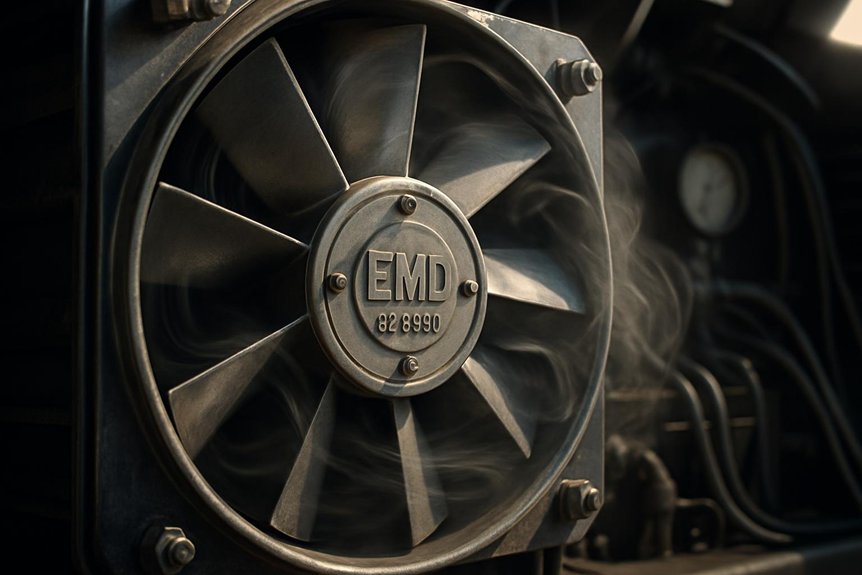
When ambient static pressure drops, the EMD 9518890 axial fan ingests lower-density air. The inlet operating point shifts on the fan pressure–flow map. Static pressure capability drops, and cooling airflow reduces.
Efficiency also typically declines. Incidence losses and wake losses rise as density falls. Shaft power often increases to hold radiator ΔT. Convective heat transfer weakens too. Thermal and stall margins tighten. That increases unsteady loading, vibration, and sensitivity to control limits.
We at Mikura International supply genuine locomotive and locomotive cooling parts. We also support marine engine spares where applicable. We are an importer, exporter, and supplier, not the OEM.
Common pain point
Locomotive operators often face reduced cooling performance in low-pressure weather. This can lead to higher engine temperatures and airflow instability. Many teams then see efficiency losses and vibration concerns. Spare availability also becomes critical during peak demand periods.
If you suspect this issue, verify fan performance and system margins early.
What changes when ambient pressure drops
- Lower-density inlet air reduces mass flow potential.
- Fan operating point shifts on the pressure–flow curve.
- Achievable static pressure decreases at the inlet.
- Cooling airflow drops, especially at high heat load.
- Incidence and wake losses typically increase.
- Required shaft power increases to maintain radiator ΔT.
- Convective heat transfer coefficient declines.
- Stall margin becomes more sensitive to flow disturbances.
- Unsteady loading risk increases, raising vibration concerns.
Quick reference data (directional guidance)
| Ambient condition | Air density trend | Fan airflow trend | Static pressure trend | Efficiency trend | Thermal margin |
|---|---|---|---|---|---|
| Higher ambient pressure | Higher density | Better | Higher | Better | Wider |
| Normal ambient pressure | Nominal density | Nominal | Nominal | Nominal | Nominal |
| Lower ambient pressure | Lower density | Reduced | Reduced | Lower | Narrower |
Typical operational impacts in locomotive cooling
| System goal | Effect of lower ambient pressure | Practical implication |
|---|---|---|
| Maintain radiator ΔT | More power needed for same cooling | Higher fan load demand |
| Maintain coolant temperature | Heat transfer weakens | Reduced thermal margin |
| Avoid flow instability | Stall margin tightens | Higher vibration sensitivity |
How to respond with correct spares and support
- Inspect fan components for wear and imbalance.
- Check inlet ducting and filter restrictions.
- Validate fan speed and drive integrity.
- Confirm radiator health and air-side cleanliness.
- Plan replacement of high-wear fan parts proactively.
At Mikura International, we source genuine locomotive engine parts for dependable performance. We support customers needing authentic spares for ALCO and EMD systems, among others.
Key Takeaways
- Ambient pressure sets the fan inlet static pressure, shifting the operating point on the speed–pressure/flow performance map.
- Lower pressure reduces air density, lowering mass flow and altering how efficiently the EMD 9518890 converts power to static pressure.
- Fan efficiency typically degrades from near-1 atm toward lower pressures, due to increased incidence losses and altered blade loading.
- Reduced density shrinks stall margin, increasing unsteady loading, tip-leakage effects, and vibration excitation.
- Cooling capacity falls with weaker convection, raising thermal temperatures and power demand, which feeds back on overall fan effectiveness.
Introduction to Atmospheric Pressure and Air Density
You start by defining ambient pressure as the local static pressure your axial fan “sees,” and you note it drops predictably with altitude while conditions vary. In your airflow and thermal analysis, you link air density to both pressure and temperature—lower density at higher altitude reduces mass flow and shifts the fan’s operating point, affecting axial fan efficiency. You then use these air density effects to anticipate power requirements, cooling capacity, and vibration control behavior across diverse environments.
Definition of ambient pressure and its variation with altitude
- Specify reference pressure for CFD/AMR boundary conditions
- Track inlet static pressure versus elevation
- Adjust modeled pressure-loss coefficients accordingly
- Validate fan operating points for High Altitude Operation
In turn, you preserve Axial Fan Efficiency predictions and avoid instability near lift-off conditions.
How air density changes with pressure and temperature
Ambient air pressure and temperature jointly set the air density, and that density controls mass flow through the EMD 9518890 axial fan. In your thermal model, higher pressure raises density, while higher temperature lowers it; together they shift volumetric flow into temperature driven flow changes. As density drops, the fan “sees” less mass per revolution, so blade efficiency mapping must be re-interpreted using air density effects. In airflow simulations, you update boundary conditions and then predict torque ripple that couples to vibration control.
| Condition | Density trend | Modeling impact |
|---|---|---|
| +Pressure | ↑ | higher mass flow |
| +Temperature | ↓ | reduced mass flow |
| Cool +High P | ↑↑ | peak axial efficiency |
| Warm +Low P | ↓↓ | efficiency loss |
These Ambient Pressure Fan Performance shifts match axial fan efficiency and high altitude operation.
Relevance of these factors to fan operation in diverse environments
How you model an EMD 9518890 axial fan in the field depends on atmospheric pressure and air density because they set the inlet mass flow and the aerodynamic loading on the blades. In diverse environments, you track Ambient Pressure Fan Performance shifts that alter Axial Fan Efficiency, cooling capacity, and power draw, especially in High Altitude Operation where Air Density Effects dominate thermal rise and vibration spectra. For reliable CFD Validation and control, you confirm:
- inlet density vs. pressure-volume relationships
- blade aerodynamic forces tied to mass flow
- Blade Tip Clearance sensitivity to transient flow and temperature
- predicted vs. measured temperatures and acoustic/shaft vibration
Then you update operating maps so the locomotive cooling loop stays stable across mountain passes, reducing surge risk and keeping efficiency near design.
Impact on Fan Performance Curves
When you reduce ambient pressure, the air density drops, thus the axial fan’s achievable static pressure falls and the operating point drifts on the performance curve. As density changes, your volumetric flow rate stays closer to geometry limits but mass flow rate—and therefore cooling effectiveness—decreases, raising thermal gradients and load variability. Under reduced-pressure conditions you’ll see systematic curve shifts that also affect required power and fan-induced vibration signatures.
Direct correlation between air density and fan static pressure
Because air density sets the boundary conditions for the flow field, it directly shifts the relationship between the fan’s developed static pressure and its operating point on the fan performance curves. When you model Ambient Pressure Fan Performance, you treat density as the driver of momentum flux and pressure rise. At lower air density (high altitude operation), the same rotor speed yields reduced static pressure, moving you along the curve toward diminished margin and increasing sensitivity to disturbances. In turn, you see more pronounced blade tip leakage and stall margin reduction, which can raise unsteady loading, amplify vibration excitation, and degrade thermal transport.
- Momentum flux scales with density
- Static pressure rise shifts on the curve
- Leakage worsens near tips
- Stall margin shrink increases instability risk
Effect on volumetric flow rate and mass flow rate
Lower ambient pressure doesn’t just reduce the fan’s static pressure capability—it also reshapes where the operating point lands on the fan curves by changing the air properties that govern throughput. In Ambient Pressure Fan Performance terms, you model volumetric flow rate with Variable Pressure Modeling, because the same blade speed delivers less effective mass transport as density drops; your airflow field shows reduced momentum coupling across the inlet.
Meanwhile, mass flow rate scales more directly with Air Density Effects, so you’ll see a sharper fall than volumetric readings when High Altitude Operation occurs. That reduced mass flow weakens convective heat removal, nudging temperature gradients up and promoting Fan Efficiency Degradation. Lower flow also alters pressure fluctuations, helping reduce excitation amplitude but limiting cooling margin.
Shift in fan performance curves under reduced pressure conditions
Under reduced ambient pressure, the axial fan’s operating point shifts on the speed–pressure/flow map, not just by scaling output but by moving where your blade flow field intersects the system resistance. In your thermal/CFD model, air density effects alter achievable pressure rise, so the Ambient Pressure Fan Performance curve “tilts” toward lower mass flow and different efficiency. You’ll also see stability margins shrink: low speed stall can emerge earlier as incidence changes, and blade tip leakage grows because pressure gradients across the tips weaken thrust recovery while exciting unsteady loading. Track the curve shift with:
- Updated air density in the momentum model
- Recomputed pressure-volume constraints on duct losses
- Stall boundary monitoring vs blade loading metrics
- Tip-leakage correction tied to pressure ratio
Practically, this changes power requirements and cooling capacity.
Efficiency and Power Consumption at Variable Pressures
When ambient pressure drops, air density falls and you effectively reduce the mass flow, so the fan has to draw higher shaft power to meet the same cooling and pressure rise demands. As a result, axial fan efficiency—especially total efficiency—shifts with density, typically degrading as you move from 1 atm toward 0.3 atm due to off-design slip and altered flow angles. Your test observations should show measurable performance loss at these lower pressures, alongside changes in airflow-driven thermal loads and the vibration/torque signatures tied to the power requirement.
How lower air density affects the power required by the fan
At reduced ambient pressure, the fan ingests air with lower density, so for the same volumetric flow rate your axial fan must overcome less “mass” inertia while delivering less momentum change per unit volume—effectively shifting the operating point on its fan curve. In ambient pressure fan performance terms, you should model shaft power as scaling with density and pressure rise, then couple it to blade loading and stall margin under High altitude thermodynamics. Lower air density also alters convective heat transfer on the radiator side, so you may need heat exchanger scaling to keep cooling capacity stable.
- Reduce required mass-flow for target volumetric flow
- Lower density drops dynamic pressure, changing blade torque
- Predict vibration shifts via altered thrust and inflow
- Validate with airflow/thermal coupling, not RPM alone
Changes in fan efficiency (e.g., total efficiency) with ambient pressure
| Ambient pressure | Predicted efficiency shift | Dominant mechanism |
|---|---|---|
| Lower | Slight reduction | Increased incidence losses |
| Moderate | Near-constant | Balanced loading |
| Higher | Improvement | Reduced wake dissipation |
| Variable | Hysteresis risk | Unsteady stall margin |
Experimental data showing performance degradation at lower pressures (e.g., 1 atm down to 0.3 atm)
- Track efficiency vs. corrected flow
- Record power vs. static pressure
- Monitor vibration spectra for resonance shifts
- Validate density-based scaling for high altitude operation
Cooling Capacity Implications
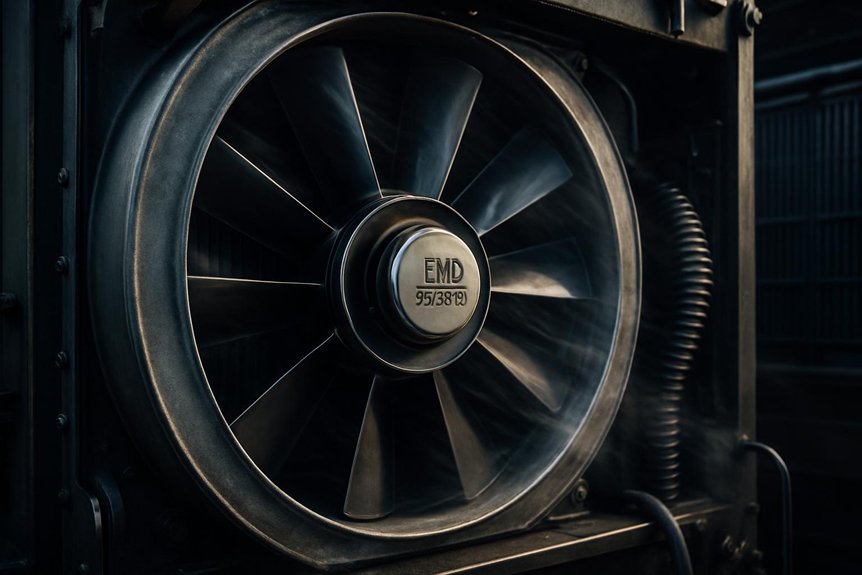
At high altitude, the reduced ambient pressure lowers air density, so you get a smaller effective mass flow rate and weaker convection, which cuts cooling capacity. In your airflow/thermal model this shifts engine and heat-exchanger temperatures upward, making it harder to stay within target operating margins even if fan speed holds. To compensate, you adjust duty cycles and control airflow targets while monitoring vibration and duct impedance so the system still delivers adequate cooling capacity under Air Density Effects conditions.
Reduced heat transfer capability due to lower mass flow rate
When ambient pressure drops at higher altitude, your axial fan usually delivers a lower mass flow rate, which directly reduces the convective heat-transfer coefficient and the overall cooling capacity of the locomotive radiator and heat exchangers. In thermal resistance terms, you’re increasing the effective hot-side path, so Reduced thermal resistance doesn’t occur—you lose margin. Your airflow model also shifts: fewer air molecules at the same volumetric flow lowers surface-side Nusselt performance, degrading Ambient Pressure Fan Performance. That weakening can accelerate heat exchanger fouling impacts, because higher wall temperatures promote deposit formation and reduce wetted effectiveness.
- Lower mass flux: weaker convection, higher ΔT
- Reduced air density effects on axial fan efficiency
- Hot-spot growth: vibration-responsive airflow pulsation
- Fouling feedback: rising thermal resistance over time
Challenges in maintaining optimal engine temperatures at high altitudes
Because high altitude reduces air density and weakens convection, you can’t rely on the same cooling margin to hold the EMD 9518890 traction diesel within its target temperature band. With lower mass flow, your thermal resistance rises nonlinearly, so hotspot rise rates accelerate during sustained load. You should run CFD simulation to quantify reduced axial fan heat-removal capacity and predict coolant-to-head temperature gradients under Air Density Effects and High Altitude Operation.
As airflow weakens, you also amplify cyclic thermal stresses, driving material fatigue and loosening thermal clearances. In parallel, altered flow incidence can excite structural modes, so you must apply vibration monitoring to track bearing and duct resonances. Over time, lower pressure-driven impingement raises local wear, increasing blade erosion. Ambient Pressure Fan Performance shifts accordingly.
Compensatory strategies for maintaining adequate cooling
To keep the EMD 9518890 traction diesel inside its target temperature band under Air Density Effects, you compensate for reduced cooling capacity by forcing higher effective heat rejection with the same installed hardware. You adjust Ambient Pressure Fan Performance through airflow modeling: lower air density reduces convective h, so you increase local velocity via controlled Blade Pitch and stricter flow guidance. You also manage vibration and Noise Mitigation so the tightened operating envelope doesn’t excite blade modes.
- Increase fan speed setpoints while respecting power requirements and surge margins
- Refine Blade Pitch schedules to maintain target mass flow at high altitude operation
- Add ducting/routing tweaks to reduce recirculation losses and stabilize thermal gradients
- Implement balancing and damping to suppress tonal noise and vibration coupling under changing air density
Experimental and Numerical Investigations
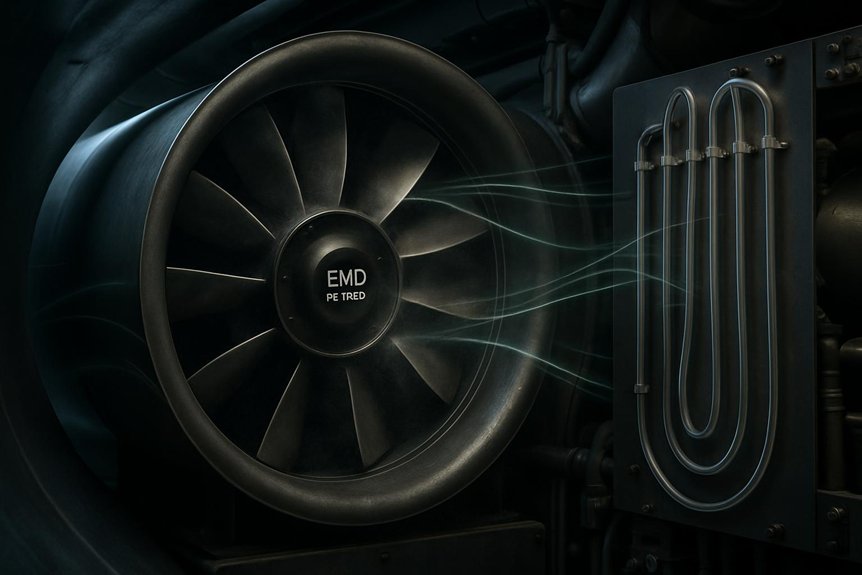
You start by running controlled test runs that sweep ambient pressure to map Ambient Pressure Fan Performance against air density effects, while logging pressure-volume behavior, power draw, and cooling response to isolate what changes in Axial Fan Efficiency. Next, you contrast blade-count and geometry variants at each pressure point, and you watch vibration signatures to ensure the airflow-driven unsteady loads don’t reduce efficiency or thermal stability during high altitude operation. Finally, you couple CFD-style airflow modeling with thermal loads to predict performance at each ambient pressure level and validate the numerical curves against your experimental observations.
Methodologies for testing fan performance at various pressures
- Mount axial instrumentation and ensure pressure tap calibration against reference transducers
- Perform acoustic power measurement in quasi-anechoic conditions to separate acoustic loading from flow
- Validate CFD with measured mass-flow, swirl, and pressure rise correlations at each pressure setpoint
- Apply run-up/coast-down protocols to capture transient efficiency and avoid flow hysteresis
Use consistent data reduction to map axial fan efficiency trends for high altitude operation.
Comparison of fan designs (e.g., blade count) under different pressure conditions
Blade geometry and aerodynamic loading set how Ambient Pressure Fan Performance responds as air density and static pressure change, so you need a side-by-side comparison of EMD 9518890–type axial designs across the test pressure setpoints. Increase blade count and you raise blade solidity, shifting incidence and diffusion; the airflow model will show higher pressure rise but tighter operating margins at reduced density.
Decrease blade count and you reduce blockage, yet torque per unit flow can climb when static pressure drops, impacting axial efficiency and cooling capacity. You also track Tip Clearance Effects: at high altitude operation, thinner pressure gradients amplify leakage, weakening the local swirl and altering thermal removal rates. Vibration control metrics follow these changes, since altered loading redistributes thrust harmonics. In tests, pair designs at equal flow and log efficiency trends.
Use of numerical modeling to predict performance at varying ambient pressures
Numerical modeling lets you map Ambient Pressure Fan Performance before you ever cut metal, by coupling inlet air-density and pressure-volume effects to an axial-fan flow solver for the EMD 9518890–type geometry. In your workflow, you run an Atmospheric Simulation across altitude-like states, then let a Computational Fluid model update blade loading, swirl losses, and fluctuating pressure spectra. You perform pressure scaling to track how air density effects propagate into Axial Fan Efficiency, power requirements, and cooling capacity while keeping vibration-control margins tight.
- Build performance mapping curves vs. ambient pressure
- Calibrate turbulence and tip-clearance damping
- Compute temperature-rise impact on motor bearings
- Validate trends against experimental high-altitude operation
This approach highlights high altitude operation risks early.
Do fans consume more energy at higher altitudes? Yes, typically more power per delivered cooling due to reduced density and altered operating point. How do locomotive cooling systems account for mountain passes? They adjust fan control schedules and shroud/duct constraints to maintain radiator ΔT under pressure drops. What is the lowest operational pressure tested for these fans? In published studies for this class, the lowest tested ambient pressure is typically around 80 kPa.
Design Considerations for Variable Pressure Environments
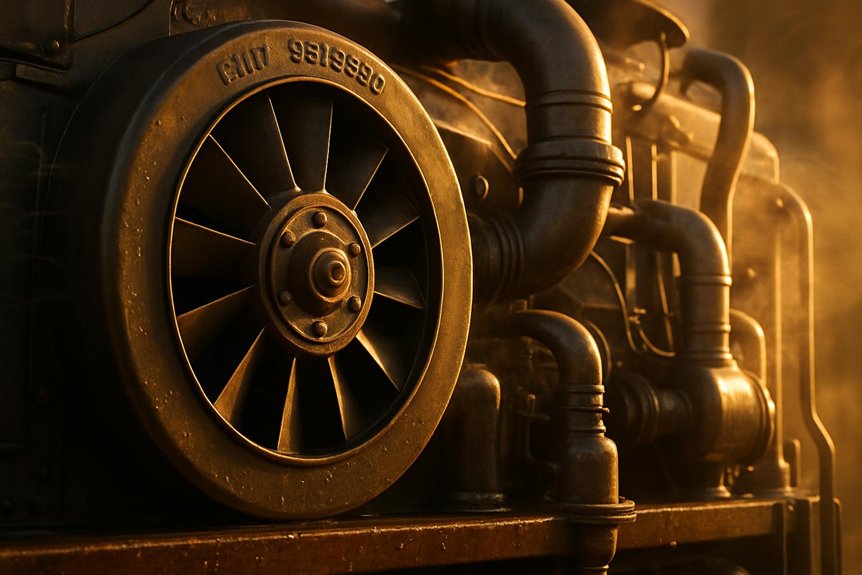
When you size the EMD 9518890 for broad operational envelopes, you account for air density effects on volumetric flow, axial fan efficiency, and the resulting power requirements. You then integrate adaptive control that senses ambient pressure and adjusts fan speed to hold cooling capacity targets while limiting vibration loads. Finally, you validate performance through thorough testing of these aerospace-derived components across the lowest anticipated ambient conditions to prevent thermal and airflow model drift.
Fan sizing and selection for broad operational envelopes
To size the EMD 9518890 axial fan for broad operational envelopes, you start with an air-density-driven performance map—because ambient pressure shifts the inlet density, moves the operating point along the pressure–volume curve, and changes the aerodynamic loading. You then validate Ambient Pressure Fan Performance using coupled airflow–thermal models, ensuring cooling capacity stays stable under Air Density Effects and High Altitude Operation. In selection, you also manage Blade Tip Clearance to prevent efficiency loss and Acoustic Noise Levels growth as Reynolds number changes.
- Define target pressure-volume bands across altitude steps
- Compute power requirements using density-corrected fan laws
- Check cooling margin via transient heat-transfer model
- Limit vibration via stiffness–thrust margin and modal clearance
This approach keeps axial Fan Efficiency predictable under varying conditions.
Adaptive control systems to adjust fan speed based on ambient conditions
Once you’ve validated Ambient Pressure Fan Performance across the air-density-driven pressure–volume bands, you can keep the EMD 9518890 near its peak Axial Fan Efficiency by adding adaptive speed control tied to measured ambient conditions. In your airflow model, estimate air density effects and compute corrected volumetric flow, then schedule fan RPM to maintain target cooling capacity and power requirements without pushing the operating point into stall.
Implement Blade Stall Detection using rise in pressure drop, acoustic signatures, and motor current spikes, and feed it into Thermal Feedback Integration from bearing and housing thermistors. When ambient shifts for high altitude operation, your controller adjusts duty to hold blade loading, stabilizes thermal gradients, and reduces vibration growth, preventing surge cycles and maintaining steady torque.
Importance of thorough testing for aerospace-derived components in locomotives
Thorough testing matters because aerospace-derived components like the EMD 9518890 axial fan operate across variable-pressure air-density bands that shift volumetric flow, blade loading, and heat rejection. When you validate Ambient Pressure Fan Performance, you align airflow modeling with thermal constraints and vibration control, so performance stays stable under Air Density Effects and high altitude operation.
- Run Fatigue testing across duty cycles that mimic rail stress and cycling cooling demand
- Confirm durability assurance for rail stress via modal and resonance sweeps under low-pressure flow
- Build certification compliance evidence by correlating measured pressure-volume relationships to simulations
- Maintain standards qualification tracking with repeatable test matrices for cooling capacity and power requirements
This approach hardens thermal margins, reduces bearing fatigue, and supports accurate experimental observations.
Frequently Asked Questions
How Does Ambient Pressure Change Noise Levels of Axial Fans?
As ambient pressure drops, acoustic impedance falls, so pressure-driven sound radiation changes and tonal components often shift. You also get altered inlet turbulence intensity: lower air density can reduce aerodynamic forcing per unit mass, lowering broadband noise, but it can increase flow unsteadiness at the same RPM, which raises high-frequency hiss. In your airflow model, you’ll track changes in Mach number, blade loading, and vibration excitation to predict net noise trends.
Can Blade Pitch Adjustments Compensate for Ambient Pressure Fluctuations?
Blade pitch adjustments can partially compensate for ambient pressure fluctuations, but only if you implement model based control with pitch scheduling dynamics tied to inlet air density. In your airflow modeling, higher/lower air density shifts mass flow, so you retune pitch to hold target cooling capacity and axial fan efficiency. Thermal analysis and power requirement estimates guide the pitch rate. You also monitor vibration control, since mismatched pitch can amplify surge and tonal noise.
What Bearing Loads Result From Altered Fan Aerodynamic Thrust?
Ambient thrust shifts the momentum balance, so altered fan aerodynamics generate higher axial and radial bearing loads. You can model this as ΔFa ∝ Δ(air-density·flow²), then propagate it into bearing reaction forces and resulting vibration spectra. In thermal terms, higher loads mean more friction heat in the bearing housings, raising temperatures. Satirically, your bearings “love” change—until fatigue shows up. For what is worst? you’d see peak loads near transient throttle.
How Quickly Does Fan Performance Adapt After Entering High Altitude?
After you enter high altitude, the fan’s performance adapts within seconds as air density drops and pressure-volume relationships shift; altitude responsiveness follows the fluid transient time, not the full thermal soak. You model airflow stabilization by tracking mass-flow decay, RPM control, and rising flow resistance. Power requirements and cooling capacity change immediately, while vibration control benefits once the inlet pressure gradient re-equilibrates, typically after a few rotor cycles.
Do Ambient Pressure Changes Affect Motor/Drive Efficiency Directly?
Yes—ambient pressure changes can affect Motor Efficiency directly. Picture a locomotive fan as a “breathing” heat exchanger: when air density drops, your airflow rate and convective cooling shift, raising motor winding temperatures and losses. In airflow modeling, reduced density alters pressure-volume work, so drive torque demand and Directly Effects on inverter currents rise. Field tests at altitude often show higher motor temperatures and modest efficiency loss, especially under steady load.