

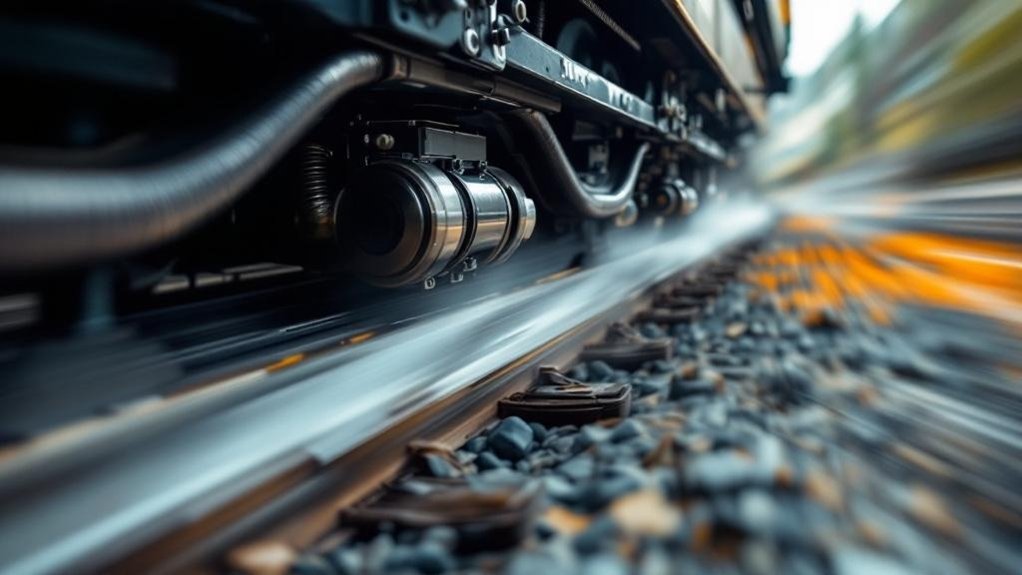
You feel that thrilling surge because vertical dampers convert violent axle-box motion directly into heat through velocity-dependent shim-stack metering. You get soft compression valving that rapidly absorbs track-joint shocks, paired with firm rebound damping that arrests wheel hop instantly. This asymmetrical tuning maintains consistent wheel-rail contact forces across bounce and pitch frequencies, preventing oscillation amplification that would otherwise make speed feel unstable. The engineering behind this force–velocity curve reveals why locomotives seem to glide.
How do vertical dampers differ from lateral dampers in locomotive bogie design?
Vertical dampers control bounce, pitch, and vertical vibrations. They mount between the bogie frame and axle box. This preserves wheel‑rail contact over track irregularities. Their stroke is tuned for vertical dynamic loads. This ensures stable ride comfort and reduces suspension wear.
Lateral dampers suppress sway and hunting oscillations. They are installed horizontally across the bogie or between bogie and carbody. These dampers absorb yaw moments at high speed. They prevent unstable lateral movements from growing. Their design targets self‑excited vibrations that threaten safety.
Vertical dampers react mainly to road‑induced inputs. Lateral dampers counteract kinematic instability. Vertical units affect dynamic wheel loads and comfort. Lateral units govern stability and curving behaviour. Their stiffness, mounting angles, and damping curves differ substantially. Engineers select each type for distinct frequency ranges and operational demands.
Key Takeaways
- Vertical dampers absorb bounce and pitch vibrations by converting dynamic axle motion into heat through viscous oil flow.
- Shim-stack valves deliver velocity-dependent damping that softens sharp impacts while maintaining body control.
- Asymmetrical compression and rebound tuning rapidly dissipates track-joint shocks to create a smoother sensation.
- Targeted energy dissipation across 0.5–10 Hz prevents oscillation amplification that would otherwise jolt passengers.
- Firm rebound damping arrests wheel hop, keeping the sprung mass stable for a controlled, thrilling ride feel.
Fundamentals of Locomotive Bogie Dampers

You control three damper classes in your bogie: vertical, lateral, and yaw. Vertical dampers manage axle motion through shim-stack valves that convert kinetic energy into heat. You tune each damper’s orifice stack for its specific dynamic mission without confusing ride comfort with stability.
Role of Dampers in Rail‑Vehicle Dynamics
Because dampers convert bogie vibration into heat, they’re the linchpin of locomotive suspension control. You rely on vertical dampers to absorb vertical dynamic loads, preventing excessive bounce and pitch. In locomotive suspension damping design, you select damping coefficients to manage energy dissipation across frequency ranges. This directly influences wheel‑rail forces and ride comfort. Without proper damping, oscillations amplify, degrading track friendliness and accelerating component fatigue.
You achieve stability by tuning hydraulic resistance to match suspension stiffness and unsprung mass. This precision ensures the bogie isolates carbody vibrations effectively. Dampers also suppress resonant modes that threaten operational safety. Therefore, your damping strategy defines the locomotive’s dynamic performance envelope. You always tailor damping curves to specific axle loads, ensuring consistent performance. This meticulous calibration protects wheel‑rail profiles.
Classification: Vertical, Lateral, and Yaw Dampers
While vertical dampers isolate the carbody from track-induced bounce, lateral dampers combat the self-excited sway and yaw that plague locomotive bogies. You exploit this classification to assign damping tasks precisely. Vertical units, mounted between bogie frame and axle box, absorb vertical shocks directly. They preserve wheel-rail contact over irregularities.
Lateral dampers locomotive bogies use horizontal mounting to suppress sway. Yaw damper mounting and tuning often combine with lateral designs, using specific bracket angles. This integration controls rotational hunting oscillations. You select each damper type for its targeted frequency range. Damping curves and stroke lengths differ markedly. The table below outlines these functional divisions. This delineation prevents cross-coupling of dynamic modes. You tune each damper to its operational demand. Proper classification ensures bogie stability.
| Damper Type | Primary Motion Controlled | Mounting Configuration |
|---|---|---|
| Vertical | Bounce | Between bogie frame and axle box |
| Lateral | Sway | Horizontally across bogie or to carbody |
| Yaw (often lateral) | Rotational Hunting | Integrated with lateral dampers, tuned via bracket angles |
Hydraulic Damping Principles and Shim‑Stack Valves
Hydraulic dampers convert kinetic energy into heat through viscous oil flow. You’ll observe shim‑stack valves metering this flow. Thin steel shims deflect progressively under pressure. This creates velocity‑dependent damping force. Blow‑off valves cap peak loads to protect seals. You tune the stack for specific damping characteristics. This directly aids bogie hunting stability control. It suppresses yaw oscillations from kinematic instability.
You design low‑speed bleed for ride comfort. High‑speed blow‑off limits excessive wheel force. Vertical dampers employ these principles in bounce mode. Their blow‑off setting avoids wheel load fluctuation. Lateral dampers use similar hydraulics for yaw suppression. You select oil viscosity for temperature compensation. Shim‑stack valves deliver reliable, repeatable performance. You rely on blow‑offs to cap hunting yaw moments. This ensures bogie hunting stability control.
Design and Mounting of Vertical Dampers
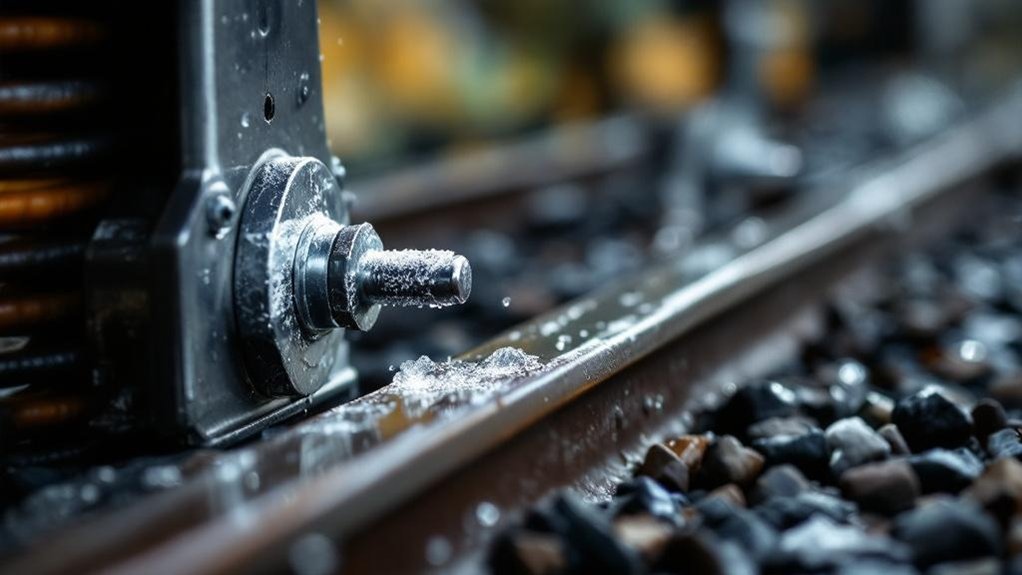
You must define functional load cases by analyzing bounce frequencies and axle‑box acceleration spectra. You’ll mount the vertical damper directly between bogie frame and axle box, often using inclined linkages to match stroke angles. Then you tune the valve stack to generate a digressive damping curve that absorbs track impacts without spiking wheel‑rail forces.
Functional Requirements and Dynamic Load Cases
Vertical dampers face a tough assignment because they must absorb sharp shocks from track joints and wheel flats without losing control at low speeds. You see high-frequency impacts demanding prompt blow-off valve response. Yet you also require firm low-speed damping for bounce control. Dynamic load cases include temporary overloads from switches and dips. These impose velocities up to 1 m/s. Your damper’s relief valve must prevent force spikes above 15 kN. Concurrently, you tune the bleed circuit for a 0.1 m/s range. This ensures body motion control without harshness. Wheel-flat impacts repeat every rotation. You need robust seals and guides to survive this cyclic pounding. Proper thermal management handles energy dissipation from consecutive irregularities.
Typical Mounting Configurations and Linkage Geometry
After absorbing those punishing vertical loads, you must direct forces cleanly into the bogie structure. You’ll place vertical dampers near axle boxes for direct wheel‑rail feedback. Alternatively, you mount them between bogie frame and bolster to isolate the carbody. Your linkage geometry isn’t arbitrary; installation angles determine how much damping targets bounce versus pitch modes. A near‑vertical alignment emphasizes pure vertical control. A slight inclination introduces a modest pitch moment component, so you tune linkage lengths to avoid bind through full suspension travel. You’ll also ensure spherical bearings accommodate axle articulation. This precise geometry preserves damper stroke alignment, maximizing energy dissipation without side‑loading seals.
Valve Tuning for Ride Comfort and Wheel‑Rail Protection
Inside the damper body, you’ll tune compression and rebound valves asymmetrically.
- Soft compression valving reduces vertical impact forces quickly.
- Firm rebound damping arrests wheel hop, stabilizing sprung mass.
- This asymmetry curbs dynamic load variation, protecting rail and suspension.
You’ll select orifice and shim stacks to get digressive force‑velocity curves. Compression blow‑off yields low damping at high piston speeds, easing impact transfer. Rebound remains firm across velocities, preventing uncontrolled axle hop. This reduces wheel‑tread and rail‑head fatigue while preserving ride comfort. By precisely asymmetrical tuning, you’ll maintain consistent wheel‑rail contact forces across varied track inputs. Temperature‑compensating valves keep damping stable, so your bogie never loses its tune. Such valve calibration ensures ride comfort and protects wheel‑rail infrastructure. Soft compression also quiets secondary suspension chatter. It extends damper life.
Design and Mounting of Lateral Dampers
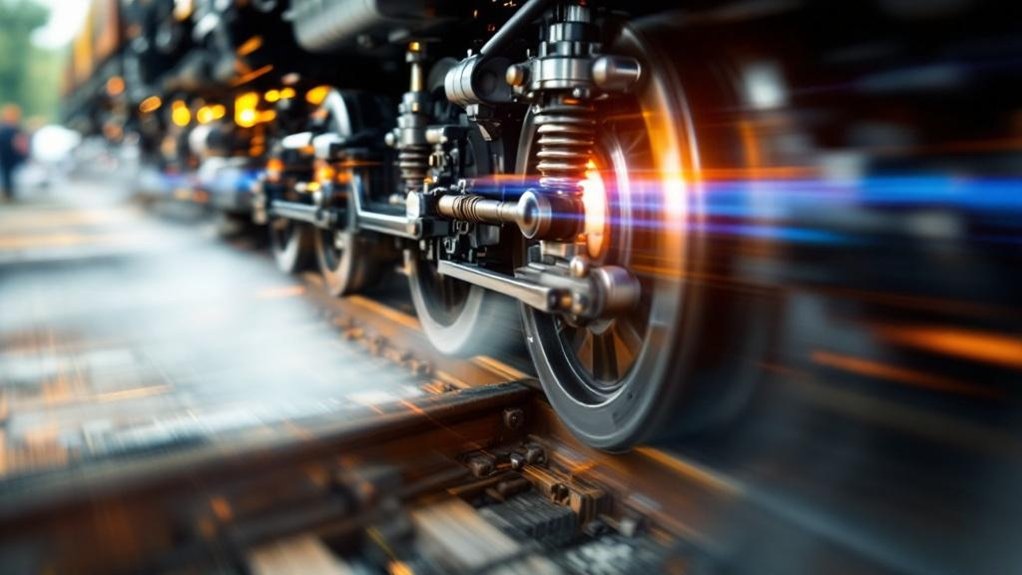
You can’t ignore hunting oscillation—it’s a self-excited lateral instability that grows without damping and you integrate lateral dampers into the secondary suspension, often coupling them with anti-yaw bars to directly resist bogie rotation. You then select a damping ratio that effectively suppresses the yaw and sway modes without over-stiffening curving behaviour.
Hunting Oscillation and the Need for Lateral Stability
When a locomotive reaches high speeds, coned wheel profiles can trigger hunting. You’ll witness a self-excited yaw-sway cycle driven by creep forces. This oscillation threatens safety and ride quality. Lateral dampers combat this directly. They’re mounted horizontally on the bogie frame, linked to the axle box, to absorb yaw moments. Here’s their role in lateral stability:
- Raise the hunting critical speed above your top operating velocity.
- Add damping to the yaw mode, decoupling it from sway resonance.
- Reduce lateral wheel forces, cutting flange wear and track shifting.
You’ll tune their valving for a digressive force-velocity curve. This prevents lockup on curves while providing strong high-speed damping. You’ll notice a sharp drop in lateral carbody acceleration. Without them, hunting ruins ride and wheel-rail life.
Integration with Secondary Suspension and Anti‑Yaw Bars
Mount lateral dampers diagonally between the bogie frame and carbody—they’ll double as yaw dampers. This angled mounting lets them resist both lateral displacement and yaw rotation simultaneously. You’ll integrate them directly with the secondary suspension’s lateral bump stops for a progressive stiffness curve. The damper’s longitudinal component generates a key stabilizing moment around the bogie’s vertical axis.
You’ll tune this anti‑yaw effect to suppress hunting without restricting gentle curving. Precise mounting bracket stiffness prevents lost motion and high‑frequency degradation. You’ll specify spherical bearings to accommodate the combined angular motions during bounce and sway. This configuration eliminates the need for a standalone anti‑yaw bar, saving weight and simplifying the bogie frame. Your installation will treat the damper as a structural link, not a simple add‑on.
Damping Ratio Selection for Yaw and Sway Modes
Properly sized lateral dampers build on that integrated mounting approach by tuning the yaw and sway modes separately. You select damping ratios based on bogie yaw inertia and equivalent wheel conicity to balance stability with curving. Remember that over‑stiffening impairs curving performance and increases wheel‑rail wear. Key selection steps include:
- Calculate the yaw damping coefficient from bogie moment of inertia and track conicity, targeting critical hunting frequency attenuation.
- Limit sway damping to avoid restricting bogie rotation on curves; excessive stiffness forces flange contact, raising lateral forces and wear.
- Employ separate damper valves for sway (low‑speed) and yaw (high‑speed) modes, preventing cross‑coupling that could destabilize the locomotive.
Therefore, by matching damping ratios to bogie dynamics, you achieve stable high‑speed running without sacrificing wear-free curve negotiation.
Key Differences and Performance Impact

You tune vertical dampers for bounce modes, directly controlling dynamic wheel loads that affect ride quality and rail wear. In contrast, lateral dampers target sway and hunting, preserving tractive effort by stabilizing the bogie’s yaw motion. You’ll find vertical units demand less frequent monitoring because their stroke cycles are more predictable than the stick‑slip stresses lateral dampers endure.
Dynamic Response: Vertical Bounce vs. Lateral Sway
Because vertical dampers act on bounce motions from track irregularities, they operate across a 0.5–10 Hz range. You’re controlling broad-spectrum energy that directly shapes ride quality. Lateral dampers, in contrast, target a narrow band—typically 1–4 Hz—where hunting oscillations emerge from kinematic instability. Their response is triggered by self-excited yaw moments, not external inputs.
- You sense vertical damping as whole-body vibration isolation; it’s a broadband comfort metric.
- Lateral damping feels like directional steadiness; it prevents a low-frequency weave from escalating.
- Vertical units dissipate forced vibration energy; lateral units suppress an unstable resonance peak.
This frequency separation demands distinct internal valve tuning for each damper.
Influence on Wheel‑Rail Wear and Tractive Effort
While you’re chasing ride quality and stability, the damper choices directly shape wheel‑rail wear. Poor vertical damping increases dynamic wheel‑load fluctuations. This accelerates tread wear and shelling. It degrades tractive effort as contact patch consistency fades. Excessive lateral damping restricts wheelset steering in curves. This raises flange forces and wheel squeal. Consistent vertical damping maintains even wheel loads.
You tune vertical damping to minimize load variation. This preserves rail profile and adhesion. You select lateral damping just enough to calm hunting. You avoid curving compliance loss. Traction motors exploit steady adhesion, reducing slip. You measure L/V ratios and gauge‑face wear. Excessive lateral forces scrub flanges, wasting energy. Effective damping balances load control with steering freedom, prolonging life. Your damper specification becomes a wear‑rate lever.
Maintenance, Monitoring, and Service Life
A locomotive’s vertical dampers work through high‑frequency cycles, so they tend to leak before lateral units. You’ll notice seal wear accelerates from constant bounce and pitch motions. Lateral dampers endure fewer cycles but face critical yaw loads. You must monitor both types with regular force‑velocity profiling.
- Leak Detection: Check vertical damper seals monthly. Oil mist attracts dirt, signaling imminent failure.
- Rod Scoring: Inspect lateral damper rods for corrosion pitting. Stiction from pitted rods destabilizes hunting control.
- Interval Replacement: Schedule vertical damper overhauls at 400,000 km. Lateral units often reach 600,000 km before service.
You’ll prevent unscheduled downtime by trending damper fade. Don’t swap mounting positions—vertical units lack lateral load capacity.
Procurement and Specification for Rail Engineers

You’ll specify stroke, damping coefficient, and mounting angles precisely for vertical and lateral dampers. Your procurement must mandate compliance with EN 13802, UIC 518, and AAR M‑1003 standards from the start. Then, you’ll enforce prototype testing protocols that verify fatigue life and temperature-compensated performance curves.
Critical Selection Parameters for Vertical and Lateral Dampers
Specifying vertical damper parameters demands accurate matching of force-velocity curves to your locomotive’s primary or secondary suspension stage. You’ll tune blow-off and bleed characteristics to regulate wheel-load fluctuations across specific route irregularities. For lateral dampers, you emphasize asymmetry to manage both high-speed hunting and low-speed curving forces.
- Force at Key Velocities: damping force at low (0.05 m/s) and high (0.3 m/s) speeds to isolate bounce from impact harshness.
- Stroke and Mounting Length: You verify that the installed length accommodates full bogie articulation without bottoming out or overextending.
- Dynamic Stiffness: You evaluate the mount’s elastic response to ensure it doesn’t add unwanted phase lag to your damping loop.
Compliance with EN, UIC, and AAR Standards
When you write a procurement specification for locomotive bogie dampers, you’ll embed the testing protocols of EN 13802, UIC 518, and AAR M‑101 to verify damping performance and durability. You’ll specify EN 13802’s dynamic tests for vertical damper force‑velocity curves under varied frequencies. UIC 518 guides your safety assessment, correlating damper response with bogie stability indices. You’ll invoke AAR M‑101 for endurance cycling that replicates years of track input. These norms mandate temperature compensation checks. You can’t skip low‑temperature damping loss limits. Compliance certifies that your vertical damper maintains wheel‑rail contact without degrading lateral stability margins. You’ll use the standards to compare suppliers objectively. This assures interoperable, predictable damping across fleets.
Supplier Evaluation and Prototype Testing Protocols
Before awarding a contract, you’ll structure a prototype testing protocol that validates real-world performance. You’ll scrutinize the supplier’s technical maturity and production readiness.
- Endurance bench tests: You’ll demand accelerated life testing to simulate five years of track service, verifying damping consistency under thermal load.
- Contamination sensitivity: You’ll inject calibrated particulates into the damper fluid, measuring force degradation to confirm robust seal integrity.
- On-track instrumented trials: You’ll record wheel-rail forces and bogie accelerations in a full locomotive, correlating data with your ride comfort models.
Assess logistics depth and spare-part lead times only after a damper prototype survives this gauntlet without cavitation or fade.
Frequently Asked Questions
Can Damper Oil Viscosity Degrade Ride Quality in Cold Climates?
Yes, damper oil viscosity directly degrades your ride quality in cold climates. You’ll feel stiffness because thickened oil resists flow through precise valve orifices. This changes your vertical damper’s force-velocity curve, locking the suspension. You lose wheel‑rail compliance, amplifying track shocks into the carbody. It shifts damping ratios from excellent bounce‑control values. You must specify oils with high viscosity indices and temperature‑compensating valves to maintain stable performance.
How Often Should Vertical Damper Bolts Be Torque-Checked?
You must torque-check vertical damper bolts every 15,000 to 30,000 kilometers of service. Your maintenance schedule should align with bogie overhaul intervals per UIC 518. Inspect the mounting fasteners visually during daily walkarounds for any loosening. A calibrated torque wrench ensures you achieve the manufacturer’s specified preload, preventing joint slip. You must not ignore this, as bolt loosening alters the damper’s stroke alignment and quickly deteriorates wheel‑rail contact quality.
Do Worn Vertical Dampers Accelerate Wheel Flange Wear?
Think of your wheelset as a dancer; worn vertical dampers turn a graceful routine into a stumbling mess. You’ll see accelerated wheel flange wear because the damper’s degraded stroke no longer controls bounce and pitch. Unchecked, these oscillations slam the wheel against the rail, causing hard flange contact. Your bogie hunts more, scrubbing the flange face on every curve. This grinding action peels away metal fast, so you’re scheduling reprofiling sooner than planned.
Can I Retrofit Digressive Valves to Older Locomotive Dampers?
You can retrofit digressive valves to older locomotive dampers if you match the mounting geometry and stroke limits. You’ll replace the linear piston with a digressive valve stack that bleeds force sharply beyond a threshold speed. This shifts the damping curve to prioritize body control under high-amplitude inputs. You must re‑tune the blow‑off point and verify hysteresis on a dyno per EN 13802. Check that your bogie’s brackets handle the altered peak loads without fatigue.
What Seal Material Best Resists Desert Sand Ingress?
For desert sand ingress, you can’t beat PTFE-based seal compounds with energizing O-rings. They shrug off abrasive fines that chew through nitrile seals. You must specify a double-lip scraper geometry that actively expels particles. This configuration maintains rod cleanliness in gritty environments, preventing scored shafts and fluid contamination. In locomotive vertical dampers, this choice directly extends service intervals and preserves consistent damping forces.