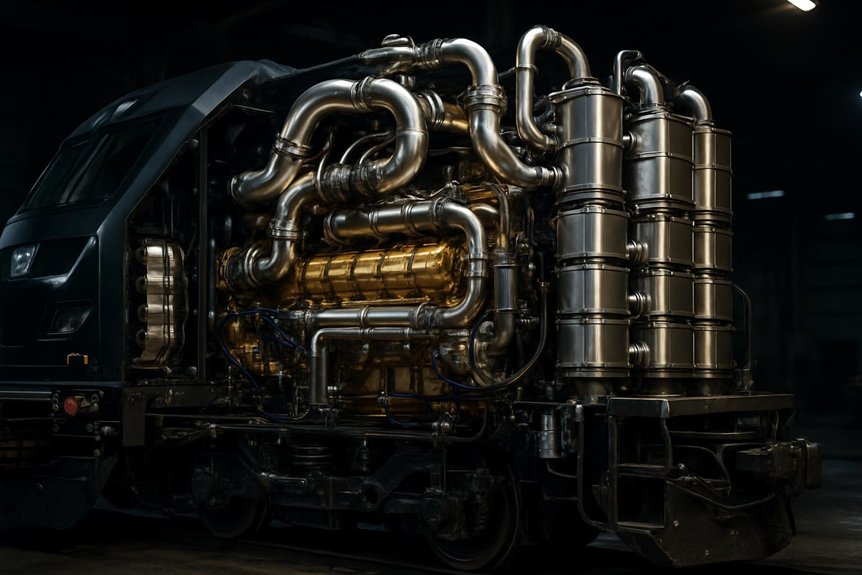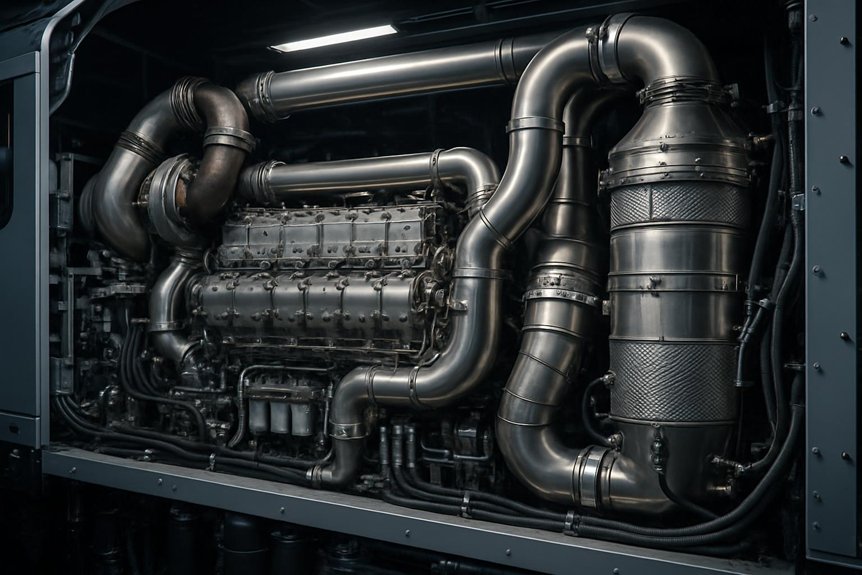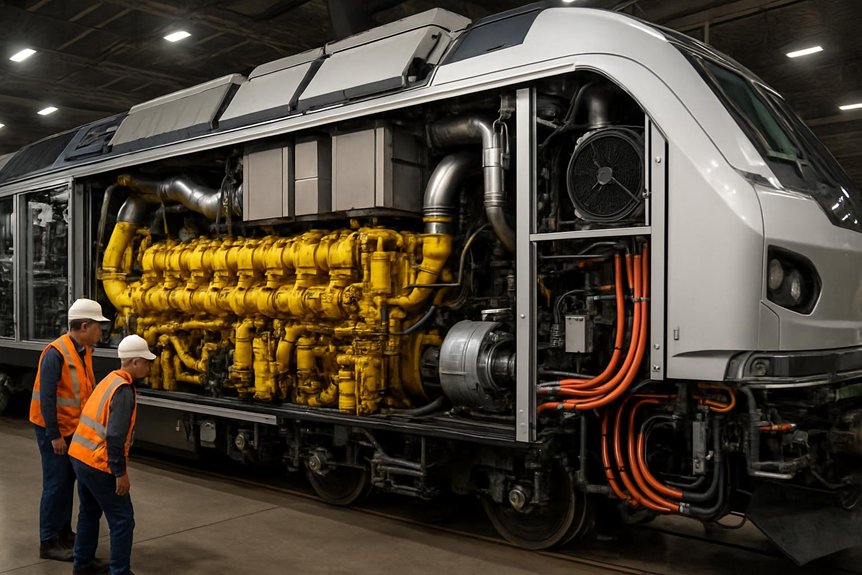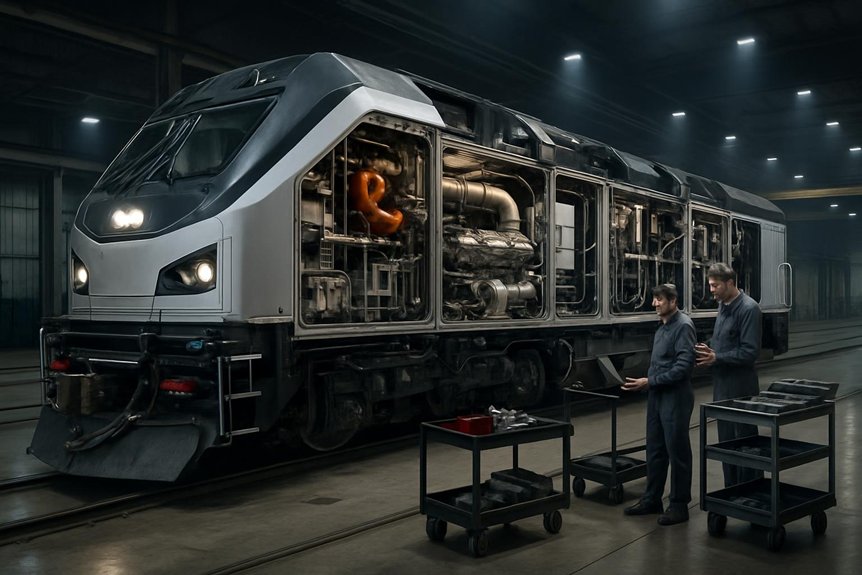
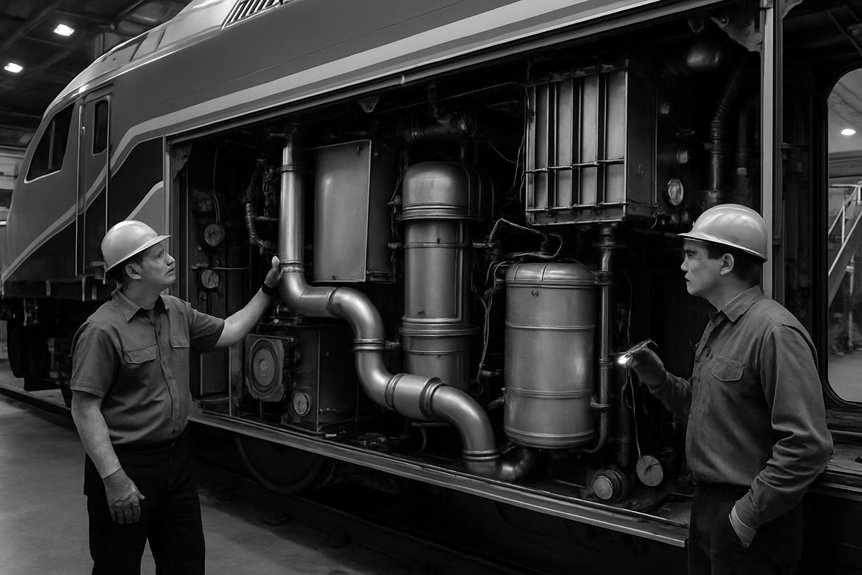
The EMD F125 aftertreatment system combines multiple components to meet stringent Tier 4 emissions for passenger locomotives. You’ll find the EMD F125 uses a Tier 4 aftertreatment package with a DOC, DPF, and SCR/DEF system. You inspect the DOC during scheduled A/B services, monitor DPF differential pressure and regeneration behavior, and plan ash cleaning around roughly 250,000–400,000 miles equivalent or engine-hour limits. Common failures include DOC poisoning or cracking, DPF plugging, sensor faults, DEF crystallization, injector coking, frozen lines, and SCR catalyst degradation. Next, you’ll see how each system affects reliability.
What aftertreatment components (e.g., SCR, DPF) are used on the EMD F125, and what are their maintenance intervals and failure modes?
The EMD F125 aftertreatment system combines multiple components to meet stringent Tier 4 emissions for passenger locomotives. It typically integrates a diesel oxidation catalyst, diesel particulate filter, and selective catalytic reduction catalyst in a compact module. Together, these units reduce particulate matter, hydrocarbons, carbon monoxide, and NOx while maintaining high power output.
Maintenance intervals are driven by duty cycle, fuel quality, and lube oil control. DPF ash cleaning often occurs between 250,000 and 400,000 miles equivalent, or at defined engine‑hour triggers. SCR systems require regular DEF quality checks, filter replacement, nozzle inspection, and sensor calibration during scheduled locomotive overhauls.
Typical failure modes include DPF plugging from excess soot or ash, cracked substrates, and failed differential pressure sensors. SCR issues include DEF crystallization, injector coking, degraded catalyst, NOx sensor drift, and wiring faults. These failures can cause derates, increased fuel consumption, higher emissions, and nuisance alarms for operators.
Key Takeaways
- The EMD F125 aftertreatment system includes a DOC, DPF, SCR catalyst, DEF dosing hardware, mixer, sensors, and exhaust monitoring controls.
- The DOC oxidizes CO and hydrocarbons, supports DPF regeneration, and should be inspected during A- or B-level services.
- DPF maintenance is driven by pressure trends, regeneration behavior, and ash cleaning typically planned around 250,000–400,000 miles equivalent.
- SCR maintenance focuses on clean DEF, filtration, nozzle checks, accurate sensors, and proper catalyst function for NOx conversion.
- Common failures include DOC poisoning, DPF plugging or cracking, DEF contamination, injector issues, sensor faults, and SCR catalyst degradation.
Understanding the EMD F125 Aftertreatment System
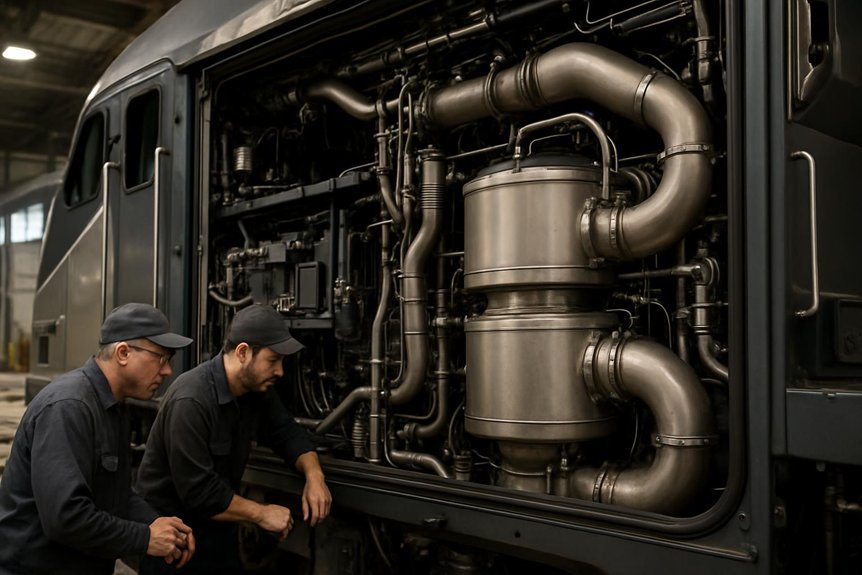
You need to understand how the EMD F125 aftertreatment system supports EPA Tier 4 emissions compliance in passenger service. You’ll see how the DOC, DPF, and SCR work together to control hydrocarbons, soot, and NOx. Then, you’ll trace the exhaust flow path and see why each stage affects reliability and maintenance planning.
Tier 4 Regulations Driving the F125 Design
Tier 4 emissions rules shaped every major design choice in the EMD F125 aftertreatment system. You face limits on locomotive NOx and particulate matter that legacy EMD platforms couldn’t meet through combustion changes alone. That’s why the F125 needed an integrated emissions strategy, not a bolt-on approach.
You also manage passenger-rail duty cycles that differ sharply from freight service. Frequent starts, station stops, rapid loading, and extended idle periods create unstable exhaust temperatures. Those conditions challenge soot control and NOx reduction while you still need dependable schedule performance.
For emd f125 emissions compliance and reliability, the design had to balance high power, low emissions, and maintainable packaging. Tier 4 pushed the F125 toward coordinated exhaust treatment, engine calibration, and controls built for commuter railroad realities, not long-haul freight assumptions.
Core Components: DOC, DPF, and SCR Overview
While the packaging is compact, the EMD F125 aftertreatment system relies on three distinct emissions-control stages. You first look at the diesel oxidation catalyst, or DOC, which oxidizes carbon monoxide and unburned hydrocarbons. That matters because cleaner exhaust chemistry supports downstream catalyst performance and Tier 4 compliance.
Next, you manage the diesel particulate filter, or DPF. It captures soot and stores noncombustible ash from locomotive fuel and lube oil. Sustained passenger duty can keep exhaust temperatures high, but ash still accumulates.
Finally, selective catalytic reduction reduces NOx using DEF and catalyst reactions. On a passenger locomotive, these components sit in a dense rooftop or carbody package. You must consider heat rejection, vibration, access, and sensor durability when evaluating emd f125 aftertreatment system reliability.
Exhaust Flow Path on the EMD F125
After identifying the DOC, DPF, and SCR, the next step is tracing the exhaust path. In the EMD F125 aftertreatment system, exhaust leaves the turbo outlet and enters the DOC first. You use this stage to oxidize hydrocarbons and carbon monoxide, while raising temperatures for downstream filtration.
Next, gases pass through the DPF, where the substrate captures soot before it reaches the SCR section. The exhaust flow path on the emd f125 then moves into a mixing section. Here, the DEF injector doses urea, and controlled turbulence helps distribute ammonia evenly.
Temperature sensors, pressure sensors, and engine controls monitor each stage. They protect catalyst efficiency and prevent poor dosing. Finally, gases pass through the SCR catalyst, reduce NOx, and exit through the locomotive stack.
Diesel Oxidation Catalyst (DOC) on the F125
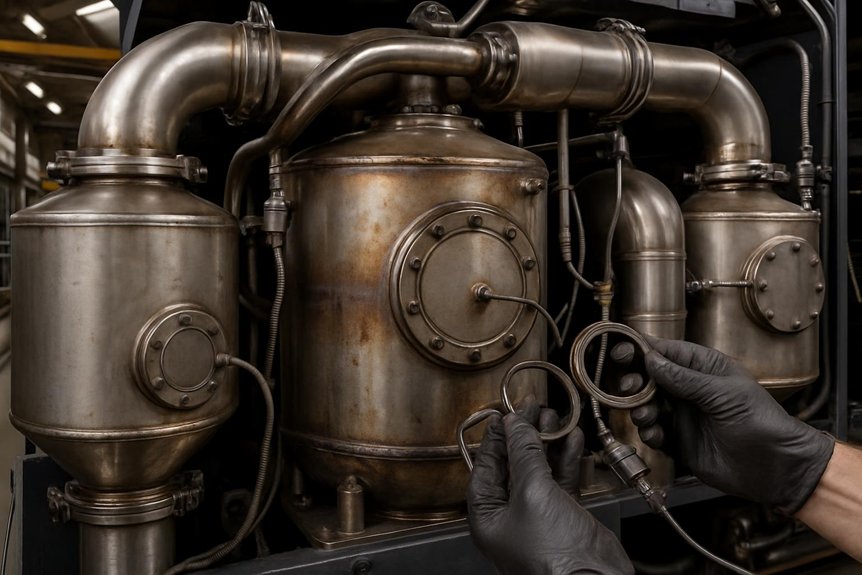
You’ll find the DOC at the front of the EMD F125 aftertreatment system, where it oxidizes hydrocarbons and carbon monoxide. You need clear inspection intervals because soot, oil ash, and thermal stress can reduce catalyst performance. When the DOC plugs, cracks, or loses activity, you risk derates, higher emissions, and costly downtime.
Role of the DOC in Locomotive Emissions Control
Convert carbon monoxide and unburned hydrocarbons early, and the DOC protects the rest of the EMD F125 aftertreatment system. You use this catalyst to oxidize CO into CO2 and burn hydrocarbons left after combustion. That cleaner exhaust reduces odor, visible smoke, and catalyst contamination downstream.
The DOC also supports DPF regeneration. As exhaust passes through, oxidation reactions raise temperature, helping burn soot when locomotive duty cycles allow it. That heat matters in commuter service, where variable load cycles and long idling can keep exhaust temperatures low. You can’t treat the DOC as a standalone part. Its performance affects diesel particulate filter maintenance for passenger locomotives, SCR efficiency, and emissions reliability. When DOC conversion drops, soot loading rises, regeneration weakens, and downtime risk increases quickly for your fleet.
DOC Maintenance Intervals and Inspection Practices
Typically, you should align DOC inspections with A- or B-level locomotive services, depending on fleet duty cycle and OEM guidance. For the EMD F125 aftertreatment system, you’ll usually confirm housing integrity, mounting security, and exhaust joint condition during scheduled service.
You should look for external damage, soot staining, loose insulation, and signs of thermal cracking. Check temperature trends across the DOC, then compare them with historical data. Use exhaust back-pressure readings to infer restriction before it affects downstream DPF loading or selective catalytic reduction on tier 4 locomotives.
Don’t rely only on visual checks. Review event logs, sensor trends, and recent regeneration behavior. If data shifts unexpectedly, escalate inspection before the next interval. This approach helps you protect emissions compliance, reduce downtime, and plan parts support with confidence.
Common DOC Failure Modes and Their Impact
A failing DOC rarely stays isolated for long on an F125. You’ll see its impact across the EMD F125 aftertreatment system, especially upstream of DPF regeneration. Sulfur, lube ash, coolant, or fuel contaminants can poison the catalyst washcoat. That reduces oxidation efficiency and leaves more hydrocarbons for downstream components.
Face plugging raises exhaust back pressure and can trigger fuel penalties during commuter duty. Thermal sintering from excessive exhaust temperatures reduces active surface area. Cracked substrates can shed material, disturb flow, and accelerate DPF loading.
You may notice poor passive regeneration, rising differential pressure, nuisance alarms, or emissions exceedances. Don’t treat those symptoms as sensor noise. Verify fuel and lube quality, inspect exhaust leaks, review temperature history, and borescope the DOC before condemning downstream SCR or DPF hardware.
Diesel Particulate Filter (DPF) on the F125
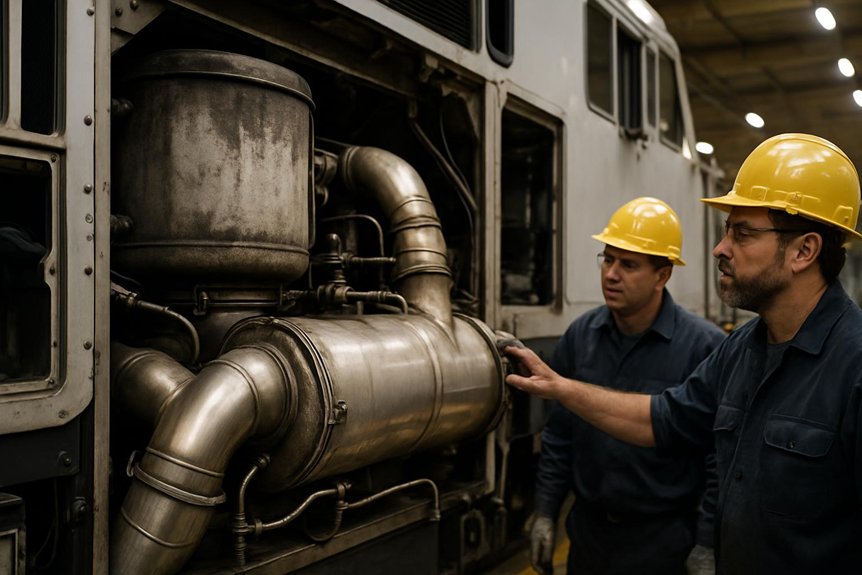
You rely on the DPF to capture soot while ash slowly accumulates in passenger service. You’ll plan cleaning around duty cycle, fuel quality, lube oil control, and pressure trends. You can spot issues early through rising backpressure, frequent regeneration faults, derates, or differential pressure sensor alerts.
How the DPF Handles Soot and Ash in Passenger Service
In passenger service, the F125 DPF traps soot in its porous filter walls while non-combustible ash builds slowly. You rely on the EMD F125 aftertreatment system to burn soot when exhaust temperature supports regeneration.
| Condition | DPF response | Your operational cue |
|---|---|---|
| Fast commuter run | Passive regeneration oxidizes soot | Stable backpressure |
| Long idle | Soot accumulates faster | Watch differential pressure |
| Stop-start duty | Temperatures fluctuate | More soot loading risk |
| High oil carryover | Ash rises | Reduced filter capacity |
Passive regeneration works best on sustained high-speed segments, where heat stays consistent. Active regeneration adds heat when controls detect soot loading above limits. You shouldn’t confuse soot with ash. Soot can burn off, but ash remains from lube additives and engine wear. That difference matters for EMD F125 emissions compliance and reliability.
DPF Cleaning Intervals and Service Planning
Typically, F125 fleets plan DPF ash cleaning around 250,000 to 400,000 miles equivalent, or matched engine-hour limits. You should treat that range as a planning baseline, not a guarantee. The EMD F125 aftertreatment system responds differently across commuter duty cycles, idle time, fuel quality, and oil consumption.
You’ll get better results by tracking DPF differential pressure trends during inspections. Rising pressure drop helps you schedule cleaning before availability suffers. Build service plans around module removal, certified cleaning, inspection, return shipping, and reinstallation windows. These DPF modules are large, so logistics matter as much as shop labor.
For diesel particulate filter maintenance for passenger locomotives, align cleaning with major inspections when possible. You’ll reduce repeat downtime, control spare-module needs, and support EMD F125 emissions compliance and reliability.
DPF Failure Modes and Diagnostic Clues
When DPF problems develop on the F125, they usually show up as airflow, temperature, or pressure abnormalities. You’ll often see the EMD F125 aftertreatment system report rising differential pressure, especially under load. That points to soot or ash plugging, restricted channels, or failed pressure sensing.
You may also see frequent regen commands, longer regen events, or incomplete regeneration. If regeneration runs uncontrolled, excessive heat can melt the substrate. Channel cracking can follow thermal shock, vibration, or uneven soot loading. Gasket leaks create bypass paths, reducing filtration and confusing sensor readings.
Watch for smoke at the stack, aftertreatment fault codes, and power derates. Don’t treat these as nuisance alarms. They protect emissions compliance, fuel economy, and service availability in passenger locomotive duty.
SCR and DEF System on the EMD F125
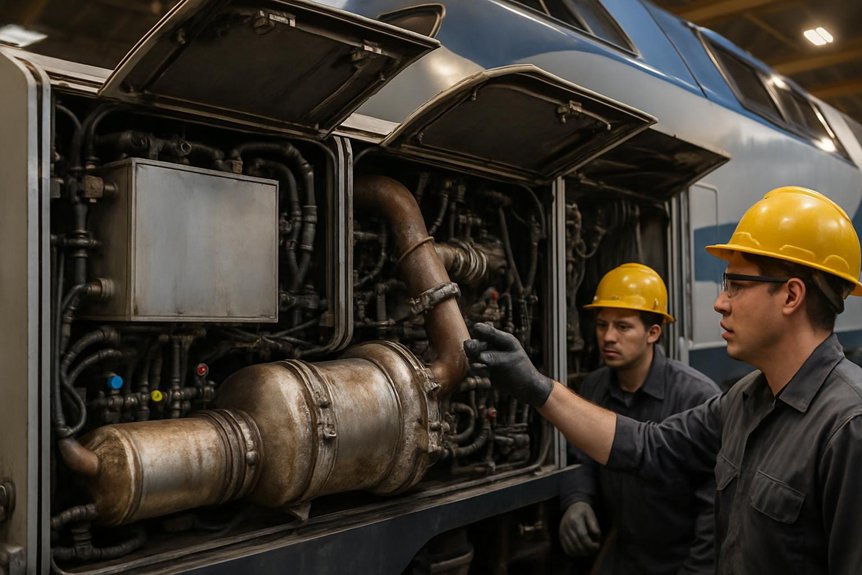
You manage SCR chemistry by dosing DEF into hot exhaust before the catalyst reduces NOx to nitrogen and water. You’ll need clean DEF, sound filtration, accurate sensors, and scheduled nozzle checks to protect emissions compliance. When crystallization, injector coking, NOx sensor drift, or catalyst damage appears, you can face alarms, derates, and downtime.
SCR Chemistry and Layout on Tier 4 Locomotives
Although SCR chemistry is straightforward in principle, the locomotive application demands careful control. In the EMD F125 aftertreatment system, you inject DEF into hot exhaust, where it decomposes into ammonia. That ammonia reacts over SCR catalyst bricks, converting NOx into nitrogen and water.
- You need uniform DEF spray before the catalyst face.
- The injector sits upstream of a mixer for evaporation.
- The mixer promotes ammonia distribution across high exhaust flow.
- Catalyst bricks sit downstream, sized for Tier 4 duty.
- Sensors verify temperature, NOx conversion, and control response.
Because locomotive exhaust paths are long and high-volume, layout matters. Poor mixing creates ammonia slip, deposits, or low NOx conversion. You protect reliability by watching temperature control, dosing accuracy, and catalyst efficiency trends.
DEF Handling, Filtration, and Service Intervals
Because SCR performance depends on clean DEF, your F125 service program should treat DEF as a controlled fluid. For the EMD F125 aftertreatment system, verify DEF concentration, cleanliness, and storage age before filling. Use sealed transfer equipment, dedicated containers, and depot dispensing filters to prevent dust, oil, coolant, or fuel contamination.
You should inspect DEF tanks for sediment, damaged caps, blocked vents, and heater operation during scheduled service. Replace DEF filters at OEM-defined intervals, commonly aligned with periodic locomotive inspections or annual service. In cold yards, confirm tank heaters, heated lines, and thaw logic work before winter service. Purge or drain exposed lines when locomotives sit in freezing conditions. Keep fill points clean, label DEF-only tools, and document batch numbers for traceability.
SCR and DEF Failure Modes in Rail Operation
Clean DEF handling reduces risk, but SCR reliability still depends on heat control, dosing accuracy, and sensor feedback. In the EMD F125 aftertreatment system, small SCR faults can quickly affect locomotive availability and compliance.
- You’ll see injector coking when heat bakes DEF residue onto the dosing nozzle.
- You can get DEF crystallization after shutdowns, leaks, or poor purge performance.
- Frozen DEF lines may block dosing during cold starts or winter layovers.
- Catalyst degradation reduces NOx conversion and raises emissions fault frequency.
- NOx sensor drift, level sensor failures, or wiring faults can mislead controls.
When the control system can’t verify NOx reduction, it may log faults, limit speed, or enforce derates under Tier 4 rules. You reduce risk with inspections, sensor checks, and disciplined troubleshooting.
Reliability, Procurement, and Best Practices for F125 Fleets
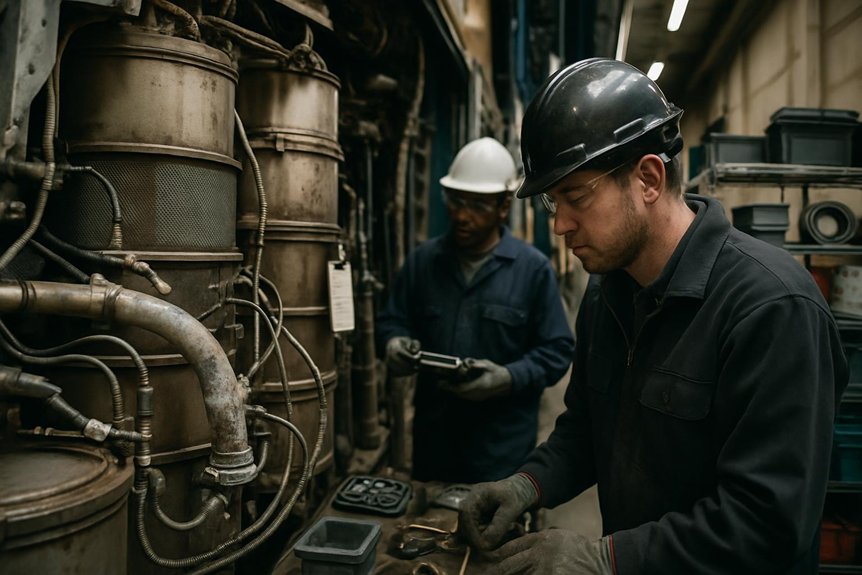
You can protect the EMD F125 aftertreatment system by tracking sensor trends, fault codes, and DPF pressure data. You’ll reduce downtime when you align spares, warranties, and vendor support before failures occur. You extend DOC, DPF, and SCR life through clean DEF handling, proper fuel quality, and stable operating practices.
Data‑Driven Maintenance and Condition Monitoring
A data-driven maintenance program helps F125 fleets shift from fixed intervals to condition-based decisions. You can protect the EMD F125 aftertreatment system by trending exhaust back-pressure, temperature, and NOx sensor data.
- Track DPF differential pressure to spot soot loading before derates occur.
- Compare inlet and outlet temperatures across DOC, DPF, and SCR sections.
- Monitor NOx conversion efficiency to confirm selective catalytic reduction performance.
- Use onboard diagnostics with remote monitoring to prioritize locomotive shop visits.
- Review fault-code history against duty cycle, fuel quality, and lube consumption.
You’ll reduce unnecessary inspections when readings stay stable. You’ll also catch sensor drift, DEF dosing issues, or rising restriction earlier. That gives rail engineers clearer maintenance triggers and helps procurement specialists plan service without guessing.
Spares, Warranties, and Vendor Coordination
Effective spares planning protects F125 availability when aftertreatment faults appear between scheduled shop windows. You should stock DPF cartridges, differential pressure sensors, NOx sensors, temperature sensors, DEF pumps, filters, injectors, and dosing lines by failure criticality. For the EMD F125 aftertreatment system, sensor gaps often cause faster service impacts than catalyst failures.
Align stock levels with lead times, fleet size, warranty coverage, and overhaul cadence. You’ll reduce risk when you document approved DPF cleaning vendors, cleaning limits, and inspection records. Warranty terms may require OEM-approved parts, calibrated sensors, and traceable service history. Aftermarket options can lower cost, but you must verify emissions compliance, fit, materials, and support. Mikura International helps you coordinate qualified parts sourcing, documentation, and vendor communication without compromising reliability.
Operational Practices to Extend Aftertreatment Life
Parts planning protects availability, but daily operating discipline protects component life. You extend the EMD F125 aftertreatment system by controlling heat, soot, ash, and contamination.
- Load the engine enough to maintain exhaust temperature and support passive regeneration.
- Minimize unnecessary idling, since cool exhaust accelerates DPF soot loading and SCR deposits.
- Use specified ultra-low-sulfur fuel, and verify suppliers meet locomotive fuel cleanliness requirements.
- Choose approved low-ash lube oil, because excess ash shortens diesel particulate filter maintenance intervals.
- Train crews and technicians to act quickly on DEF, NOx, temperature, and differential-pressure alarms.
You can’t eliminate every fault, especially in commuter duty cycles. Still, consistent operating discipline reduces plugging, regen issues, nuisance derates, and unscheduled downtime. Mikura International supports that discipline with dependable parts planning and technical guidance.
Frequently Asked Questions
How Does Altitude Affect EMD F125 Aftertreatment Performance?
Altitude lowers air density, so you get less oxygen for combustion and hotter exhaust management challenges. On the EMD F125 aftertreatment system, that can increase soot loading, affect DPF regeneration, and change SCR NOx conversion efficiency. You’ll need calibration that accounts for elevation, clean sensors, proper DEF dosing, and verified turbocharger performance. Don’t ignore altitude-related derates; they protect catalysts, control emissions, and prevent costly passenger locomotive downtime in service.
Can Aftertreatment Faults Affect Passenger Train Schedule Recovery?
Yes, aftertreatment faults can directly hurt schedule recovery. You may lose horsepower when the EMD F125 aftertreatment system triggers derates from DPF restriction, SCR faults, DEF issues, or sensor failures. That slows acceleration after station stops and limits recovery margins. You’ll also face alarms, troubleshooting delays, or locomotive swaps. To protect schedules, you should trend pressures, NOx data, DEF quality, and fault codes before issues become service disruptions.
What Data Should Procurement Teams Request From Aftertreatment Suppliers?
Ask suppliers for lifecycle data that separates wheat from chaff. You’ll want EMD F125 aftertreatment system duty-cycle assumptions, DPF ash capacity, cleaning intervals, SCR conversion efficiency, DEF consumption, sensor calibration limits, fault-code logic, warranty exclusions, and documented failure rates. Request locomotive-specific test evidence, not generic engine claims. You should also ask for lead times, rebuild options, core policies, technical support scope, and parts traceability to protect uptime and budgets.
How Should Stored F125 Locomotives Protect Aftertreatment Components?
You should protect stored F125 locomotives by keeping exhaust paths sealed, DEF drained or stabilized, and batteries maintained for controls. Don’t let moisture enter DOC, DPF, or SCR housings. Run approved periodic start-ups only when exhaust temperatures reach regeneration thresholds. Inspect NOx sensors, pressure lines, and wiring before return to service. You’ll reduce crystallization, corrosion, substrate cracking, and nuisance derates by following OEM storage procedures and documenting conditions.
Are Remanufactured Sensors Suitable for EMD F125 Emissions Systems?
Yes, you can use remanufactured sensors on the EMD F125 aftertreatment system if they meet OEM calibration, response-time, and durability requirements. You shouldn’t treat NOx, temperature, or differential-pressure sensors as generic parts. Validate serial traceability, bench-test results, connector integrity, and warranty coverage before installation. Poor reman quality can trigger false faults, DEF dosing errors, DPF regeneration issues, derates, and emissions noncompliance. Mikura International helps you source reliable, tested locomotive sensor solutions.