

Why Performance Testing Is Critical
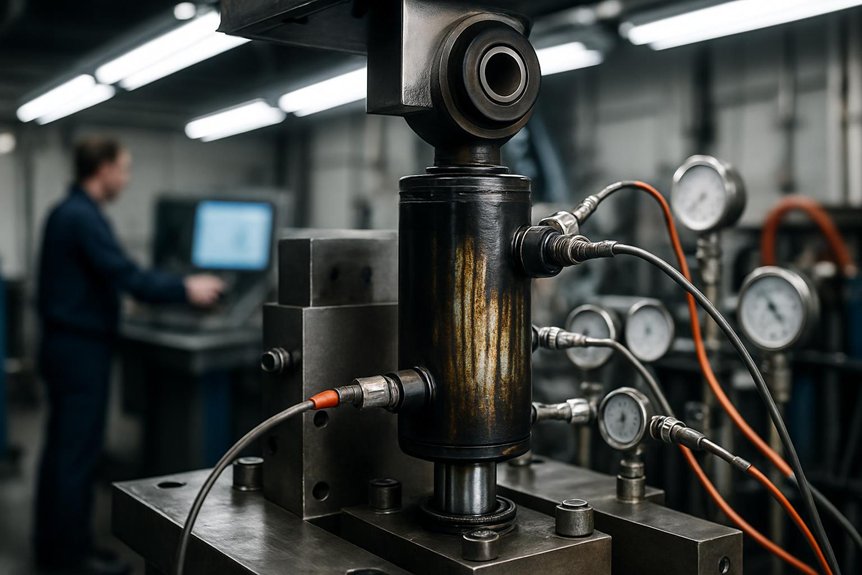
A locomotive’s damper assembly absorbs forces that would otherwise destabilize the entire chassis. You need verification to confirm each unit withstands repeated shock loads without degrading. Test repeatability matters because inconsistent results mask early warning signs of wear. Your measurement instrumentation must capture microsecond-level pressure changes during dynamic loading cycles. Precise sensors reveal damping inconsistencies before they escalate into chassis instability. Quality assurance protocols catch manufacturing defects that visual inspection alone can’t detect.
Rigorous testing ensures every damper meets specified force-displacement curves under variable conditions. Compliance validation confirms assemblies satisfy railway safety standards before deployment. You can’t rely on assumptions when passenger safety depends on consistent damping performance. Engineers who skip thorough testing risk premature failures during high-speed operation. Procurement teams should demand documented test data, not just supplier claims. Every verified damper reduces derailment risk and extends maintenance intervals greatly. Thorough testing protects both rolling stock integrity and operational schedules across rail networks.
Types of Performance Tests Conducted
You’ll rely on several standardized tests to validate damper performance under real-world conditions. Each test isolates specific mechanical properties, from load-bearing capacity to long-term fatigue resistance. Engineers use these results to predict failure modes before they occur in service.
Load Testing
Since damper assemblies absorb ongoing mechanical stress, load testing forms the basis of performance evaluation. You’ll begin by configuring the suspension setup to replicate actual bogie conditions accurately. Instrumentation calibration ensures every sensor captures precise force and displacement data. Load cell selection matters, since capacity mismatches distort readings under peak static loads. Engineers then apply incremental static loads to observe damper deflection and hysteresis behavior. Dynamic loads follow, simulating track irregularities and coupling shocks at varying frequencies. Test fixture alignment prevents lateral forces from skewing damping response results. Environmental conditioning subjects units to temperature extremes before repeating load cycles. This sequence reveals stiffness variations, fluid degradation, and seal fatigue early. You’ll gain dependable data for validating damper durability before deployment.
Damping Coefficient Testing
Damping coefficient testing quantifies the force–velocity relationship inherent to each damper’s design. You’ll apply controlled displacement cycles across multiple velocity ranges to capture accurate data. An instrumented switchover between compression and rebound phases reveals critical performance shifts. Rebound characteristics show how quickly the damper returns to neutral position. Temperature sensitivity affects fluid viscosity, so you’ll test across varying thermal conditions. Hysteresis behavior indicates energy dissipation efficiency within each cycle. You’ll plot force against velocity to verify compliance with design specifications. Deviations from expected curves often signal internal wear or seal degradation. Corrosion resistance testing ensures damper housings withstand harsh rail environments reliably. Combined results validate whether assemblies meet OEM specifications under real operating conditions consistently.
Vibration and Frequency Response Testing
How does a damper assembly perform under sustained track-induced oscillations? You’ll subject the unit to a frequency sweep across defined bandwidths. Engineers replicate real-world conditions using a validated track model. This model captures irregularities found in actual rail geometry. Resonance mapping identifies critical frequencies where amplification risks occur. Vibration benchmarking establishes acceptable performance thresholds for each damper variant.
| Test Parameter | Measured Output |
|---|---|
| Frequency Range | 5–150 Hz |
| Peak Resonance Point | Amplitude ratio |
| Damping Consistency | Phase lag deviation |
| Tuning Adjustment | Stiffness correction factor |
Tuning procedures refine damper response once resonance points get flagged. You’ll calibrate stiffness and damping coefficients until output aligns with benchmarks. Precision here prevents premature fatigue failures downstream.
Endurance/Fatigue Testing
Endurance testing extends this analysis beyond frequency response into long-term durability. You’ll run damper assemblies through millions of load cycles, simulating years of locomotive service. Strain gauge monitoring tracks stress concentrations across critical mounting points and seal interfaces throughout testing. Engineers analyze damping hysteresis curves to detect performance degradation as cycles accumulate. Thermal cycling introduces temperature extremes, replicating real-world operating conditions from cold starts to sustained high-load runs. Seal material aging becomes evident as elastomers lose elasticity under repeated compression and heat exposure. Corrosion resistance gets validated through cyclic exposure to moisture and contaminants common in rail environments. Procurement specialists rely on this data to predict maintenance intervals accurately. Your damper assemblies must withstand this rigorous protocol before deployment across demanding locomotive fleets.
Common Failure Modes in Damper Assemblies
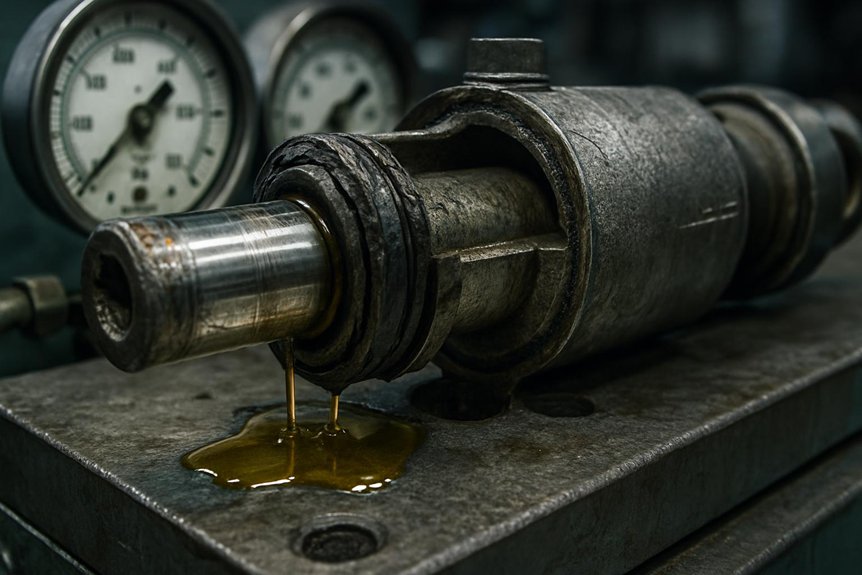
Damper assemblies endure extreme thermal and mechanical stress during locomotive operation. You’ll encounter three primary failure modes when analyzing performance data: fluid leakage, reduced damping efficiency, and structural fatigue. Each mode demands distinct diagnostic approaches and directly impacts locomotive safety margins.
Fluid Leakage and Seal Failure
Three main factors cause fluid leakage in locomotive damper assemblies: wear, pressure fluctuation, and temperature extremes. Seal material aging accelerates once elastomers lose elasticity under thermal cycling. Cavitation damage forms when localized pressure drops create vapor bubbles inside the fluid. These bubbles collapse violently, eroding seal surfaces and internal components. Contamination ingress introduces abrasive particles that scratch sealing lips and damage housings. Pressure relief malfunctions often trigger excessive internal pressure, forcing fluid past worn seals. Air entrapment effects reduce damping efficiency while increasing seal stress during compression cycles. You’ll notice these failure mechanisms compound rapidly once initiated.
| Failure Cause | Primary Effect | Detection Method |
|---|---|---|
| Wear | Seal degradation | Visual inspection |
| Pressure fluctuation | Fluid bypass | Pressure testing |
| Temperature extremes | Material embrittlement | Thermal imaging |
| Contamination ingress | Surface scoring | Fluid analysis |
Engineers must monitor these indicators to prevent catastrophic seal failure. Routine inspections combined with data analysis extend damper assembly service life importantly. Precision testing methods matter most.
Reduced Damping Efficiency Over Time
Once internal components begin wearing, damping efficiency drops gradually but steadily. You’ll notice internal stiction developing as friction surfaces roughen over repeated cycles. Seal degradation follows, letting fine contaminants breach the damper’s internal chambers. Valving clogging then restricts fluid flow, disrupting the piston’s precise response curve. Oil contamination accelerates this decline, thickening or thinning the working fluid unpredictably. Spring wear compounds these issues, reducing preload and altering force distribution across strokes. You’ll detect these shifts through inconsistent damping curves during dynamometer testing. Rail engineers should track force-velocity data across service intervals for early detection. Procurement teams must specify wear-resistant materials to extend damper service life materially.
Structural Fatigue and Cracking
Because locomotive dampers endure millions of load cycles across their service life, structural fatigue becomes inevitable. You’ll notice fatigue crack growth typically initiates at points of stress concentration, such as mounting brackets or weld joints. Repeated tension-compression cycles accelerate microscopic crack propagation until visible fracture lines appear. Mean stress effects compound this risk, especially under asymmetric loading conditions common in freight operations. Engineers rely on fracture surface inspection to determine crack origin, propagation direction, and failure mechanism.
You should also apply S-N curve interpretation to predict remaining fatigue life under specific stress amplitudes. This data helps you set safe inspection intervals before cracks reach critical length. Without rigorous fatigue analysis, dampers risk catastrophic failure during operation, compromising both safety and reliability across rail networks.
Root Cause Analysis Approach
When a damper fails in service, guesswork won’t identify the actual cause. You need root cause mapping to trace the failure path systematically. Inspection comes first, revealing visible failure evidence like seal wear or fluid leakage. Testing follows, verifying performance against baseline specifications under load. Engineers apply diagnostic sequencing to isolate variables and narrow contributing factors. This data driven triage separates primary causes from secondary symptoms quickly.
| Step | Focus Area |
|---|---|
| Visual Inspection | Surface cracks, leaks, corrosion |
| Functional Testing | Damping force, response time |
| Data Comparison | Deviation from spec thresholds |
| Corrective Actions | Material, design, or process fixes |
Rail engineers benefit from this structured sequence, avoiding assumptions that waste time. Procurement teams gain clarity on which components need replacement versus redesign. Consistent documentation at each stage strengthens future failure investigations across fleets. Precision here reduces recurring damper issues and unplanned locomotive downtime significantly.
How Testing Data Improves Design
Test benches generate more than pass or fail results for locomotive dampers. You capture waveforms, thermal signatures, and load spectra that reveal design weaknesses. Test instrumentation calibration guarantees every data point reflects true damper behavior. Engineers then compare recorded outputs against theoretical predictions through response model validation. Discrepancies highlight where analytical assumptions diverge from real-world performance.
You use these gaps to guide manufacturing tolerance review across critical components. Seals, pistons, and valve orifices often need tighter tolerances after such analysis. Data driven parameter tuning follows, adjusting damping coefficients and spring rates for best response. This step transforms raw numbers into actionable design improvements.
Design verification planning closes the loop by confirming updated components meet performance targets. You schedule follow-up tests to validate every refinement under service-representative conditions. Each iteration strengthens damper reliability while reducing failure risks. This structured feedback cycle keeps designs grounded in verified, real-world data.
Conclusion: Ensuring Reliability Through Rigorous Testing
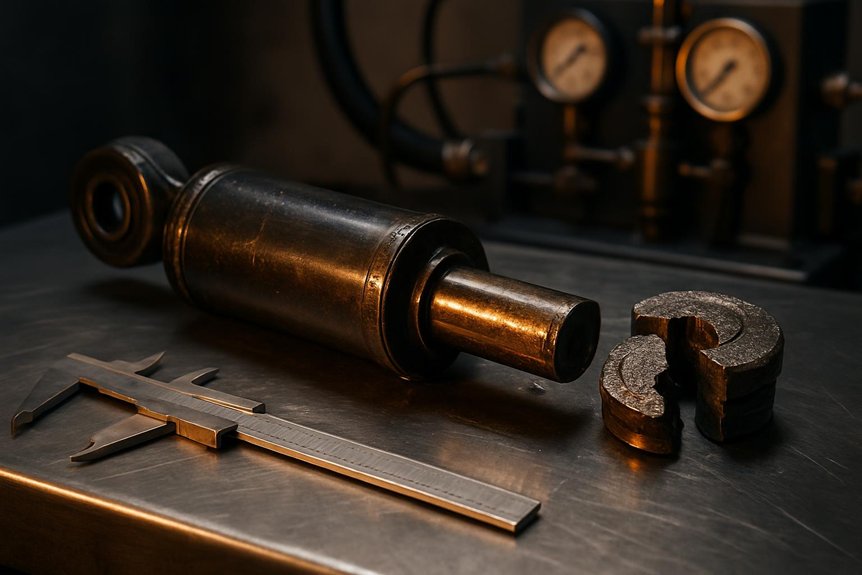
Rigorous testing protocols separate reliable locomotive dampers from liability-prone components. You need prototype validation at every design iteration to catch failure modes early. Acceptance criteria must align with compliance standards before you approve any damper assembly for service. Measurement instrumentation determines whether your test data holds engineering value. Precision instruments capture stress, displacement, and thermal loads accurately across operating cycles.
Reliability engineering principles guide you toward predictive failure analysis rather than reactive fixes. You can’t afford dampers that fail unpredictably in harsh rail environments. Systematic testing reveals weaknesses that visual inspection alone misses entirely. Locomotive operators depend on dampers that perform consistently across millions of cycles.
Your procurement decisions should prioritize suppliers who validate performance through thorough testing regimes. Mikura International applies these principles to deliver dampers engineered for durability. Every component you source should meet documented acceptance thresholds. Testing isn’t optional; it’s the foundation of dependable locomotive performance you can trust.
Frequently Asked Questions
What Certifications Should Damper Assembly Suppliers Provide?
You should request material compliance certificates verifying alloy and elastomer specifications. Ask for test certificates confirming damping force and endurance parameters. Quality management system certifications, like ISO 9001, demonstrate manufacturing consistency. Traceability records must link each damper assembly to raw material batches. You’ll also need warranty documentation outlining coverage terms and failure liability. These certifications collectively validate performance claims and support long-term reliability in service.
How Often Should Dampers Be Replaced in Service?
You’ll set replacement intervals using fleet history and documented failure data, not fixed calendars. Inspection frequency should increase under harsh service conditions like heavy grades or extreme temperatures. You’re looking for end of life criteria such as seal leakage, damping force degradation, or internal wear beyond tolerance. Don’t wait for complete failure—proactive swaps based on measurable performance decline protect locomotive ride stability and reduce unplanned downtime across your fleet.
Can Dampers Be Retrofitted Across Different Locomotive Models?
Yes, you can retrofit dampers, but you’ll first verify Retrofit Compatibility across platforms. Mounting Interfaces frequently differ between Vehicle Variants, so bracket geometry and bolt patterns must align precisely. You’ll also confirm the damper’s Load Envelope matches your locomotive’s suspension demands and axle loading. Electronic units require Software Validation to ensure control logic integrates with existing onboard systems. Skipping these checks risks premature failure or inconsistent damping response.
Does Ambient Temperature Affect Damper Storage Requirements?
Yes, ambient variability directly impacts storage stability for damper assemblies. You’ll notice thermal cycling accelerates seal deterioration when temperatures fluctuate beyond specified limits. Humidity effects compound this risk, promoting corrosion on precision-machined components. You should maintain storage environments within manufacturer-specified boundaries to prevent premature wear. Packaging guidance recommends sealed, moisture-resistant enclosures with desiccants for extended storage durations. Following these protocols consistently ensures dampers retain performance integrity before installation, guaranteeing reliability.
Which Industry Standards Govern Damper Assembly Procurement?
Standards act as the backbone holding your damper assemblies upright. EN 13749 and UIC 517 anchor your Railway Procurement decisions. You’ll find Contract Requirements referencing ISO 9001 for quality management. Quality Audits verify Supplier Compliance against these benchmarks rigorously. Documentation Standards demand traceable material certificates and test reports. You can’t skip AAR M-1003 if you’re sourcing internationally. These frameworks don’t just guide you—they protect your fleet’s reliability.