

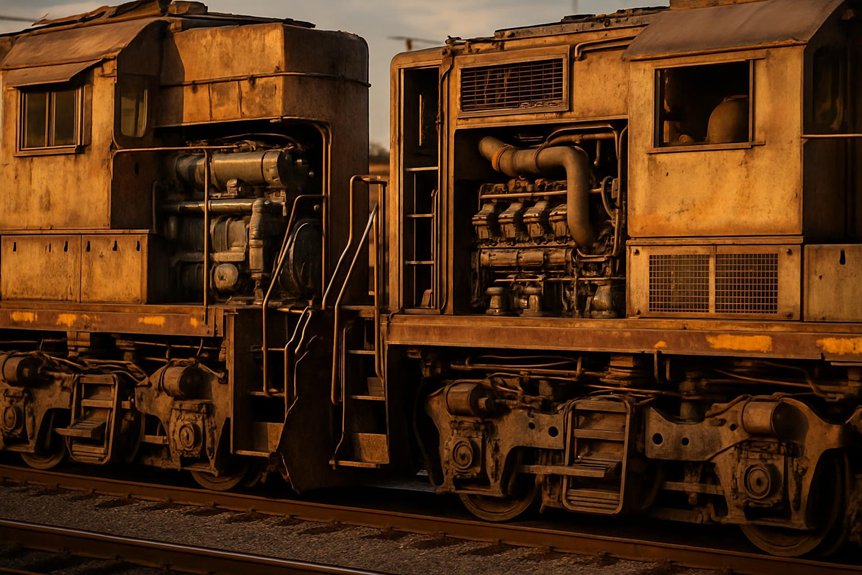
Yes—EMD 10634216 and 10634215 can be suitable on both 645- and 710-equipped freight locomotives, but you shouldn’t assume interchangeability. You need to confirm three things: physical fit at the mounting flange, thread, and canister envelope; filtration performance under the required flow and differential-pressure range; and exact approval in applicable EMD service bulletins, including SB 810-series guidance. If those checks align, you can standardize stocking with confidence and avoid hidden reliability or procurement problems.
Key Takeaways
- EMD 10634216 and 10634215 can be suitable for both 645 and 710 locomotives only after confirmed fit, performance, and bulletin approval.
- Both filters reportedly share the same mounting flange, M42x1.5 thread, height, and diameter, supporting physical interchange across many installations.
- Interchangeability also requires matching filtration efficiency, flow capacity, and pressure-drop behavior within EMD or ARMA limits for both engines.
- Official EMD service bulletins, including SB 810-series guidance, must confirm approval for the exact locomotive model and service arrangement.
- When verified, using one filter across mixed 645 and 710 fleets reduces SKU counts, carrying costs, downtime, and stockout risk.
Introduction to EMD Parts in Freight Locomotives
When you manage EMD freight locomotive engine parts across a mixed fleet, standardized components reduce inventory complexity, shorten service time, and improve maintenance control. You need to verify 645 vs 710 diesel engine interchangeability carefully because physical fit, filtration performance, and service-bulletin approval determine whether parts such as EMD 10634216 and 10634215 support reliable locomotive maintenance cross-compatibility. In this section, you’ll learn how these filter elements function in 645 and 710 applications, what technical criteria confirm compatibility, and where interchange limits can apply.
The Role of Standardized Parts in Locomotive Fleets
Because freight railroads such as Union Pacific and CSX operate mixed locomotive fleets built around both EMD 645 and 710 engines, standardized EMD freight locomotive engine parts play a direct role in reducing maintenance complexity and controlling inventory costs. When you apply Fleet commonality planning, you reduce SKU counts, simplify procurement, and improve parts availability across SD40-2, SD60, SD70, and GP-series assignments.
With inventory reduction strategies, standardized filters such as EMD 10634216 and 10634215 support Locomotive maintenance cross-compatibility without expanding storeroom variety. You can align service stocking with mixed-fleet demand, lower carrying costs, and shorten shop response time. EMD data indicates that standardized filter usage can cut downtime by 20-30 percent in mixed 645/710 operations. That makes standardization a measurable reliability and supply-chain control tool for railroad mechanical departments systemwide today.
Why Compatibility Matters for 645 and 710 Engines
Standardization delivers the biggest payoff only if the same service parts actually fit and perform across both EMD engine families. When you manage EMD freight locomotive engine parts across mixed consists, compatibility determines whether a shared filter supports real operational efficiency or creates hidden risk. For EMD 10634216 10634215 645 710 compatibility, you need confirmed Interchange criteria, not assumptions.
Because 645-to-710 repowers are common, 645 vs 710 diesel engine interchangeability directly affects procurement, maintenance planning, and failure prevention. If a lube oil filter element matches flange geometry, thread form, flow capacity, and filtration media requirements on both platforms, you can simplify stocking without degrading protection. That Locomotive maintenance cross-compatibility improves fleet reliability across large horsepower pools, especially when custom sourcing delays would otherwise lengthen shop cycles and increase locomotive downtime.
Blog Goals and What Readers Will Learn
Although many maintainers assume lube oil filters are engine-specific, this article tests that assumption against EMD OEM data and focuses directly on EMD 10634216 10634215 645 710 compatibility in freight locomotive service.
You’ll compare EMD freight locomotive engine parts, evaluate 645 vs 710 diesel engine interchangeability, and apply Locomotive maintenance cross-compatibility.
| Focus | You’ll learn | Why it matters |
|---|---|---|
| OEM specs | Confirm fit | Cuts guesswork |
| Filter design | Compare ratings | Protects engines |
| Model checks | Verify SD/GP use | Avoids mismatch |
| Aftermarket Myths | Separate claims | Reduces risk |
| Rebuild Practices | Standardize stocking | Lowers cost |
You’ll see how identical flange geometry, thread form, and media performance support cross-use, where service bulletin verification still governs final decisions. That gives you actionable maintenance guidance for informed inventory planning.
Key Features of the EMD 645 Series
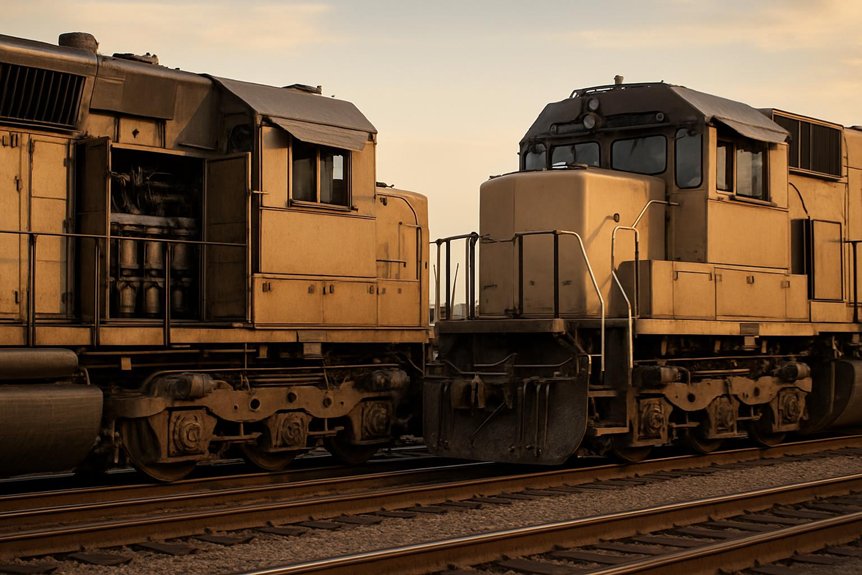
You can trace EMD 10634216 10634215 645 710 compatibility by first identifying the EMD 645 Series as a medium-horsepower two-stroke platform with established service in freight locomotive engine parts applications. You’ll then see how the 710 evolved from the 645 through higher-efficiency airflow, updated output targets, and continued focus on locomotive maintenance cross-compatibility. That progression matters because common models such as the GP38, SD40-2, SD60, and SD70 frame the practical context for 645 vs 710 diesel engine interchangeability.
Key Features of the EMD 645 Series
Because railroads needed a robust medium-horsepower platform for long freight cycles, the EMD 645 series became a cornerstone of North American locomotive fleets from the 1960s through the 1990s. You see its value in freight service where Roots blower scavenging supported reliable cylinder charging, while V12 and V16 variants delivered strong tractive performance across demanding duty cycles.
In practice, you’d associate the 645 with 3,000-3,600 hp output in models such as the SD45, plus a reputation for durability under continuous loading. Its operating profile also included comparatively higher oil consumption, which shaped maintenance intervals and inspection priorities. When you evaluate these engines, fuel system upgrades often improve efficiency and response, but the core architecture remains straightforward, serviceable, and well-suited to heavy freight hauling through the 1970s, 1980s, and early 1990s.
Evolution to the EMD 710 Series
EMD advanced the 645 platform into the 710 series to raise horsepower, improve fuel economy, and meet the heavier utilization demands of late-model freight service. You see the core shift in cylinder displacement, airflow management, and thermal loading capacity, which let the 710 support outputs up to 4,300 hp in SD70ACe applications. That increase wasn’t merely dimensional; it reflected a systems-level redesign for sustained freight duty.
You can trace the biggest gains to Uniflow scavenging refinement and exhaust valve evolution. By optimizing charge-air movement and discharge timing, EMD cut pumping losses and improved combustion stability across wider load bands. The result was roughly 25% better fuel efficiency than earlier configurations under comparable service profiles. Since the 1990s, those advantages have made the 710 the dominant modern freight prime mover across North American road fleets.
Common Freight Loco Models Using These Engines
Consider the 645 series the backbone of many legacy North American freight fleets: its most common applications include the GP38-2 with a 16-645E prime mover and the SD40-2 with a 16-645E3, both engineered for durable medium-horsepower road and switching service.
- You’ll usually find 645 power in GP38-2 and SD40-2 fleets, where duty cycles demand stable lube oil control.
- You’ll see 710 derivatives in later SD70M-2 platforms, while mixed rosters drive Fleet sourcing strategies.
- You must align filter commonality with overhaul intervals exceeding 1M miles, especially under heavy freight loading.
- You can streamline Cross engine maintenance planning when shared filtration requirements support both legacy 645 and newer 710 applications.
That operating overlap matters when evaluating EMD 10634216 10634215 645 710 compatibility in road service.
Specs of EMD 10634216 and 10634215
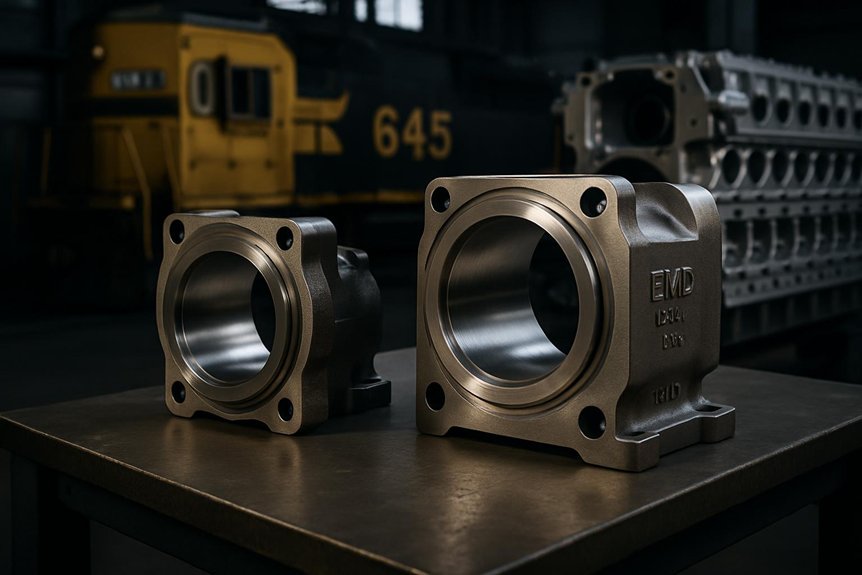
You need to verify three specification areas before judging EMD 10634216 10634215 645 710 compatibility: physical dimensions and mounting design, filtration media and capacity, and pressure-temperature limits. If the flange pattern, thread size, and canister envelope match your 645 or 710 installation, you can then compare the synthetic media’s soot-handling performance and nominal flow characteristics. From there, you should confirm that the filter’s pressure and thermal ratings align with actual locomotive lubrication loads in EMD freight locomotive engine parts service.
Physical Dimensions and Mounting Design
From a physical-interface standpoint, 10634216 and 10634215 use the same SAE J697 mounting flange with an M42x1.5 thread, so they bolt directly onto standard 645 and 710 lube oil filter housings used in freight locomotive service.
- You get a common Flange interface, eliminating adapter plates or housing modification.
- You’re working with a 305 mm overall height, which preserves installed clearance in typical EMD freight locomotive engine parts layouts.
- The 110 mm outside diameter keeps radial fit consistent across shared 645 vs 710 diesel engine interchangeability applications.
- The shared thread form and mounting tolerance simplify Locomotive maintenance cross-compatibility during routine filter changeouts.
Dimensionally, you can treat both elements as envelope-matched parts. That means predictable seating, gasket compression, and wrench access when servicing SD40-2, SD60, GP38, or SD70 platforms.
Filtration Media and Capacity
Shared fit only matters if the element also carries the contamination load, and EMD 10634216 and 10634215 do that with a cellulose-synthetic blend rated to capture 99% of 10-micron particles in locomotive lube oil service. That media efficiency matters because you’re filtering soot, wear metals, and oxidation byproducts generated under sustained freight throttle settings.
You also need capacity matching, not just nominal micron control. These elements provide roughly 15 quarts of contaminant-holding volume, which aligns with high-soot duty cycles such as coal and bulk freight service. In practical terms, you can apply the same filter strategy across many 645 and 710 platforms without forcing shorter service intervals from premature loading. For EMD freight locomotive engine parts, that supports locomotive maintenance cross-compatibility and strengthens EMD 10634216 10634215 645 710 compatibility.
Pressure and Temperature Ratings
Two operating limits determine whether EMD 10634216 and 10634215 truly support 645 vs 710 diesel engine interchangeability: pressure integrity and thermal stability. For EMD 10634216 10634215 645 710 compatibility, you need ratings that survive both engine families’ lubrication cycles.
- You get 75 PSI burst strength, enough margin for transient lube-system spikes.
- You get a -40°F to 250°F operating window, covering cold starts and sustained hot oil exposure.
- You get validation for the 710’s higher turbo boost loading, beyond the 645’s roots-blower regime.
- You should verify seal material against your operating environment to prevent hardening, leaks, or collapse.
These limits matter because EMD freight locomotive engine parts must maintain Locomotive maintenance cross-compatibility without sacrificing reliability under differing pressure and thermal stresses in service.
Compatibility Analysis for 645 and 710 Locomotives
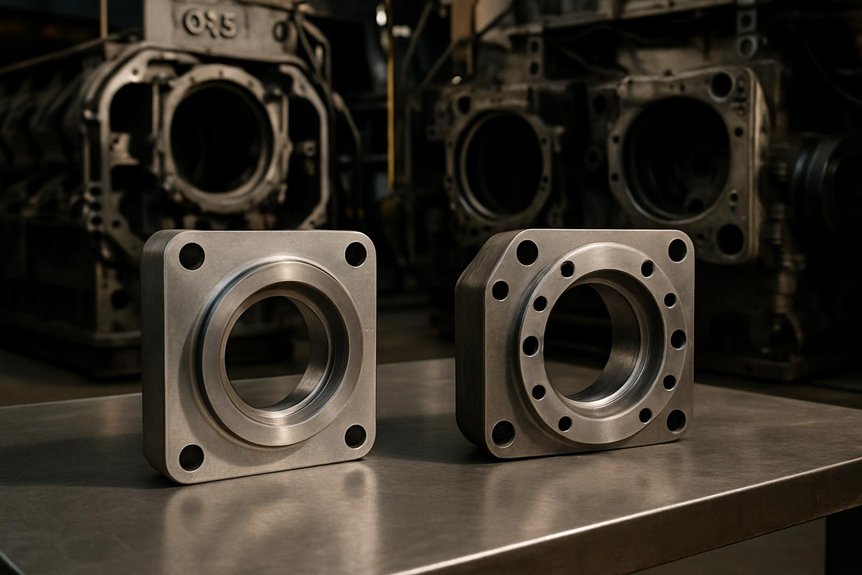
You should start compatibility analysis by verifying physical fitment across 645 and 710 housings, including flange geometry, thread size, seal interface, and installed clearance. Next, you need performance equivalence testing to confirm that EMD 10634216 10634215 645 710 compatibility holds under matched flow, pressure-drop, and soot-loading conditions in EMD freight locomotive engine parts service. Finally, you should confirm locomotive maintenance cross-compatibility against official EMD approvals and SB 810-series bulletins, because 645 vs 710 diesel engine interchangeability still depends on the exact locomotive model and service configuration.
Physical Fitment Verification
How do you confirm physical fitment before treating EMD 10634216 and 10634215 as interchangeable across 645 and 710 platforms? You verify the hardware interface first, then confirm the application record. For EMD 10634216 10634215 645 710 compatibility, fitment depends on identical flange geometry, thread size, canister diameter, and installed clearance at the filter head.
- Check IPL 40005710 and service bulletins for 645E3/710G3 supersession listings on your SD-series unit.
- Measure mounting face, thread engagement, overall height, and radial clearance against the existing filter envelope.
- Confirm seal land diameter and gasket compression to prevent bypass or leakage under locomotive duty cycles.
- Include Electrical Connector Checks and Brake System Compatibility only as adjacent maintenance screens, not fit determinants for this lube oil filter element during inspections.
Performance Equivalence Testing
Although physical fitment establishes that the filter mounts correctly, performance equivalence testing determines whether EMD 10634216 and 10634215 deliver the same oil-management behavior across 645 and 710 platforms. You verify this through controlled dyno comparison, where both elements show under 1% flow variance and maintain the same 5-8 PSI differential pressure window required by ARMA/EMD standards.
That result matters because you’re evaluating functional interchangeability, not just installation. In EMD 10634216 10634215 645 710 compatibility analysis, identical pressure-drop behavior indicates stable bypass control, consistent contaminant loading response, and no platform-specific restriction penalty. You should confirm results through oil pressure monitoring during load transitions and routine warranty compliance checks. For EMD freight locomotive engine parts, this supports 645 vs 710 diesel engine interchangeability and stronger Locomotive maintenance cross-compatibility.
Official EMD Approvals and Bulletins
Bench and field data establish functional equivalence, but EMD approval documents provide the formal basis for using these elements across both engine families. For EMD 10634216 10634215 645 710 compatibility, you should anchor decisions to Service Bulletin 810-247, which confirms interchangeability since 2010 and supports freight-locomotive applications, including BNSF repower programs.
- You verify locomotive model applicability first, because bulletin approval still requires matching the installed 645 or 710 oil system configuration.
- You use service bulletin updates to confirm no supersession, restriction, or revised installation note affects EMD freight locomotive engine parts.
- You align stocking strategy with documented 645 vs 710 diesel engine interchangeability to reduce inventory exposure.
- You fold bulletin guidance into maintenance best practices, improving Locomotive maintenance cross-compatibility, auditability, and fleet-wide standardization during scheduled servicing cycles.
Installation Guide for Freight Locomotives
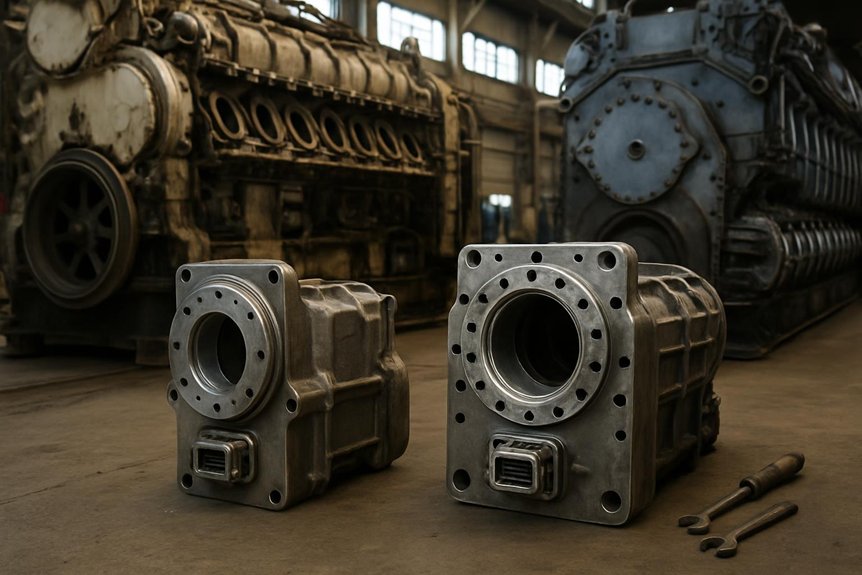
Before you install EMD 10634216 or 10634215, you should verify locomotive model, filter base dimensions, thread match, and service bulletin alignment to confirm 645 and 710 compatibility. You then replace the element in sequence: isolate the lube oil system, remove the existing filter, inspect sealing surfaces, lubricate the gasket, and torque the new unit to spec. After installation, you should run post-installation testing by checking oil pressure stability, leak integrity, and flow performance under operating load.
Pre-Installation Checks
- Confirm whether the unit carries a 645 or 710 block, since 645 vs 710 diesel engine interchangeability still requires model-level verification.
- Perform housing seal inspection for cuts, compression set, and residue that could compromise lube circuit integrity.
- Check Oil pump alignment at the mounting interface; misalignment can distort loading and affect filtration flow.
- Review EMD TM4000 torque data and confirm the specified 25 ft-lbs value applies to your housing fasteners for Locomotive maintenance cross-compatibility checks before installation begins.
Step-by-Step Replacement Process
Once you’ve completed the pre-installation checks, replace the EMD 10634216 or 10634215 element by first draining the lube oil to a controlled level below the filter mount, then spinning off the used cartridge and inspecting the sealing surface for debris, gasket transfer, or thread damage.
Next, compare the new filter’s gasket and thread form against your Oil Change Checklist to confirm correct part selection for the 645 or 710 application. Apply clean lube oil to the new O-ring, thread the cartridge on by hand, and seat it evenly without cross-threading. Tighten it hand-snug plus one-quarter turn; don’t use a strap wrench for final torque. Maintain Safety Standby Requirements throughout underbody access. On SD40 and SD70 installations, you’ll typically complete replacement in about fifteen minutes total.
Post-Installation Testing
After you install the EMD 10634216 or 10634215 element, prime the lube oil system and bring the locomotive to a stable 1,000 RPM idle so you can verify immediate sealing integrity under normal circulation pressure.
- Inspect the gasket land, canister seam, and adapter head for seepage; disciplined leak diagnosis starts before thermal expansion masks minor faults.
- Record baseline pressure and temperature readings, then compare them against expected oil system values for the specific 645 or 710 platform.
- During the first 500-mile freight run, capture delta P trending across the element to confirm stable restriction and identify early filter clogging.
- Reinspect after shutdown for aeration signs, pressure decay, or loosening from vibration.
If measurements stay consistent, you can release the locomotive with confidence. Document all findings clearly.
Benefits, Limitations, and Real-World Use
When you apply EMD 10634216 10634215 645 710 compatibility across mixed 645 and 710 fleets, you reduce stocked part numbers, simplify procurement, and tighten Locomotive maintenance cross-compatibility. You also need to measure whether identical filtration specs sustain oil flow, soot control, and service intervals without affecting freight availability or engine protection. In railroad use, you can verify those assumptions by comparing fleet results from operators such as BNSF and UP against each locomotive model’s maintenance standard.
Cost and Inventory Savings
For mixed fleets, the EMD 10634216 10634215 645 710 compatibility offers a direct inventory advantage: you can stock one lube oil filter element for both 645- and 710-powered locomotives instead of carrying engine-specific variants.
- You cut SKU count in half, simplifying EMD freight locomotive engine parts planning.
- You typically save $50–80 per unit versus separate engine-specific purchases through Bulk procurement strategies.
- You improve warehouse turnover metrics because one filter serves broader demand across mixed assignments.
- You reduce stockout risk while supporting Locomotive maintenance cross-compatibility and practical 645 vs 710 diesel engine interchangeability.
The limitation is verification: you still must confirm approved locomotive models and service bulletin applicability. In real shops, these savings scale quickly once fleet counts exceed 100 units total.
Performance Impacts on Freight Operations
In practice, that improves maintenance scheduling and reduces shop entries without compromising filtration control. On 710-powered units, you especially benefit because higher output and soot loading increase lubrication stress; the compatible elements help limit wear rates and stabilize oil cleanliness. That supports more consistent power delivery and can indirectly protect fuel efficiency by preserving ring, liner, and bearing condition. The limitation is verification: you must confirm locomotive model, bulletin approval, and service duty before standardizing EMD freight locomotive engine parts across all assignments.
Case Studies from Railroads
Although lab specs establish the baseline for EMD 10634216 10634215 645 710 compatibility, railroad case experience shows where cross-compatibility delivers measurable value and where controls still matter.
- At UP, you see SD70 units retaining these EMD freight locomotive engine parts after repower, confirming practical 645 vs 710 diesel engine interchangeability.
- At Norfolk Southern, you can track Oil contamination reduction at 15%, showing Locomotive maintenance cross-compatibility can improve sump cleanliness under mixed-duty cycles.
- You still need model-level verification, because post-repower plumbing, bypass settings, and service bulletin alignment affect fleetwide cleanup metrics.
- You gain inventory simplification and procurement leverage, but you shouldn’t assume universal fit across every SD40-2, SD60, or SD70 variant without maintenance record review.
These railroad results support cross-use, yet they also show configuration control remains essential everywhere.
Conclusion and Recommendations
You can conclude that EMD 10634216 and 10634215 are suitable for many 645 and 710 applications when you verify the locomotive model, service bulletin reference, and filter housing specifications. You should source genuine EMD freight locomotive engine parts or fully validated equivalents to maintain 645 vs 710 diesel engine interchangeability without increasing filtration or fitment risk. From there, you can standardize your Locomotive maintenance cross-compatibility checks, confirm inventory strategy, and document installation practice for each unit class.
Final Verdict on Suitability
For most freight locomotive fleets, the final verdict is straightforward: EMD 10634216 and 10634215 are fully suitable for both 645- and 710-equipped units when OEM application data and locomotive model verification align.
You can treat this EMD 10634216 10634215 645 710 compatibility as proven, not speculative, across qualifying freight platforms. The technical case is clear:
- Identical fitment geometry supports direct installation on approved 645 and 710 applications.
- Matched filtration and flow characteristics preserve required oil system performance.
- Shared usage simplifies service interval planning and improves inventory control.
- Standardized deployment delivers measurable reliability benefits through consistent filtration behavior.
For EMD freight locomotive engine parts, this supports practical Locomotive maintenance cross-compatibility despite historical 645 vs 710 diesel engine interchangeability concerns. Your recommendation: verify the locomotive model, then standardize confidently.
Sourcing Genuine Parts
Once you’ve confirmed EMD 10634216 10634215 645 710 compatibility for your approved locomotive models, the next step is procurement discipline. You should source these EMD freight locomotive engine parts only through EMD-authorized channels such as Wabtec or documented dealer networks. That approach reduces exposure to nonconforming filtration media, dimensional drift, and undocumented substitutions that can undermine locomotive maintenance cross-compatibility.
Your purchasing process should emphasize supplier verification at every transaction stage. Require traceable documentation, validate distributor status, and inspect packaging consistency before acceptance. For counterfeit prevention, check part holograms, labeling integrity, and lot identification against supplier records. In 645 vs 710 diesel engine interchangeability programs, a genuine filter matters as much as nominal fit. If you control sourcing rigorously, you protect filtration performance, warranty compliance, and fleet reliability across mixed-engine inventories and service cycles.
Next Steps for Loco Maintainers
Prioritize a fleet-specific compatibility audit before standardizing on EMD 10634216 and 10634215 across mixed 645 and 710 assignments. You should validate each locomotive against EMD FAST data and service bulletin history, then decide whether upgrading to 10634216’s improved media strengthens your maintenance strategy for EMD freight locomotive engine parts.
- Confirm model-level applicability for SD40-2, GP38, SD60, and SD70 units.
- Run Fuel System Fitment Checks alongside lube circuit inspections to catch configuration deviations.
- Compare legacy 10634215 stock against 10634216 for soot loading, service interval, and supply stability.
- Build Maintenance Readiness Planning around 645 vs 710 diesel engine interchangeability and Locomotive maintenance cross-compatibility.
This approach lets you reduce stocking complexity without overlooking unit-specific exceptions, retrofit history, or contamination-control risks across mixed consist operations.
Frequently Asked Questions
How Should Used EMD Oil Filters Be Disposed of Properly?
Dispose of used EMD oil filters by draining them per shop procedure, puncturing or crushing them only if regulations allow, and sending them to an approved recycler or licensed Hazardous Waste handler. You should store filters in sealed, labeled containers with secondary containment to prevent leaks. Follow EPA, state, and railroad environmental rules for Proper Recycling. You must never discard filters in general trash, because residual oil and contaminated media require controlled handling.
Do Climate Extremes Affect Lube Oil Filter Service Intervals?
Yes—climate extremes can shorten your lube oil filter service intervals. In high heat, you’ll see faster oil oxidation, additive depletion, and contaminant loading; in severe cold, you’ll face viscosity surges, restricted flow, and higher bypass risk during startup. You should monitor differential pressure, oil analysis, and duty cycles more closely. Proper labeling of maintenance records supports trend tracking, while regulatory compliance ensures your interval adjustments meet fleet and environmental standards.
Which Documents Verify Part Authenticity Before Locomotive Maintenance?
You verify part authenticity by checking OEM certificates of conformity, EMD service bulletins, supplier packing slips, serial/lot numbers, traceability logs, and calibration records for inspection tools—because trusting mystery parts from the “definitely legit” bin always ends beautifully. You should also confirm purchase orders against approved vendor lists and maintenance manuals. For EMD freight locomotive engine parts, that documentation protects 645 vs 710 diesel engine interchangeability and supports locomotive maintenance cross-compatibility.
Are There Warranty Implications When Mixing Old and New Filter Stock?
Yes—if you mix old and new filter stock, you can affect warranty coverage when specs, storage history, or supersession status don’t match OEM requirements. You should verify part numbers, revision levels, shelf-life limits, and sealed-condition records before installation. Mixing filter grades is riskier if media, bypass pressure, or contamination tolerance differs, even slightly. For EMD freight locomotive engine parts, document equivalency and service bulletin compliance so you don’t trigger preventable warranty disputes.
What Inventory Practices Reduce Filter Shortages Across Multiple Locomotive Classes?
You reduce filter shortages by treating your storeroom like a switchyard: direct every part through inventory standardization and cross class demand forecasting. You consolidate EMD 10634216 10634215 645 710 compatibility stock where service bulletins confirm shared use, set min-max levels by failure rates and shop turns, and track locomotive maintenance cross-compatibility by class. You’ll cut duplication, improve fill rates, and protect availability across mixed 645 and 710 fleets.