

You can revolutionize your locomotive’s efficiency by upgrading to advanced DC contactors with bidirectional switching, intelligent arc suppression, and IoT-enabled predictive maintenance. Modern units handle continuous currents exceeding 500 amperes while delivering up to 25% energy cost savings. They support regenerative braking recovery, precise battery charge/discharge management, and real-time contact wear monitoring that eliminates unplanned downtime. The full technical picture — covering arc extinguishing mechanisms, BESS integration, and smart diagnostics — is just ahead.
What are the advancements in energy-saving control strategies for high-power DC contactors to meet the demands of electric and hybrid locomotives?
Modern electric and hybrid locomotives demand revolutionary power management solutions. High-power DC contactors have evolved significantly to meet these challenges. Advanced bidirectional switching technology enables efficient energy distribution. Arc extinguishing chambers now provide superior performance under extreme conditions. These innovations directly reduce operational costs and emissions across rail networks.
Continuous current ratings now exceed 500 amperes in compact designs. Modular configurations offer unprecedented flexibility for battery integration requirements. Energy efficiency improvements reach up to 25 percent in modern systems. Smart monitoring capabilities enable predictive maintenance and real-time diagnostics. Total cost of ownership has decreased substantially through improved reliability.
Key Takeaways
- Modern DC contactors handle continuous currents exceeding 500 amperes, delivering measurable energy efficiency improvements up to 25 percent across locomotive power systems.
- Advanced arc extinguishing chambers use magnetic blowout coils, ceramic plates, and optimized gas flow to minimize energy losses during high-current switching.
- Bidirectional DC contactors support both motor drive acceleration and regenerative braking energy recovery, maximizing overall locomotive energy utilization.
- IoT-embedded smart monitoring tracks contact wear and switching frequency, enabling predictive maintenance that prevents costly operational failures before they occur.
- Integration with battery energy storage systems allows DC contactors to manage high inrush currents and parallel battery module configurations on non-electrified routes.
Understanding DC Contactors in Modern Locomotive Systems
When you manage a modern locomotive’s power systems, DC contactors serve as the critical switching backbone for all energy distribution. You’ll find that contactor technology has evolved dramatically, moving from basic mechanical switches to sophisticated bidirectional switching systems. Understanding this evolution helps you appreciate why energy efficiency in locomotive operations directly impacts both operational costs and emissions performance.
The Evolution of Contactor Technology in Rail Transportation
DC contactors have powered locomotive electrical systems for decades, but they’ve transformed dramatically in recent years.
Traditional series-parallel control systems couldn’t meet modern demands. You’ll notice three critical evolutionary milestones that define today’s high-power DC contactors for electric trains:
- Mechanical-to-electronic shift — Simple switching gave way to precision electronic control systems.
- Current capacity expansion — Modern contactors now handle continuous currents exceeding 500 amperes compactly.
- Bidirectional capability integration — Advanced designs now support regenerative energy recovery efficiently.
These advances directly address energy-saving contactor efficiency requirements for battery trains. Hybrid and electric locomotives demand sophisticated power management that earlier designs couldn’t deliver.
You’re now seeing contactors function as intelligent power distribution devices. They’ve moved far beyond basic mechanical switches into broad energy management solutions.
Critical Role of DC Contactors in Power Distribution
Every locomotive’s power system depends on DC contactors as its central nervous system. They’re not simple on-off switches. Instead, they manage complex power distribution across demanding rail environments.
You’ll find DC contactors for locomotive energy efficiency at every critical power junction. They bridge batteries, generators, and traction systems with precision. They control high currents during acceleration, deceleration, and regenerative braking cycles.
In hybrid locomotives, power flows between multiple energy sources simultaneously. Bidirectional DC switching technology for rail enables smooth management of these complex flows. Your contactor selection directly affects reliability, performance, and operational costs.
Improper contactor selection creates voltage instability and energy waste. It accelerates component degradation across connected systems. Choosing advanced contactors ensures precise current control and optimized energy distribution throughout your locomotive’s entire power architecture.
Why Energy Efficiency Matters in Locomotive Operations
Fuel costs consume a substantially portion of every locomotive operator’s budget. Efficiency improvements directly impact your profitability and sustainability goals. The DOE actively evaluates low-carbon locomotive technologies for widespread adoption.
Modern arc extinguishing chamber innovation in locomotives reduces energy losses significantly. Advanced contactors improve conduction efficiency and thermal management simultaneously.
Here’s how energy efficiency improvements translate to measurable operational benefits:
- Reduced energy losses — Modern contactor systems deliver up to 25 percent efficiency improvements.
- Lower total cost of ownership — Improved reliability extends component lifespan considerably.
- Decarbonization compliance — Efficiency gains directly support rail industry emissions reduction targets.
You’re inherently converting wasted thermal energy into operational savings. Every efficiency percentage point compounds across your entire locomotive fleet.
Arc Extinguishing Technology: The Heart of Modern DC Contactors
When you interrupt high-current DC circuits in locomotives, you create electrical arcs that can damage contacts and reduce system efficiency. You’ll find that advanced arc extinguishing chambers now use magnetic blowout coils, ceramic plates, and optimized gas flow to suppress these arcs rapidly. Modern contact surface materials, including silver-tungsten and copper-chromium alloys, further extend operational lifespan under extreme switching conditions.
Understanding Arc Formation and Extinguishing Challenges
DC arcs don’t extinguish naturally the way AC arcs do. In AC systems, current crosses zero periodically, allowing natural arc extinction. DC current flows continuously, making arc management a critical design challenge for locomotive contactors.
When contacts separate under high current, three damaging effects occur:
- Melting — intense arc heat liquefies contact surface material
- Erosion — repeated arcing gradually removes conductive material
- Oxidation — arc energy chemically degrades contact surfaces
These effects compound over time, eventually causing contact welding or complete failure. You’re dealing with sustained energy that actively resists interruption. The arcing chamber addresses this by physically relocating the arc away from contact surfaces. It then extinguishes the arc through elongation and thermal cooling, protecting your locomotive’s power system integrity.
Advanced Arc Extinguishing Chamber Designs
Modern arc extinguishing chambers tackle one of locomotive power engineering’s most demanding problems. You’ll find these chambers employ multiple contact points that divide high-energy arcs into smaller, manageable segments. Arc runners then guide each divided arc deeper into the chamber’s cooling structure.
Schaltbau’s latest contactor designs integrate precision-engineered cooling fins and metal plates. These components dissipate arc energy rapidly, preventing thermal damage to contact surfaces. This mechanism directly reduces contact erosion during high-current switching events.
You’ll see immediate benefits in extended component lifespan and reduced maintenance intervals. Improved arc management also means less energy lost during each switching cycle. Schaltbau’s modular configurations apply these chamber innovations specifically to rail propulsion and battery-train applications. The result is measurably better system reliability across your locomotive’s entire operational lifecycle.
Material Innovations in Contact Surfaces
Beyond chamber geometry and arc cooling structures, contact surface materials determine how well your contactor survives repeated arcing events.
Modern locomotive contactors use silver-copper alloy contacts. These materials outperform traditional alternatives considerably. Your system benefits from three critical material advantages:
- Arc resistance — Silver-copper alloys withstand thousands of high-ampere switching cycles without structural degradation.
- Oxidation reduction — Advanced surface compositions resist corrosion, maintaining consistent electrical continuity throughout operational lifespan.
- Erosion management — Material selection directly controls arcing energy patterns, minimizing contact wear rates.
Locomotive-grade contactors must handle potentially thousands of amperes reliably. Your contact surfaces must preserve both electrical and mechanical integrity simultaneously. Choosing superior materials reduces maintenance intervals. It also extends overall contactor service life considerably.
Bidirectional Switching and Battery Integration for Hybrid Systems
When you integrate bidirectional DC contactors into hybrid locomotives, you enable seamless current flow in both directions. This capability lets you manage battery charging and discharging cycles without switching between separate components. You can also connect battery energy storage systems (BESS) directly into the locomotive’s power architecture efficiently.
Bidirectional DC Contactor Fundamentals
Bidirectional DC contactors fundamentally redefine how hybrid and battery-electric locomotives manage power flow. Unlike traditional unidirectional contactors, these devices enable current in both directions. You get critical energy management flexibility that conventional designs simply can’t deliver.
Three core capabilities distinguish bidirectional contactors:
- Motor drive power delivery — current flows from the power source to traction motors during acceleration
- Regenerative braking recovery — energy flows back toward battery storage during deceleration
- Battery charge/discharge management — precise switching controls energy exchange between storage systems and traction networks
The Schaltbau C303 series achieves 500-ampere continuous ratings through specialized contact geometries. These mechanical innovations withstand high-current reversal without arc damage. You’re essentially gaining sophisticated energy strategies that unidirectional contactors make impossible.
Battery Charging and Discharging Cycle Management
Managing battery charge and discharge cycles precisely determines locomotive battery longevity. Slim-line DC contactors control these cycles within battery-electric and hybrid locomotives. They integrate directly with battery management systems (BMS) to regulate charging rates and discharge profiles.
Rapid charge-discharge cycling degrades battery state of health (SoH) notably. Your contactor system must therefore prevent aggressive cycling that accelerates capacity loss. Software-controlled switching strategies balance economic optimization against long-term battery preservation.
You’ll find that precise cycle management extends battery service intervals considerably. Contactors enable the BMS to apply controlled charging curves. They also manage discharge depth limits during high-demand traction phases.
This integration directly reduces replacement costs. It lowers total cost of ownership across battery-electric locomotive operations substantially.
Integration with Energy Storage Systems (BESS)
Battery Energy Storage Systems transform how hybrid and battery-electric locomotives manage power distribution. You’ll find contactors serving as critical power management components throughout these systems. They handle high inrush currents during battery connection reliably.
Advanced BESS-grade contactors enable practical deployment on non-electrified routes through three core capabilities:
- Parallel contactor configurations distribute power across multiple battery modules efficiently.
- Overcurrent protection interfaces coordinate with locomotive control systems for cohesive energy management.
- Bidirectional switching manages both charging infrastructure connections and discharge cycles seamlessly.
Your BESS integration depends on contactors that interface precisely with protection systems. Modern designs handle complex switching requirements without compromising reliability. These components create unified energy management platforms connecting batteries, chargers, and locomotive controls. This cohesion directly enables expanded battery-electric locomotive deployment across non-electrified regional routes.
Energy Efficiency Improvements and Performance Metrics
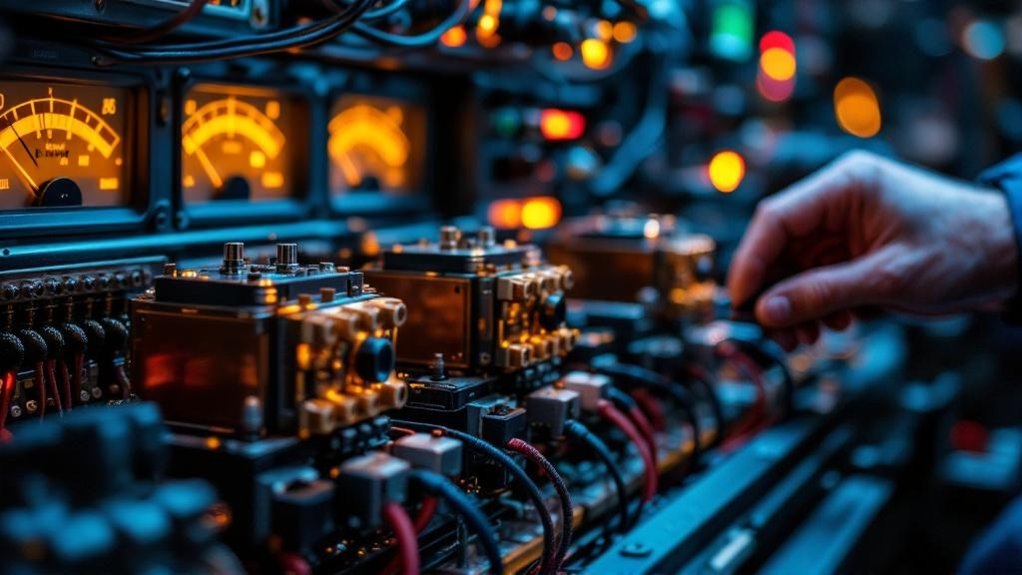
When you upgrade to advanced DC contactors, you gain measurable energy efficiency improvements of up to 25 percent. You’ll notice superior thermal management reduces heat dissipation losses across locomotive power circuits considerably. Comparing these systems against traditional switching technology reveals dramatic performance metric advantages for modern rail operations.
Quantifying Energy Efficiency Gains
Advanced DC contactors consistently deliver measurable energy efficiency gains in modern locomotive systems. You’ll see improvements reaching 25 percent compared to previous-generation designs. Three primary mechanisms drive these gains:
- Reduced conduction losses through lower-resistance contact paths minimize wasted energy during current flow.
- Improved arc suppression eliminates unnecessary energy dissipation during switching operations.
- Optimized thermal management reduces power losses across the contactor’s operational range.
The Schaltbau C303 series demonstrates these principles in practice. It achieves 25 percent energy cost savings through enhanced efficiency and extended component longevity. In battery-electric locomotive applications, these savings directly reduce charging cycle energy consumption. For diesel-hybrid systems, reduced contactor losses translate into lower fuel consumption. Both scenarios deliver significant reductions in total operational expenditure across the locomotive’s service life.
Thermal Management and Heat Dissipation
Energy efficiency gains mean little if heat builds up unchecked inside your contactor. High-current switching inevitably generates heat. Every loss mechanism inside your contactor contributes cumulatively to internal heating. Terminal temperature serves as your most reliable thermal performance indicator.
Excessive heat signals wasted energy directly impacting locomotive efficiency. Advanced contact materials reduce resistive losses markedly. Enhanced heat dissipation paths channel thermal energy away from critical components. Some modern designs integrate active cooling features for extreme operating conditions.
Maintaining terminal temperatures within specified limits protects component longevity. Your maintenance schedules depend heavily on thermal performance data. Predictive maintenance systems continuously monitor terminal temperatures in real time. They optimize contactor replacement intervals before thermal failures occur. This approach prevents unplanned downtime and extends your locomotive’s operational reliability considerably.
Comparative Analysis: DC Contactors vs. Traditional Switching Systems
How much performance separates modern DC contactors from traditional switching systems? The gap is substantial. You’re comparing fundamentally different engineering philosophies for locomotive power management.
Modern electromagnetic contactors outperform resistance-controlled mechanical systems across three critical metrics:
- Continuous current capacity reaches 500+ amperes, versus legacy systems handling under 300 amperes
- Inrush current tolerance extends to 5,000 amperes, enabling aggressive locomotive acceleration cycles
- Rated insulation voltage achieves 1,500 volts, supporting next-generation battery-electric locomotive architectures
These improvements deliver 25% operational efficiency gains. You’ll also notice reduced maintenance intervals and lower total cost of ownership. Bidirectional switching capability eliminates unidirectional contact limitations entirely. Traditional systems simply can’t support regenerative braking energy recovery at modern locomotive performance standards.
Smart Monitoring, Predictive Maintenance, and Digitalization
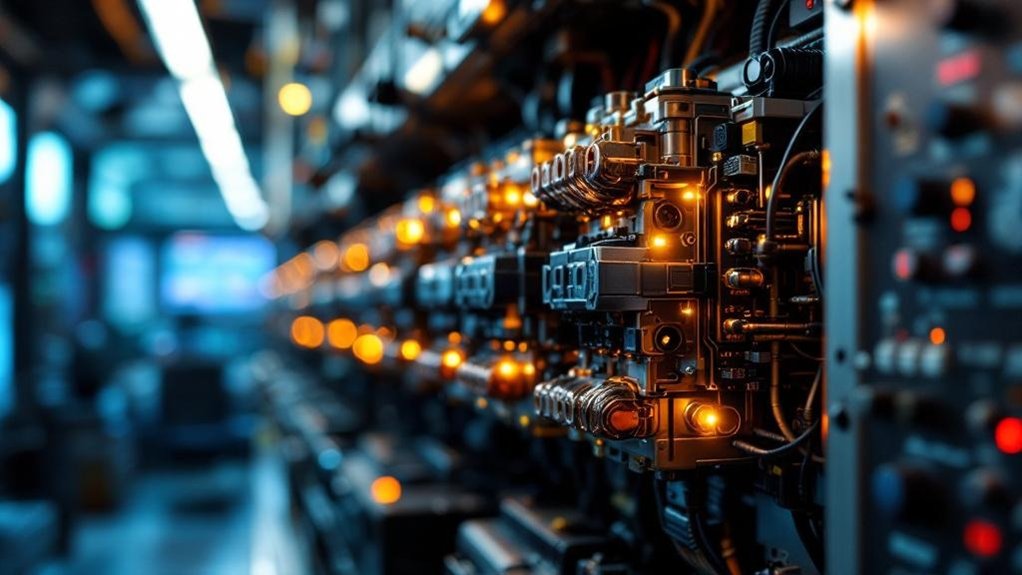
Modern DC contactors now embed IoT sensors that stream real-time operational data to centralized monitoring platforms. You can track contact wear, coil temperature, and switching frequency across your entire locomotive fleet simultaneously. This continuous data flow enables early fault detection before failures disrupt rail operations.
IoT-Enabled Diagnostic Capabilities in Modern Contactors
Smart monitoring has transformed how engineers manage DC contactors in locomotive power systems. You can now access real-time contactor health data through integrated IoT sensors. These systems deliver actionable insights that prevent costly failures before they occur.
Modern IoT-enabled contactors provide three critical diagnostic functions:
- Continuous arc energy measurement — tracking cumulative contact wear across every switching cycle
- Thermal performance monitoring — detecting abnormal heat patterns that signal insulation degradation
- Contact resistance trending — identifying early-stage erosion before it compromises switching reliability
You’ll receive diagnostic alerts directly through locomotive management systems. This integration eliminates manual inspection guesswork entirely. Next-generation contactors transmit performance data to centralized maintenance platforms. Your maintenance teams can then schedule interventions precisely, reducing unplanned downtime meaningfully. Real-time visibility ultimately extends contactor service life across demanding rail operations.
Frequently Asked Questions
What Global Certifications Are Required for Locomotive DC Contactors?
Just as railway tracks must align perfectly for safe travel, your DC contactors must align with global certifications for compliant operation.
You’ll need IEC 63438 certification as your primary standard. Additionally, you must secure EN 50155 for railway electronics compliance. UL certification covers North American deployments. Your components also require CE marking for European markets. DNV certification validates performance under extreme operational conditions.
How Do Extreme Weather Conditions Affect Contactor Performance in Locomotives?
Extreme weather conditions directly impact your DC contactor’s performance in locomotives. In freezing temperatures, contact mechanisms stiffen, increasing switching delays. High humidity accelerates oxidation on contact surfaces. Desert heat reduces arc-extinguishing efficiency considerably. You’ll notice insulation degradation in tropical climates. Modern contactors use sealed housings and thermal-resistant materials. They maintain stable operation between -40°C and +70°C, ensuring reliable locomotive power management across all environments.
What Is the Typical Lifespan of DC Contactors in Heavy-Haul Locomotives?
In heavy-haul locomotives, you’ll typically see DC contactors lasting 8 to 15 years under standard operating conditions. Your contactor’s lifespan depends heavily on switching frequency and load intensity. High-cycle applications can reduce this to 5 to 8 years. Modern arc extinguishing chambers *greatly* extend contact surface life. You’ll maximize longevity through predictive maintenance monitoring, proper current rating selection, and consistent thermal management protocols throughout operation.
How Do DC Contactors Differ Between Freight and Passenger Locomotive Applications?
Freight and passenger locomotive DC contactors differ markedly in their design priorities.
You’ll find freight contactors handle higher continuous current ratings, often exceeding 500A. They prioritize durability under sustained heavy loads.
Passenger locomotive contactors emphasize rapid switching cycles and regenerative braking compatibility. They support frequent acceleration and deceleration patterns.
Freight applications demand robust arc extinguishing chambers. Passenger systems require superior thermal management for consistent performance during high-frequency switching operations.
Can Existing Older Locomotives Be Retrofitted With Advanced DC Contactor Systems?
“You can’t teach an old dog new tricks” — but you *can* retrofit older locomotives. Yes, you can upgrade aging locomotive power systems with advanced DC contactor systems. Modern modular designs accommodate space-constrained installations effectively. You’ll need to assess existing wiring, current ratings, and arc extinguishing compatibility first. Bidirectional switching technology integrates smoothly into retrofitted configurations. Energy efficiency improvements of up to 25% become achievable, reducing your operational costs notably.