

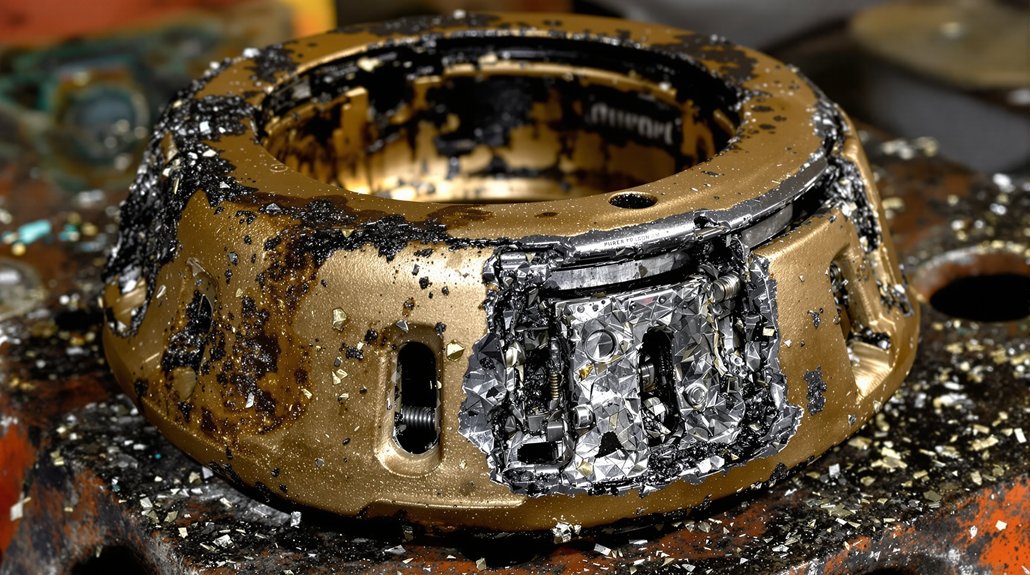
Your locomotive camshaft bearings fail prematurely due to oil starvation (causing over 60% of failures), installation errors creating misaligned oil holes, and excessive thermal stress from high-performance operations. Contamination introduces abrasive particles that destroy bearing surfaces within minutes, while mechanical misalignment accounts for 12.6% of failures through bore distortion and improper clearances. Heavy-duty overloading compounds these issues, preventing adequate cooling and accelerating material fatigue that systematically compromises bearing integrity before reaching designed service intervals.
Key Takeaways
- Oil starvation from pump failures, blocked passages, or misaligned oil holes causes over 60% of premature bearing failures.
- Installation errors like flipped bearing halves and misaligned oil holes block lubrication and create stress concentrations.
- Mechanical misalignment and bore distortion prevent proper oil film formation and create uneven load distribution.
- Contaminated oil loses protective properties, leading to metal-on-metal contact that destroys bearings within minutes.
- Debris particles as small as 10 microns from contaminated assembly procedures cause catastrophic surface damage immediately.
Lubrication System Breakdowns That Destroy Camshaft Bearings
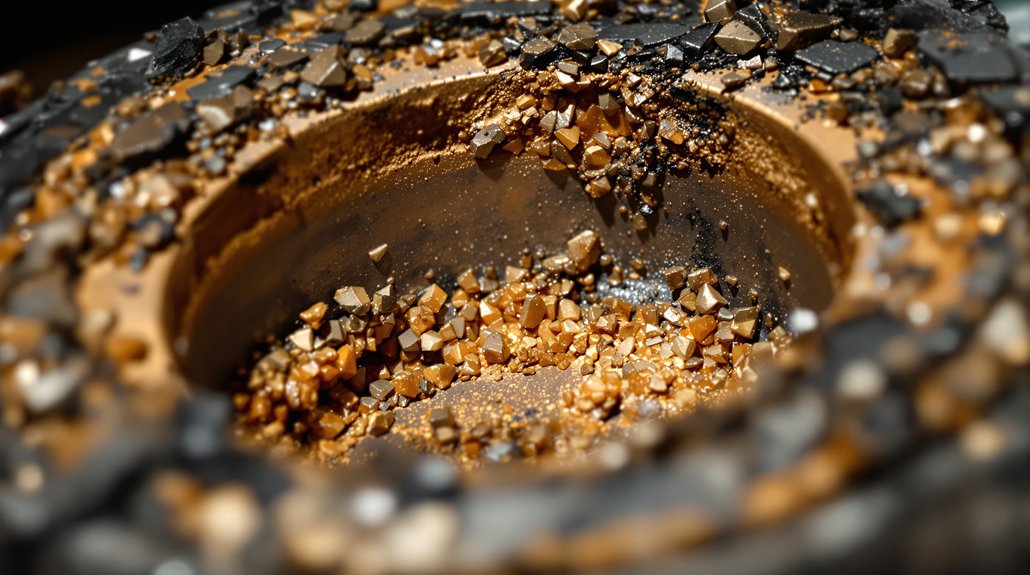
Beyond mechanical stress and manufacturing defects, lubrication system breakdowns represent the primary destroyer of locomotive camshaft bearings, with oil starvation alone accounting for over 60% of premature bearing failures in diesel engine applications.
You’ll encounter several critical failure modes that systematically destroy bearing integrity. Oil pump malfunctions and pressure relief valve failures prevent adequate circulation, while pump cavitation reduces effective oil delivery to bearing surfaces. Dry starts without pre-lubrication systems expose bearings to immediate metal-to-metal contact damage.
Your engine’s oil delivery system becomes compromised when suction screens block or filters clog, restricting flow rates under operating loads. Blocked oil passages from misassembled components prevent proper lubrication flow to critical surfaces. Oversized bearing bores create excess clearance that allows harmful camshaft movement and reduces effective lubrication support. When oil film breaks down between bearing and journal, you’ll see distress starting at the bearing center and progressing outward, ultimately causing wiping action and hot short failure.
Installation Errors That Lead to Bearing Failure
You’ll encounter bearing failures when installation procedures compromise critical alignment specifications and contamination control protocols. Misaligned oil holes block lubrication passages by up to 50%, while improper bearing orientation creates stress concentrations that exceed material limits within 200 operating hours. Contaminated assembly procedures introduce abrasive particles that accelerate wear rates and prevent proper oil film formation between camshaft journals and bearing surfaces. Incorrect bearing size results in poor fit and excessive camshaft movement that compromises the structural integrity of the entire bearing system.
Misaligned Oil Holes
Installation errors can wipe out even the highest-quality locomotive bearings when oil holes don’t align properly between the bearing and engine block. You’ll see catastrophic lubrication failure when oil hole orientation prevents adequate flow to camshaft journals during operation. Misaligned passages create localized overheating that extends from bearing journals onto the camshaft itself, while bearing overlay mismatch compounds the problem by disrupting oil distribution patterns.
Partial blockage reduces oil volume reaching critical bearing surfaces, and complete blockage eliminates lubrication entirely. You’ll notice bearing journal discoloration indicating insufficient lubrication from blocked passages. The increased friction accelerates bearing wear exponentially, creating uneven wear patterns that signal distortion. Excessive clearance space allows camshaft movement, reducing lubrication and support while contributing to bearing journal damage. Precise alignment during installation avoids these failures and guarantees proper camshaft lubrication throughout operation.
Improper Bearing Orientation
When locomotive camshaft bearings aren’t oriented correctly during installation, you’re setting up a cascade of failures that’ll destroy even premium bearing materials within hours of operation. Incorrect orientation disrupts the critical oil film formation between bearing and journal surfaces, creating metal-to-metal contact that generates excessive heat and wear particles.
Flipped halves represent the most catastrophic orientation error you’ll encounter. When bearing shells are reversed, oil holes misalign with housing passages, starving lubrication systems and preventing proper oil distribution. This misalignment also affects bearing crush specifications, reducing the interference fit that maintains bearing stability under dynamic loads. You’ll observe accelerated journal scoring, bearing material transfer, and complete lubrication breakdown when orientation errors compromise the hydrodynamic lubrication envelope essential for camshaft bearing longevity. These installation errors often result from over-tightened bearing caps, which compound the orientation problems by creating uneven stress distribution across bearing surfaces.
Contaminated Assembly Procedures
Contaminated assembly procedures destroy locomotive camshaft bearings faster than any other installation error, with debris particles as small as 10 microns creating catastrophic surface damage within the first operating cycle. You’ll compromise bearing integrity when compressed air blowing pushes contaminants deeper into surfaces instead of removing them. Assembly airflow systems must maintain positive pressure while filtering particles to prevent contamination introduction.
Tooling contamination transfers metal particles directly onto bearing journals during installation. You’re creating abrasive conditions when dirt embeds in bearing material, causing immediate surface scoring. Blocked oil passages result from misaligned holes during improper installation, preventing lubrication flow. Impact guns distort bearing housings, affecting oil film thickness. You’ll guarantee bearing longevity by implementing thorough cleaning protocols, proper torque specifications, and contamination-free assembly environments.
Contaminated oil immediately loses its ability to provide adequate lubrication protection, leading to metal-on-metal contact that destroys bearing surfaces within minutes of operation.
Mechanical Misalignment and Structural Support Defects
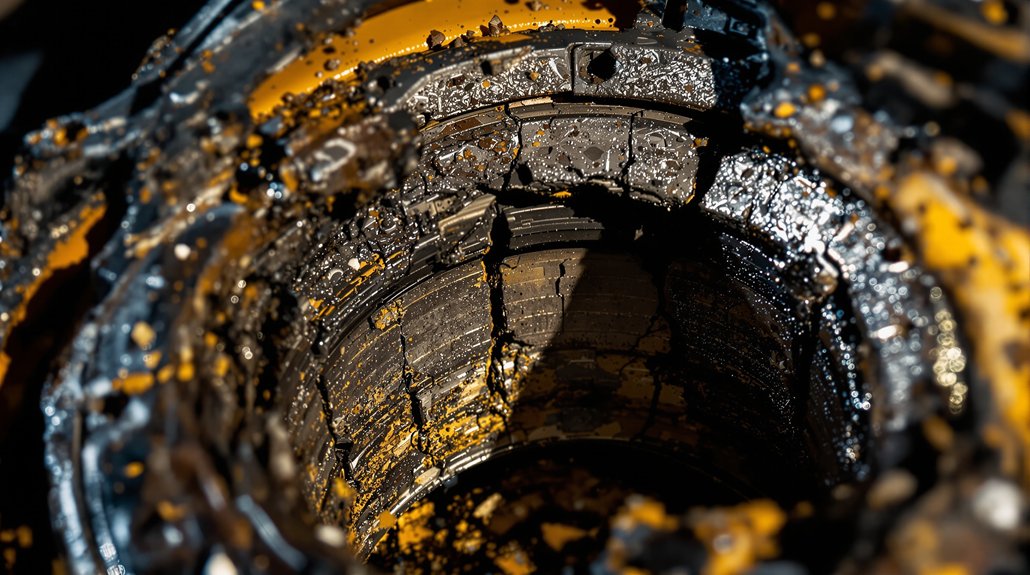
When you’re diagnosing camshaft bearing failures, you’ll find that mechanical misalignment creates direct friction damage that accounts for 12.6% of premature failures across engine applications. Your bearing bore distortion prevents adequate oil film formation between surfaces, while camshaft support misalignment blocks critical lubrication passages and generates excessive heat buildup. These structural defects compromise load distribution across bearing surfaces, creating the foundation for accelerated wear patterns that’ll ultimately destroy your locomotive’s camshaft system. The babbitt overlay construction used in many cam bearings lacks the tri-metal design found in rod and main bearings, making them more susceptible to delamination under mechanical stress.
Bearing Bore Distortion
Beyond surface contamination issues, bearing bore distortion represents one of the most complex failure mechanisms affecting locomotive camshaft systems. You’ll encounter progressive block deformation that allows camshafts to gradually adapt before complete failure occurs. When bearing housing bores become undersize, oversize, or out-of-round, they create immediate operational problems requiring bore annealing and thermal relaxation procedures.
Engine blocks sometimes utilize oversize OD bearings as salvage operations, though replacement parts become difficult to obtain. Excessive clearance space allows damaging camshaft movement within bores, while steel backing yields during installation in undersize holes. You can identify distortion through uneven wear patterns and “X”-shaped contact marks. Polymer liners and composite sleeves offer solutions for correcting bore irregularities and restoring proper bearing support geometry. Finished-In-Place bearings require precision machining during rebuilding, introducing variables not present in original assembly configurations.
Camshaft Support Misalignment
Structural support defects compound the challenges you face with bearing bore irregularities by introducing systematic misalignment throughout the camshaft assembly. When bearing supports lack proper positioning, you’ll observe shaft wobble that creates concentrated stress points on journal surfaces. This misalignment disrupts load distribution patterns and generates excessive heat buildup.
| Misalignment Effect | Resulting Damage |
|---|---|
| Concentrated stress points | Journal scoring |
| Disrupted oil flow patterns | Bearing blackening |
| Excessive clearances | Accelerated wear |
Installation errors worsen these conditions by blocking oil holes and creating inconsistent support structures. You’ll notice journal scoring develops rapidly when misaligned bearings concentrate loads on specific contact areas. Temperature-related expansion differences between components further amplify existing alignment problems, creating cascading failure effects that compromise valve timing precision. The resulting timing disruption significantly impacts locomotive power output and operational efficiency across the entire assembly.
Excessive Operating Loads and Harsh Service Conditions
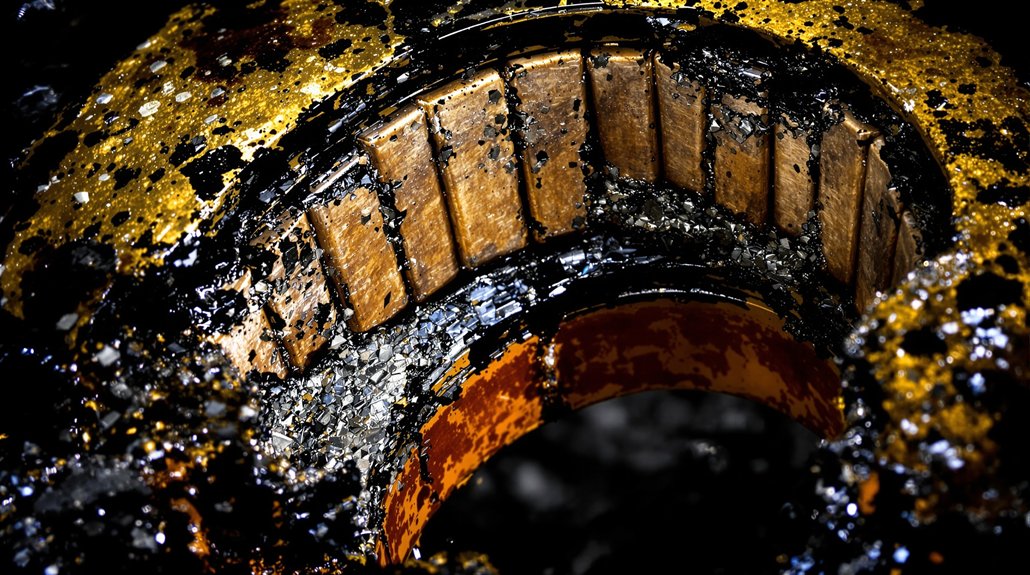
Although locomotive camshaft bearings are engineered to withstand substantial operational forces, excessive loading conditions and harsh service environments consistently push these critical components beyond their design thresholds. When you operate locomotives under heavy-duty conditions, overloading accounts for 8.1% of premature bearing failures, while insufficient lubrication contributes another 11.4%. These concentrated mechanical stresses create uneven load distribution across bearing surfaces, accelerating material breakdown beyond designed service life.
You’ll encounter elevated operating temperatures that break down lubrication systems, causing catastrophic failures when lead content melts and damages shaft surfaces. Thermal expansion creates improper clearances, while hot short conditions result in surface wiping. Continuous high-load operations prevent adequate cooling periods, and severe duty cycles exceed normal design parameters. The disrupted timing mechanisms cause engine misfires that further compromise locomotive performance and accelerate component deterioration. Marine and heavy-duty applications subject your bearings to extreme environmental stress, where contaminants combined with excessive loads markedly reduce service life expectancy. Effective overload mitigation and strategic duty cycling become essential for maintaining bearing integrity.
Contamination Sources and Engine Cleanliness Issues
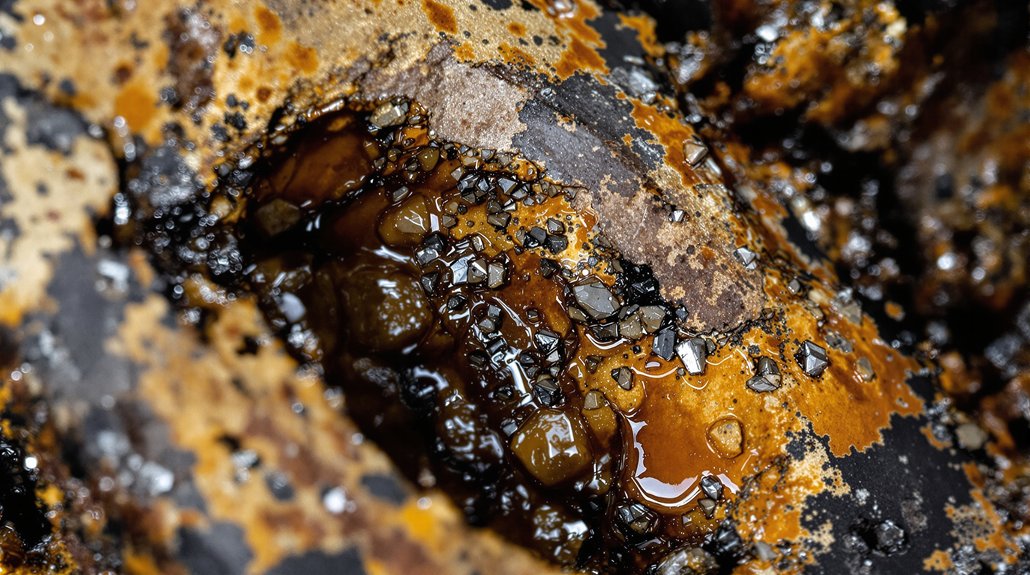
Within locomotive engine systems, contamination represents the primary threat to camshaft bearing longevity, accounting for the majority of premature failures through multiple pathways that compromise bearing surface integrity. You’ll encounter hard particles creating sharp-edged dents with concentrated stress points, while polymer particles extrude under 200,000 psi contact pressures, forming shallow surface damage. Metallic debris acts like grinding wheels against journal surfaces when protruding from embedded positions.
Your engine block cleaning protocols directly determine bearing survival rates. Inadequate cleaning practices allow debris accumulation, while compressed air redistribution worsens particle embedding during assembly. You must maintain extremely clean conditions throughout installation procedures.
Oil system contamination introduces wear fragments from other components, particularly when you neglect filter replacement or extend change intervals. Environmental contaminants enter through compromised air filtration systems, embedding road dirt and sand particles into bearing linings, creating metal-to-metal contact and accelerated wear patterns. Iron particles released from cast engine blocks can accelerate oil oxidation and create secondary lubrication problems that further compromise bearing performance.
Design Specifications and Clearance Problems
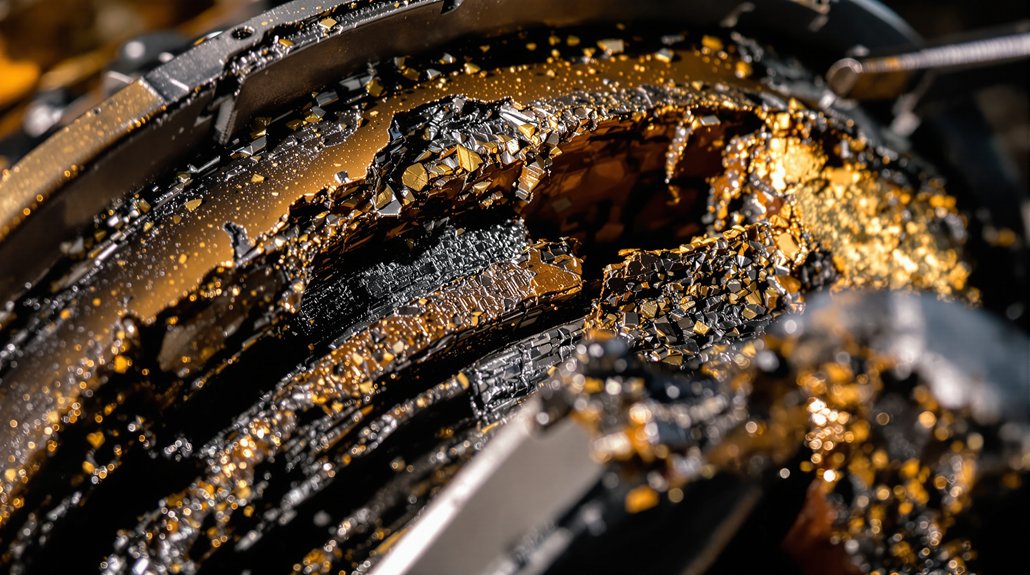
Beyond contamination factors, your bearing failures often stem from fundamental design specification mismatches and clearance control deficiencies that create destructive operating conditions. Locomotive applications demand precise bearing clearances between .003″ to .004″ for peak performance, yet tolerance stack-up from block machining, shaft diameter variations, and bearing manufacturing creates compounded errors that push clearances beyond acceptable limits.
Your material selection directly impacts failure rates. Aluminum alloy bearings lack the self-compensation properties of softer materials, requiring stricter clearance control. Copper-based alloys provide superior fatigue resistance under locomotive’s extreme loads, while steel-backed copper-plated materials handle the most demanding applications.
| Specification Parameter | Critical Requirement |
|---|---|
| Minimum Clearance | .003″ locomotive applications |
| Surface Finish | 10 micro-inches Ra maximum |
| Material Selection | Copper alloys for high loads |
| Measurement Protocol | Verify at installation |
| Temperature Stability | Account for thermal expansion |
You must measure clearances at installation since manufacturing tolerances compound unpredictably, creating bearing distortion that mirrors block bore irregularities.
Oil Quality Degradation and Viscosity Breakdown

Degraded oil destroys your camshaft bearings through viscosity breakdown that eliminates the protective hydrodynamic film essential for preventing metal-to-metal contact. When you operate locomotives under high-load conditions, oil temperature spikes accelerate molecular breakdown, reducing viscosity below critical thresholds required for bearing protection.
Oxidation products form when oil molecules react with oxygen at elevated temperatures, creating acidic compounds that corrode bearing surfaces and thicken remaining oil. You’ll notice sludge formation as these oxidation products accumulate, restricting oil flow through critical bearing passages.
Additive depletion occurs simultaneously as anti-wear agents, viscosity improvers, and antioxidants become exhausted through normal operation. Without these protective additives, your oil can’t maintain stable viscosity under thermal stress. The resulting thin oil film collapses under bearing loads, causing direct metal contact that generates heat, accelerates wear, and ultimately leads to catastrophic bearing failure in your locomotive’s camshaft system.
Thermal Stress and Temperature-Related Bearing Damage
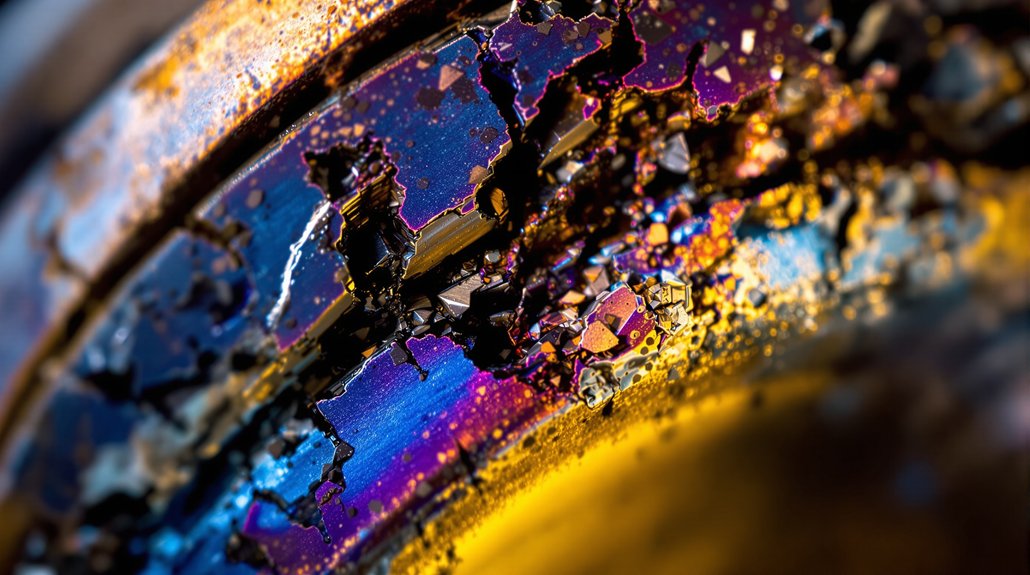
Temperature spikes from viscosity breakdown create a cascade of thermal damage that systematically destroys your locomotive’s camshaft bearings through multiple failure mechanisms. High-performance engines generate excessive cylinder pressures that compound thermal stress effects, while thermal gradients across bearing surfaces create stress concentration points that accelerate material fatigue.
| Thermal Source | Temperature Impact | Failure Mechanism |
|---|---|---|
| Engine Operation | Elevated bearing temps | Material fatigue acceleration |
| Manufacturing Grinding | Residual thermal stress | Reduced operational lifespan |
| Adjacent Motor Components | 66.9% stress increase | Non-uniform heat distribution |
| Cyclic Loading | Temperature fluctuations | Dimensional tolerance changes |
Your bearing overlay materials lose critical strength properties at elevated temperatures, while thermal expansion differentials between components create internal mechanical stresses. Manufacturing processes introduce additional thermal damage through grinding operations and heat treatment cycles. When traction motor heating combines with operational loads, you’ll experience maximum stress concentrations that systematically compromise bearing integrity before visible symptoms appear.
Frequently Asked Questions
How Often Should Locomotive Camshaft Bearings Be Inspected for Early Wear Signs?
You should inspect locomotive camshaft bearings every 750 hours for oil changes and conduct thorough assessments at 3,000-hour intervals. Implement monthly inspections focusing on visual examination of raceways, manual rotation testing, and systematic mounting alignment checks. Integrate vibration monitoring systems with daily component inspections to detect early wear indicators like cracking, flaking, or smearing. Document all findings for regulatory compliance and performance tracking.
What Specific Tools Are Needed to Properly Measure Camshaft Bearing Clearances?
You’ll need micrometers for precise journal measurements, dial bore gauges with dial indicator attachments for actual clearance calculations, and plastigage measurement strips for quick visual verification. Calibrate all precision instruments before use, ensuring you follow EMD-specific torque specifications during assessment. Clean all surfaces thoroughly before applying plastic gauges across the entire journal surface. These tools provide thorough data for accurate bearing clearance analysis and preventive maintenance decisions.
Can Rebuilt Camshaft Bearings Perform as Well as New OEM Bearings?
You’ll find rebuilt camshaft bearings can achieve performance parity with OEM units when properly reconditioned using precision machining and OEM specifications. However, you’re facing warranty concerns since rebuilt bearings typically offer shorter coverage periods and may lack thorough failure protection. You’ll need to verify the rebuilder’s quality control processes, material specifications, and dimensional tolerances match OEM standards. Performance depends on the rebuilding facility’s technical capabilities and adherence to manufacturer specifications.
Which Bearing Materials Work Best for High-Mileage Locomotive Engine Applications?
Like a marathon runner needs endurance gear, you’ll find aluminum-based bi-metal bearings excel in high-mileage locomotive applications. Their 0.010″ thickness tolerates extensive wear while superior conformability accommodates misalignments that develop over time. Bronze alloys deliver exceptional fatigue resistance for heavy loads, though polymer composites show promise in specific applications. You’ll achieve peak performance by selecting aluminum bi-metal construction over tri-metal alternatives for extended service intervals.
How Much Does Premature Camshaft Bearing Failure Typically Cost in Repairs?
You’ll face repair costs ranging from $15,000 to $45,000 per locomotive when camshaft bearings fail prematurely. Engine teardown, bearing replacement, and associated component damage drive these expenses higher. You’re looking at 3-7 days downtime, compounding operational losses. Insurance claims typically cover catastrophic failures but exclude wear-related issues. Factor in secondary damage to camshafts, cylinder heads, and timing systems when calculating total repair costs for your fleet maintenance budget.