

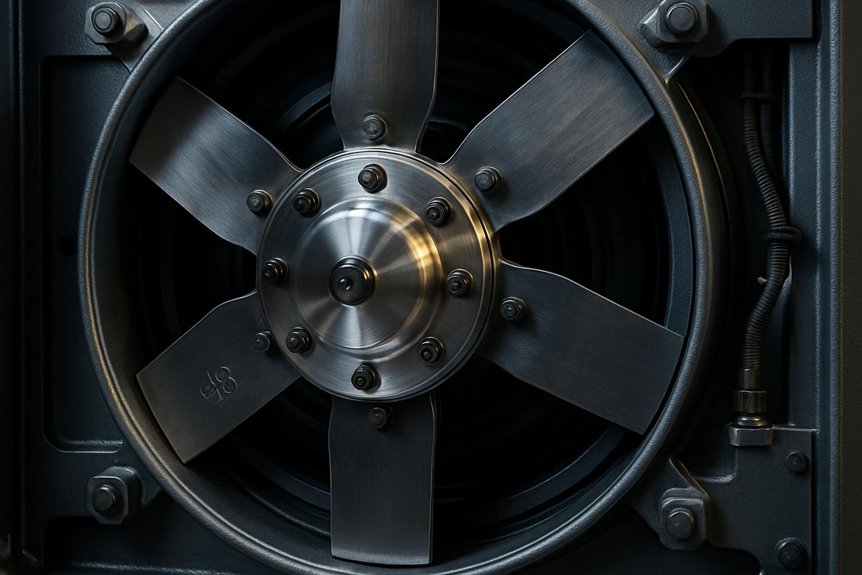
Users often face premature fan blade wear and efficiency loss. Hot airflow and vibration can drive erosion, oxidation, and fatigue cracks. This shortens service intervals and raises downtime costs. Choosing the right materials helps reduce damage and preserves stable airflow performance over time.
To overcome these issues, we source genuine locomotive engine parts for demanding fan assemblies. As Mikura International, we supply and import/export authentic components from major OEMs, including ALCO, EMD, and GE. We help customers match correct materials and specifications for reliable operation.
Typical materials used in a 48” locomotive fan assembly
- Heat-treated carbon steel for blades, hub, and structural frame.
- Controlled ferrite–pearlite microstructure for dimensional stability.
- High tensile strength to resist vibration loads.
- Good weldability for field and shop fabrication.
- Ni-Cr-Fe hardfacing overlays on leading edges.
- Erosion and oxidation resistance at the blade entry zone.
- Thermally stable barrier coatings near the surface.
- Fatigue resistance under cyclic hot airflow.
Why these materials are chosen
Heat-treated carbon steel supports strength and stable geometry. Hardfacing improves leading-edge durability. Barrier coatings help maintain hardness near the surface. Together, they improve fatigue life and long-term structural rigidity.
Quick comparison table (what each material protects)
| Fan component area | Typical material / treatment | Primary failure risk | Material benefit |
|---|---|---|---|
| Blades (bulk) | Heat-treated carbon steel | Fatigue cracking | High tensile and fatigue strength |
| Hub | Heat-treated carbon steel | Cyclic stress | Stable structure and rigidity |
| Frame | Heat-treated carbon steel | Distortion and loosening | Dimensional stability under load |
| Leading edges | Ni-Cr-Fe hardfacing | Erosion, oxidation | Durable surface against hot flow |
| Near-surface zone | Barrier or ceramic-type coating | Hardness loss | Helps preserve surface hardness |
Sourcing note from Mikura International
Material selection must match the original locomotive design. We supply genuine locomotive engine parts and related components. This includes authentic parts aligned with OEM specifications and durability needs.
Key Takeaways
- Carbon steel is commonly used for fan blades and structural members for strength, machinability, and heat-treatment-controlled microstructure stability.
- Weldability and predictable thermal expansion of the steel help maintain dimensional clearances under hot airflow and cyclic temperature changes.
- Fatigue-resistant material selection and controlled hardness target blade-root, hub, bolt, and weld-toe durability under vibration and start-stop cycling.
- Ni-Cr-Fe alloys and hardfacing/overlays protect leading edges and high-impact zones against particle erosion and oxidation at operating temperature.
- Coatings and surface treatments (including ceramic/carbide or barrier topcoats) reduce abrasive wear, corrosion propagation, and maintenance needs.
Introduction to Material Selection in Heavy Machinery
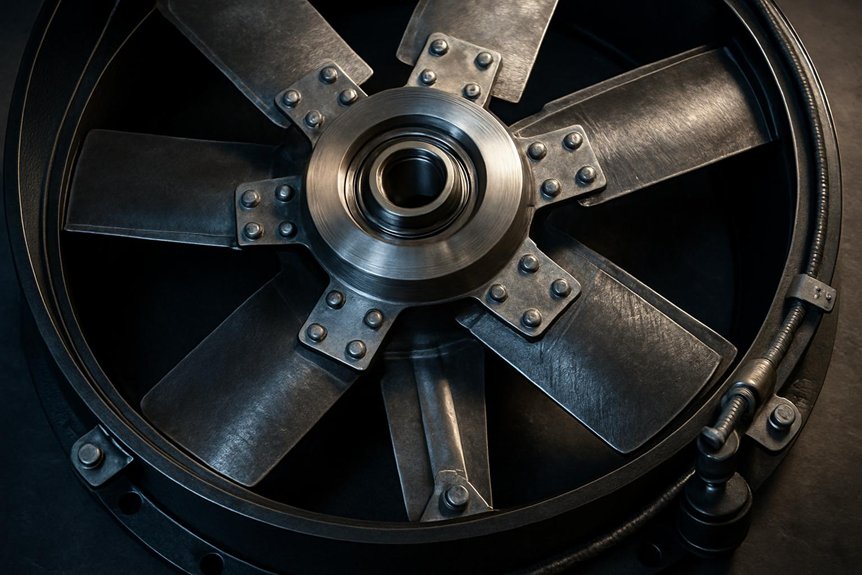
When you choose Locomotive Fan Materials, you’re balancing material science with durability to secure long-term reliability under cyclic loading and vibration. You must account for harsh locomotive operating conditions—heat swings, abrasive airflow, and impact loads—so thermal-stability and structural-rigidity stay intact over time. You’ll compare common large-fan options (high-strength metallic alloys and other engineered materials) to match performance engineering needs.
Importance of material properties for long-term reliability
For long-term reliability in heavy-duty locomotive fan assemblies, you can’t treat “materials” as a single choice—you must match material properties to the duty cycle. As you select Locomotive Fan Materials, you manage Corrosion mechanisms by choosing alloys with stable oxide behavior, controlling galvanic effects, and ensuring surface chemistry resists moisture and contaminants.
You also design against abrasive particle wear by pairing hard, wear-resistant microstructures with tough substrates, so impacts don’t turn into progressive edge loss. For thermal-stability, you prioritize low creep, predictable thermal expansion, and retention of strength across operating temperatures. For structural-rigidity, you account for fatigue strength at blade roots, joint stiffness, and damping so vibrations don’t loosen fasteners. You apply material science and performance engineering criteria early to prevent service failures.
Harsh operating conditions in locomotive environments
Locomotive fan assemblies operate under abrasive dust, cycling temperatures, moisture, and vibration, so your material choices must account for more than strength alone. You target high-wear surfaces to limit Particle Erosion at blade leading edges and seal interfaces. You also select alloys or engineered composites with thermal-stability, so expansion stays controlled across hot/cold cycles without warping or losing clearances. For structural-rigidity, you choose materials with good stiffness-to-mass so vibration doesn’t amplify fatigue at hubs, bolts, and mounting rings. Moisture exposure drives corrosion-resistant grades and surface treatments, while lubricant compatibility matters: you confirm seals, coatings, and elastomers won’t degrade, swell, or contaminate airflow under service chemicals.
Overview of common materials in large fan construction
Selecting locomotive fan materials starts with balancing material science requirements against the realities of heavy machinery—temperature swings, abrasive dust, and vibration loads. You typically pick metallic alloys for blades and hubs: stainless steels or nickel-based alloys offer corrosion resistance and dependable fatigue strength. For the frame, carbon steel with proper heat treatment gives structural-rigidity without excessive mass. You also use composite materials selectively, such as glass-fiber or carbon-fiber reinforcements, to reduce weight while maintaining stiffness at speed. Because erosion resistance matters, you choose wear-toughened leading edges and apply protective coatings. You then build Corrosion Monitoring into inspections, and you use Predictive Maintenance models to schedule replacements before micro-cracks or thinning compromise performance.
Metallic Components: Alloys for Strength and Durability
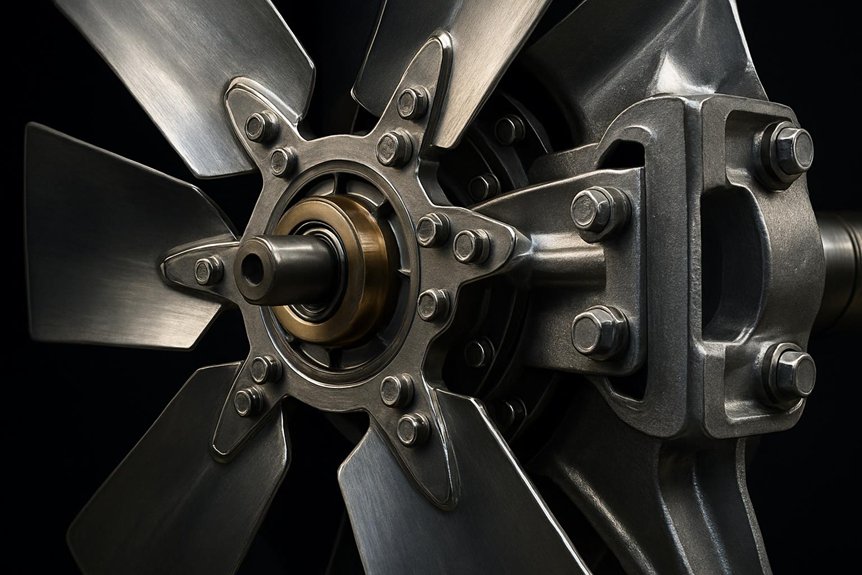
When you select Locomotive Fan Materials, start with carbon steel for fan blades and structural elements because it delivers high strength, reliable weldability, and cost-effective manufacturing. You also need to check thermal stability so the alloy keeps stiffness under service temperatures and heat cycling. Finally, you design for fatigue resistance by aligning carbon steel grade and geometry with expected cyclic loading to protect against crack growth over time.
Use of carbon steel for fan blades and structural elements
Carbon steel often anchors locomotive fan blade and structural assemblies because it delivers a strong balance of tensile strength, machinability, and cost-effective durability. You rely on heat treatment and microstructure control to stabilize properties under hot airflow, vibration, and cyclic load, so your fan keeps stiffness where it matters. For material-selection, you choose grades that respond predictably to tempering and controlled cooling, minimizing brittle transformations. Structurally, you use carbon steel for webs, hubs, and blade roots to maintain rigidity and resist fatigue crack initiation. To engineer it for performance engineering, you target:
- Controlled ferrite–pearlite ratios
- Tight dimensional tolerances after machining
- Tempered hardness matched to wear conditions
- Predictable thermal-expansion behavior during service
Advantages of steel: high strength, weldability, cost-effectiveness
Steel brings locomotive fan assemblies a practical mix of high strength, reliable weldability, and cost-effective performance**, letting you build rigid structures that hold alignment under hot airflow and vibration. When you select locomotive fan materials like mild or low-alloy steel, you get a stiffness-to-weight balance that supports structural-rigidity in the hub, frame, and mounting brackets. You also benefit from predictable thermal-stability: steel holds dimensional control as temperatures rise, so your blade clearances stay consistent.
Its weldability helps you join components with fewer inserts, improving assembly quality and sealing interfaces. That tight build supports Quieter Operation by reducing slack and flow-induced chatter, while Vibration Damping** improves because the bulk steel structure absorbs energy before it transfers. You also keep costs manageable for large production runs.
Considerations for fatigue resistance in cyclic loading applications
Fatigue resistance governs whether your locomotive fan assembly keeps its structural-rigidity through thousands of start-stop cycles, high-amplitude vibration, and fluctuating aerodynamic loads. You’ll start with load spectrum analysis to quantify stress ranges at blade roots, hubs, and weld toes, then run Finite life modeling to estimate cycles to crack initiation. Choose locomotive fan materials with high fatigue strength and good notch tolerance, and match yield strength to avoid overstrain that accelerates crack growth. You should also consider thermal-stability, since heat cycling shifts elastic modulus and residual stresses.
- Minimize stress concentrators and sharp transitions
- Use controlled weld procedures and inspections
- Select alloys with proven fatigue strength data
- Validate with vibration testing under real duty cycles
Surface Treatments and Coatings for Enhanced Performance
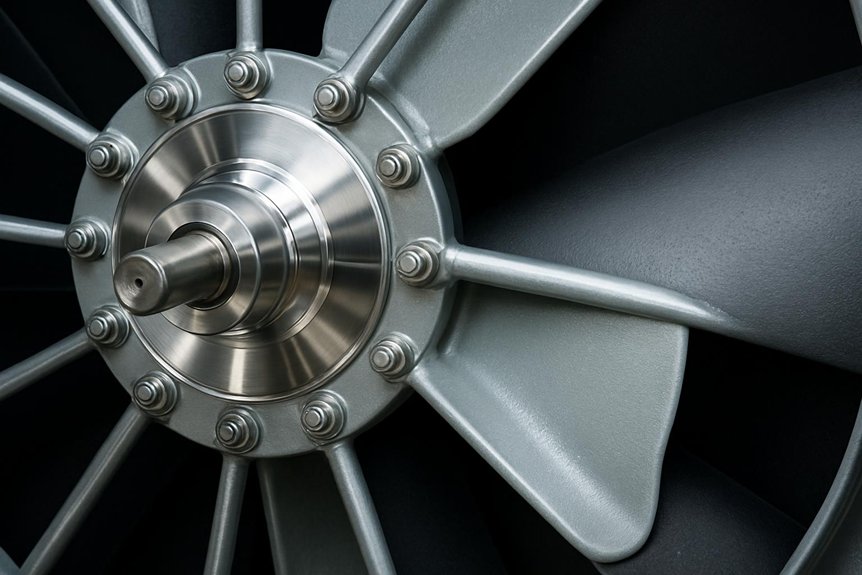
When you select Locomotive Fan Materials, applying Ni-Cr-Fe alloys to the blade surface helps you resist erosion and abrasive particles while tolerating corrosive environments. Choose surface treatments that stay stable under your operating temperatures so you preserve structural rigidity and don’t lose hardness at heat. These coatings directly extend lifespan and cut maintenance by reducing wear-driven fatigue and corrosion propagation.
Application of Ni-Cr-Fe alloys for erosion resistance
Ni-Cr-Fe alloys deliver a robust foundation for locomotive fan blades exposed to particle-laden airflow, because you can engineer the surface to resist erosive wear without sacrificing thermal-stability. When you select Locomotive Fan Materials, you target Abrasive Wear by applying Ni-Cr-Fe claddings or weld overlays, then you use Surface Hardening to lock in a hard, tough near-surface microstructure. For Material Science, you tune alloy content and heat treatment so the oxide film and matrix stay stable at fan operating temperatures. Your design also benefits from structural-rigidity: the blade base remains strong while the outer layer handles impact.
- Choose Ni-Cr-Fe for wear-resistant phase stability
- Apply hardfacing overlays for erosion control
- Heat-treat for reliable Surface Hardening response
- Verify hardness-depth vs. operating temperature limits
Protection against abrasive particles and corrosive environments
To keep locomotive fan assemblies reliable in abrasive, corrosive air, you pair Locomotive Fan Materials with surface treatments and coatings that lock in thermal-stable chemistry and strong near-surface protection. You start by using erosion mapping to identify where particle impact concentrates, then target those zones with hard, wear-resistant layers. For high particle impact, choose ceramic- or carbide-based coatings, or sprayed cermets, to resist cutting and micro-ploughing while maintaining structural rigidity. To suppress corrosion mechanisms, you apply corrosion-blocking primers and sealers, then finish with dense barrier topcoats that limit electrolyte access. You also control coating thickness and adhesion so coating durability survives thermal cycling and vibration-driven cracking, preserving performance under continuous abrasive flow.
Impact of coatings on material lifespan and maintenance
Surface treatments and coatings extend your locomotive fan assembly’s service life by protecting the near-surface region where abrasive impacts, hot oxidation, and corrosive species work together. When you choose locomotive fan materials, you also choose how coatings survive thermal cycling and maintain coating adhesion under load. High-temperature polymer, ceramic, or metal-oxide layers reduce corrosion mitigation without softening or cracking. You’ll typically specify:
- Surface roughness control for strong coating adhesion
- Oxidation-resistant ceramic topcoats for thermal stability
- Galvanic or barrier primers to block corrosive ions
- Wear-capable sealants at leading edges for erosion resistance
If your coating system matches your alloy’s expansion, you’ll preserve structural rigidity, slow crack initiation, and cut maintenance intervals.
Advanced Materials and Composites
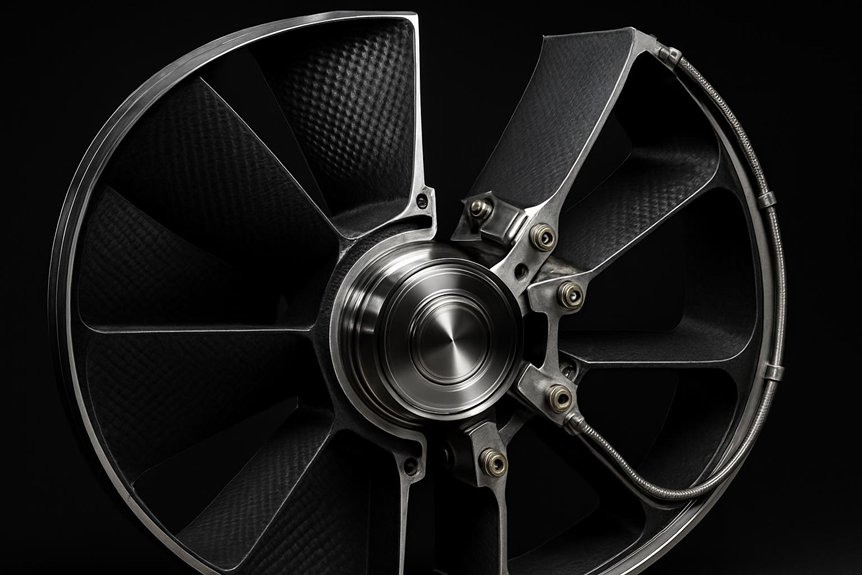
You can explore lightweight composite materials for locomotive fan blades to target structural rigidity with higher thermal stability while cutting rotating inertia, which boosts performance engineering efficiency. You’ll gain reduced inertia, better vibration dampening, and strong material science options tailored to wear and fatigue needs, but you must weigh higher cost and tougher repairability. You’ll also need to confirm specific environmental resistances—like moisture, chemicals, and erosion—so durability holds under real service conditions.
Potential applications of lightweight composite materials for fan blades
Lightweight composite materials can significantly improve fan-blade performance when you prioritize high specific stiffness, corrosion immunity, and stable operation under heat. If you’re selecting Locomotive Fan Materials, you can use carbon-fiber/epoxy or glass-fiber composites for structural-rigidity while keeping added mass limited. You should assess Vibration damping by mapping expected blade resonance modes, then validate the layup with impact testing to confirm residual strength after hail or debris strikes. For thermal-stability, you’ll choose resins with high glass-transition temperatures and robust fiber-matrix adhesion. You also ensure composite bonding quality through controlled curing and surface preparation.
- Carbon-fiber reinforced laminates
- Glass-fiber with toughened epoxies
- High-Tg thermoset matrices
- Quality-controlled adhesive bonding seams
Benefits: reduced inertia, improved efficiency, and vibration dampening
Reduce rotating inertia and sharpen aerodynamic response by using advanced composite structures in locomotive fan assemblies. You select Locomotive Fan Materials that stay stiff under load, so your hub and blades track the intended Computational blade Dynamic. Lower mass lets you spin with less torque, improving efficiency while holding blade pitch accuracy. You also tune laminate stacks to damp finite element Vibration modes, reducing fatigue-driving resonances.
| Design goal | Material trait | Selection method |
|---|---|---|
| Low inertia | Fiber-reinforced low density | mass/section optimization |
| Thermal stability | Resin with high Tg | thermal soak + NDE |
| Vibration dampening | Viscoelastic interlayers | finite element Vibration tuning |
| Structural rigidity | High modulus fibers | ply orientation mapping |
| Reliability in service | durable matrix | Material Science validation |
Challenges: cost, repairability, and specific environmental resistances
Cost and repairability often shape your practical choices for Locomotive Fan Materials as much as stiffness and strength do. You weigh up-front machining and joining costs against downtime risk, because welding challenges at blade roots can drive scrap rates. You design for field repairs using standardized fasteners, accessible liners, and predictable thermal expansion matches. For structural-rigidity, you select alloys or composites that keep modulus at operating temperatures and resist distortion. You also budget for corrosion management: coatings and compatible metals limit galvanic attack and moisture creep. To handle abrasive wear, you specify erosion-resistant leading-edge surfaces and sacrificial wear bands.
- Minimize service time with modular assemblies.
- Choose wear liners to survive abrasive wear.
- Match thermal cycles to prevent stress.
- Plan corrosion management with coatings.
Material Selection Criteria
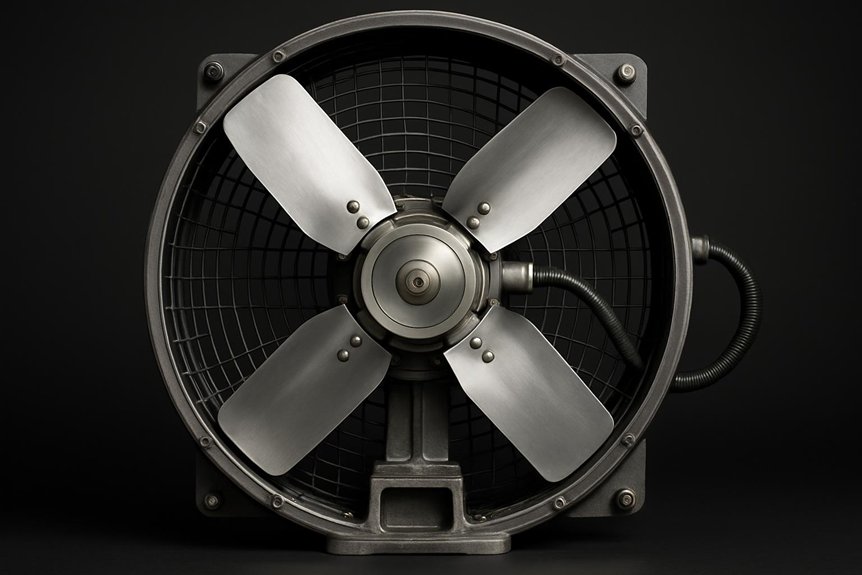
When you select locomotive fan materials, you prioritize a high strength-to-weight ratio so the assembly stays rigid without adding unnecessary mass. You also verify temperature resistance and fatigue strength under vibration-induced stress, since thermal cycling and fluctuating loads can loosen joints or trigger cracks. Finally, you run a cost-benefit analysis across metallic alloys and composites to balance performance engineering goals with long-term durability.
Factors influencing material choice: strength-to-weight ratio, temperature resistance
You’ll want to treat material selection as a coupled design problem: strength-to-weight ratio sets the blade and hub stiffness you need for efficient airflow, while thermal-stability governs whether that stiffness and dimensional accuracy survive sustained service. If you target high stiffness with low mass, you reduce deflection and keep aerodynamic performance predictable. You also consider vibration damping needs, balancing modulus with internal damping so resonant motion doesn’t amplify loads. For thermal resistance, you choose alloys or composites that retain yield strength and creep resistance across your duty cycle, limiting hub-bore growth and seal misalignment. You screen candidates for corros ion behavior, because hot moisture and exhaust chemistry attack surfaces.
- Specific stiffness targets
- Creep/thermal aging limits
- Vibration damping capability
- Corrosion behavior suitability
Resistance to vibration-induced stress and fatigue
To keep a locomotive fan assembly stable under cyclic loads, you design for resistance to vibration-induced stress and fatigue, not just static stiffness. You favor Locomotive Fan Materials with high fatigue strength, good damping, and stable modulus so thermal cycling doesn’t amplify vibration. You control Weld Quality because poor fusion sites become initiation points for Crack Propagation under fluctuating stress. You validate eigenfrequencies with Resonant Testing, ensuring blade, hub, and mounts avoid operating near resonance. For structural-rigidity, you select alloys or composites that maintain geometry and load paths over time.
| Feature | Selection target | Why it matters |
|---|---|---|
| Weld Quality | full penetration | reduces crack starters |
| Crack Propagation | low growth rate | slows fatigue failure |
| Resonant Testing | shifted modes | avoids resonant amplification |
Cost-benefit analysis of different material options
Cost-benefit analysis of Locomotive Fan Materials starts with life-cycle performance, not purchase price, because fatigue, wear, and thermal cycling drive the real operating cost. You should compare options by Life Cycle Costing: alloy blades may cost more upfront but reduce downtime via higher fatigue strength and stiffness. Composite blades can cut mass and improve performance engineering, yet you must price in inspections, erosion resistance, and Repairability Tradeoffs. Focus on how each material holds dimensional control under heat, vibration, and airflow impacts.
- Alloy (high-nickel/steel): best stiffness and predictable fatigue strength
- Aluminum alloys: lower mass, moderate thermal stability
- Composites: high strength-to-weight, erosion and bond-risk checks
- Coatings/liners: extend durability against wear and hot oxidation
Challenges and Future Outlook in Material Science
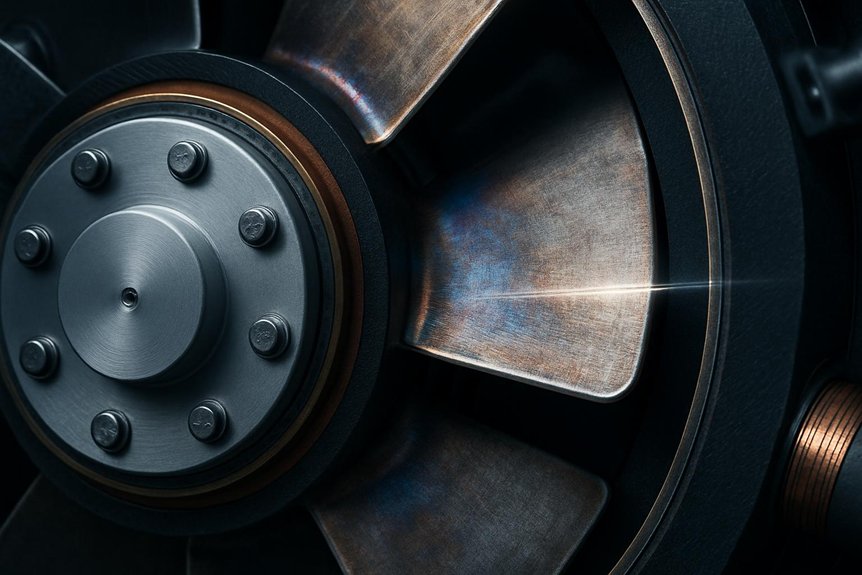
You’ll face long-term challenges as locomotive fan materials degrade from corrosion and erosion, especially where airflow and moisture combine. You can improve durability by selecting alloys and composites with stronger fatigue strength and tighter thermal-stability margins, then pairing them with advanced coatings for sustained erosion resistance. Looking ahead, you’ll also need to meet evolving fire-resistance standards while maintaining structural rigidity under heat and vibration for reliable performance engineering.
Addressing material degradation (e.g., corrosion, erosion) over time
- Select corrosion-resistant base metals
- Apply protective coatings and sealants
- Use surface hardening layers for abrasive wear
- Monitor thermal cycles and microcrack growth
Innovations in material science for improved fan durability
As material science advances, you can push locomotive fan assemblies toward higher thermal stability and better structural rigidity by targeting the failure modes you actually face—fatigue, erosion, and thermally driven microcracking—rather than treating durability as a single property. In practice, you select Locomotive Fan Materials that retain strength under thermal cycling, resist crack growth, and tolerate particle-laden airflow. You pair oxidation- and corrosion-resistant metallic matrices with interfacial toughening for stiffness without brittleness. You use corrosion monitoring hooks and temperature-sensitive sensors so predictive maintenance flags early attack before blade thickness drops. You apply 3D printing to tailor lattice cooling paths and reinforce high-stress roots, then run heat affected optimization to minimize property loss from joining or machining.
Meeting fire resistance standards for rail vehicle components
- Flame-retardant matrix chemistry
- Thermally stable oxidation barriers
- Verified thermal shock and fatigue strength
- Low creep strain at peak heat
This Material Science approach protects Durability and Performance Engineering margins.
Frequently Asked Questions
Which Alloys Best Resist Blade Fatigue Under High Cyclic Loading?
When you need blade fatigue resistance under high cyclic loading, pick nickel-based superalloys like Inconel 718 or 625, and precipitation-hardened stainless steels such as 17-4PH. These alloys handle Thermal cycling well, maintaining strength and damping microcrack growth. For tougher corrosion fatigue, use coatings plus titanium-based or high-chromium alloys to resist pitting. Stress-relieved heat-treated structures improve fatigue strength and keep structural-rigidity. Like a shield, correct alloying delays failure.
What Manufacturing Methods Improve Strength in Locomotive Fan Hubs?
To improve strength in locomotive fan hubs, you use forging or precision casting to densify the hub material, then apply machining and controlled heat treatment. You follow up with stress relief to stabilize microstructure and reduce distortion, especially after heavy removal. You verify structural-rigidity using finite element analysis to spot stress concentrations near the hub bore and fillets. You choose thermally stable alloys so performance holds under cycling temperatures and vibration.
How Do Leading-Edge Materials Reduce Erosion From Airborne Debris?
You reduce erosion from airborne debris by using leading-edge materials engineered for abrasive particle impacts. Think “an ounce of prevention is worth a pound of cure.” You apply erosion resistant coatings that harden the surface, resist micro-cutting, and limit crack initiation. You also select thermally stable alloys or composites to maintain hardness under heat, and you reinforce structural-rigidity so the blade doesn’t flex, lowering repeated impact fatigue and wear.
What Balance of Weight and Stiffness Matters Most in Fan Blades?
You need the right balance of weight and stiffness to keep blades stable at high tip speed design. Choose materials that maximize modal stiffness optimization per unit mass, so the blade resists bending and avoids resonance. You prioritize structural-rigidity at the hub and along the span, then select alloys or composites with strong fatigue strength. Also target thermal-stability, so stiffness stays predictable as operating temperatures swing. That combo reduces vibration, wear, and failure risk.
Which Tests Verify Durability Before a Fan Assembly Enters Service?
Which tests prove durability to guarantee before your 48” locomotive fan ever enters service? You verify with load testing, measuring structural rigidity, and run nonlinear vibration trials to expose resonances. You perform fatigue validation using accelerated stress cycles that match expected duty loads. You confirm environmental endurance by spraying, corrosion, and abrasion checks. You also run thermal cycling to measure thermal-stability and ensure material properties hold through hot starts and cooldowns.