


You’ll need to isolate the pneumatic circuit, verify zero pressure, and lockout/tagout before replacing WABCO locomotive brake diaphragms. Use calibrated torque wrenches and M16x1.5 property class 8 nuts while maintaining proper PPE. Remove failed diaphragms after disconnecting control valves and mechanical linkages. Install new Type 24 Long-Stroke components with even torque distribution. Conduct pressure cycling tests from 0-100 PSI within specifications. Master these critical procedures to guarantee safe brake system restoration.
Key Takeaways
- Isolate pneumatic circuit completely, verify zero pressure, and implement lockout/tagout procedures before beginning diaphragm replacement work.
- Remove failed diaphragm by disconnecting air lines, releasing mechanical linkages, and using 24mm hex wrench for M16x1.5 nuts.
- Install new WABCO diaphragm with proper orientation, apply specified lubricant, and tighten caging bolt to 15±2 Nm.
- Test replacement by pressure cycling from 80-100 psi, executing full brake applications, and verifying pressure drop under 5 psi/minute.
- Document all work performed, apply WB stencil marking, and schedule next maintenance within 368 days per requirements.
Essential Safety Precautions Before Starting Diaphragm Replacement

Before you touch any component on a WABCO brake system, you’ll need to isolate the entire pneumatic circuit and verify zero pressure conditions exist at the diaphragm location. Disengage automatic brake valves and exhaust all air from the affected cylinder. Wait 20 seconds after complete pressure release before proceeding with any maintenance checks.
You must secure the locomotive in a parked position with no movement capability. Apply all handbrakes and place wheel chocks. Document the current main reservoir pressure (should be 130-145 PSI) before isolation begins. Following safety protocols, disconnect the air supply lines feeding the diaphragm assembly and install lockout tags on isolation valves.
Use handheld gauges to confirm zero pressure at multiple test points. Don’t rely on system gauges alone. Check for residual pressure trapped in dead-end piping sections. Verify brake rigging won’t move unexpectedly when you remove the diaphragm. Place LOCOMOTIVE UNDER REPAIR blue signs at both cab entrances to alert other personnel of ongoing maintenance work. Log all pre-maintenance readings per SMP documentation standards before starting component removal.
Identifying Failed Diaphragms in WABCO Brake Systems

You’ll need to perform systematic soap bubble tests at all chamber mounting points and hardware connections to pinpoint air leaks that indicate diaphragm failure. Look for wear patterns including frayed edges, tears, or visible cracks along the diaphragm surfaces during inspection. Excessive vibration from damaged compressor parts can accelerate diaphragm deterioration and should be monitored as part of your diagnostic process.
Air Leak Detection Methods
A failed diaphragm typically announces itself through telltale signs of escaping air, compromising your locomotive’s braking performance and creating potential safety hazards. You’ll need systematic leak detection methods to pinpoint diaphragm failures before they escalate into critical brake malfunctions.
Start with visual inspection—check brake lines for corrosion and examine diaphragm chambers for fluid residue. Apply soapy water to suspected areas; bubbling indicates air leakage. For precision diagnostics, deploy advanced sensor technologies like acoustic leak detectors or the WABCO Leakage Finder 2.0. These ultrasonic systems identify internal valve leaks and microscopic cracks invisible to standard inspection. Complement acoustic detection with thermal imaging to identify temperature variations around diaphragm seals that indicate air escape points.
Conduct mandatory pressure stability tests—monitor system pressure drop, ensuring it doesn’t exceed 5 psi per minute. Automated testing terminals streamline this process, executing standardized protocols while flagging components that fail retention thresholds.
Wear Pattern Analysis
Once you’ve detected air leaks in your WABCO brake system, examining wear patterns on removed diaphragms provides critical diagnostic intelligence about failure mechanisms and underlying system problems. You’ll identify uneven erosion along clamping bands indicating pressure imbalances, while seal extrusion in high-stress zones reveals over-pressurization events. Check for sagging or bulging regions that signal localized thermal expansion during repetitive braking cycles. Document discoloration patterns suggesting heat exposure or chemical contamination. Analyze surface cracks along seal edges for material fatigue indicators. Your pressure analysis should note whether diaphragm wear appears symmetrical or concentrated in specific quadrants. These visual markers directly correlate with mounting misalignments, contaminated air supply, or faulty pressure regulators affecting system performance.
Required Tools and Replacement Parts for the Job

Before you begin replacing your WABCO brake diaphragms, you’ll need specific tools including a torque wrench calibrated for M8/M16 fasteners, spring compression tools for barrel spring handling, and lip seal installation tools to prevent damage during assembly. Your replacement parts must match exact specifications—ensure you’ve got the correct Type 24 Long-Stroke Diaphragm (8971205364) or UNISTOP components (8971205354, 8971205104) with proper depth and diameter measurements. The Type 24 LS Diaphragm measures 2.05 inches in height with a 7.0-inch outer diameter for proper fitment. Cross-reference all part numbers against your locomotive’s OEM replacement lists, as using incorrect components can lead to catastrophic brake failure.
Essential Tool Requirements
Having the right tools makes the difference between a smooth brake diaphragm replacement and a frustrating maintenance ordeal that risks damaging expensive WABCO components. You’ll need metric socket sets for M8 and M16 fasteners, adjustable wrenches for DIN934-M8 nuts, and quality torx/hex keys for ISO4017-M8x50 screws. Don’t overlook specialized equipment like spring compressors for barrel springs and diaphragm retaining clamps.
Your tool selection must include torque wrenches to meet OE specifications and air pressure testers for post-assembly validation. Keep bolt extractors and nut splitters ready for seized fasteners. Proper tool maintenance guarantees reliable performance—clean your sockets after each use, calibrate torque wrenches quarterly, and inspect spring compressors for wear before tackling TRISTOP™ D actuators.
Correct Replacement Parts
While proper tooling sets the foundation for successful maintenance, selecting the correct replacement diaphragms determines whether your WABCO brake system will deliver reliable stopping power or fail catastrophically under load.
Cross-reference OEM part numbers against your chamber specifications—verify 8971205104 replaces DAF 1325346 or MAN 81511130013. You’ll need compatibility checks confirming stroke length matches your application (standard versus long-stroke variants like 8971205464). Measure diaphragm dimensions precisely: 6.14″ diameter and 1.38″ thickness tolerances can’t deviate from OEM specs.
Premium diaphragm materials must feature vulcanized rubber compounds meeting temperature extremes and hydraulic sealing requirements. Confirm TRISTOP 30/30 double-diaphragm configurations for heavy-duty locomotives versus single-diaphragm UNISTOP chambers. Don’t compromise—inferior materials cause premature failure, air leaks, and potentially deadly brake malfunctions. WABCO maintains comprehensive inventory with models ranging from budget-conscious 8971205104 at $24.99 to heavy-duty 8971205264 at $113.49, ensuring immediate availability for critical repairs.
Preparing the Locomotive and Draining Air Systems

Once you’ve secured the locomotive in the maintenance bay, you’ll need to systematically prepare the air brake system for diaphragm replacement. Begin locomotive stabilization by chocking all wheels and engaging manual parking brakes. Implement lockout/tagout procedures on compressed air systems before proceeding.
For air line isolation, disconnect control valve inputs using approved blanking plates on MR pipes. When working with modern air brake systems, ensure you properly isolate the W distributor valve which provides proportionate brake valve application during A9 operation. You’ll locate drain valves on reservoir tanks and auxiliary systems—open these sequentially to release pressure. Don’t rush this process; rapid decompression can damage components.
Verify zero pressure at control units using calibrated gauges. Purge residual air from idle control circuits and vacuum-assisted components through Gaul testing. Document pre-drainage pressures and note any obstructions encountered.
Wear proper PPE including eye protection throughout. Once you’ve achieved complete system isolation, conduct soap bubble tests on critical joints to detect microleaks. Update your maintenance logs with drainage completion time and air quality readings before proceeding to diaphragm removal.
Removing the Failed Diaphragm Assembly
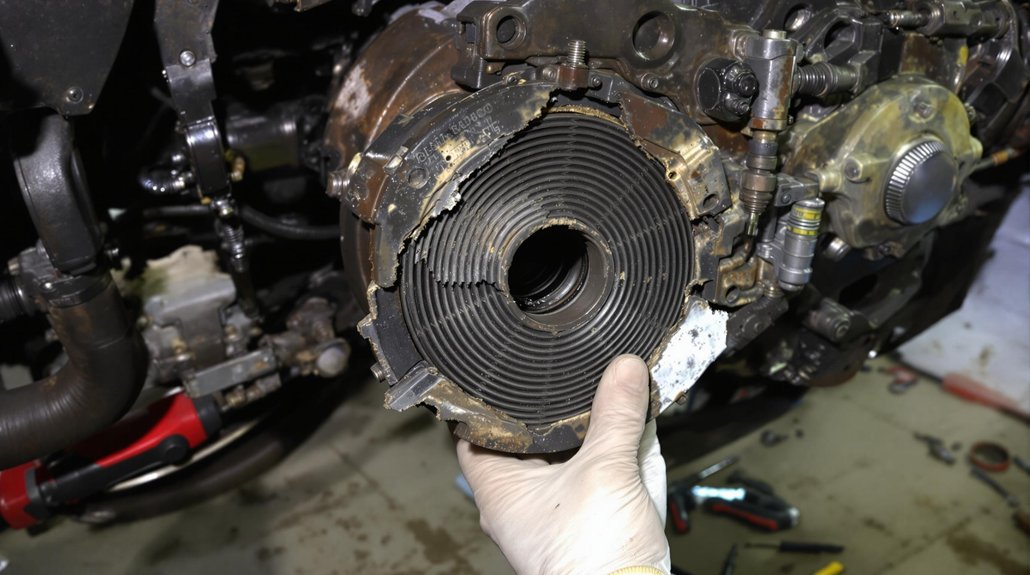
With the air brake system fully depressurized and documented, you’re ready to extract the failed diaphragm assembly from its housing. First, disconnect all air lines from supply and exhaust ports, marking connector positions for reassembly. You’ll need to release mechanical linkages by removing cam dog assemblies and disconnecting actuator connections while maintaining proper linkage tension.
Apply specialized removal techniques using a 24mm hex wrench to loosen property class 8 nuts according to WABCO torque specifications. Remove retaining rings and circlips that secure the diaphragm, documenting fastener orientations to prevent cross-threading later. As you dismantle pressure plates and retainer systems, conduct thorough diaphragm inspection for wear patterns on contact surfaces.
Wearing protective gear, carefully extract the failed assembly after confirming complete spring chamber depressurization. Log manufacturing codes and dates for maintenance records, then transfer the component to your inspection container. This systematic approach guarantees safe removal while preserving surrounding components’ integrity.
Installing the New WABCO Diaphragm Component

Begin the replacement process by positioning the new WABCO diaphragm assembly at the chamber opening and verifying its orientation matches the original component’s configuration. You’ll need proper diaphragm alignment with the chamber’s mounting surfaces before proceeding. Clean all internal surfaces and apply manufacturer-specified lubricant to guarantee smooth operation.
Install the chamber using M16x1.5 property class 8 nuts, following WABCO’s fastening techniques for secure attachment. Tighten the caging bolt to 15 ± 2 Nm using manual tools only—never use power tools that could damage components. Insert dust plugs to protect the parking brake side and guarantee the return unit’s hexagon remains unobstructed.
Sequentially tighten all fasteners to maintain even load distribution across the diaphragm surface. Don’t reuse stretched nuts as they’ll compromise torque accuracy. For self-locking nuts, increase torque slightly to assure long-term stability. Double-check all torque values before reconnecting the parking brake pressure supply valve connector.
Testing and Pressure Cycling the Replacement

Connect the locomotive’s main reservoir air supply to initiate thorough testing of your newly installed WABCO diaphragm assembly. You’ll conduct extensive pressure testing to verify proper installation and functionality before returning the locomotive to service.
Begin your cycling procedures with these critical validation steps:
- Initial pressure build-up: Charge the system from 80 to 100 psi within two minutes, monitoring gauge readings for anomalies
- Dynamic response testing: Execute full brake applications from 0 to maximum pressure, analyzing diaphragm response times
- Graduated release checks: Apply 25%, 50%, and 75% pressure releases to confirm proportional braking response
- Leakage verification: Measure pressure drops during 20-psi service reductions—maintain under 5 psi/minute
Document cut-out pressure at ≤145 psi and cut-in at ≥80 psi during repeated cycles. Cross-reference all pressure gauges within 3 psi tolerance. Complete AFM testing if flow meters are available, ensuring ≥10 CFM sensitivity for accurate leak detection.
Post-Installation Maintenance and Documentation Requirements

Once you’ve completed diaphragm installation and testing, establish thorough maintenance protocols to guarantee long-term brake system reliability and regulatory compliance. Schedule your next maintenance interval within 368 days, ensuring auxiliary reservoir cleaning and air pipe inspections occur during lift periods.
Document all post installation checks in official maintenance logs immediately. Record pressure test results, component replacements, and any defects identified during inspection. Apply the WB stencil with your depot symbol, month, and year to track overhaul history. You’ll need these records for FRA compliance verification.
Monitor brake pipe pressure between 75-90 psi during regular operations. If you detect pressure drops exceeding specifications, investigate immediately. Apply Rocol 1000 to slide valves and bushings at prescribed intervals, avoiding over-lubrication that could contaminate the system. Secure all air pipes to prevent vibration-induced failures, and protect exhaust nipples with wood covers during equipment transit.
Frequently Asked Questions
What Is the Typical Service Life of WABCO Locomotive Brake Diaphragms?
You’ll find WABCO locomotive brake diaphragms typically provide 3-5 years of reliable service when you follow proper diaphragm maintenance protocols. Your service indicators include pressure drop exceeding 5 lbs/min, visible cracking, or material degradation during 368-day inspections. You’re required to replace diaphragms showing these defects immediately. Environmental factors like extreme temperatures and contamination levels directly impact longevity, so you’ll need frequent monitoring in harsh operating conditions.
Can Aftermarket Diaphragms Be Used Instead of Genuine WABCO Parts?
You shouldn’t use aftermarket diaphragms unless they’re verified for WABCO system compatibility. While aftermarket quality varies considerably, non-OEM parts risk invalidating warranties and compromising brake safety. Check diaphragm compatibility through material specifications matching WABCO numbers like 8971205354. Aftermarket options might save money initially, but they’re prone to premature failure, alignment issues, and unpredictable performance. Stick with genuine WABCO parts to guarantee proper torque retention and leak-free operation.
How Much Does a Complete Diaphragm Replacement Typically Cost?
Your wallet’s about to take a calculated hit. You’re looking at $500-2,000 per diaphragm replacement, factoring OEM parts, certified technician labor, and mandatory brake testing. Budget planning must account for regional pricing variations, emergency repair premiums, and potential system-wide replacements. You’ll find aftermarket options cut initial diaphragm replacement costs by 40%, but risk premature failure. Factor in shipping, import duties, and warranty implications when calculating total expenditure.
What Causes Premature Diaphragm Failure in WABCO Brake Systems?
You’ll experience premature diaphragm failure when diaphragm materials degrade from oil contamination, thermal cycling, or chemical exposure. Poor maintenance practices accelerate deterioration – irregular inspection schedules, using non-genuine parts, and improper storage expose components to UV damage and corrosive buildup. High-pressure fluctuations strain the rubber beyond design limits, while moisture accumulation and particle ingress create abrasive conditions. Don’t overlook contamination from incorrect lubricants or compressed air quality issues.
Are There Different Diaphragm Types for Freight Versus Passenger Locomotives?
You’ll find freight locomotives operate at 125-140 psi versus passenger trains‘ 90-110 psi, requiring fundamentally different diaphragm designs. Your freight locomotives need high-durometer rubber compounds and reinforced metal edges to handle extreme loads and prolonged braking cycles. Meanwhile, passenger locomotives utilize lighter, faster-responding diaphragms with optimized airflow pathways for rapid deceleration. Material composition, thickness, and valve integration differ considerably between applications to meet specific operational demands.