


An aftermarket soak-back pump can look identical to the unit it replaces and still perform very differently. Two pumps with the same mounting pattern and port positions may deliver different flows or draw different currents. They may also use seal materials unsuited to hot lube oil, or come with no record of how they were built or tested. None of this is visible when the box is opened.
For procurement and quality teams, the answer is to qualify the supplier before relying on the product. That means asking for the right documents, checking that they are credible and testing a sample before approving the supply. It also means monitoring performance once units are in service.
This guide sets out what to ask for at each stage: datasheets, test certificates, traceability records, quality system evidence and warranty terms. It is written as a practical checklist that can be adapted to your organisation’s own approval procedures.
Why Supplier Qualification Matters for Soak-Back Pumps
The hidden cost of an unverified pump
A soak-back pump rarely fails in a way that stops a locomotive. A weak or failing pump can run for weeks while the turbocharger bearings receive less oil than they need after every shutdown. The first clear evidence is often turbocharger damage, which costs far more to put right than the pump.
This makes the soak-back pump a high-consequence part, despite its small size. A poor-quality unit can lead to:
- Turbocharger bearing damage and early overhaul
- Unplanned locomotive downtime
- Repeated replacements of the same pump position
- Time lost diagnosing faults that trace back to the part itself
Qualifying the supplier is the most effective way to keep these risks out of the fleet before the part is installed.
What “OEM-compatible” does and does not tell you
Many aftermarket parts are described as OEM-compatible, OEM-quality or a direct replacement. These terms usually mean the part is intended to fit and function in place of the original. They do not, on their own, confirm any of the following:
- That the pump meets the original flow and pressure performance
- That its motor or inverter suits your locomotive’s electrical system
- That each unit has been tested before dispatch
- That materials and seals are rated for continuous hot-oil service
- That the design is controlled and will not change between batches
Treat compatibility claims as a starting point. A qualified supplier should be able to back each claim with documents and test evidence.
A three-stage qualification process
A structured approach makes supplier evaluation repeatable and easier to defend in an audit. Most organisations work through three stages:
- Desk review: assess the supplier’s documents, including datasheets, sample test certificates, quality system evidence and warranty terms.
- Sample evaluation: inspect and test one or more units against the documentation, then trial them in service on a limited number of locomotives.
- Ongoing monitoring: track delivered units’ performance and the supplier’s responsiveness, and requalify when something changes.
A supplier that performs well at the desk-review stage may still fall short in sample testing. Qualification should only be granted once all three stages support the decision.
Product Documentation: Datasheets and Test Certificates
What a complete datasheet should contain
The datasheet is the reference against which every other document and test is judged. If it is incomplete, nothing else can be properly verified.
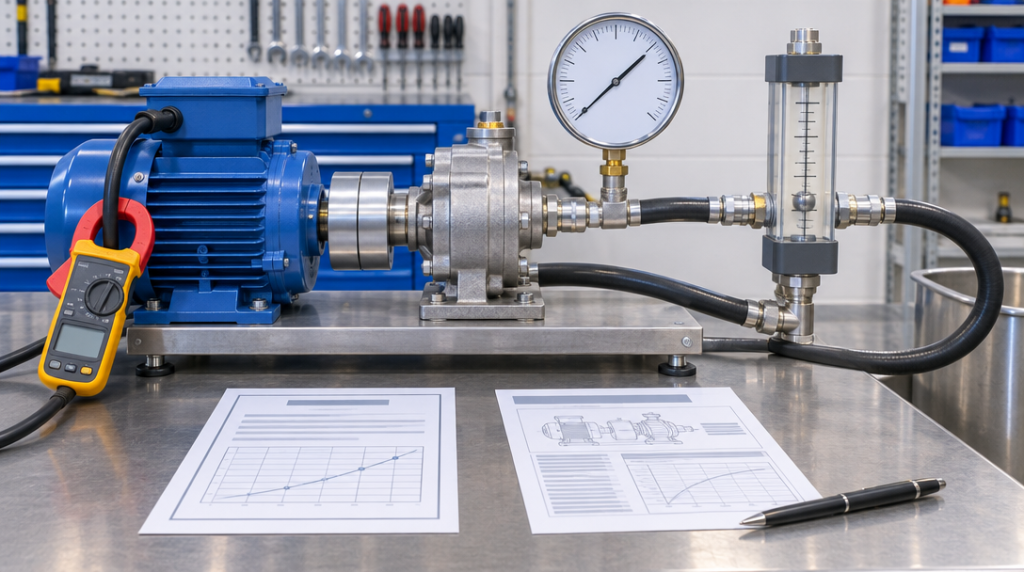
A complete soak-back pump datasheet should include:
Hydraulic performance:
- Rated flow at a stated speed, pressure and oil temperature
- Rated discharge pressure and relief setting, where a relief valve is fitted
- Recommended oil type or viscosity range
Electrical data:
- Motor type (brushed DC, or AC with inverter)
- Accepted supply voltage range
- Rated current at continuous duty
- Maximum current at peak pressure
- Starting current
For inverter-driven units, also expect:
- Output waveform and frequency
- Protection functions such as under-voltage cut-off and thermal shutdown
Mechanical data:
- Overall dimensions and weight
- Mounting pattern
- Port sizes and positions
- Direction of rotation
- Coupling arrangement
Materials and environment:
- Housing and gear materials
- Seal and gasket materials
- Operating temperature range
- Any shock, vibration or enclosure ratings
Each figure should be stated with its test conditions. A flow figure with no stated pressure, speed or oil temperature cannot be compared or verified.
Per-unit test certificates: flow, pressure and current draw
A type test proves that a design can meet its specification. A routine test, carried out on every unit before dispatch, proves that the unit in your hands does. For soak-back pumps, ask whether each unit is routine-tested and request a sample certificate during the desk review.
A useful per-unit certificate records at least three measurements:
- Flow: measured delivery at the rated test condition, compared with the datasheet value and its acceptance limit.
- Pressure: discharge pressure achieved, and the relief valve opening point where one is fitted.
- Current draw: motor or inverter input current at the test condition, which reveals tight assemblies, motor faults or incorrect windings.
The certificate should also record:
- Pump serial number
- Test date
- Supply voltage during the test
- Oil type and temperature
- Pass or fail result
- Name or signature of the person responsible
Additional checks add confidence:
- A leakage check at the shaft seal and joints
- A noise and vibration check
- An insulation resistance test on the motor
Judging whether a test certificate is credible
A certificate is only as good as the test behind it. When reviewing a sample, ask the supplier to describe the method:
- Test rig: does it measure flow directly with a calibrated flow meter, or estimate it from timed volume? Either can be valid if the method is controlled and repeatable.
- Test oil: is the oil type and temperature controlled? Pump output varies with oil viscosity, so results taken with oil that is too thick or too cold can flatter a worn or loosely built pump.
- Calibration: are gauges, meters and power supplies calibrated, with current calibration records available on request?
- Acceptance limits: are pass/fail limits defined in advance, or does the certificate simply record a reading with no limit to compare against?
Warning signs include certificates with no serial numbers, identical readings across many units and missing test conditions. Certificates produced only after the order is placed are also a concern. Where possible, ask to witness a routine test, in person or by video, on one of your own units.
Traceability and Quality System Evidence
Serial numbers and build records
Traceability links each pump to the records of how it was built and tested. Every unit should carry a permanent, unique serial number on the housing or a durable nameplate. That number should connect to:
- The test certificate for that unit
- The build date and production batch
- The batches of critical components used, such as castings, seals, bushings, motors and inverters
- The name of the technician or work station responsible for assembly and testing
Good traceability works in both directions. If a pump fails in service, you should be able to trace it back to its build records. If the supplier finds a defect in a component batch, it should be able to identify exactly which delivered units are affected.
Ask the supplier how long build and test records are kept. Then ask for a demonstration: pick a serial number at random and request its full history.
Material and component certification
The internal parts of a soak-back pump run continuously in hot oil and must hold tight clearances over a long service life. Ask what evidence the supplier holds for its critical materials and bought-in components:
- Castings: material certificates confirming grade and composition, and inspection records for porosity or cracking.
- Gears and shafts: material and heat-treatment records where hardened parts are used.
- Seals and elastomers: compound specifications confirming suitability for the oil type and operating temperature.
- Motors: insulation class, rated duty and enclosure protection.
Inverter-driven units need additional evidence for the electronics. Ask for test evidence covering:
- Temperature range
- Shock and vibration resistance
- Electromagnetic compatibility
Rolling stock electronics standards covering these areas, such as EN 50155 and IEC 61373, are widely used reference points. Check which standards your organisation or region requires, and ask the supplier to show the actual test reports, not just a statement of compliance.
Quality management and change control
A supplier’s quality system shows whether good results are likely to be repeated across every batch. Ask for:
- A current quality management certificate, such as ISO 9001, and its scope
- Any railway-specific quality certification, such as ISO/TS 22163, if your organisation requires it
- The supplier’s procedure for handling non-conforming parts
- Results of recent internal or customer audits
Change control is often overlooked, but it matters as much as initial quality. A supplier may change a casting source, seal compound, motor vendor or inverter design between batches. Each change can affect performance. Ask for a written commitment to notify you of any change in design, materials, component sources or manufacturing location before it affects your deliveries. Where possible, the commitment should also include samples of the changed design for re-evaluation.
Warranty, Sample Evaluation and Ongoing Monitoring
Warranty terms to get in writing
A warranty is only useful if its terms are clear before a claim arises.

Ask for the full written terms and check that they answer these questions:
- Period: how long is the cover, and does it start at shipment, delivery or installation? Parts held as spares for months before fitting can lose much of their cover if it runs from shipment.
- Scope: does it cover the pump assembly, motor and inverter, or only some of them?
- Exclusions: what voids the warranty? Examples include incorrect installation, contaminated oil, unapproved oil types or opening the unit.
- Claim process: what evidence is needed, and how quickly will the supplier respond?
- Remedy: repair, replacement or credit, and who arranges returns?
- Failure analysis: will the supplier investigate returned units and share a written report of the root cause?
The last point is often the most valuable. A supplier that tears down failed units and shares its teardown findings helps you separate product defects from installation or oil-system problems on the locomotive.
First-article evaluation and receiving checks
Before approving a supplier, evaluate one or more sample units in detail. A first-article evaluation typically includes:
- Document check: confirm that the unit’s serial number matches its test certificate, and that the certificate meets the requirements in Section 2.
- Dimensional and fit check: compare mounting faces, port positions, coupling and overall envelope against the installation drawing for your locomotives.
- Independent test: where your depot has a suitable test rig, repeat the flow, pressure and current-draw tests and compare them with the supplier’s figures.
- Service trial: fit the sample to a small number of locomotives and monitor them over an agreed period before approving wider use.
Once the supplier is approved, keep a simple receiving check for every delivery:
- Inspect packaging and external condition
- Confirm the serial number and nameplate details
- Confirm that a matching test certificate is included
- Check for visible damage or leakage
A unit with missing paperwork should be held until the documentation is supplied.
Monitoring supplier performance over time
Qualification is not a one-off decision. Track each approved supplier against measures such as:
- Service life of delivered pumps compared with your fleet history
- In-service failure rate, by cause
- Rate of documentation errors or missing certificates
- On-time delivery against agreed lead times
- Response time and quality of warranty and failure-analysis reports
For any significant failure or repeated problem, ask for a formal corrective action report. It should identify the root cause, the fix and the steps taken to prevent recurrence. Requalify the supplier when there is a notified design change, a change of manufacturing site, a run of failures or a long gap between orders.
The full checklist, gathered from the sections above:
| Area | What to ask for |
|---|---|
| Datasheet | Complete hydraulic, electrical, mechanical and material data, with test conditions |
| Test certificates | Per-unit flow, pressure and current-draw results with serial number and limits |
| Test method | Rig description, oil control and calibration records |
| Traceability | Permanent serial number linked to build, component and test records |
| Materials | Casting, heat-treatment and seal compound evidence; electronics test reports for inverter-driven units |
| Quality system | Current certification, non-conformance procedure and change notification commitment |
| Warranty | Written period, start point, scope, exclusions, claim process and failure analysis |
| Evaluation | First-article inspection, independent test and service trial |
| Monitoring | Failure tracking, corrective action reports and requalification triggers |
A supplier that can provide this evidence without delay is showing the same discipline it applies to its products.