

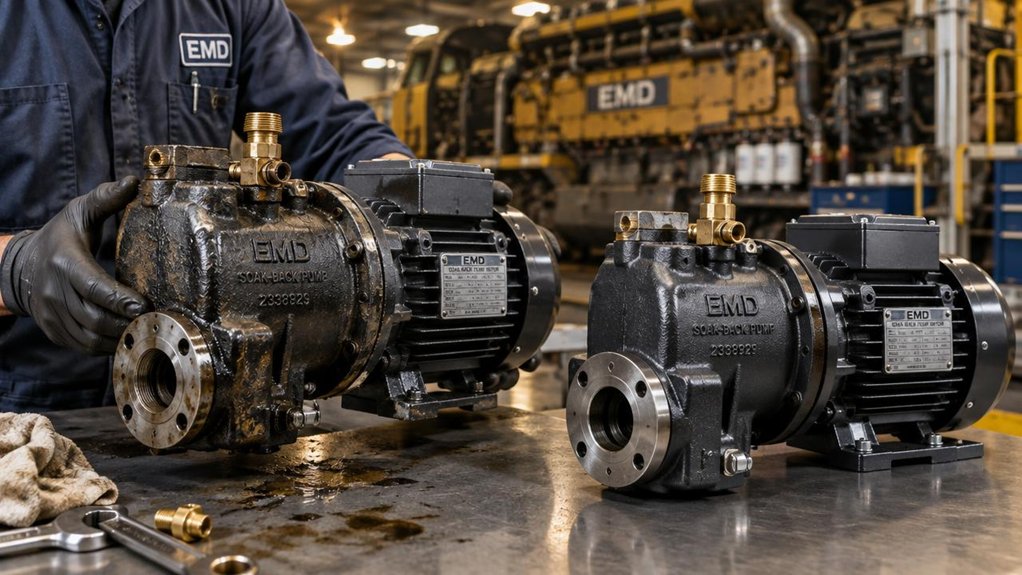
You’ll secure the right EMD soak-back pump by confirming your engine generation first, since 645 and 710 units differ in turbo model, lube piping, and control logic. Don’t trust part numbers alone. Supersessions like 40094071 to 40182032 usually run one way. Check the mounting bolt pattern, port threads, motor voltage, rotation, and connector before you order. Request written cross-reference confirmation and traceability records. Below, you’ll find the checks that keep costly mistakes off your locomotive.
Understanding the Soak-Back System on EMD Locomotives
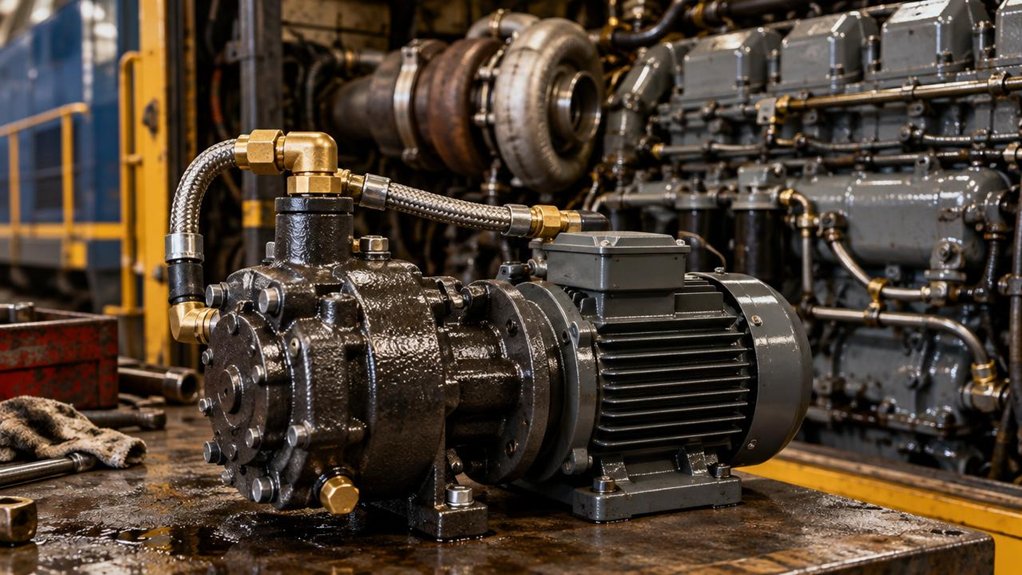
Your EMD turbocharger spins at extreme speeds and holds intense heat long after the engine stops. Without engine-driven oil pressure, those bearings rely on a separate electric pump to stay lubricated and cool. Before you source a replacement, you’ll want to understand how the EMD soak-back pump handles pre-lube and post-shutdown cycles.
What an EMD Soak-Back Pump Does for the Turbocharger
Because an EMD turbocharger spins at extreme speeds and runs very hot, its bearings can’t tolerate oil starvation. At low engine speeds, a gear train drives the turbo. When you shut the engine down, engine-driven oil pressure disappears. Residual heat stays trapped in the bearings. Your EMD soak-back pump solves this. It’s a separate electric motor-driven pump pushing filtered oil to turbo bearings. The oil carries heat away and stops it from carbonizing, so heat soak prevention becomes automatic. Before cranking, the same pump pre-lubricates those bearings.
You can trace the flow simply:
- Sump or strainer housing supplies the oil.
- Pump pressurizes it.
- Soak-back filter removes contaminants.
- Turbocharger bearings receive cooling lubrication.
- Return lines carry oil back.
Knowing this path makes diagnostic testing faster.
Pre-Lube and Post-Shutdown Cycles Explained
Knowing the oil path is only half the picture. You also need to understand when the pump runs. Before cranking, it pushes oil to the turbocharger bearings so they don’t start dry. After shutdown, a timer or control relay keeps it running for a set period. That flow carries heat away from the bearings and prevents oil coking.
Don’t worry if you hear the pump running after the engine stops. It’s normal operation, not a fault. Run duration and control logic vary by locomotive model and control system generation. Older units rely on relay logic, while newer ones use microprocessor control. Always check your maintenance manual for exact values. Use those figures during diagnostic testing, so you can confirm the cycle works as designed.
Decoding EMD Part Numbers and Supersession
Part numbers on a soak-back pump tell you more than you’d expect, if you know how to read them. You’ll find older EMD catalogs listing 7-digit numbers, while later parts carry 8-digit numbers starting with “40.” Once you understand that shift and Progress Rail’s supersession notes, you won’t have to guess at interchangeability.
How EMD and Progress Rail Part Numbering Evolved
If you’ve opened an older EMD parts book, you’ve seen numbers that don’t match today’s listings. That gap comes from EMD’s 7 digit history, when shorter numeric part numbers were standard. Later components followed an 8 digit evolution, using numbers that begin with “40.” Progress Rail, a Caterpillar company, then acquired EMD and consolidated its catalogs. It also updated some part numbers along the way.
Why does this matter to you? Your legacy fleet records, older parts books and rebuild documentation often list numbers missing from current price lists. Before ordering, clarify early numerics against the current Progress Rail catalog. Then map “40” series replacements to each legacy entry you find. This step keeps your soak-back pump order accurate and avoids costly fitment surprises.
Reading Supersession Notes Without Guesswork
A supersession note looks simple, but each phrase carries a specific instruction for your order. “Superseded by” means EMD or Progress Rail has retired the old number and assigned a newer one. “Replaced by” usually signals the same move, though the new part may differ in design or materials. “Use until exhausted” lets you install remaining stock of the old number before switching to the new one. “Interchangeable” means both numbers fit the same application without modification.
Most supersessions run one way. The new pump fits old applications, but the old pump may not fit newer ones.
- Read every related service bulletin.
- Check warranty notes for fitment conditions.
- Map the supersession chain in a cross reference table.
- Trace old numbers forward for ordering accuracy.
The Cross-Reference: 40182032, 40094071 and Earlier Numbers
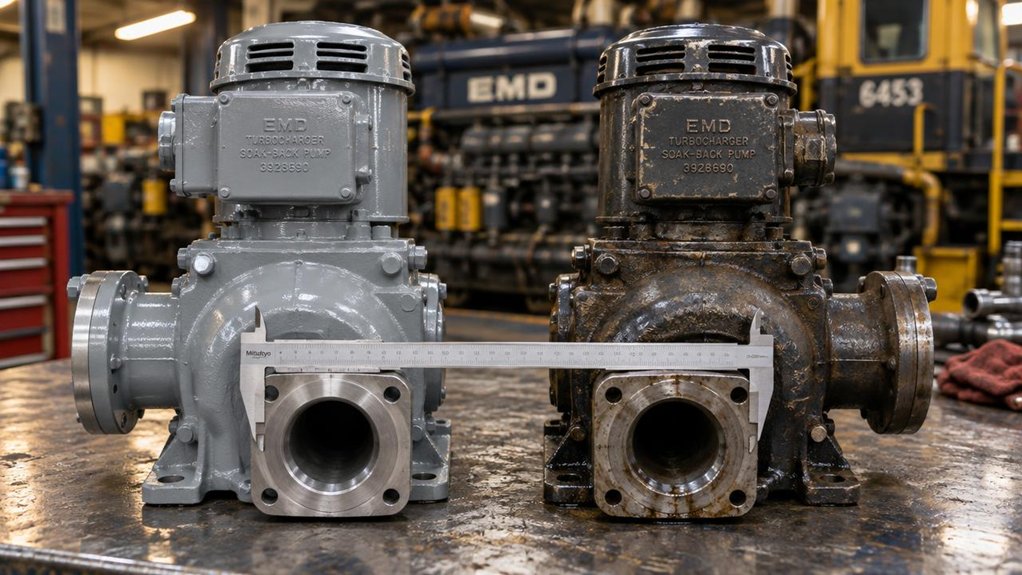
You’ll often see 40094071 and 40182032 side by side in catalogs, quotes and stores records. Knowing how they connect, and how both trace back to older 7-digit EMD numbers, protects your order. Start with where 40094071 fits, how to identify it on the engine, and where 40182032 enters the picture.
EMD Soak-Back Pump 40094071: Applications and Identification
Why does 40094071 turn up so often in EMD soak-back pump discussions? It’s a widely referenced assembly number across turbocharged EMD 645 and 710 applications. Still, you shouldn’t assume it fits every engine. Fitment varies by engine model and configuration.
Before ordering, identify your installed unit with these checks:
- Tag location: Find the pump tag on the housing and record every digit exactly.
- Data plate: Match the engine model and serial number against your locomotive records.
- Cast markings: Inspect the pump body for casting numbers, which often survive when tags fade.
- Motor nameplate: Confirm voltage, rotation and connector type, since these affect interchangeability.
Next, verify the specific locomotive and engine application in the current parts catalog. When records conflict, confirm directly with the OEM.
How 40182032 Relates to 40094071 and Legacy Part Numbers
Once you’ve identified the installed pump, the next step is tracing its part number history. Older EMD catalogs used 7-digit numbers. Later parts moved to 8-digit numbers beginning with “40.” Many references list 40182032 as superseding 40094071. That usually means one-way interchangeability: the newer pump replaces the older one, not always the reverse.
| Legacy Number | Intermediate Number | Current Number | Interchangeability Type | Notes |
|---|---|---|---|---|
| 7-digit EMD number | 40094071 | 40182032 | One-way (verify) | Confirm motor voltage, ports, mounting and connector |
Don’t treat this table as final. Supersession status can change, and suppliers may list numbers differently. Validate every entry against the latest Progress Rail catalog. Your pump tag and data plate must match the catalog. After fitting, run seal leak diagnostics and installation torque checks on the replacement.
Fitment, Specifications and Interchangeability Checks
A matching part number on paper doesn’t guarantee your replacement pump will bolt up and run correctly. Before you install 40182032 in place of 40094071, you’ll need to confirm voltage, mounting, ports, rotation and wiring. You’ll also want to account for differences between 645 and 710 engine applications that affect EMD soak-back pump fitment.
Technical Details to Verify Before Swapping Part Numbers
How can two pumps that do the same job refuse to share the same mounting pad? It happens because function doesn’t guarantee fit. Small physical or electrical differences can block a drop-in replacement on your 645 or 710 engine. Before you swap part numbers, run this pre-order checklist:
- Compare pump housings, mounting bolt patterns and filter interfaces against your existing unit.
- Verify duty ratings, including 74 VDC motor voltage, current draw and rotation direction.
- Match connector type so the pump plugs into your harness without splicing.
- Confirm port thread size for inlet and outlet fittings before you issue the order.
Don’t trust a catalog description alone. Photograph the old pump’s tag and housing, then share both with your supplier. Mismatches caught now cost less.
645 vs. 710 Engine Considerations for an EMD Soak-Back Pump
Separate your 645 and 710 records before you order a single EMD Soak-Back Pump. Each engine generation brings its own turbocharger model, lube piping and control logic. Compare turbocharged 645 engines, such as the 645E3 series, against 710G3 engines carefully. A piping layout mismatch can stop a pump from bolting up or sealing at the ports. Turbo control variance also matters, because timer and relay arrangements differ between generations.
These lifecycle differences can change which part number actually applies to your specific unit. Pump verification should consequently start with the engine model, not the locomotive’s road number alone. If you run a mixed fleet, keep one application record per engine generation. You’ll prevent cross-fleet ordering errors and avoid costly returns, delays or turbocharger damage.
Procurement Strategy and Maintenance Best Practices
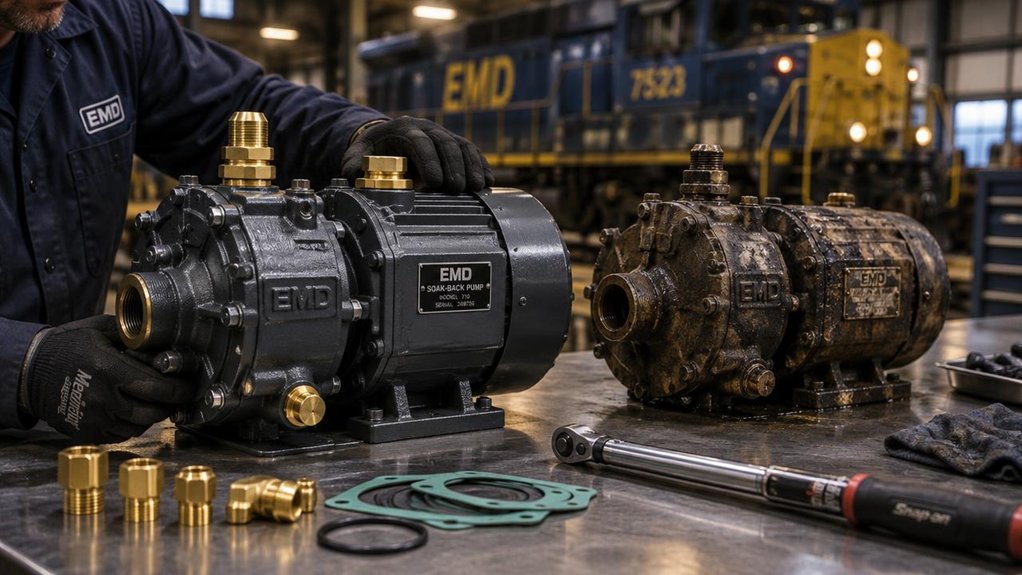
You’ve confirmed fitment, so your next decision is where to source your EMD Soak-Back Pump. Genuine OEM, aftermarket and remanufactured units each balance cost, lead time and traceability differently. We’ll also cover failure signs, testing methods and the ordering mistakes that put your turbocharger at risk.
Sourcing an EMD Soak-Back Pump: OEM, Aftermarket and Reman Options
Once you’ve confirmed the correct part number, the next decision is where to buy your EMD soak-back pump. Each route balances lead time, warranty, traceability and total cost of ownership differently.
- Genuine OEM supply: Progress Rail parts offer full documentation, but lead times can stretch. OEM only validation brings certainty, though it can raise costs.
- Aftermarket equivalents: Established suppliers can shorten delivery. Ask for certificates of conformance to reduce cross reference risk.
- Remanufactured or unit-exchange pumps: Core return lowers cost. Watch for warranty pitfalls, such as coverage voided by incorrect installation.
- Documentation checks: Request traceability records and perform counterfeit verification on every shipment.
Always request written cross-reference confirmation from your supplier. Still, never let supplier claims replace your own parts catalog verification before ordering.
Failure Signs, Testing and Avoiding Costly Ordering Mistakes
Catch a failing EMD soak-back pump early, and you’ll protect the turbocharger, one of your locomotive’s costliest assemblies. Watch for a pump that won’t run after shutdown, low soak-back pressure, a tripped breaker or blown fuse. Grinding or whining motor sounds are key noise vibration indicators, alongside turbo bearing distress. Test motor, relay and timer per your maintenance manual. Thermal soak verification confirms oil flow continues through the full post-shutdown cycle. One skipped check can cost you a turbocharger rebuild and days of downtime.
Ordering errors are just as costly. Don’t rely on old fleet records or ignore motor voltage and connector differences. Never skip data-plate checks. Follow this workflow: match engine and serial number, check the catalog, then compare the pump tag.
Frequently Asked Questions
What Does a Soak-Back Pump Do on an EMD Locomotive?
Your soak-back pump protects the turbocharger bearings before cranking and after shutdown. An ounce of prevention is worth a pound of cure, and this pump proves it. Through automatic priming, it pushes lube oil to the bearings before the engine turns. After shutdown, engine control keeps it running on a timer. That flow carries away trapped heat, so oil doesn’t coke. You’ll avoid costly turbo damage and unplanned locomotive downtime.
Is Part Number 40182032 Interchangeable With 40094071?
Often, yes, but usually in one direction only. 40182032 is generally the later number superseding 40094071, so the newer pump typically replaces the older one. That doesn’t guarantee a drop-in fit. You’ll still need to confirm motor voltage, mounting pattern, port configuration, rotation and connector type. Run compatibility testing against your existing pump tag and parts catalog. Then complete cross model validation, because 645 and 710 applications can differ considerably.
How Long Does the Soak-Back Pump Run After an EMD Engine Shuts Down?
A timer controls your soak-back pump’s post-shutdown run, and the duration varies by locomotive model and engine generation. You’ll find the exact interval in your maintenance manual. Some units also use thermostat control logic, keeping the pump running until turbocharger oil temperatures drop. If it stops early or never starts, don’t guess. Start with wiring fault diagnostics on the timer relay, connectors and 74 VDC supply to protect your turbocharger.
Does Extreme Cold Weather Affect EMD Soak-Back Pump Performance or Run Time?
Yes, extreme cold affects soak back pump efficiency, though the timer usually keeps run time fixed. Thickened oil raises motor load and slows flow to the turbocharger bearings. Low battery voltage on the 74 VDC supply can worsen these run time impacts. You’ll protect cold weather reliability by checking motor current, oil pressure and relay function. During winter testing, confirm settings against your maintenance manual. Don’t assume summer readings apply.
Can a Failed Soak-Back Pump Void a Turbocharger Warranty Claim?
Yes, it can, and the clue often hides inside the bearing housing. Coked oil and scored journals tell investigators a lubrication story. Warranty reviewers ask one question: did your soak-back system work? If logs can’t prove it, they’ll likely deny coverage. Terms vary by supplier, so read yours carefully. To determine warranty eligibility, you should inspect pump failure records, timer tests and relay checks. Keep that evidence documented before you file.