

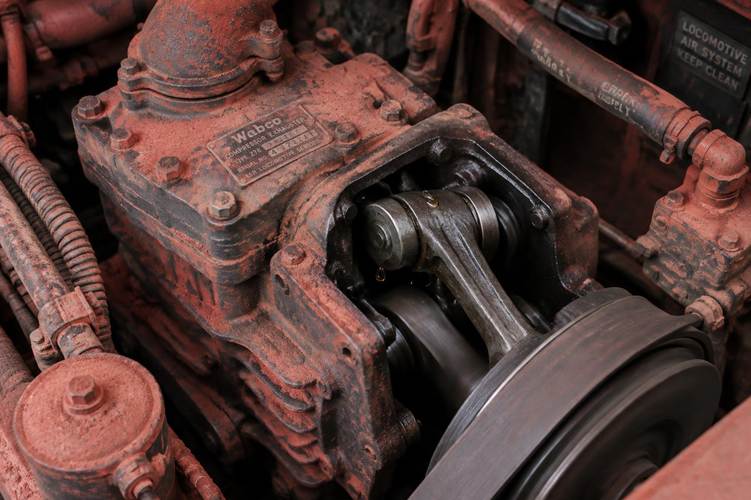
A compressor exhauster that seizes up 400 kilometres west of Broken Hill is not an inconvenience. It is a stranded train, a blocked line, and a very long wait for a road crew to reach the middle of nowhere with the right parts.
After twenty-odd years crawling around diesel-electric locomotives on Australian tracks, this author has seen more failures traced back to poor oil flow than to almost any other single cause. The exhauster keeps the compressor breathing, and the compressor keeps the brakes and auxiliary systems working. Starve the crankshaft of oil for even a short stretch, and the whole chain falls apart fast.
This article walks through the three crankshaft oil systems that have earned their keep on Australian rail networks, and why the fanciest option on paper is not always the one you want under your hood. Some engineers get seduced by complexity. This author has learned, the hard way, that dead simple often beats clever when you are hundreds of kilometres from the nearest workshop.
Here is what the article covers:
- Why oil flow matters so much for compressor exhausters in harsh, dusty, remote conditions
- The pressure-fed system built for heavy-haul locomotives doing the long, hard slog
- Splash lubrication – old-school, low-fuss, and still surprisingly capable for shunting duties
- Hybrid systems that try to blend the strengths of both approaches
- How to match the right system to your fleet and your patch of Australian track
By the end, readers will know exactly what separates these three systems, and – more importantly – how to judge which one suits their own operation. Because the “best” system was never really about bells and whistles. It is about the one that keeps running when everything around it is red dirt, heat, and no phone signal.
Why Compressor Exhausters Need Spot-On Oil Flow Down Under
Ask any yard foreman what breaks first on a locomotive left running through summer, and the compressor exhauster comes up fast. It’s not glamorous kit. It sits there quietly pulling air, but without it, nothing else on the train works properly.
What This Little Unit Actually Does
A compressor exhauster uses exhaust gas energy from the diesel engine to drive a small turbine, which in turn compresses air. That air isn’t a luxury – it feeds the braking system and runs auxiliary equipment, and it needs to hit pressures up to 200 PSI to do the job properly.
That’s a serious amount of pressure for a component roughly the size of a large toaster. Every moving part inside relies on a thin film of oil to stop metal grinding against metal at speed.
The Three Things Fighting Against That Oil Film
Heat is the first enemy. Average daily temperatures across much of the country regularly climb past 35°C, and inside an engine bay that number is much worse. Oil starts breaking down chemically well before it looks dirty, losing viscosity right when the bearings need it most.
Dust is the second problem, and it’s brutal in places like the Pilbara, where fine red grit works its way into every seal and breather. Once dust gets into the oil, it behaves like a very slow, very expensive grinding paste on bearing surfaces.
Distance is the third. A run from Perth to Sydney covers roughly 3,900 kilometres, often with a single crew and limited stops. There’s no popping the hood every 200 kilometres to check oil condition – the system has to look after itself for days at a stretch.
Pro Tip: Check oil condition (not just level) before any run over 1,000 kilometres – heat-thinned or dust-loaded oil can look fine on the dipstick and still be failing at the bearing surface.
What Happens When Lubrication Falls Short
Bearings run hot, seals harden and crack, and the exhauster’s working life gets cut down from years to months. I’ve pulled units apart that should’ve had another five years left, killed early by grit-laden oil nobody bothered testing. That’s an entirely avoidable failure.
Get the oil system wrong and you’re not just replacing a part – you’re risking a stranded train with no air brakes. Companies serious about uptime, like Mikura International, treat lubrication specs as a first-order design decision, not an afterthought bolted on later.
Heat, dust, and distance don’t operate alone – they compound each other on every long-haul route. That combination is exactly why the choice of oil system matters so much more here than it might on a short suburban shunt.
The Robust Pressure-Fed System for Heavy Haulers
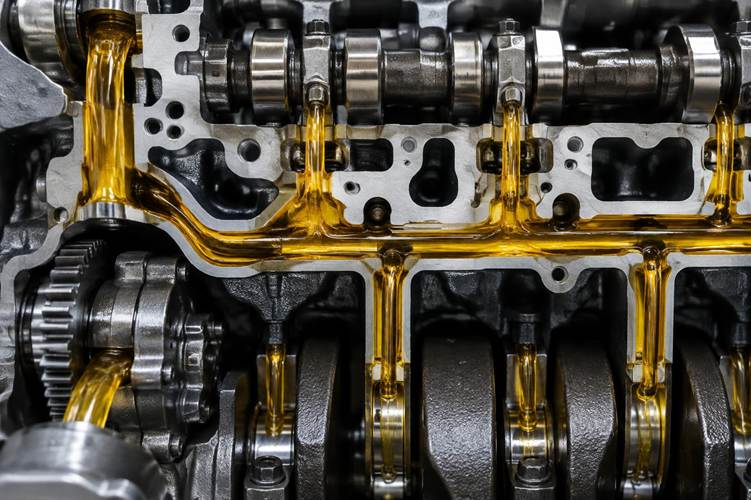
None of that oil damage happens in the same way once you fit a system built to force lubricant where it needs to go, rather than hoping gravity and splash do the job. That’s the whole premise behind pressure-fed lubrication, and it’s why you’ll find it under the hood of most serious freight power in this country.
Unlike systems that rely on rotating parts flinging oil around, a pressure-fed setup uses a dedicated oil pump, usually gear-driven off the crankshaft itself, to push lubricant through the engine at 40 to 60 PSI. That’s a real, measurable pressure, not a hopeful trickle. It’s the difference between watering a garden with a hose and just waiting for rain.
What’s Actually in the System
Strip one down and you’ll find three main players doing the work.
- The oil pump – draws oil from the sump and forces it into the system under constant pressure, rather than letting engine motion do the job.
- The filter – typically rated to 10 microns, fine enough to catch the abrasive grit that would otherwise chew through bearing surfaces.
- The oil galleries – internal channels drilled through the engine block that carry pressurised oil directly to the crankshaft, bearings, and compressor exhauster components that need it most.
This is why you’ll see pressure-fed systems as the standard on EMD and GE locomotives running for operators like Pacific National and Aurizon. These aren’t light-duty shunting units. They’re hauling heavy freight over long distances, and that kind of sustained load punishes any lubrication system that isn’t actively forcing oil to the right places under pressure.
Where the Maintenance Effort Goes
The trade-off, and it is a real one, is complexity. More components means more things to check, and pressure-fed systems typically get folded into 90-day service schedules rather than left to run indefinitely between inspections.
- Check filter condition – a clogged 10-micron filter drops line pressure fast, and that’s when bearings start starving.
- Test pump output pressure – readings outside the 40-60 PSI band usually point to wear in the gear drive or a failing pump.
- Inspect galleries for blockage – dust ingress, even filtered, can build up sludge deposits over years of service.
I’ll say it plainly: for anything hauling serious tonnage over serious distance, pressure-fed is the only system I’d trust. It costs more in upkeep, but it earns that cost back in engine life. Whether that complexity is worth it for lighter duty work is a different question entirely, and one worth weighing against simpler splash-fed or hybrid setups.
Splash Lubrication’s Simple Charm for Shunters
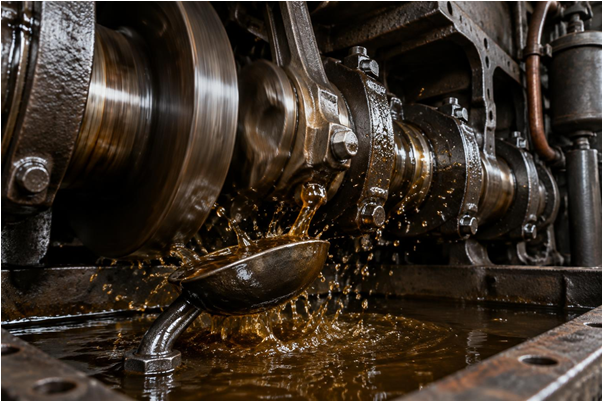
A splash system does the same basic job with a fraction of the parts, and for a yard shunter, that’s exactly the point. There’s no pump pushing oil anywhere. No filter housing to crack open every service. Just dippers or slingers fixed to the crankshaft, spinning through a sump of oil and flinging it up onto the bearings and cylinder walls as they pass.
That’s it. That’s the whole mechanism. I’ve always had a soft spot for this design because it reminds me of the old farm engines I grew up around – no electronics, no sensors, just a rotating part doing double duty as its own lubrication pump.
Why Fewer Parts Means Fewer Headaches
Cut the pump, cut the filtration stage, cut most of the plumbing, and you’ve cut a lot of what can actually go wrong. Some estimates put the component count reduction at up to 70 percent compared to a pressure-fed setup. Fewer parts, fewer failure points – that’s not a slogan, that’s just arithmetic.
It also shows up in the price tag. A splash-lubricated compressor unit typically runs 30 to 50 percent cheaper upfront than its pressure-fed equivalent. For a rail operator running a fleet of shunters that spend their whole life inside a yard boundary, that’s real money saved on units that were never going to see the hard running that justifies the pricier system anyway.
Where It Actually Earns Its Keep
You’ll mostly find splash lubrication tucked into older or smaller compressor units – the kind bolted onto a shunt engine shuffling wagons around a marshalling yard, or a light unit on a short regional passenger run. Low speeds, short bursts of work, and nowhere near the sustained load a mainline freight engine deals with.
In that setting, it’s not a compromise. It’s the right tool. Overspeccing a yard shunter with a full pressure-fed exhauster is a bit like fitting a industrial tractor engine to a garden mower – technically impressive, practically pointless.
Where It Falls Over
The catch is consistency. Splash lubrication depends on the crankshaft moving fast enough, and the sump holding enough oil, to keep the splash reliable under all conditions. Push the load up, or run at low idle for extended periods, and oil delivery gets patchy in exactly the spots that need it most.
That’s a real limitation, not a minor footnote. It’s also exactly the gap that hybrid designs try to close – borrowing the simplicity of splash for most operating conditions while adding just enough forced delivery to cover the moments splash alone can’t handle.
Combining the Best: Hybrid Systems for Versatility
Rather than picking a side, some manufacturers just split the job down the middle. A hybrid lubrication system feeds oil under pressure to the main bearings – the parts carrying the heaviest, most constant load – while letting the connecting rod bearings get by on splash, the way a dipper flings droplets around with each rotation. It’s not a compromise so much as a deliberate division of labour.
Why Split the Job at All?
The main bearings sit at the crankshaft’s core, and they cop the punishment first if oil supply falters. Give them a dedicated pressure feed and you’ve covered the weakest point without building a full pressure system around every moving part.
That means a smaller pump, fewer galleries to drill and maintain, and less plumbing overall compared to a complete pressure-fed setup. The connecting rod bearings still get splash-fed oil, which is fine, because they’re generally more tolerant of the odd inconsistent moment than the mains are.
Where You’ll Actually Find These
This isn’t some theoretical middle ground dreamed up on a whiteboard. Gardner Denver and Knorr-Bremse both build mid-range compressor units around this exact split, and they’ve shown up in plenty of regional freight and commuter fleets around the country. Not the heaviest haul work, not the lightest shunting duty – something in between.
The wear reduction is the real selling point here. Splash alone tends to starve bearings during long idle stretches; hybrid design solves that specifically where it matters most, while leaving the simpler splash approach doing what it does fine everywhere else.
| Feature | Hybrid System |
| Main bearing lubrication | Pressure-fed |
| Connecting rod lubrication | Splash-fed |
| Pump size vs full pressure system | Smaller, less complex |
| Typical application | Regional freight, commuter services |
Cost-wise, it sits where you’d expect – pricier than a bare-bones splash unit, but nowhere near what a full pressure-fed system demands in pumps, filters and galleries. For an operator running a mid-tier duty cycle, that’s often the sweet spot: better protection than splash alone, without paying for capability you won’t use.
Whether that trade-off actually beats a straight pressure-fed or splash setup for a given job is a different question – and one that really only makes sense once you line all three up side by side.
Choosing Your Compressor’s Lubrication for Australian Conditions
Picking the wrong lubrication system doesn’t fail you gently – it fails you at the worst possible moment, usually somewhere without phone reception. A triple-header hauling iron ore needs the sustained protection of a pressure-fed setup, full stop. That’s not an opinion, it’s a function of load: three locomotives dragging tonnage across hundreds of kilometres cannot afford inconsistent oil delivery to a compressor exhauster keeping the brakes charged.
Shunting yards sit at the other end. Short bursts, low speeds, engines that shut down and restart constantly – a splash system’s simplicity actually wins here, because there’s less to maintain and less that can go wrong on a unit doing gentle, repetitive work.
Match the System to the Duty Cycle, Not the Budget Sheet
Regional passenger services occupy the awkward middle ground. Longer runs than a shunter, but nowhere near the continuous strain of a freight consist – this is where a hybrid setup earns its keep, balancing protection against complexity.
Here’s the decision framework I actually use in the field:
- Duty cycle: continuous heavy load, intermittent short bursts, or something in between?
- Environment: how much dust and heat is the exhauster exposed to daily?
- Staff skill: can your depot handle a more complex system, or do you need something a junior fitter can service unsupervised?
- Total cost of ownership: what does the system cost over ten years, not just on day one?
That last point trips people up constantly. A cheaper system that fails twice a year on a remote freight corridor is not cheap – it’s a liability wearing a low price tag.
Pro tip: Ask any supplier for their oil analysis program before signing anything. A properly run analysis program – regular sampling, tracked wear metals, moisture checks – can stretch service intervals by 15 to 20 percent, which on a fleet of any size is real money back in your pocket.
Don’t skip the regulatory box either. Anything running on the network needs to meet AS 4292.1-2006, the standard covering rail safety systems, and that shapes which components are even legal to fit. Ask your supplier directly whether their unit is certified against it – if they hesitate, that’s your answer.
Ask suppliers three things before you commit: what’s the mean time between failures in dusty conditions, what does a rebuild kit cost, and can your existing crew service it without factory training. If they can’t answer all three cleanly, keep shopping.
Conclusion
There’s no single “best” crankshaft oil system – only the best system for the job the locomotive actually does. A pressure-fed setup wasted on a light shunter is like fitting a header tank to a ride-on mower. Overkill costs money and adds complexity nobody needed.
The engineer who chooses lubrication based on duty cycle, not brochure claims, is the one who avoids being stranded outside Broken Hill with a seized bearing.
- Pressure-fed systems earn their keep on heavy-haul routes where sustained load and long distances demand constant, forced oil delivery.
- Splash lubrication remains a smart, low-maintenance choice for shunters doing light, intermittent duty around the yard.
- Hybrid systems split the difference, handling variable workloads without the full cost or complexity of a full pressure system.
- Regular oil analysis catches problems early – around 80% of lubrication-related failures show warning signs before they become breakdowns.
- Remote Australian conditions punish over-engineered systems; simplicity and serviceability often matter more than raw specification sheets.
The next step is practical, not theoretical. Pull the maintenance logs on the locomotive’s current oil system, check when the last oil analysis was done, and if it’s been longer than the recommended interval, book one this week.
Reliability isn’t bought off a spec sheet – it’s built through choosing the right system and never skipping the checks that keep it honest.