

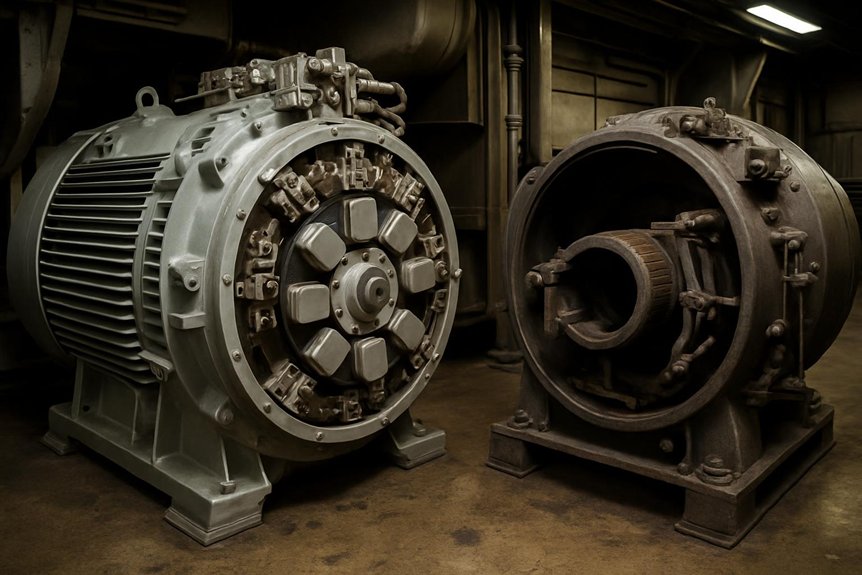
The biggest difference you’ll notice is how excitation is regulated. Earlier DC generators relied on vibrating relay-type mechanical regulators that cycled contacts to maintain a voltage band, introducing response lag and setpoint hysteresis. The D87 replaces that entire approach with a solid-state AVR feeding a brushless rotating exciter, delivering millisecond-level excitation adjustments without mechanical wear. It also integrates directly with EMD’s EM2000 microprocessor for closed-loop optimization—and the operational implications run deeper than you’d expect.
What are the primary differences in excitation control between EMD’s D87 traction alternators and earlier DC generator models?
DC generator excitation relied on a compound-wound field and a mechanical regulator. These regulators used vibrating contacts to limit current. Brushes and commutators required frequent maintenance. Voltage regulation was slow and imprecise. Overloads could cause flashovers. Engineers manually adjusted field resistance for different loads.
In contrast, the D87 traction alternator uses a brushless, three-phase AC design. Excitation comes from a rotating exciter and a solid-state automatic voltage regulator. The AVR rapidly modulates the exciter field current. This responds to load changes in milliseconds. No carbon brushes are needed. The system delivers smooth, stable DC output after rectification.
The biggest leap is digital integration. The D87’s excitation control interfaces with the locomotive’s EM2000 microprocessor. This enables real-time traction motor control. It automatically adjusts for wheel-slip and engine power limits and improves fuel economy and reliability. It eliminates manual tuning. Maintenance costs drop significantly. Electronic excitation control transforms locomotive performance over outdated DC generators.
Key Takeaways
- The D87 replaces mechanical vibrating-relay voltage regulators with a solid-state AVR, enabling millisecond-level excitation adjustments without mechanical wear.
- D87’s brushless rotating exciter eliminates commutators and carbon brushes entirely, removing flashover risks inherent in earlier DC generator designs.
- Earlier DC generators required manual field resistance adjustments, while D87 excitation is automatically optimized through EM2000 microprocessor integration.
- Mechanical regulators produced delayed, oscillating voltage bands with setpoint hysteresis, whereas D87 delivers precise, continuous real-time voltage correction.
- D87 uses closed-loop feedback incorporating wheel-slip, RPM, and throttle data for instant excitation correction requiring zero manual operator intervention.
The Evolution of Excitation in EMD Locomotives
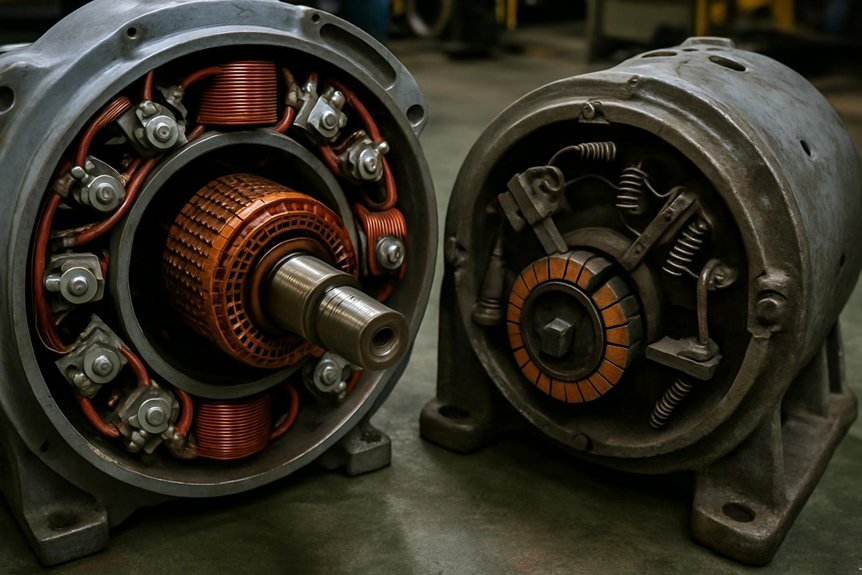
EMD’s shift from compound-wound DC generators to the brushless D87 traction alternator redefined locomotive excitation control. You’ll find the D87 alternator excitation control replaces mechanical voltage regulators with solid-state, microprocessor-integrated systems. Understanding this evolution helps you evaluate reliability, maintenance costs, and procurement decisions for your fleet.
The Era of DC Generators
The earliest EMD locomotives relied on compound-wound DC generators for traction power. You’d find a mechanical voltage regulator governing exciter output. Vibrating contacts cycled rapidly to limit field current. This method responded slowly to load transients. Voltage overshoot was common during sudden demand changes.
Carbon brushes rode against segmented commutators continuously. You had to inspect and replace them at short intervals. Commutator flashovers posed serious risks under field surge conditions. Overloads could arc across segments without warning.
Manual field resistance adjustments were standard practice. Engineers tuned excitation for each throttle notch. Operating near thermal limits demanded constant vigilance. Excessive heat degraded insulation and shortened generator lifespan. These systems delivered adequate power but demanded intensive maintenance. D87 alternator excitation control later eliminated most of these constraints entirely.
Introduction of the D87 Alternator
When EMD introduced the D87 traction alternator, it fundamentally redefined locomotive excitation architecture. You’re looking at a three-phase brushless power source. It eliminates commutators, carbon brushes, and mechanical voltage regulators entirely. The D87 uses a rotating exciter feeding the main alternator field. Rectifier assemblies then convert AC output to DC for traction motors.
The solid-state AVR replaces vibrating-contact regulators with semiconductor switching. You get millisecond-response excitation adjustments. Electronic startup sequences replace manual field resistance settings. This means faster, more predictable power delivery under varying load conditions.
The D87’s design integrates directly with EMD’s EM2000 microprocessor. This enables real-time excitation optimization. Mikura International supplies D87 alternator components to rail operators worldwide seeking reliable procurement channels.
Why Excitation Control Matters
Because excitation current directly governs traction motor output, it controls torque, adhesion, and fuel burn. You can’t optimize locomotive performance without precise excitation management. Traction torque sensitivity means even small voltage deviations affect drawbar pull. Unstable excitation causes wheel slip and rail damage.
The adhesion optimization impact of modern D87 alternator excitation control is measurable. You’ll see improved train handling across all throttle notches. The solid-state voltage regulation responds faster than any mechanical regulator. It adjusts exciter field current before wheel slip develops.
Poor excitation wastes fuel and accelerates component wear. You lose revenue when locomotives derate due to unreliable voltage control. Effective excitation isn’t optional—it’s the foundation of locomotive power management and operational efficiency.
How Traditional DC Generator Excitation Worked
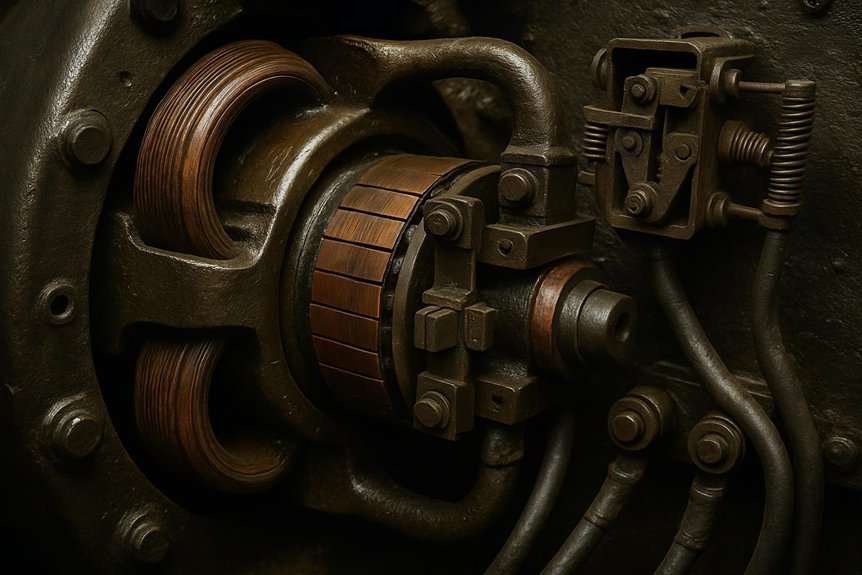
When you examine legacy DC generator excitation, you’ll find mechanical voltage regulators governed output through vibrating contacts. You also had to maintain carbon brushes and commutators on strict inspection cycles. Manual field resistance adjustments added operational complexity and slowed your locomotive’s response to load changes.
Mechanical Voltage Regulators
How exactly did early EMD locomotives maintain stable traction voltage under varying loads? They relied on vibrating relay-type regulators. These regulators cycled contacts rapidly to modulate field current. You’d find them mounted near the main generator frame. Their operation was straightforward but inherently limited.
The relay contacts opened and closed at fixed intervals. This created setpoint hysteresis in the regulated voltage output. You couldn’t achieve fine-grained control with this approach. Voltage would oscillate within a band rather than hold steady.
Contact wear was the primary failure mode you’d encounter. Carbon buildup and pitting degraded contact surfaces over time. This worsened regulation accuracy progressively between maintenance intervals. You’d need to inspect and dress contacts frequently. Each maintenance event meant locomotive downtime and added labor costs.
Brush and Commutator Maintenance
These combined tasks drove labor costs upward and reduced fleet availability. Your maintenance crews spent significant hours on repetitive mechanical servicing. The D87 alternator’s brushless design eliminates this entire maintenance category. You redirect those labor hours toward higher-value system diagnostics instead. Mikura International supplies D87 components engineered for extended, maintenance-reduced operation.
Manual Field Adjustments and Their Drawbacks
Beyond brush and commutator upkeep, DC generators demanded constant manual field adjustments. You had to physically set field-shunting resistors for each service condition. This process couldn’t adapt to dynamic load changes in real time.
Field shunting delays directly impacted traction performance. Each resistor adjustment introduced lag between demand and response. You couldn’t match excitation output to rapidly shifting rail conditions.
These delays created persistent load mismatch issues across traction motors. Uneven current distribution accelerated wheel slip and component wear. You risked flashovers when excitation exceeded safe operating thresholds.
Manual tuning also required skilled personnel at every maintenance interval. This inflated labor costs and extended locomotive downtime. The D87 alternator excitation control eliminates these inefficiencies through solid-state voltage regulation and microprocessor integration.
Inside the D87 Traction Alternator’s Electronic Excitation
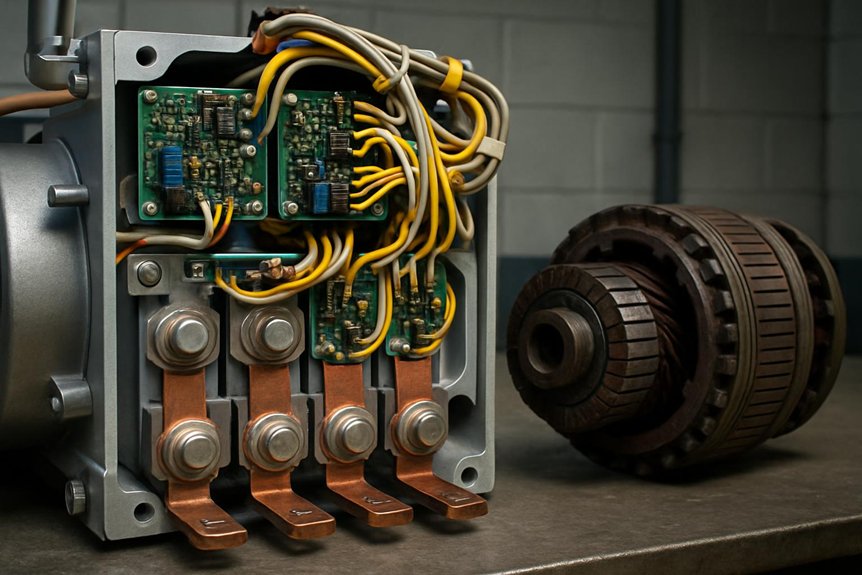
When you examine D87 alternator excitation control, three core innovations separate it from legacy DC systems. The brushless excitation design eliminates carbon brushes and commutator maintenance entirely. Solid-state voltage regulation and EM2000 microprocessor integration then deliver real-time, precision traction power management.
Brushless Excitation Design
How does the D87 alternator excitation control eliminate brushes entirely from the power chain? A pilot exciter generates AC power. That AC is rectified and fed to the main exciter field. The main exciter then powers the alternator’s rotating field. No carbon brushes contact any rotating component. This drastically simplifies brushless maintenance scheduling across your fleet.
You’ll find pilot exciter diagnostics essential for predictive maintenance programs. Monitoring exciter output voltage confirms system health instantly.
- Zero brush wear eliminates commutator resurfacing and carbon dust contamination
- Rotating rectifier assembly converts exciter AC to DC without slip rings
- Pilot exciter provides autonomous initial field current generation
- Reduced forced outages from eliminated brush-related flashover risks
- Simplified spare parts inventory supports streamlined locomotive power management procurement
Solid-State Automatic Voltage Regulation (AVR)
The brushless architecture removes mechanical contact points from the D87’s power chain. You’ll find the AVR uses power transistors to modulate exciter field current continuously. It achieves microsecond-level response without mechanical wear. This solid-state voltage regulation eliminates vibrating contact regulators entirely.
| Feature | AVR Specification |
|---|---|
| Response Time | Microsecond-level adjustment |
| Fault Tolerance | Redundant sensing circuits with automatic failover |
The AVR’s protection logic monitors output voltage, current, and temperature simultaneously. You’re getting real-time overcurrent and overvoltage safeguards built into the controller. If parameters exceed thresholds, the system reduces excitation instantly. This prevents flashovers that plagued earlier DC generators. Mikura International supplies these critical AVR components for D87 alternator excitation control systems worldwide.
Microprocessor Integration and Real-Time Control
Because the D87 alternator’s excitation controller interfaces directly with EMD’s EM2000 microprocessor, it achieves closed-loop power optimization. The system maps engine RPM, throttle notch, and wheel-slip data continuously. It then adjusts exciter field current in real time. This eliminates manual tuning entirely.
- Wheel-slip correction occurs within milliseconds via EM2000 feedback loops.
- Throttle notch response matches alternator output to engine power limits automatically.
- Remote diagnostic capability lets maintenance crews identify excitation faults off-site.
- Communication protocol integration enables seamless data exchange between subsystems.
- Fuel optimization results from precise load-matching across all operating conditions.
You gain predictive maintenance insights through continuous sensor monitoring. The EM2000’s communication protocol standardizes data flow between excitation control and traction systems. Mikura International supplies D87 alternator components supporting these advanced integration requirements.
Key Performance Differences That Impact Operations
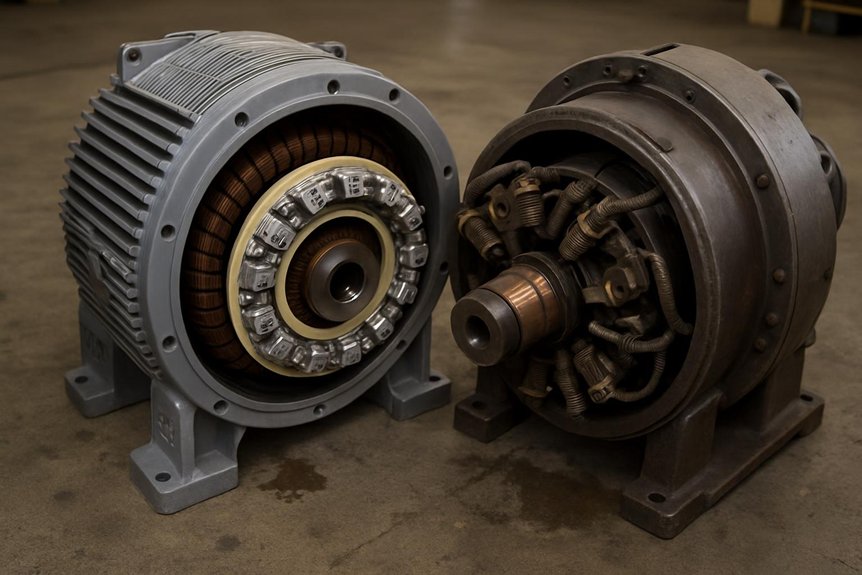
You’ll notice the D87 alternator excitation control outperforms legacy DC generators in three critical areas. Its solid-state voltage regulation delivers faster response time, extended maintenance intervals, and measurable fuel savings. These differences directly affect your locomotive power management, fleet availability, and lifecycle operating costs.
Response Time and Load Matching
When a locomotive encounters sudden grade changes or consists variations, excitation response time becomes operationally critical. The D87 alternator’s solid-state AVR achieves real time voltage sensing and correction within milliseconds. This prevents power sag during sudden load increases. Traction motors receive smooth, uninterrupted supply throughout load transients matching demands precisely.
Older DC generators relied on mechanical regulators with vibrating contacts. Their response lagged noticeably behind dynamic operating conditions.
- D87 excitation adjustment occurs in milliseconds, removing voltage dips during rapid load shifts.
- Real time voltage sensing feeds continuous data to the EM2000 microprocessor.
- Load transients matching is automatic, requiring zero manual intervention from operators.
- Mechanical regulators introduced dangerous response delays, risking commutator flashovers.
- Stable DC output after rectification ensures consistent traction motor performance.
Reliability and Maintenance Intervals
DC generators demanded frequent manual inspection and field resistance adjustment. The D87 eliminates that burden. Mikura International supplies critical D87 components engineered for these extended maintenance cycles. Your lifecycle costs drop measurably with each avoided service intervention.
Fuel Efficiency and Adhesion Control
The D87 alternator excitation control directly optimizes fuel consumption through precise power matching. You’ll see measurable fuel savings when excitation responds in milliseconds. The system keeps the prime mover at best fuel map points. This eliminates wasteful over-fueling during load transitions.
Automated adhesion management reduces wheel-slip events before they escalate. You avoid unnecessary sanding and minimize wheel wear across your fleet.
- Precise excitation matches alternator output to real-time tractive effort demands
- Traction optimization algorithms adjust field current faster than mechanical regulators ever could
- Wheel-slip correction occurs automatically through EM2000 microprocessor feedback loops
- Reduced wheel wear extends bogie component lifecycles and lowers maintenance budgets
- Lower sanding frequency cuts consumable costs and improves rail-head conditions
Procurement Considerations for Modern Excitation Systems
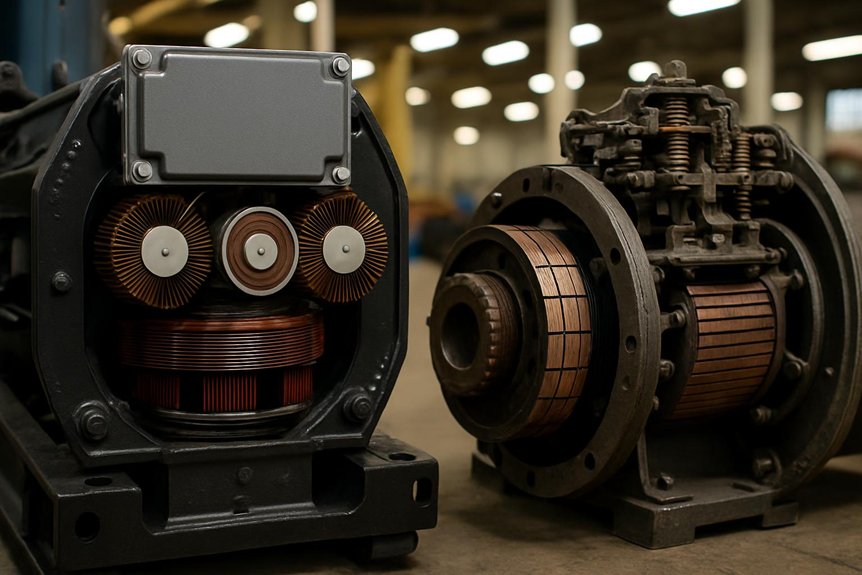
When you evaluate D87 alternator excitation control systems, lifecycle cost analysis reveals clear advantages over legacy DC generators. You’ll need to weigh retrofit feasibility against new-build procurement based on your fleet’s existing platform specifications. Selecting solid-state voltage regulation now future-proofs your locomotives for EM2000 digital integration and evolving power management requirements.
Lifecycle Cost Analysis
Although D87 alternator excitation control systems carry higher initial acquisition costs, they deliver superior total cost of ownership. You’ll recover the price differential through measurable operational savings.
- Reduced maintenance scheduling intervals: Brushless design eliminates commutator resurfacing and brush replacement cycles.
- Improved reliability metrics: Solid-state AVR components outperform mechanical vibrating regulators by significant margins.
- Lower fuel consumption: Digital excitation optimization reduces diesel fuel burn per gross ton-mile.
- Decreased unplanned downtime: Fewer mechanical wear points mean fewer in-service failures.
- Extended overhaul intervals: D87 alternators sustain performance longer between major inspections.
You should factor these cumulative savings into your procurement analysis. Mikura International supplies genuine D87 alternator excitation control components with full traceability documentation for your fleet standardization programs.
Retrofit vs New Build Options
Because older DC-generator locomotives remain operational across many fleets, procurement teams face a pivotal decision. You must evaluate retrofit integration against factory-equipped D87 alternator builds. Each path carries distinct trade-offs.
| Factor | Retrofit Integration | New Build (D87) |
|---|---|---|
| Upfront Cost | Moderate | Higher |
| Excitation Control | Upgraded AVR + alternator | Factory-calibrated D87 system |
| EM2000 Compatibility | Requires wiring modifications | Native digital integration |
| Downtime | Extended shop time | Immediate deployment |
| Long-Term ROI | Strong | favorable |
Your cost comparison should account for wiring harness redesign, rectifier installation, and recalibration labor. Retrofit integration demands careful engineering validation. However, it extends locomotive service life notably. For fleet-wide standardization, new-build D87 units from Mikura International deliver superior excitation control consistency.
Future-Proofing with Digital Controls
Rising, fleet operators recognize that D87 alternator excitation control isn’t merely an upgrade—it’s a tactical investment. Its digitized sensing architecture interfaces directly with EM2000 microprocessors. This guarantees compatibility with evolving smart-rail platforms. Adaptive field control enables real-time exciter modulation across differing load profiles.
Key procurement considerations for modern excitation systems include:
- Telemetry integration — D87 supports remote diagnostics and predictive maintenance workflows
- Scalable firmware — Software updates extend system capability without hardware swaps
- Data logging — Continuous operational records streamline compliance and fleet analytics
- Interoperability — Digital protocols align with next-generation locomotive control networks
- Lifecycle value — Reduced maintenance and improved fuel efficiency lower total ownership costs
You’re not just buying components. You’re securing long-term operational relevance. Mikura International supplies genuine D87 alternator components worldwide.
Frequently Asked Questions
What Is the Main Advantage of D87 Alternator Excitation Over Old DC Generator Systems?
The D87 alternator excitation control is a beacon replacing the flickering lamp of mechanical regulation. You’ll experience a reduced maintenance burden by eliminating brushes, commutators, and vibrating contacts entirely. Its solid-state AVR delivers millisecond-level response, ensuring faster fault recovery during load transients or wheel-slip events. You’re gaining brushless traction alternator reliability paired with EM2000 digital integration. This means precise voltage regulation, automated power management, and notably lower lifecycle operating costs.
Can a Locomotive With a DC Generator Be Upgraded to D87-Style Electronic Excitation Control?
Yes, you can retrofit a DC generator locomotive to D87-style electronic excitation control. Retrofitting feasibility depends on your platform’s mechanical and electrical compatibility requirements. You’ll face upgrade challenges including mounting modifications and power bus reconfiguration. Control integration with existing governor and load regulator systems requires careful systems-level analysis. You’ll need a solid-state AVR and compatible rectifier assembly. Mikura International can supply specification-driven D87 alternator components for your retrofit project.
How Does the D87 Excitation Control System Improve Locomotive Fuel Consumption?
The D87’s AVR matches exciter field current to real-time engine load demands. You’ll achieve harmonic stability improvement across all notch positions. This prevents energy waste from over-excitation. The EM2000 interface optimizes power output per gallon of fuel consumed. Digital diagnostics coverage lets you identify inefficiencies before they escalate. You’re reducing parasitic losses and eliminating manual field adjustments. Overall, fuel savings typically reach 5–8% compared to legacy DC generator configurations.
What Diagnostic Tools Are Recommended for Troubleshooting D87 Alternator Excitation Faults Onsite?
You’ll need a calibrated digital multimeter for onsite multimeter checks of exciter field resistance and AVR output voltage. Perform insulation resistance testing using a megohmmeter on stator and exciter windings. Connect the EM2000 diagnostic laptop to read real-time excitation fault codes. You should also verify rectifier diode integrity with forward-bias drop measurements. These tools let you isolate solid-state voltage regulation faults quickly and accurately.
How Does Ambient Temperature Affect D87 Solid-State Voltage Regulation Performance in Locomotives?
Ambient temperature directly impacts your D87’s solid-state voltage regulation performance. As temperatures rise, you’ll encounter temperature shifting in semiconductor components, reducing regulator effectiveness. The AVR compensates within its rated temperature boundaries, typically –40°C to +85°C. Beyond these thresholds, output steadiness degrades noticeably. You should monitor heat sink conditions and ensure adequate airflow. Thermal derating curves in EMD specifications help you predict performance under extreme operating environments.