

Marine engine overheating causes unexpected shutdowns, costly repairs, and dangerous power losses at sea.
Poor coolant flow silently destroys engine components.
Most operators detect problems only after significant damage occurs.
Understanding coolant flow optimization prevents these failures before they start.
Common Pain Points of Poor Coolant Flow:
- Engine overheating during sustained high-load operations
- Uneven cylinder temperature causing premature liner wear
- Corrosion buildup in stagnant coolant passages
- Frequent thermal throttling reducing available power output
- Increased NOx emissions exceeding maritime regulatory limits
- Premature water pump and thermostat failures
- Scaling and deposit formation restricting coolant passages
- Unexpected engine shutdowns during critical voyages
- Elevated fuel consumption due to poor thermal efficiency
- Shortened intervals between major engine overhauls
| Coolant Flow Issue | Impact on Marine Engine | Estimated Efficiency Loss |
|---|---|---|
| Restricted coolant passages | Localized hot spots on cylinder liners | 8–12% combustion efficiency drop |
| Faulty thermostat valve | Unstable operating temperature range | 5–8% thermal efficiency loss |
| Worn water pump impeller | Reduced coolant circulation rate | 10–15% cooling capacity reduction |
| Air pockets in coolant system | Uneven heat dissipation across cylinders | 6–10% performance degradation |
| Corroded coolant channels | Accelerated component wear (3–5x faster) | 3,000–5,000 hours reduced lifespan |
| Clogged heat exchanger tubes | Elevated exhaust gas temperatures | 15–20% increase in thermal stress |
- Optimizing marine engine coolant flow keeps combustion temperatures within 80–95°C.
- This is the bracket where thermal efficiency peaks.
- Component stress stays minimal in this range.
- Every marine operator should target this window consistently.
- When coolant circulation drops, combustion efficiency falls by 8–12%.
- Corrosion accelerates 3–5x faster in stagnant zones.
- The ECM triggers thermal throttling that directly cuts power output.
- These combined effects cripple marine engine reliability over time.
- Proper coolant flow control reduces NOx emissions by 20–35%.
- This helps marine operators meet increasingly strict maritime emission regulations.
- It also extends engine lifespan by 3,000–5,000 operational hours.
- The return on investment is substantial for any vessel operator.
- Genuine marine engine cooling system components ensure optimal flow rates.
- Authentic thermostats, water pumps, and gaskets maintain designed coolant pathways.
- Substandard parts compromise flow characteristics and invite premature failures.
- Regular coolant system diagnostics catch problems early.
- Monitor coolant pressure differentials across the engine block.
- Track inlet and outlet temperature spreads at the heat exchanger.
- Record water pump flow rates during routine maintenance intervals.
- Flushing coolant passages removes scale and corrosion deposits effectively.
- Replace coolant at manufacturer-recommended intervals without exception.
- Use only approved coolant formulations for your specific marine engine type.
- Mixing coolant types accelerates chemical degradation and deposit formation.
- Inspect water pump impellers for cavitation damage during every major service.
- Check thermostat opening temperatures against factory specifications regularly.
- Verify heat exchanger tube integrity using pressure testing methods.
- Replace zinc anodes before they reach 50% depletion levels.
- At Mikura International, we supply genuine locomotive and marine engine parts.
- We source authentic components from ALCO, EMD, GE, WABCO, and other leading manufacturers.
- Our inventory includes water pumps, thermostats, gaskets, and heat exchanger components.
- Every part meets original equipment specifications for reliable marine engine cooling performance.
- Investing in coolant flow optimization delivers measurable savings per operational hour.
- Reduced fuel consumption, fewer unscheduled repairs, and extended overhaul intervals compound over time.
- Operators who prioritize cooling system maintenance consistently outperform those who react to failures.
Key Takeaways
- Optimized coolant flow eliminates localized hot spots that cause preignition, detonation, and metal warping in cylinder heads.
- Poor coolant circulation triggers timing retard and fuel mixture enrichment, resulting in 8–12% combustion efficiency loss.
- Maintaining coolant within target temperature ranges prevents 5–10% excess fuel consumption and reduces oil sludge buildup.
- Proper flow velocity between 2–4 meters per second prevents corrosion, cavitation erosion, and scale that reduces heat transfer by 40–60%.
- Regulating coolant flow within a 5–10°F variance protects engine longevity, preventing a 15–25% reduction in lifespan.
What Does Coolant Flow Do Inside a Marine Engine?
Within a marine engine, coolant flow serves as the primary thermal management system that keeps combustion temperatures within safe operating limits—typically 160–180°F. It absorbs excess thermal energy from cylinder walls and heads, then transfers it to the heat exchanger for efficient heat shedding. This continuous circulation maintains thermal balance across all marine engine components, eliminating localized hot spots that cause preignition, detonation, and metal warping.
Beyond temperature control, the coolant establishes corrosion barriers on internal engine surfaces through specialized inhibitor protection compounds. These additives maintain pH levels between 8.5 and 9.5, neutralizing acidic byproducts while defending ferrous and non-ferrous metals against galvanic corrosion—a critical concern in marine environments where saltwater exposure intensifies corrosive threats.
Coolant also lubricates water pump bearings and impeller seals, prevents scale buildup that can reduce heat transfer efficiency by up to 40%, and maintains system pressurization to eliminate cavitation damage throughout the cooling circuit of your marine engine. A split flow of water through the cylinder head in opposite directions increases coolant flow velocity, which helps avoid the accumulation of air bubbles and the formation of air pockets causing hot spots.
How Does Poor Coolant Circulation Kill Performance?
When your coolant flow drops below ideal rates, hotspots form in cylinder heads and exhaust manifolds, forcing your engine management system to retard timing and enrich fuel mixtures—costing you 8-12% in combustion efficiency. Stagnant zones within the cooling jacket allow corrosion inhibitors to separate and pH levels to stratify, accelerating material degradation in the very passages you need functioning at peak capacity.
These thermal and chemical breakdowns trigger thermal throttling, where your ECM actively limits power output to prevent catastrophic failure, turning a circulation problem into a direct performance loss. Because marine cooling relies on efficient heat transfer from metal surfaces through coolant to seawater, even partial restrictions in the closed-loop circuit reduce total system efficiency before visible symptoms appear.
Hotspots Cause Energy Loss
Poor coolant circulation doesn’t just raise temperatures—it creates thermal stratification that systematically destroys marine engine performance from multiple angles.
When inadequate coolant mixing allows temperature gradients of 15-25°C between hotspots and bulk coolant, you’re losing 2-4% thermal efficiency for every 10°C rise above design specs. That translates directly to 3-6% increased fuel consumption as combustion chamber temperatures in marine diesel engines deviate from ideal parameters—a significant operational cost increase over extended voyages.
Hotspots accelerate deposit formation, reducing heat transfer coefficients by 40-60% within 2,000 operating hours. Each millimeter of scale buildup cuts cooling effectiveness by 15-25%. Simultaneously, localized overheating drives coolant pH from 8.5 to 6.5 within 1,000 hours, compounding degradation throughout the marine engine’s cooling circuit. You’ll see exhaust temperatures climb 20-40°C—a clear signal that heat rejection inefficiency is draining your engine’s output capacity and undermining the vessel’s overall propulsion efficiency. Research on seawater pollution in ship main engine coolers confirms that eliminating fouling factors produced a heat transfer increase of 52.622% in the seawater circuit alone, demonstrating just how drastically deposit accumulation throttles cooling capacity.
Stagnant Zones Breed Corrosion
Stagnant coolant zones don’t just sit idle—they actively corrode your marine engine from the inside out through a cascade of electrochemical reactions that accelerate far beyond normal wear rates. Without proper corrosion control, pitting penetrates ferrous surfaces at 0.5–2.0 mm annually—twenty times faster than in flowing coolant. Preventive maintenance must target these dead zones before irreversible damage occurs.
| Corrosion Mechanism | Stagnant Zone Rate | Flowing Coolant Rate |
|---|---|---|
| Pitting penetration | 0.5–2.0 mm/year | 0.05–0.1 mm/year |
| Sludge accumulation | 2–4 mm in 6–12 months | Minimal buildup |
| pH degradation | 4.0–5.5 (acidic) | Maintained 7.0–8.5 |
| Inhibitor effectiveness | Reduced 50–70% | Full protection |
| Passage restriction | 10–25% blockage | Open flow maintained |
Marine engines operating with stagnant coolant zones lose 15–35% heat transfer efficiency as deposits insulate metal surfaces, driving coolant temperatures up 8–15°C and accelerating engine block perforation within 3–5 years. Research on circulating cooling water systems confirms that low flow velocity promotes fouling, compounding deposit buildup and reinforcing the very stagnation conditions that trigger aggressive corrosion in enclosed engine passages. Selecting a high-performance marine-grade coolant from a trusted supplier like Mikura International helps maintain consistent flow characteristics and inhibitor distribution, reducing the risk of dead-zone formation across critical engine passages.
Thermal Throttling Reduces Power
Inadequate coolant circulation invariably triggers a chain reaction that strips your marine engine of usable horsepower long before any component physically fails. When hot spots exceed safe parameters by 15-25°C, your ECU’s thermal sensor detects the spike and initiates protective countermeasures. You’ll experience fuel deration that cuts horsepower output by 8-15% as the system retards ignition timing and reduces injection volume.
Simultaneously, oil viscosity drops 10-15% per 10°C rise above 100°C, allowing metal-to-metal contact that consumes 5-8% of available power through friction. Your combustion efficiency deteriorates as air charge density falls and preignition forces aggressive timing retard. Exhaust gas temperatures climb 40-60°C, confirming energy’s escaping as heat rather than driving your propeller. Each mechanism compounds the others systematically. Research into pump throttling at light loads has demonstrated that strategically managing coolant flow reduces heat-transfer coefficients in the water jacket and radiator, yielding a predicted 0.5% decrease in BSFC with potential for even greater savings from reduced friction and thermal losses at elevated engine temperatures.
What Temperature Should Marine Engine Coolant Run At?
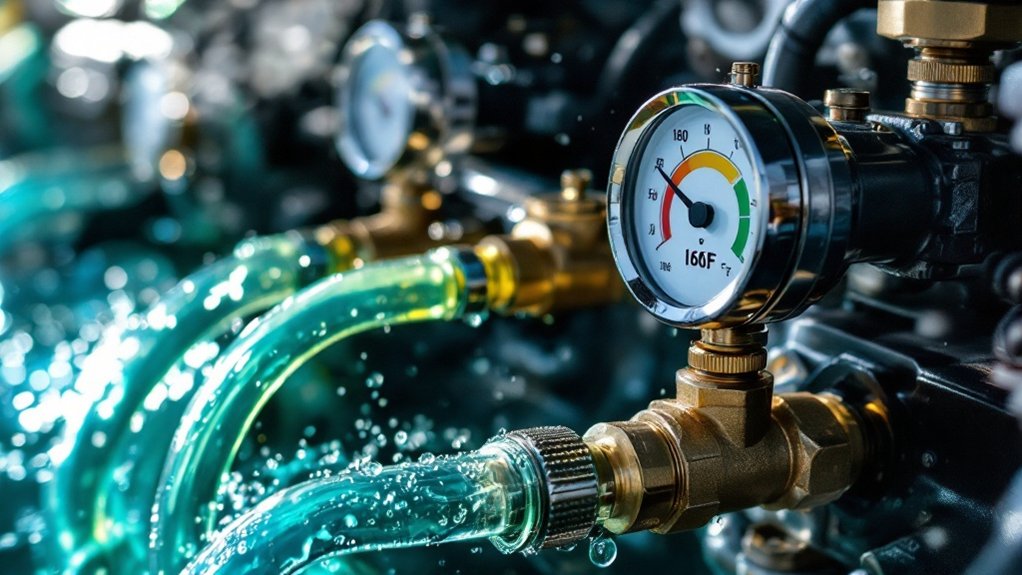
Maintaining your marine engine coolant within the correct temperature range directly determines combustion efficiency, component longevity, and fuel economy. Marine diesel engines perform optimally between 160°F and 180°F, while marine gasoline engines target 180°F to 210°F. Operating below these ranges increases fuel consumption by 5-10% and accelerates oil sludge buildup in marine powerplants.
Freshwater Efficiency delivers tighter thermal control at 160°F to 180°F, while Saltwater Heat exchange systems run warmer at 170°F to 185°F due to scaling considerations. Your thermostat maintains Thermostat Balance by regulating coolant flow within a 5-10°F variance—failure here reduces marine engine lifespan by 15-25%. Modern marine engines employ Sensor Redundancy through multiple temperature monitors that catch deviations before damage occurs.
Heavy loads during open-water cruising push temperatures 10-25°F above baseline, while extended trolling at low RPMs prevents optimal thermal efficiency. You’ll extend marine engine service intervals by 30% when you maintain consistent, manufacturer-specified coolant temperatures across all operating conditions on the water.
5 Coolant Flow Methods That Prevent Overheating
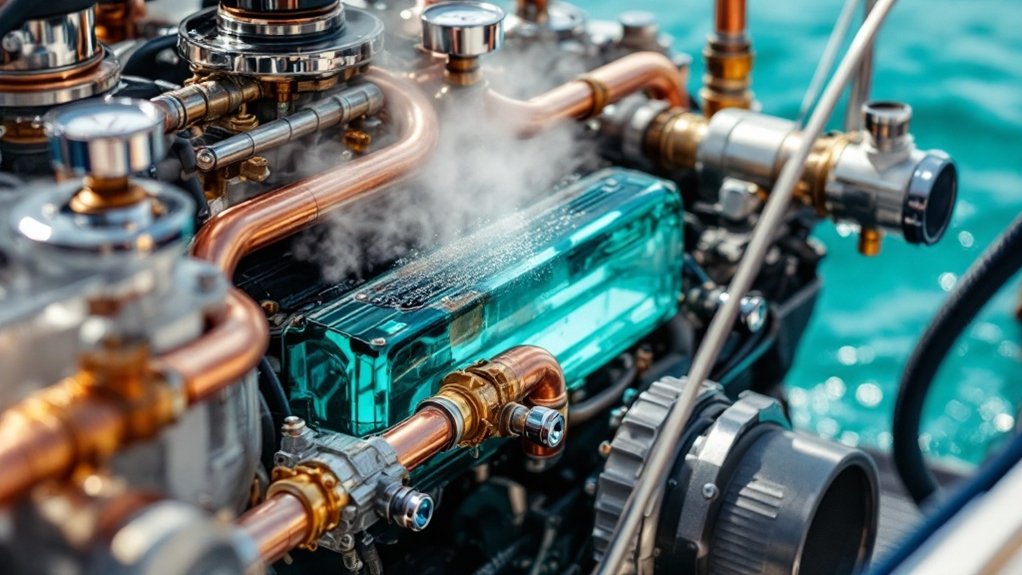
You’ll prevent overheating most effectively by combining thermostat regulation techniques with forced circulation systems that work together to maintain precise coolant flow rates. Your thermostat controls flow based on real-time engine temperature, gradually increasing circulation as the engine warms and responding to changes within 5–10 seconds when using modern wax-based designs. Pairing this regulation with a centrifugal pump delivering 15–25 gallons per minute ensures consistent pressure between 25–60 PSI, pushing coolant through every engine passage without cavitation or dead spots. Maintaining these optimized flow rates is critical because most marine diesel engines operate within the 80–95°C bracket, and exceeding that range quickly leads to heat stress and component damage.
Thermostat Regulation Techniques
Because marine engines operate within narrow thermal windows, thermostat regulation techniques directly determine whether your cooling system prevents overheating or aids in it**. Your wax-pellet or bi-metallic thermostat maintains coolant temperature within ±5°F tolerance**, while modulating designs provide proportional flow adjustment rather than abrupt on-off switching.
Fail-safe behavior ensures coolant continues circulating if your thermostat fails, preventing catastrophic engine damage. You’ll want to verify calibration accuracy within ±3°F of factory settings regularly.
Bypass blending is equally critical—proportional bypass valves mix return flow with bypass circuits during load transitions, eliminating thermal shock that causes cylinder head cracking. As coolant approaches setpoint, modulating valves progressively reduce bypass flow while increasing primary circulation. Monitor inlet-outlet temperature differentials; exceeding 15°F signals thermostat malfunction or flow restriction. Research confirms that three-way valve configurations deliver excellent warm-up time, temperature tracking, and reduced cooling system power consumption compared to two-way, factory, and no-valve setups.
Forced Circulation Systems
Centrifugal pumps drive coolant at 15-20 feet per second through marine engine block passages, eliminating hot spots that cause localized corrosion and stress cracking in large displacement powerplants found aboard vessels. Marine engines require a minimum of 0.5 GPM per horsepower to prevent thermal failures, a critical threshold given the sustained high-load operating profiles common in commercial shipping and offshore operations. Belt-driven pumps scale output proportionally to RPM, while variable displacement designs adjust to real-time thermal demand, offering marine engineers greater control over cooling performance during varying sea states and throttle conditions.
Heat exchanger efficiency depends directly on forced flow—plate-frame units commonly installed in marine engine rooms achieve 90%+ thermal transfer when circulation maintains proper velocity through counterflow arrangements. These exchangers often interface with raw seawater circuits, making consistent forced circulation essential to prevent salt scaling and fouling on heat transfer surfaces. Hybrid approaches that integrate direct seawater mixing with exhaust-steam injection have been modeled as alternatives designed to eliminate large heat exchangers entirely while still managing thermal loads effectively.
Flow sensor validation confirms the system sustains adequate pressure between 8-20 PSI, detecting pump cavitation or leakage before overheating occurs—a vital safeguard in marine environments where engine failure can leave a vessel stranded at sea. Pressurization raises the coolant’s boiling point approximately 1°F per PSI, which is particularly important for marine engines operating in tropical waters or enclosed engine compartments where ambient temperatures run significantly higher than open-air conditions.
How to Diagnose and Fix Marine Coolant Flow Problems
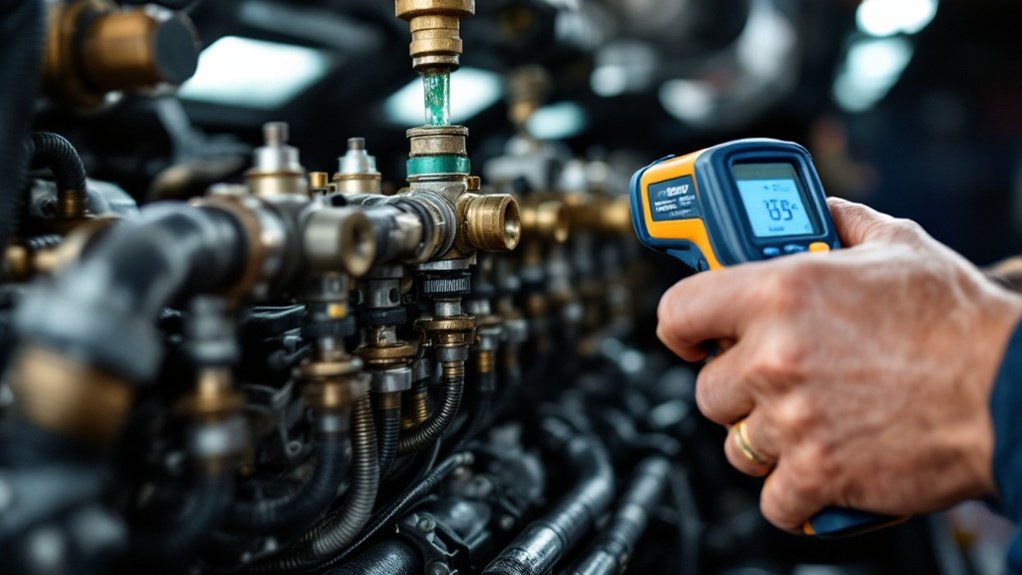
When your marine engine temperature gauge climbs past 200°F or you notice white, milky coolant in the reservoir, you’re likely dealing with a coolant circulation failure that demands immediate diagnosis.
Start with these critical diagnostic steps:
- Pressure test the system at idle—readings below 10 PSI confirm pump failure, while proper operation maintains 13-16 PSI. Dynamic monitoring during acceleration pinpoints restriction zones throughout the marine cooling circuit.
- Perform leak detection around pump housing, hose connections, and manifold gaskets—external seepage introduces air, compromising pressure maintenance and flow consistency across the vessel’s engine cooling system.
- Inspect the water pump impeller for cavitation damage—saltwater impeller erosion reduces displacement by up to 40% annually, making 500-750 hour replacement intervals essential for marine engines operating in harsh seawater environments.
Use infrared thermography to map cold spots revealing blocked passages within the marine engine’s cooling network. Reverse flush with chelating agents to clear mineral and salt deposits that reduce flow by 30-50%. Replace deteriorated hoses showing internal collapse before they restrict circulation further, ensuring your vessel’s engine maintains reliable thermal regulation during extended voyages and demanding operating conditions. A malfunctioning thermostatic valve that remains stuck in the bypass position can keep coolant from reaching the cooler entirely, so always verify temperature control valve response during your diagnostic sequence.
How Better Coolant Flow Stops Corrosion and Cavitation
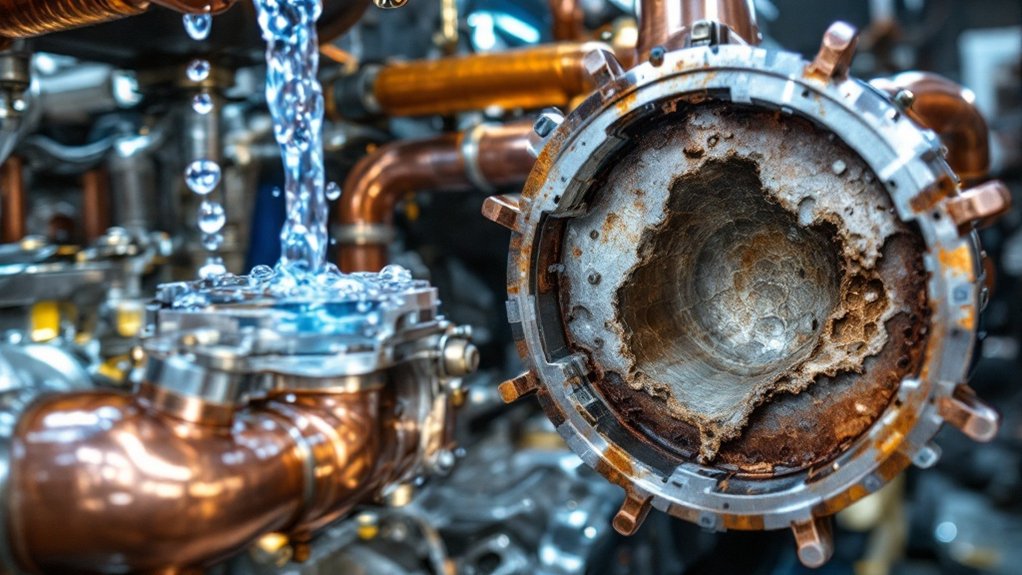
Maintaining steady coolant velocity through your marine engine’s passages directly prevents the two most destructive failure modes in saltwater cooling systems: electrochemical corrosion and cavitation erosion. When you maintain flow velocity control between 2-4 meters per second, you ensure consistent inhibitor distribution of anti-corrosion compounds across all metal surfaces. Stagnant zones accelerate corrosion 3-5 times faster than properly circulated systems. Raw ambient water cooling systems compound these risks because corrosive chemicals and debris carried through the engine cause significant contamination damage beyond what corrosion alone would produce.
| Protection Factor | Poor Flow Result | Optimized Flow Result |
|---|---|---|
| Corrosion inhibitors | Uneven coverage, localized attack | Uniform protective film delivery |
| Vapor pressure drop | Bubble formation in narrow passages | Stable pressure throughout system |
| Pressure differential management | Cavitation erosion on impellers/liners | Consistent pressure prevents bubble nucleation |
Cavitation erosion strips 0.1-0.5mm annually from aluminum passages when pressure differentials go unmanaged. You can prevent this by selecting properly sized pumps that eliminate low-pressure zones where vapor bubbles form and implode against critical marine engine surfaces. Sourcing high-quality replacement cooling system components from a trusted marine engine parts supplier like Mikura International ensures that pumps, thermostats, and water jackets meet the precise specifications required to maintain optimal flow rates and protect your vessel’s engine from corrosion and cavitation damage over the long term.
Why Optimized Coolant Flow Lowers Marine Emissions
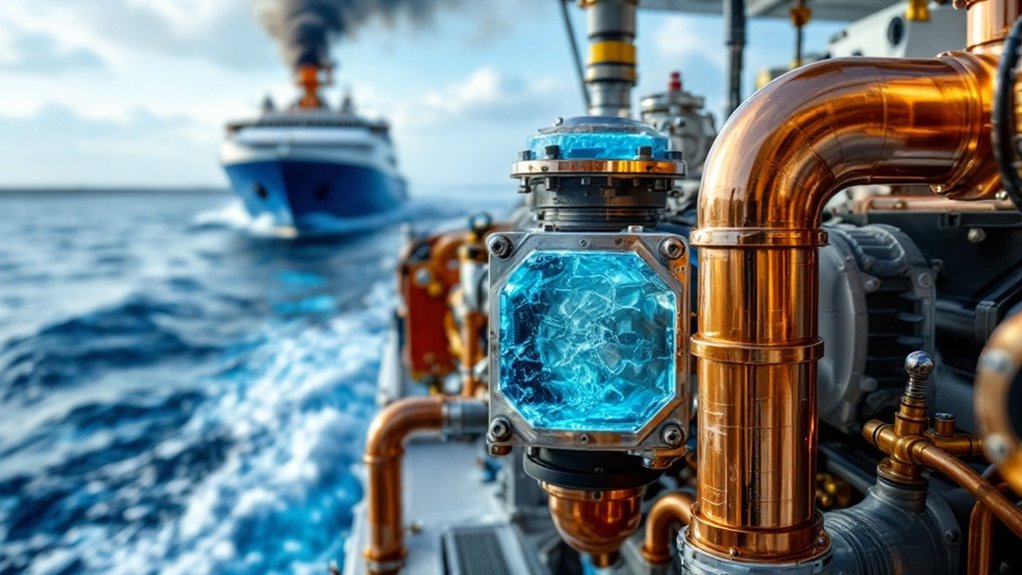
Beyond protecting metal surfaces from corrosion and cavitation, properly controlled coolant flow directly reduces your marine engine’s exhaust emissions by maintaining combustion temperatures within the 80–90°C operating window where fuel burns most completely.
Optimized coolant flow does more than prevent corrosion—it holds combustion temperatures steady for cleaner, more complete fuel burn.
When you optimize thermal management in a marine engine, you’re targeting three critical emission pathways simultaneously:
- NOx reduction: Stable coolant circulation keeps combustion chamber temperatures below critical thresholds, cutting nitrogen oxide formation by 20–35% and reducing variability by 8–12 g/kWh.
- Particulate matter control: Eliminating cold spots through consistent heat removal decreases black carbon emissions by 18–22% and reduces soot output from 3.5 to 2.2 grams per hour.
- SOx minimization: Temperature stability prevents thermal degradation of fuel oil, lowering sulfur oxide precursors by 10–15%.
These gains in emission reduction translate directly to fuel efficiency improvements of 3–8%, supporting MARPOL Annex VI compliance while cutting operational costs per nautical mile.
What Marine Coolant Flow Optimization Saves You Annually
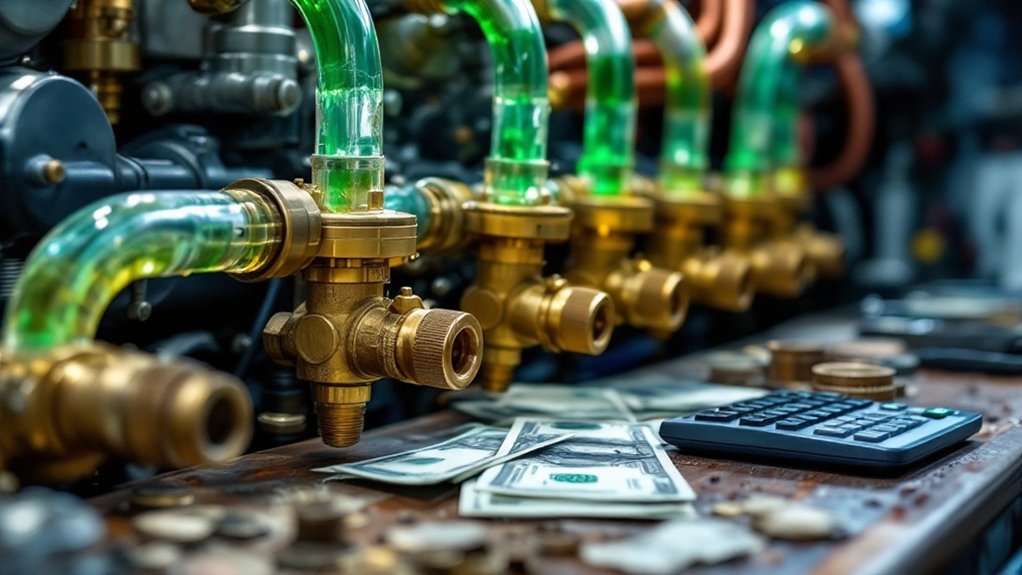
Although emission reductions and combustion efficiency gains represent measurable environmental wins, they’re only part of the equation—optimized marine coolant flow delivers quantifiable financial returns across five cost categories that compound annually.
You’ll reduce fuel consumption by 8-15%, generating $15,000-$50,000 in annual savings on medium-sized vessels. Seasonal fuel tuning becomes more effective when thermal management maintains consistent combustion temperatures across varying sea conditions and climate zones year-round. Unscheduled maintenance costs drop 20-30%, saving $8,000-$25,000 annually while deferring major marine engine overhauls by 2-4 years.
Marine engine lifespan extends 3,000-5,000 operational hours, deferring $200,000-$500,000 replacement costs per unit. You’ll eliminate 60-80% of coolant-related downtime, recovering $5,000-$20,000 monthly in operational revenue that would otherwise be lost to unplanned port stays and delayed voyages. Insurance premiums decrease 5-12% through documented thermal management protocols, and compliance reporting accuracy improves with consistent performance data that satisfies maritime regulatory requirements. Studies focused on main engine cooling systems have demonstrated that variable speed pumps can achieve a 60% reduction in electrical power demand, translating to 296.2 tons of annual fuel savings and 948 tons of CO₂ emission reductions per vessel.
These five categories—fuel, maintenance, lifespan, availability, and insurance—create compounding returns that strengthen your vessel’s financial performance each operational year.
Frequently Asked Questions
How Does Coolant Flow Optimization Affect Marine Engine Torque Under Continuous Duty?
Ironically, the very fluid that never touches your pistons determines whether they deliver full power. When you maximize coolant flow in a marine engine, you’re directly preserving torque stability by maintaining cylinder temperatures between 180-210°F, preventing thermal losses up to 15%. You’ll sustain bearing film integrity, combustion pressure consistency, and injector precision—all critical torque drivers in marine propulsion systems. Proper thermal management also protects fuel efficiency by ensuring ideal combustion conditions, keeping your marine engine performing at peak output through demanding continuous duty cycles at sea.
Can Optimized Coolant Flow Extend the Lifespan of Gaskets and Seals?
Yes, optimized coolant flow directly extends gasket and seal lifespan in locomotive and marine engines. By maintaining gasket temperature stability within 160-180°F, you’ll prevent thermal cycling that degrades elastomer compounds, pushing service life from 3-5 years to 7-10 years. This is particularly critical in marine engines exposed to continuous high-load operation and locomotive powerplants subjected to demanding duty cycles. Effective coolant pressure control eliminates cavitation and turbulent pressure spikes, reducing fluctuation amplitude by 60-75%. You’re also preventing stagnant zones where corrosive compounds and abrasive deposits accelerate seal deterioration—a common concern in marine engine cooling systems where saltwater intrusion and mineral buildup pose additional threats to gasket integrity.
What ROI Can Vessel Operators Expect From Coolant Flow Optimization Investments?
You can expect payback periods of 6–18 months, with annual fuel savings of 3–8% translating to $50,000–$200,000+ on large commercial vessels. Extended overhaul intervals reduce major engine repair costs by delaying them 2–5 years. The emission impact positions you favorably for IMO 2030/2050 compliance, enabling green corridor exemptions and 5–10% higher charter rates—compounding your return across operational, regulatory, and market dimensions. Partnering with a trusted coolant supplier like Mikura International ensures you source high-performance marine-grade coolants that maximize these gains, protecting your engine investment while delivering measurable returns across every voyage.
Does Coolant Flow Optimization Help Meet IMO 2020 Emission Compliance Standards?
Yes, coolant flow optimization directly supports your IMO 2020 compliance strategy aboard marine vessels. By enhancing thermal efficiency within your ship’s engine cooling system, you can reduce fuel consumption by 2-3%, which proportionally lowers sulfur oxide emissions from your marine fuel system. Well-optimized coolant circulation across your vessel’s main and auxiliary engines helps achieve 8-12% reductions in particulate matter while preventing NOx formation in high-temperature combustion zones common in large marine diesel powerplants. When you pair optimized cooling with compliant low-sulfur marine fuels, your fleet can deliver 20-25% better emission profiles than baseline operations require, keeping your vessels well within the regulatory thresholds set by the International Maritime Organization.
How Much Does Cooling System Downtime Cost Commercial Vessels per Day?
You’re facing $15,000–$300,000+ in daily losses depending on your vessel type and cargo profile. Containerships average $50,000–$100,000 daily, while tankers reach $150,000. Beyond revenue loss, you’ll absorb emergency response costs ranging $50,000–$200,000 per incident, plus onboard maintenance labor at $200–$500 per hour for specialized marine engine technicians. Add contractual penalties, demurrage charges, and berthing fees, and unoptimized marine cooling systems rapidly compound into catastrophic operational expenditures. Partnering with a trusted supplier like Mikura International for high-quality marine engine coolants and cooling system components helps vessel operators minimize unplanned downtime and protect against these escalating costs.