

Marine engineers constantly battle overheating engines, corroded liners, and unexpected coolant failures at sea. Poor circulation leads to thermal hotspots, cracked cylinder heads, and costly unplanned downtime.
Knowing the right coolant circulation techniques prevents catastrophic engine damage onboard.
Common Pain Points in Marine Engine Coolant Circulation:
- Localized hotspots exceeding safe operating temperatures
- Sludge and scale deposits reducing heat transfer by up to 30%
- Thermostat valves sticking open or closed unexpectedly
- Seawater contamination entering the freshwater cooling circuit
- Cavitation damage on cylinder liner surfaces
- Coolant pressure drops causing vapor lock in passages
- Uneven coolant distribution across multiple cylinder banks
- Premature corrosion of heat exchanger tubes
- Clogged filtration systems allowing debris recirculation
- Excessive coolant consumption due to undetected leaks
| Problem | Root Cause | Recommended Technique | Potential Heat Transfer Loss |
|---|---|---|---|
| Thermal hotspots | Stagnant coolant zones | Centrifugal pump forced flow | Up to 25% |
| Scale buildup | Hard water minerals | Magnetic filtration | Up to 30% |
| Overcooling at low loads | Fixed-flow systems | Thermostat valve regulation | 10–15% |
| Seawater ingress | Corroded heat exchanger | Heat exchanger seawater isolation | Up to 40% |
| Vapor lock | Low system pressure | System pressurization | 15–20% |
| Uneven cylinder cooling | Single-path flow design | Bypass flow control | Up to 20% |
| Slow warm-up | No natural convection path | Thermosiphon circulation | 5–10% |
The seven best engine coolant circulation techniques for ships are listed below.
1. Thermosiphon (Natural Convection) Circulation relies on temperature-driven density differences. Hot coolant rises naturally while cooler fluid descends.
This technique provides passive circulation during pump failure emergencies. It serves as a critical backup in marine engine rooms.
2. Centrifugal Pump Forced Flow delivers consistent coolant velocity through engine jackets. It eliminates stagnant zones that cause localized overheating.
Properly sized pumps maintain uniform temperature across all cylinders.
3. Heat Exchanger Seawater Isolation separates corrosive seawater from engine freshwater circuits. This prevents salt contamination from degrading internal passages.
It extends the lifespan of cylinder liners and gaskets significantly.
4. Thermostat Valve Regulation adjusts coolant flow based on real-time engine temperature. It prevents overcooling during low-load operations at sea.
Properly calibrated thermostats maintain optimal operating temperature ranges consistently.
5. System Pressurization raises the coolant boiling point above atmospheric conditions. This prevents vapor lock in high-temperature zones near combustion chambers.
Pressurized systems reduce cavitation damage on liner surfaces.
6. Magnetic Filtration captures metallic particles and ferrous debris from circulating coolant. It prevents sludge deposits from coating heat transfer surfaces.
Clean coolant maintains efficient thermal conductivity throughout the engine.
7. Bypass Flow Control diverts a portion of coolant around the heat exchanger. This balances temperature across multiple engine banks evenly.
It prevents thermal shock during rapid load changes at sea.
Each method targets a specific failure point in marine engines. Thermal hotspots exceeding 100°C above design limits cause irreversible damage.
Sludge deposits can cut heat transfer efficiency by up to 30%. These techniques work together as an integrated cooling strategy.
Maintaining genuine, high-quality coolant system components is essential for reliability. Thermostats, pump impellers, gaskets, and filtration elements must meet OEM specifications.
Substandard parts compromise the entire cooling circuit’s performance.
At Mikura International, we supply genuine marine engine parts from trusted manufacturers like ALCO, EMD, and GE. We source authentic coolant system components including thermostats, pump assemblies, and heat exchanger parts.
Our expertise ensures your vessel’s cooling system operates at peak efficiency. Contact us for reliable parts that keep your marine engines running safely.
Key Takeaways
- Thermosiphon circulation uses natural convection—hot coolant rises, cool coolant sinks—eliminating pump failure risks entirely.
- Centrifugal pump systems maintain optimal flow velocities of 2–8 ft/sec through cylinder blocks and heat exchangers.
- Proper expansion tank placement at the system’s highest point prevents vapor lock and maintains consistent circulation pressure.
- Bypass passages ensure coolant continues circulating during cold starts when thermostats restrict normal flow paths.
- Wax-element thermostat valves regulate coolant temperature between 75–85°C, optimizing fuel efficiency and preventing thermal damage.
How Poor Coolant Circulation Destroys Marine Engines
When coolant circulation falters in a marine engine, the destruction begins faster than most operators realize. Thermal hotspots exceeding 100°C above design parameters develop within minutes, accelerating fatigue cracking and pushing metal surfaces toward 400°C+ limits. Simultaneously, stagnant coolant pockets breed corrosion scale at 0.5–2mm per season, cutting heat transfer efficiency by up to 12% annually.
Cavitation damage poses a severe threat as vapor bubbles collapse at pressures exceeding 10,000 psi, stripping 2–4mm of impeller material yearly. Lubricant breakdown follows quickly—oil viscosity drops 40–50% when temperatures rise just 15°C above specification, triggering sludge formation that chokes oil galleries within 300 hours.
The consequences compound rapidly. Gasket failure strikes within 500–1,000 operating hours at below 40% circulation efficiency. Piston seizure develops as thermal expansion eliminates bearing clearances. For large marine diesels, vessel operators face $500,000–$2,000,000+ in repair costs from entirely preventable failures. Research has demonstrated that eliminating seawater pollution from main engine coolers restores significant thermal performance, with heat transfer in the seawater circuit alone increasing by an average of 52.622% after cleaning.
Thermosiphon Circulation That Needs No Pumps
When you eliminate mechanical pumps from your cooling circuit, you’re relying on natural convection—hot coolant rises as its density drops while cooler fluid descends, creating continuous circulation driven entirely by the temperature differential within your engine block. To sustain this thermosiphon effect, you’ll need to position your header tank at the system’s highest point, ensuring proper air release and maintaining the gravitational head that initiates and sustains flow through larger-bore passages.
This passive configuration removes pump failure as a breakdown risk, which accounts for up to 15% of fleet mechanical failures annually, giving you a simpler, more reliable cooling architecture for engines under 150 horsepower. Because thermosiphon driving pressures are extremely low, excessive piping resistance from long runs or improper routing will kill flow, so you should keep piping short and maintain a continuous upward slope of at least 1:10 from the engine to the header tank to prevent circulation stall conditions.
Natural Convection Flow Principles
Although most marine cooling systems rely on mechanical pumps to push coolant through engine jackets, thermosiphon circulation exploits a simpler principle: heated coolant becomes less dense and rises, while cooled coolant grows denser and sinks. This density differential drives continuous flow at 0.3–0.6 m/s, provided you maintain a minimum 5°C temperature difference between the engine outlet and the radiator return. In marine vessels operating in warm tropical waters, this temperature differential can be more challenging to sustain, making proper system design even more critical.
To achieve reliable natural convection in a marine engine cooling setup, you must address three critical design requirements:
- Elevation differential: Position your radiator or heat exchanger at least 0.5 meters above the marine engine jacket outlet to generate sufficient hydrostatic pressure head. On vessels where engine room layout restricts vertical space, careful compartment planning during the build phase is essential to accommodate this requirement.
- Air pocket elimination: Route all piping to avoid high points where trapped air interrupts circulation flow. In marine installations, the constant pitch and roll of a vessel at sea can shift air pockets into unexpected locations, so piping runs should incorporate gradual inclines and strategically placed bleed valves to ensure uninterrupted coolant movement.
- Vapor lock prevention: Keep the system sealed to maintain pressure stability and prevent vapor formation that stalls thermosiphon action. Marine engines operating under heavy load in confined engine rooms generate significant ambient heat, which increases the risk of localized boiling within coolant passages. A properly pressurized expansion tank and high-quality pressure caps rated for marine service help mitigate this risk and keep natural convection functioning reliably across varying sea conditions.
Optimal Tank Placement
Every thermosiphon cooling system in a marine engine lives or dies by where you place your expansion tank. You need a minimum 1-2 meters of elevation between your heat source and the tank to generate sufficient hydrostatic pressure. Mount the expansion tank at the system’s highest point, and keep it within 3-5 meters of the marine engine to preserve pressure head effectiveness.
Your venting strategy matters just as much—position vent openings at the tank’s apex to release trapped air and prevent vapor lock, which is especially critical in marine environments where vessel motion can agitate coolant flow. Inside the tank, baffle placement at strategic intervals minimizes thermal stratification by directing flow between opposite-end inlets and outlets. You’ll want suction-side positioning to cut cavitation risk while enabling gravity-driven circulation. Insulate all connecting piping to maintain the temperature differentials that keep your thermosiphon running reliably, even in the demanding humidity and temperature conditions found in engine rooms aboard marine vessels.
Reduced Mechanical Failure Points
Getting your expansion tank positioned correctly sets the foundation, but the real payback of a thermosiphon system comes from what it removes entirely: mechanical failure points. You’re eliminating the components responsible for most coolant system downtime in marine engine installations:
- Impeller cavitation erosion, which typically forces replacement every 8,000–12,000 operating hours on vessel cooling circuits
- Mechanical seal deterioration, accounting for roughly 23% of marine cooling failures across engine room systems
- Drive belt and coupling wear, removing friction-based degradation from your shipboard maintenance schedule
Seal failure avoidance becomes inherent rather than managed. Without pressurized pump assemblies stressing connections at 15–30 PSI, you’ll see hose integrity benefits that extend gasket and O-ring life by 40–60% across your marine engine’s cooling network. Your MTBF jumps to 15,000+ hours, and unscheduled shutdowns drop 15–20% annually—measurable gains from simply removing what breaks. For vessels operating extended voyages or continuous duty cycles, this reduction in mechanical failure points translates directly into fewer mid-sea cooling emergencies and lower spare parts inventory demands onboard. However, it’s critical to maintain vigilant coolant level monitoring, since thermosiphon systems are sensitive to fluid loss and even a small coolant deficit can halt natural convection circulation entirely, negating the reliability advantages you’ve gained.
Centrifugal Pumps That Force Coolant Where It Needs to Go
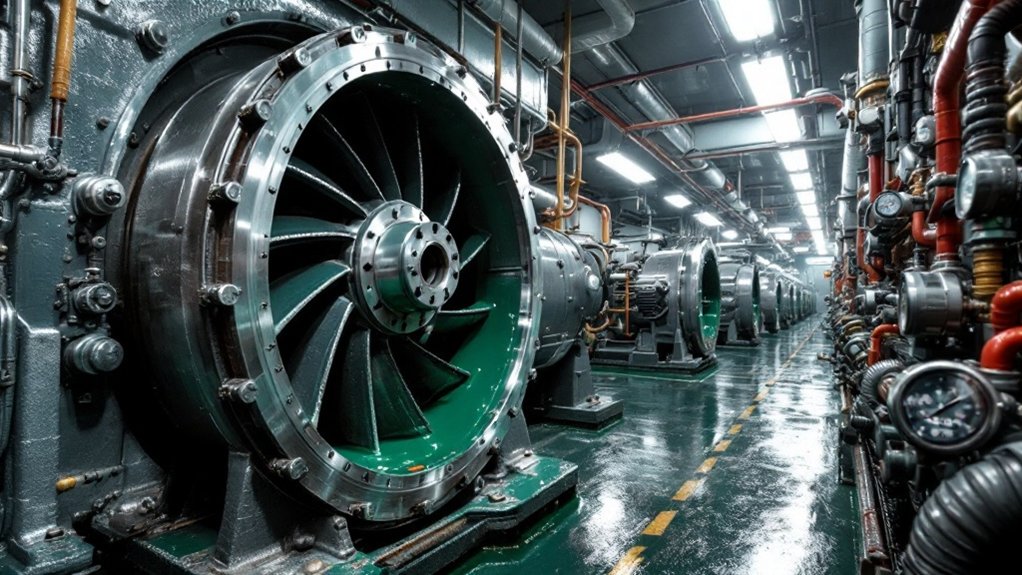
The centrifugal pump serves as the heart of any marine engine cooling system, converting rotational energy into the fluid pressure needed to push coolant through every critical passage in the engine block. Impellers spinning between 1,200-3,600 RPM generate discharge pressures of 30-150 PSI while delivering 50-5,000 GPM based on vessel demands.
| Parameter | Alternative Range | Critical Threshold |
|---|---|---|
| Flow Velocity | 2-8 ft/sec | Below 2 ft/sec risks inadequate heat transfer |
| Shaft Alignment | Within 0.002 inches | Exceeding tolerance causes bearing failure |
| Efficiency Zone | 70-85% rated capacity | Operating outside accelerates wear |
Cavitation prevention requires maintaining positive suction head at the pump inlet. Bypass passages must remain functional during cold starts when thermostats restrict flow. Vibration monitoring through routine analysis detects impeller imbalance and shaft deflection early, allowing marine engineers to address problems before they escalate into costly failures. In heat exchanger cooling systems, the centrifugal pump circulates fresh treated water through cylinder block passages and around the tube stack of the heat exchanger, ensuring efficient thermal transfer between the primary and raw water circuits.
Heat Exchangers That Keep Seawater Out of Your Coolant Loop
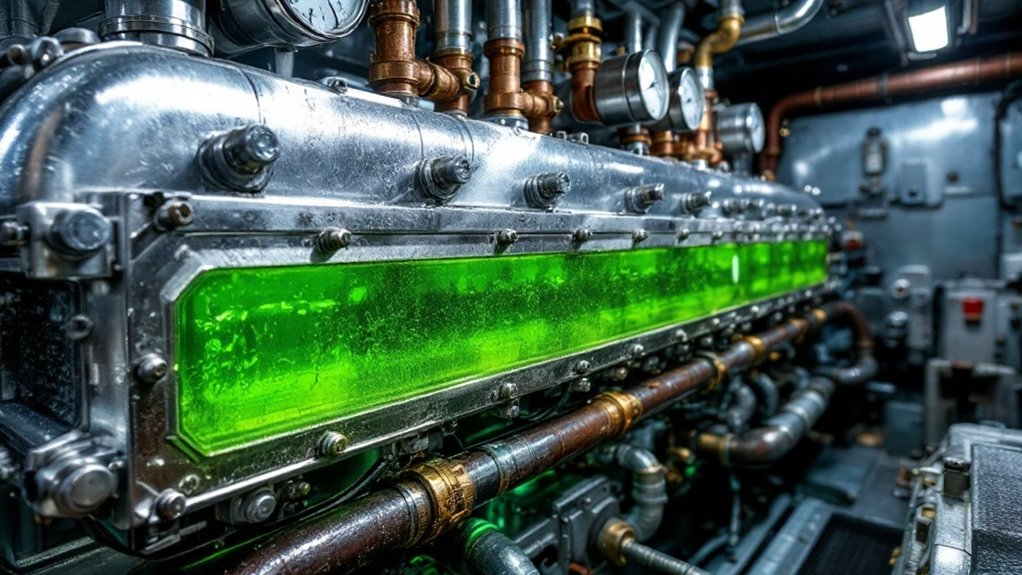
Beyond the pump’s ability to move coolant efficiently, the heat exchanger stands as your primary defense against seawater contamination—a threat that’ll destroy marine engine internals faster than almost any other failure mode. Your corrosion barrier options determine long-term reliability: titanium plates corrode at just 0.001mm/year, while duplex stainless steels with PREN values of 40-50 handle continuous saltwater exposure for a decade without efficiency loss.
Your heat exchanger is the last line between seawater and engine destruction—choose corrosion barriers that outlast the ocean itself.
You’ll want to prioritize these protective layers:
- Sacrificial anode systems that reduce galvanic corrosion by 70-85% through zinc or aluminum anodes consuming 3-5kg annually
- Double-wall tube construction providing secondary containment if primary barriers degrade
- Dual isolation ball valves enabling emergency circuit protection within 30 seconds during failure events
Gasket integrity monitoring prevents cross-contamination between circuits, keeping failure rates below 0.5% annually. Plate frame designs let you swap compromised components without full system shutdown—minimizing vessel downtime while maintaining separation integrity across your marine engine’s freshwater and raw water circuits. Compact units like the Aalborg MC can be installed horizontally or vertically to fit the available space within your engine room, making integration into existing coolant loop configurations straightforward.
Thermostat Valves That Fine-Tune Coolant Circulation
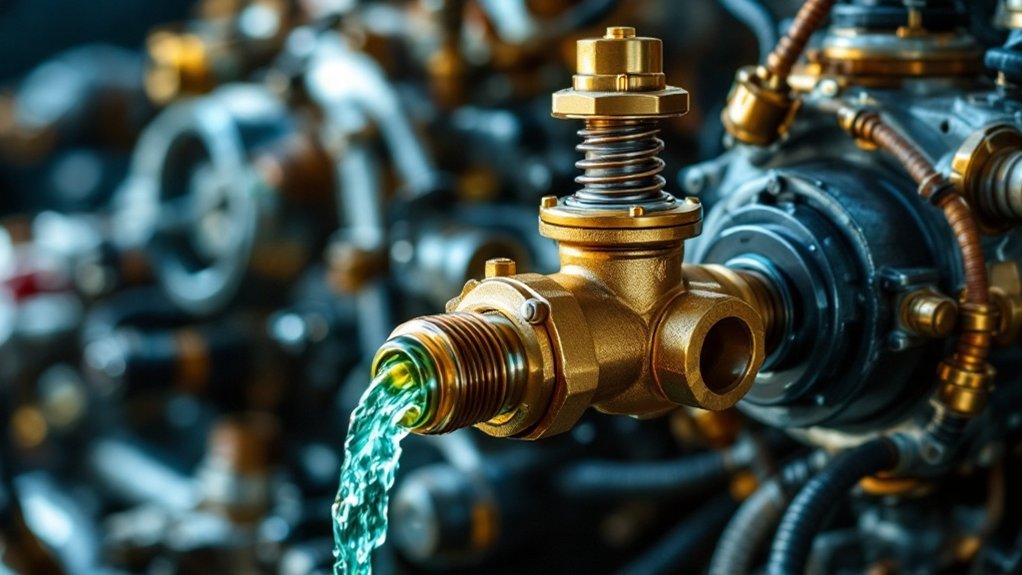
Wax-element thermostats modulate progressively as coolant reaches target setpoints—typically 75°C to 85°C for heavy-fuel marine propulsion engines. Proper thermostat calibration determines whether you gain 2–3% fuel savings at warmer settings or sacrifice efficiency by 4–6% at colder ones. Bypass ports redirect coolant during warm-up, while jiggle pins enable vapor lock prevention by permitting small coolant movements that eliminate trapped air pockets in the engine block and cylinder liners.
Multi-stage configurations let you separate high-temperature main engine cooling from auxiliary loops serving onboard generators, hydraulic steering gear, and other shipboard systems. You’ll want hysteresis bands of 2–5°C to prevent destructive valve cycling that accelerates wear in seawater-exposed cooling circuits. Monitor for stuck-open failures—they’ll increase fuel consumption by 5–8% across extended ocean passages—and stuck-closed conditions that risk catastrophic overheating within minutes, potentially warping cylinder heads or damaging turbochargers mid-voyage. Replacing conventional wax-element thermostatic valves with electrically actuated rotary control valves driven by a PID electronic controller delivers near-zero internal leakage, holding shutoff below 0.01% to eliminate the persistent cold-water ingress that forces preheaters and auxiliary boilers to compensate continuously during port stays.
Pressurized Systems That Stop Your Coolant From Boiling
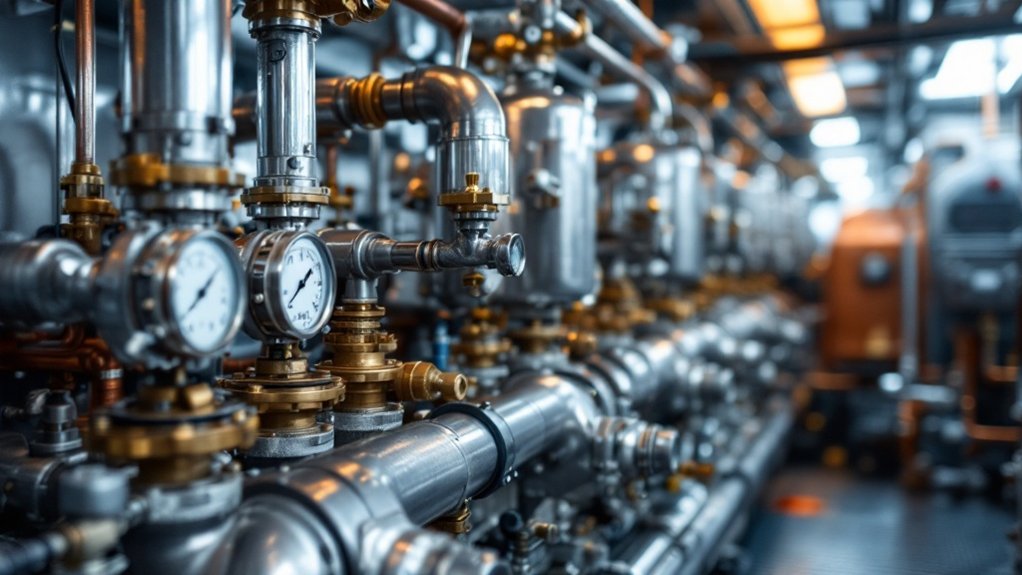
Because marine engines generate extreme heat under sustained load, your cooling system must maintain positive pressure—typically 7–15 PSI—to elevate coolant boiling points well beyond atmospheric thresholds. Each PSI of added pressure raises your coolant’s boiling point by 1–2°F, enabling effective Coolant Vapor Control that prevents cavitation damage from vapor pocket formation.
Your pressurized system relies on three critical components working together:
- Pressure relief valves — Spring-loaded mechanisms that automatically vent excess coolant vapor when pressure exceeds safe maximums, protecting your engine block
- Sealed expansion tanks — Nitrogen-charged bladder designs that accommodate 5–10% volume increases during thermal cycling while maintaining Tank Pressure Stability
- Digital pressure transducers — Real-time monitoring devices with ±0.5 PSI accuracy that trigger alarms when pressure drops below 3 PSI, indicating potential coolant loss
You’ll also need properly formulated 50/50 ethylene glycol coolant, which elevates boiling points to approximately 260°F under standard system pressure. Where cooling water pumps can develop a pressure head greater than the design pressure of the system, relief valves are required on the pump discharge to effectively limit discharge pressure to safe operating levels. Mikura International supplies high-performance marine-grade coolants engineered to withstand the demanding thermal conditions that vessel engines encounter during prolonged operation at sea.
Magnetic Filters That Keep Debris Out of Your Coolant
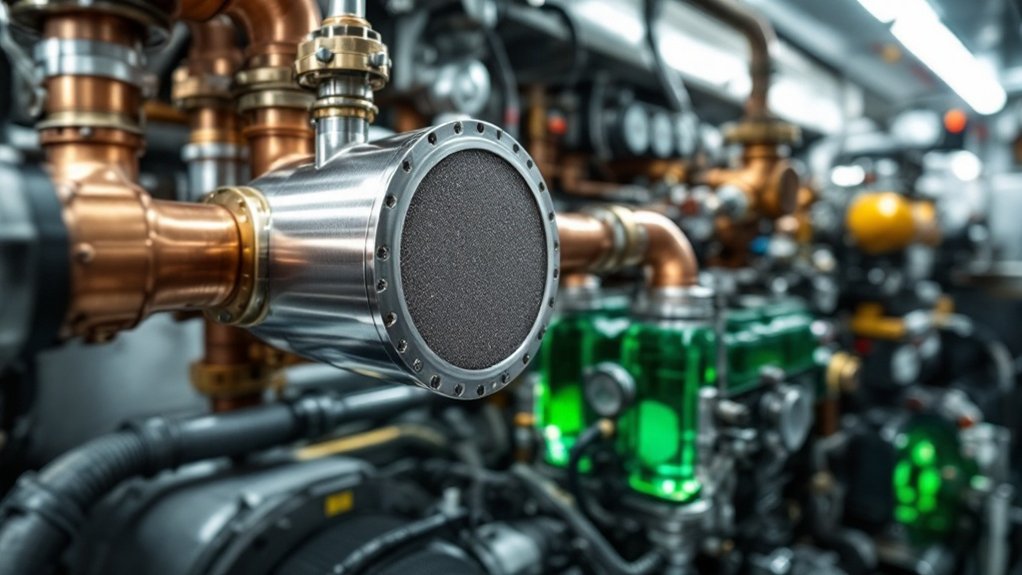
While pressurized systems protect against vapor formation, they can’t address the ferrous debris that locomotive and marine engine wear, corrosion, and internal component degradation continuously shed into your coolant circuit. Magnetic filters using neodymium or ferrite magnets capture 95-99% of ferrous particles between 5 and 100 microns, preventing the sludge deposits that reduce heat transfer efficiency by 15-30% in these heavy-duty powerplants.
You’ll achieve best results by installing these filters in coolant return lines where particle concentration peaks. Side-stream configurations treat coolant without reducing primary flow capacity—a critical consideration in locomotive engines operating under sustained traction loads or marine propulsion systems running continuous duty cycles. Debris saturation indicators include visual dark coating on magnetic surfaces, pressure differentials exceeding 0.5 bar, and coolant analysis showing ferrous concentrations above 200 ppm. These magnetic filtration units also handle glycol-water mixtures, making them compatible with coolant blends containing up to 50% glycol commonly used in marine and locomotive applications.
Incorporate magnetic filter servicing into your preventive maintenance plans every 250-500 operating hours, aligning with the rigorous service schedules that locomotive fleets and marine vessels already follow. This investment extends coolant service life from three years to five-seven years, cuts replacement costs by 40%, and reduces bearing and pump wear rates by 40-60%—delivering significant operational savings across locomotive and marine engine applications.
Frequently Asked Questions
How Often Should Marine Engine Coolant Be Completely Flushed and Replaced?
You should completely flush and replace your marine engine coolant every 3–5 years or 3,000–5,000 operating hours, whichever comes first. Saltwater vessels demand shorter maintenance intervals due to accelerated corrosion caused by the harsh marine operating environment. You’ll want to increase your coolant sampling frequency to detect pH drops, contamination, or color changes early. Don’t wait for overheating—proactive testing lets you adjust replacement schedules based on actual coolant condition rather than arbitrary timelines. For vessel operators managing fleets across open-water and coastal routes, staying ahead of coolant degradation is essential to preventing costly marine engine failures at sea.
What Type of Coolant Is Best for Saltwater Marine Engines?
You’ll want an ethylene glycol-based coolant with marine-specific corrosion inhibitors designed for saltwater engine applications. When evaluating freshwater vs saltwater formulations, saltwater-rated coolants contain nitrite and silicate inhibitors that form protective oxide layers on internal cooling system surfaces, cutting corrosion by up to 85% in marine engines exposed to harsh saltwater environments. Choose a 40-50% glycol concentration that’s chromate-free and meets ASTM D6210 specifications. This ensures reliable protection against galvanic corrosion between dissimilar metals throughout your marine vessel’s cooling system, extending engine life and reducing costly maintenance intervals at sea.
Can Coolant Circulation Techniques Differ Between Two-Stroke and Four-Stroke Engines?
Yes, the differences are night and day. You’ll find two stroke flow patterns in large marine propulsion engines demand multi-stage cooling circuits with coolant velocities of 2.5–3.5 m/s through cylinder liners, maintaining continuous circulation even at low loads during extended sea voyages. In contrast, four stroke heat rejection in medium-speed marine auxiliary engines and locomotive power units operates efficiently through simpler single-circuit systems with lower pressure drops of 80–120 kPa. You’ll need 20–30% higher coolant flow rates for two-stroke marine applications to manage their sustained thermal output effectively during continuous operation at sea.
How Do You Diagnose Air Pockets Trapped Inside Marine Coolant Circulation Systems?
You’ll diagnose trapped air pockets by conducting pressure hold testing—pressurizing the marine coolant system to rated PSI and monitoring for drops caused by compressible air. Use thermal imaging to identify localized hot spots where air restricts coolant flow through engine blocks, heat exchangers, and aftercoolers, and compare inlet/outlet temperature differentials exceeding normal parameters. Perform venting diagnostics at high-point bleed valves while checking for coolant discoloration and foam, which commonly develop in marine engine cooling circuits operating under varying vessel loads and sea conditions. Electromagnetic flowmeters confirm reduced circulation rates, pinpointing blockage zones accurately across the marine engine’s cooling network.
What Coolant Additives Prevent Corrosion in Mixed-Metal Marine Engine Systems?
Think of mixed-metal corrosion as a silent predator stalking your marine engine’s cooling circuits. You’ll combat it using galvanic corrosion inhibitors like molybdate additives (500-1000 ppm) that establish passive films between aluminum and iron interfaces commonly found in marine propulsion systems. Pair these with nitrite corrosion control compounds working synergistically with silicates to passivate steel while preventing dezincification in brass components frequently used in marine engine heat exchangers and seawater cooling loops. You should also maintain reserve alkalinity between pH 8.5-9.5 for sustained protection, which is especially critical in marine environments where saltwater exposure and humidity accelerate electrochemical reactions across dissimilar metal junctions in vessel engine cooling systems.