

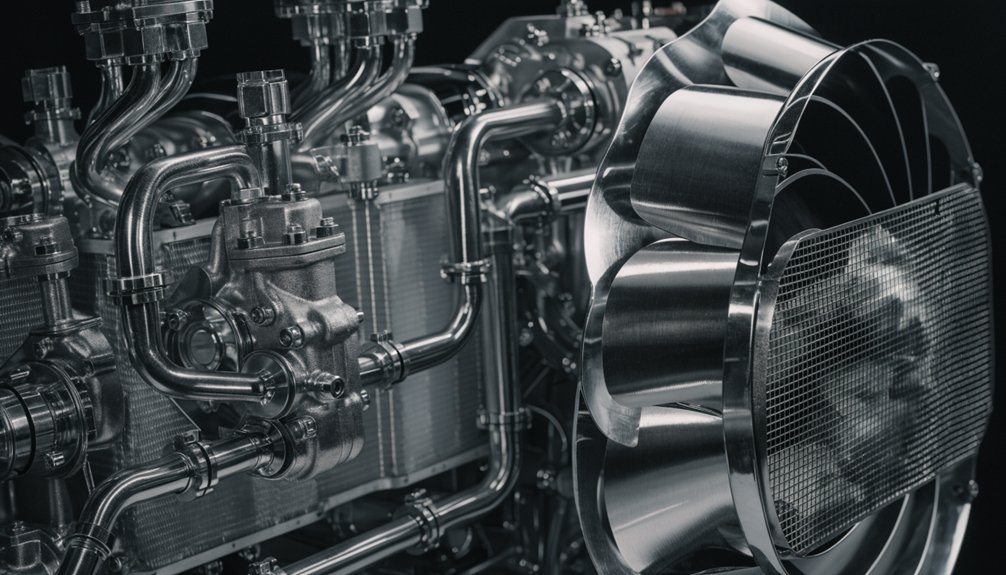
You’ll ensure maintain your EMD F125’s cooling circuit through four integrated components: the engine water jacket absorbs combustion heat, the centrifugal pump circulates coolant, the thermostat regulates flow at ~82°C, and the radiator core rejects heat through finned tubes. You’ll detect fouling by monitoring airflow restrictions and temperature differentials across the core. You’ll prevent fan failures through temperature-based backup controls and continuous rise-rate fault detection that triggers alerts before boiling conditions occur. Systematic pre-trip verification of coolant levels, radiator cleanliness, and thermostat calibration ensures operational readiness, though each component demands specific attention protocols.
Key Takeaways
- Engine water jacket absorbs combustion heat through passages around cylinders; thermostat bypass prevents localized hot spots during warm-up cycles.
- Centrifugal pump maintains coolant circulation pressure; thermostat valve regulates flow at ~82°C to balance heat rejection with engine warm-up efficiency.
- Radiator core uses small tubes and fins for heat rejection; upper/lower headers distribute coolant uniformly across the tube bundle.
- External core debris removal, shroud sealing verification, and airflow path maintenance prevent fouling; differential temperature monitoring detects early restriction progression.
- Temperature-based fan controls automatically activate before critical conditions; continuous temperature rise rate monitoring triggers alerts preventing pressure-relief boiling events.
The Four Core Cooling Components
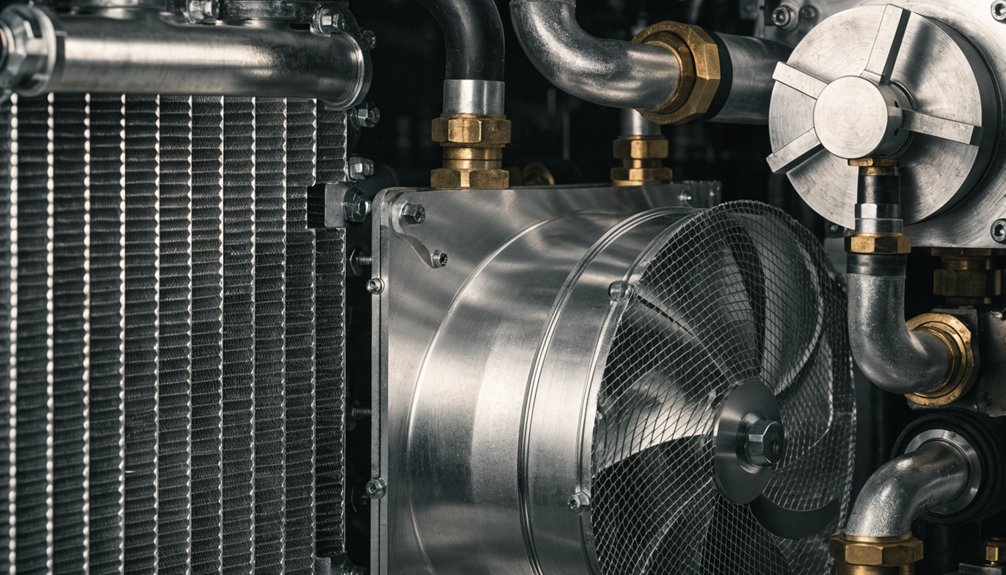
You’ll maintain the EMD F125 cooling circuit’s reliability by understanding its four core components. Your engine water jacket, centrifugal pump, thermostat, and radiator core work together systematically. Each component plays a specific role in temperature regulation and heat rejection.
Engine Water Jacket Function
The EMD F125 locomotive cooling circuit‘s engine water jacket absorbs combustion heat directly. You’ll find coolant flowing through jacket passages surrounding cylinder blocks and heads. These passages enable jacket heat transfer by circulating liquid through the hottest engine zones.
Thermostat bypass control maintains stable jacket temperature and prevents localized hot spot formation. Proper coolant passage design ensures jacket flow uniformity across all combustion chambers. Any fouling or flow restriction reduces heat absorption and triggers overheating.
Your heater core dependence on jacket-heated coolant affects cabin readiness during operation. Steam shield formation and cavitation risks emerge when flow becomes restricted or temperature spikes. Consistent jacket circulation is essential because the radiator can only shed heat that the jacket successfully transfers first.
Centrifugal Pump Operations
How does coolant actually move through your EMD F125 locomotive cooling circuit? Your centrifugal pump’s impeller accelerates coolant outward, creating the pressure differential needed for circulation. Four core components work together: impeller, pump casing/volute, suction inlet, and discharge outlet.
You must monitor suction condition monitoring to prevent impeller cavitation risk. Worn impellers reduce flow without stopping engine operation, often appearing as slow radiator cooling. Your volute pressure losses increase with debris accumulation at the pump inlet.
Maintaining correct coolant quantity prevents circulation loss. Pump speed effects directly influence flow rate delivery to engine jackets. Protect your NPSH margin management by keeping the suction line clear and unobstructed. Damaged or eroded impellers compromise cooling effectiveness greatly. Regular debris removal ensures best pump performance throughout locomotive operation.
Thermostat Flow Regulation
When your EMD F125 locomotive cooling circuit reaches operating temperature, a thermostat regulates coolant flow to the radiator. The device uses a wax pellet that expands against a spring, shifting an internal valve from closed to open as temperature climbs. Your thermostat typically calibrates around 82°C, enabling coolant bypass during warm-up and restricting radiator flow until needed. Once open, increased flow allows hot coolant through small tubes and finned surfaces for effective heat rejection. This valve calibration maintains thermal stability by preventing temperature overshoot. Should your thermostat stick shut, coolant temperature rises dangerously despite functional radiators and fans. Conversely, sticking open causes slow warm-up and reduced efficiency. Proper flow control behavior ensures your locomotive operates within designed thermal parameters consistently.
Radiator Core Design
Your EMD F125 locomotive radiator core design integrates four essential cooling components for effective heat transfer. Small tubes carry hot coolant through the core’s center passages. Fins between tubes expand surface area for enhanced heat rejection. An upper header distributes coolant across the tube bundle systematically. Lower headers collect cooled fluid for return circulation.
Tube material selection affects corrosion resistance and thermal conductivity. Fin spacing optimization balances airflow with heat transfer efficiency. Header flow distribution ensures uniform coolant velocity across the tubes. Coolant pressure drop varies with tube diameter and length. Corrosion protection coatings preserve tube integrity during extended service.
You’ll ensure core performance by monitoring pressure differentials. Regular inspection prevents fouling that compromises cooling capacity. Mikura International supplies premium radiator core components meeting OEM specifications. These components guarantee reliable thermal management for your locomotives.
Spot Radiator Fouling Before It Fails
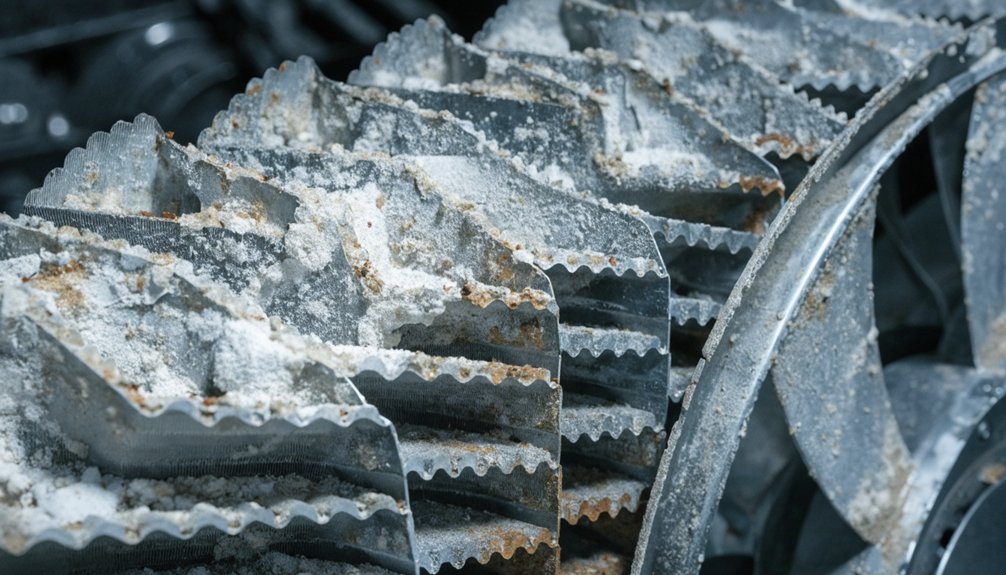
You’ll spot radiator fouling by examining external core debris and monitoring airflow paths regularly. Remove mud, insects, and fin rot promptly to maintain heat transfer efficiency. Monitor for blocked tube rows and uneven dirt streaks that signal localized hot spots.
External Core Debris Removal
Because blocked fin passages reduce heat rejection in EMD F125 locomotive cooling circuit components, you’ll spot radiator fouling early by monitoring coolant temperature rise rates. Remove external core debris promptly by physically clearing mud, insects, and packed leaf litter from between tubes and fins. Deploy wire mesh screens and debris capture trays to prevent future accumulation. Apply fin edge brushing techniques carefully to avoid damaging cooling surfaces. Utilize a low pressure rinse system for thorough cleaning without forcing contaminants deeper into passages. Verify airflow after cleaning using airflow verification tools to confirm the fan system draws air through finned sections. Record inspection findings systematically. Perform periodic clean-outs to prevent gradual buildup that accelerates overheating and fan duty failures.
Airflow Path Monitoring
How can you detect EMD F125 locomotive cooling circuit fouling before catastrophic failure occurs? Monitor differential temperature across your radiator continuously. As duct restriction develops, hot coolant outlet temperature rises noticeably. Early fouling signals manifest before total system failure. Check airflow sensors regularly for accuracy. Verify shroud sealing remains intact around core perimeters. Inspect air damper positioning during operation. Bypass leakage around radiator bypass valves masks fouling symptoms initially. Observe coolant flow improvement when thermostats open near 82°C. Poor heat rejection despite normal pump flow indicates restriction. Schedule external surface inspections during downtime. Look for fin blockage, mud accumulation, and debris patterns. These observations reveal fouling progression systematically.
Prevent and Reverse Radiator Fouling

You’ll need to clean the external fin-and-tube core surfaces systematically. Remove mud, dirt, and fin rot deposits that block airflow paths. Maintaining these passages directly restores heat transfer efficiency across your EMD F125 radiator.
External Core Cleaning Methods
Maintaining the EMD F125 locomotive cooling circuit requires systematic external core cleaning. You’ll start with debris prewash using compressed air to dislodge mud and dirt from cooler finning without damaging delicate fins. Next, apply gentle chemical cleaners targeting oil films and insects accumulated on surfaces. Thorough rinse techniques follow to eliminate residues that trap additional contaminants. Finally, verify airflow restoration by measuring differential temperatures across the radiator post-cleaning.
| Cleaning Stage | Method | Duration |
|---|---|---|
| Debris prewash | Compressed air jets | 15–20 minutes |
| Chemical application | Gentle cleaners | 10–15 minutes |
| Rinse technique | Water circulation | 20–30 minutes |
| Inspection thermals | Temperature differential check | 5–10 minutes |
| Airflow verification | Fan operation test | 10 minutes |
You’ll document inspection thermals systematically to confirm fouling removal, not displacement.
Airflow Path Maintenance
For EMD F125 locomotive cooling circuit performance, unavoidable airflow through radiator fins is essential. You’ll maintain clear passages by performing systematic airflow path maintenance checks.
Start with air filter sealing verification. Damaged seals allow unfiltered air to bypass, reducing cooling effectiveness. Next, inspect fan shroud fitment to ensure proper air channeling through the core. Any gaps will compromise directional airflow.
Conduct duct leakage checks along the cooling circuit pathway. Leaks divert cooling air away from heat rejection zones. Then perform grille obstruction inspection, removing debris blocking inlet screens. Finally, execute core alignment verification to confirm radiator positioning corresponds to shroud geometry.
These checks prevent airflow restrictions that cause overheating. You’ll restore thermal performance by eliminating bypass paths and obstruction points systematically.
Stop Fan Failures With Backup and Alerts
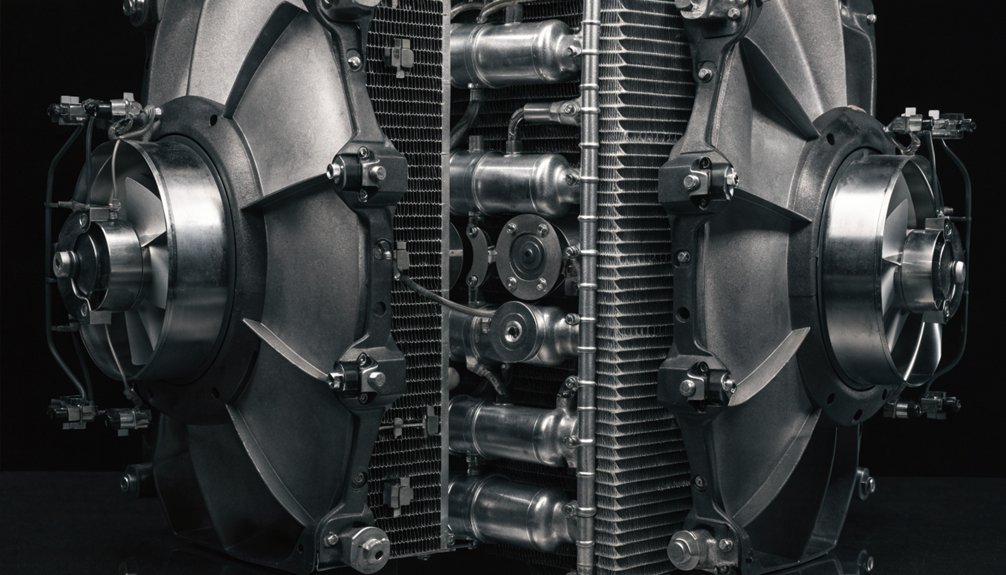
When the EMD F125 cooling circuit’s fan fails, engine overheating escalates rapidly. You’ll need robust backup protection to prevent catastrophic damage. Temperature-based fan controls automatically command fan operation as coolant approaches critical setpoints. These thermostatic systems prevent delayed activation that could allow boiling conditions.
When the EMD F125 cooling circuit’s fan fails, engine overheating escalates rapidly—temperature-based controls activate backup protection before catastrophic damage occurs.
Deploy fault detection logic to monitor radiator-to-coolant temperature rise rates continuously. If temperature rise accelerates while coolant flow remains stable, your system triggers immediate alerts. Alarm thresholds alert crews before pressure-relief conditions occur—the radiator cap’s ~14 psi rating only delays boiling, not overheating prevention.
Conduct fan command checks during routine maintenance to verify sensor responsiveness. Airflow verification confirms the fan actually runs when commanded by temperature logic. Your crew response protocols must include early intervention steps before mechanical failure progresses.
Mikura International supplies tested cooling circuit components engineered for reliable fault detection. Our parts ensure your locomotive maintains stable heat rejection during demanding operations.
Daily Checks and Service Schedules

You’ll inspect coolant levels and condition before each operation cycle. Monitor your radiator core for fin fouling and debris accumulation regularly. Verify thermostat function and fan engagement during warm-up to prevent thermal runaway.
Pre-Trip Coolant Inspections
Before every departure, conducting thorough pre-trip coolant inspections on your EMD F125 locomotive cooling circuit prevents catastrophic overheating failures. Start with coolant leak checks around pump seals and hose connections. Perform pressure cap testing to confirm proper sealing and ~14 psi rating integrity. Inspect hose clamp tightness at all connection points systematically. Monitor recovery tank levels for low coolant or contamination evidence. Verify glycol concentration using refractometer readings to ensure boiling-point protection. Check radiator cap seal condition for cracks or deterioration. Document all findings in your maintenance log before operation commences. Address any discrepancies right away—don’t postpone repairs. These inspections catch developing problems before they compromise cooling effectiveness during revenue service.
Radiator Core Cleanliness Monitoring
Daily visual inspections of the EMD F125 locomotive cooling circuit radiator core prevent fouling-induced overheating. You’ll examine the external fins for mud, lint, and debris blocking airflow passages. Monitor coolant level checks and overflow tank inspection during each pre-trip walk-around. Watch for hose leak detection signs like seeping or pooling beneath the radiator. Note rising coolant outlet temperatures indicating fouling severity.
Schedule cleaning intervals based on debris accumulation patterns in your operating environment. Between services, verify the radiator still pulls air effectively with normal fan operation. Adjust cleaning frequency after heavy dust exposure or seasonal debris influx. Track repeat fouling patterns systematically. Inspect fan belt condition and listen for water pump noise suggesting internal circulation problems. Maintain core cleanliness documentation for predictive maintenance planning.
Thermostat And Fan Verification
Keeping the EMD F125 locomotive cooling circuit radiator core clean prevents fouling, yet thermal regulation demands equal attention. You’ll verify thermostat calibration by confirming valve opening at ~82 °C setpoint. Monitor fan sensor health through daily coolant temperature observations during operation. Perform viscous clutch testing to ensure mechanical shift from slip mode to locked drive engagement. Check coolant probe accuracy against known reference points during scheduled inspections. Watch for heater heat soak indicators suggesting thermostat malfunction or stuck valve conditions.
| Verification Task | Testing Method | Acceptance Criteria |
|---|---|---|
| Thermostat calibration | Boiling water in-service test | Opens at specified setpoint |
| Fan sensor health | Temperature monitoring | Correct engagement timing |
| Viscous clutch testing | Bimetal spring response check | Smooth slip-to-lock transition |
| Coolant probe accuracy | Reference point comparison | ±2 °C tolerance |
| Heater heat soak | Daily observation | Normal temperature drop |
Frequently Asked Questions
What Are the Major Components of the Cooling System?
You’ll locate the EMD F125’s cooling system built around five critical components. Your radiator inspection reveals the core heat exchanger with finned tubes. Monitor your thermostat operation for proper temperature regulation. Assess your water pump health to ensure sufficient coolant circulation. Check your bypass valve function for system pressure management. Finally, maintain your coolant chemistry through regular analysis. These elements work together, requiring systematic attention to prevent overheating and component degradation.
What Are the Two Main Factors That Contribute to Engine Failure or Overheating?
You’re steering thermal management challenges when coolant flow fails or radiator fouling occurs. Insufficient flow stems from thermostat blockages, water pump wear, or impeller degradation. Reduced heat rejection happens when debris restricts airflow through fins. Both scenarios compromise cooling efficiency and coolant chemistry stability. Regular maintenance inspection prevents airflow restriction and flow interruptions. Monitor pump performance and radiator cleanliness consistently. These preventive measures safeguard against catastrophic overheating events.
What Are the Main Causes of Cooling System Problems?
You’ll encounter five primary cooling system problems. Radiator clogging from debris blocks airflow and heat transfer. Coolant leaks reduce system fluid levels and cause boiling. Thermostat faults prevent proper coolant circulation to the radiator. Air blockage restricts fan airflow effectiveness. Impeller wear reduces pump performance and circulation pressure throughout your EMD F125 locomotive’s cooling circuit.
What Are the Key Checks for a Cooling System?
You’ll need to systematically inspect your EMD F125’s cooling circuit like checking a vital heartbeat. Start with coolant level verification and concentration checks. Next, perform radiator inspection for fouling and airflow blockages. Then conduct thermostat testing through heat cycles. Verify pressure cap integrity and hose integrity throughout. Finally, confirm fan engagement at proper temperatures. These checks prevent catastrophic overheating failures during operation.