

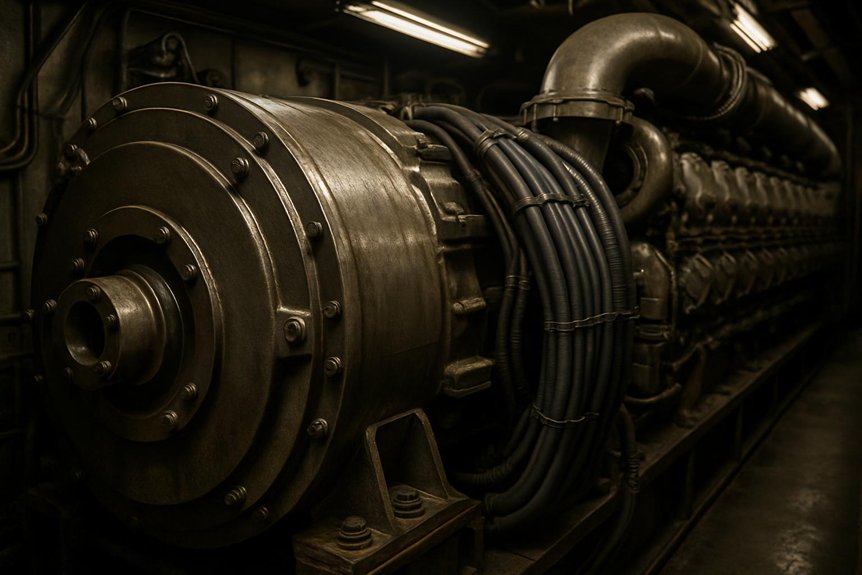
The EMD 710’s broad, flat torque plateau delivers near-constant mechanical input across all eight notch positions, which means you’ll see the main alternator produce a predictable voltage-current envelope at every throttle setting. As you advance notches, voltage climbs proportionally while current tapers inversely to maintain constant horsepower. The load regulator maps excitation directly to available torque, preventing engine lugging and alternator saturation in real time. Understanding how these systems interact reveals critical implications for traction performance, component longevity, and operational efficiency.
How does the EMD 710 engine’s torque curve influence the output characteristics of the main alternator in SD70 series locomotives?
The EMD 710 engine provides a broad torque plateau. This flat curve defines mechanical input limits. It ensures stable power delivery across notches. The main alternator converts this mechanical energy. Electrical output mirrors the engine’s torque profile. Control systems map torque to excitation levels. This mapping protects both engine and alternator. Low speed operation allows high current output. Voltage remains lower during these initial phases. The load regulator shapes the alternator field. It maintains safe copper and thermal limits. Traction current balances with engine capability.
This prevents lugging under heavy load conditions. SD70 series locomotives utilize constant horsepower loading. As rpm rises, voltage increases steadily. Allowable current tapers to match limits. The alternator output follows these boundaries. Traction inverters translate this to rail effort. Governors maintain stability throughout the process. Excitation modulates load to track torque. This ensures adhesion-limited performance consistently. Overload risks are minimized through precise control. Procurement focuses on steady-state margins primarily. Transient robustness is also a key factor. These elements define reliable locomotive performance.
The diesel-electric traction system relies on electromechanical coupling. Engine torque directly influences alternator characteristics. A flat torque curve enables consistent power. This consistency is vital for heavy haul operations. The main alternator acts as the primary converter. It transforms rotational force into electrical energy. Excitation control adjusts output based on demand. The load regulator prevents excessive thermal stress. It ensures the alternator operates within safe limits. High torque at low speeds boosts starting effort. This feature is crucial for freight initiation.
Voltage builds as engine speed increases. Current decreases to maintain constant horsepower. This balance optimizes traction motor performance. Rail engineers value this predictable behavior. It simplifies control algorithm development significantly. Procurement specialists prioritize reliability in these components. They seek systems with proven durability records. The SD70 series exemplifies this engineering philosophy. Its powertrain design minimizes operational failures. Efficient energy transfer reduces fuel consumption. This efficiency lowers long-term operating costs.
Stability in power delivery is paramount for rail. The EMD 710 engine achieves this through design. Its torque curve supports varied operational needs. The main alternator responds dynamically to changes. Excitation systems adjust field strength rapidly. This responsiveness maintains optimal traction effort. Adhesion limits are respected through careful control. Wheel slip is minimized by stable output. The locomotive powertrain integrates these functions seamlessly.
Electromechanical coupling ensures efficient energy use. Thermal management protects critical components effectively. Copper limits are monitored continuously. Insulation integrity is preserved over time. This longevity reduces maintenance frequency significantly. Rail operators benefit from increased uptime. Procurement decisions reflect these operational advantages. Engineers specify components based on performance data. The SD70 series sets industry standards. Its design influences future locomotive developments. Understanding torque-alternator interaction is essential. It drives innovation in rail transportation. Reliable power sources enable global trade. Efficient locomotives support sustainable logistics.
Key Takeaways
- The EMD 710’s flat torque plateau delivers near-constant mechanical input, enabling stable and predictable alternator output across all eight notches.
- Alternator excitation increases proportionally with each notch advancement, directly mapping field current to the engine’s stepped torque curve.
- The load regulator balances alternator voltage and current in real time, preventing engine lugging and alternator saturation during transitions.
- Predictable torque increments minimize erratic electrical transients, supporting consistent traction motor current and improved wheel-rail adhesion management.
- Stable torque loading reduces cyclic mechanical and thermal stress on alternator windings and bearings, extending component service life.
Understanding the EMD 710 Engine Dynamics
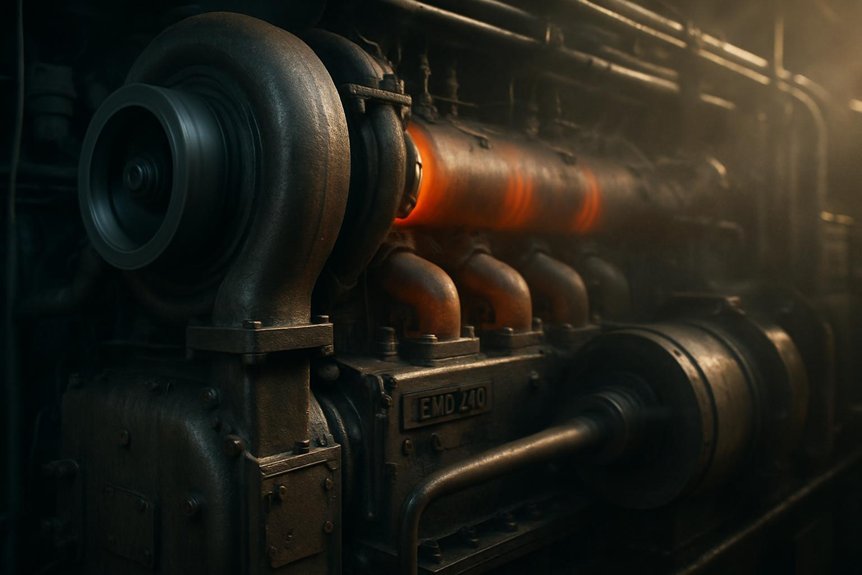
When you examine the EMD 710 torque curve, its flat torque plateau stands out immediately. This characteristic guarantees mechanical input stability across all eight operational notches. You’ll find that consistent power delivery at each notch directly governs how the SD70 main alternator receives its rotational energy.
The Flat Torque Plateau
Because the EMD 710 engine maintains a broad, flat torque plateau, it delivers near-constant mechanical input across its operating range. You won’t see dramatic torque dips between notch shifts. This stability directly supports effective load balancing across the alternator’s operational envelope.
This flat EMD 710 torque curve provides four critical advantages:
- Predictable alternator excitation — control systems map consistent torque to stable field current.
- Reduced thermal transients — steady input minimizes alternator copper temperature spikes.
- Improved fuel savings — the engine avoids inefficient off-peak torque regions.
- Simplified governor response — flat characteristics reduce corrective control interventions.
You’re essentially working with a mechanically stable platform. Minor speed fluctuations don’t compromise electrical output quality. This consistency defines the SD70’s reliable diesel-electric traction performance.
Operational Notches and Power Delivery
Each EMD 710 engine notch corresponds to a specific fuel rack position and governed speed setpoint. You’ll find eight discrete notches plus idle. Each delivers a predictable torque increment. The flat EMD 710 torque curve ensures consistent mechanical input across these steps.
As you advance through notches, alternator excitation increases proportionally. This stepped approach prevents sudden load transients. You’re managing resistance gearing electrically rather than mechanically. The control system maps each notch to defined voltage-current boundaries.
This predictable power delivery simplifies brake cylinder integration during blending operations. Dynamic braking changes remain smooth because torque increments are well-defined. You can trust each notch to deliver repeatable traction effort. For procurement specialists, this consistency translates directly into component longevity and reduced warranty exposure across SD70 fleets.
Mechanical Input Stability
Beyond consistent notch-to-notch power delivery, you need stable mechanical input at each operating point. The EMD 710’s design minimizes torque ripple and vibration. This mechanical stability directly protects alternator longevity.
Effective torque ripple control and rotational mass damping reduce stress throughout the powertrain. Here’s what this stability preserves:
- Coupling integrity — Lower torsional oscillations extend flexible coupling service life.
- Bearing longevity — Reduced radial loads decrease wear on alternator bearings.
- Electrical output quality — Smoother rotation yields cleaner alternator waveforms.
- Structural reliability — Minimized vibration prevents fatigue cracking in mounting assemblies.
You’ll find this stability essential for SD70 main alternator performance. Without it, excitation control systems can’t maintain precise output. Procurement specifications should always verify torsional damping characteristics before sourcing replacement components.
Main Alternator Output Characteristics in SD70 Locomotives
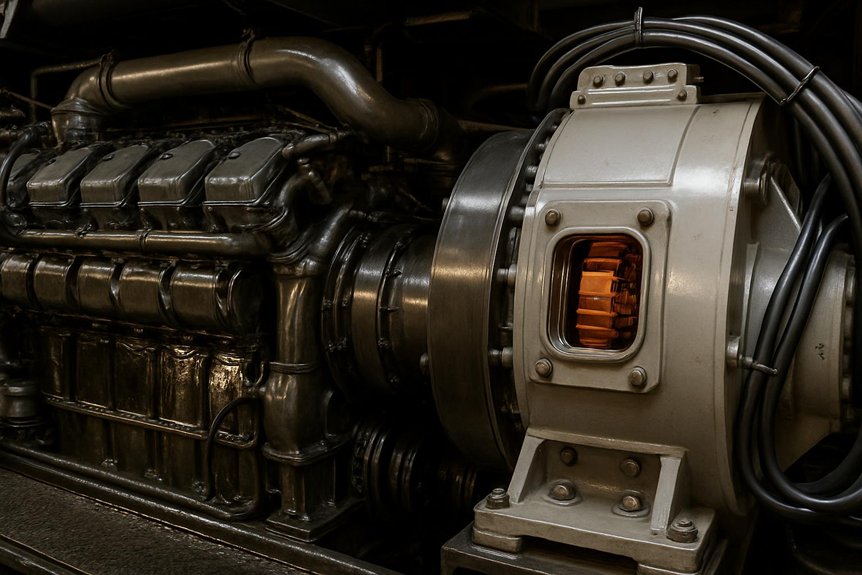
When you examine the SD70 main alternator, you’re analyzing an electromechanical converter that transforms engine torque into usable electrical energy. You’ll find its output defined by a voltage-current envelope constrained by thermal and copper limits. Understanding these boundaries lets you predict traction performance across all operating notches.
Electromechanical Energy Conversion
Because the main alternator serves as the sole electromechanical converter, its output characteristics define traction capability directly. You should perceive four critical conversion parameters:
- Rotational-to-electrical efficiency — Mechanical torque transfers through electromagnetic coupling with minimal loss.
- Voltage regulation — Output voltage scales proportionally with engine speed and excitation current.
- Current capacity — Copper thermal limits constrain maximum sustained amperage at each notch.
- Waveform quality — Harmonic suppression ensures clean AC output for downstream processing.
The alternator’s output waveform directly affects inverter commutation performance in AC traction systems. You can’t obtain dependable traction without stable electromechanical conversion. Mikura International supplies alternator components engineered for these demanding conversion cycles. Proper energy conversion preserves thermal margins and extends component service life across all operating notches.
Voltage and Current Relationship
As the EMD 710 engine accelerates through its notch positions, alternator output voltage climbs proportionally. You’ll observe current tapering inversely to maintain constant horsepower. This inverse voltage-current relationship protects thermal and magnetic boundaries.
The load regulator governs this balance precisely. It modulates alternator field strength in real time. You’re ensuring copper windings stay within safe temperature limits. Excessive current at high voltage would degrade insulation rapidly.
Your excitation strategy maps directly to the EMD 710 torque curve. At low notches, high current supports maximum traction effort. Voltage remains suppressed during these demanding start-up phases. As RPM builds, voltage rises while current decreases systematically.
This controlled transition prevents alternator saturation and engine lugging. You maintain efficient diesel-electric traction across all operating conditions.
Thermal and Copper Limits
Although the EMD 710 torque curve delivers stable mechanical input, the main alternator’s output ceiling depends on thermal constraints. You must respect these boundaries to prevent premature failure.
The alternator windings face strict current-carrying limits. Exceeding them accelerates insulation aging and creates copper hotspot conditions. Your control system monitors these parameters continuously.
Key thermal and copper limits you should track include:
- Winding temperature rise — sustained overcurrent degrades insulation class ratings.
- Copper hotspot formation — localized heating causes uneven resistance distribution.
- Excitation field adjustment — the load regulator reduces field strength before limits breach.
- Duty cycle duration — prolonged high-current operation compounds thermal accumulation.
These limits directly shape the alternator’s allowable output envelope. You can’t extract more electrical energy than thermal margins permit.
Control Systems and Load Regulation
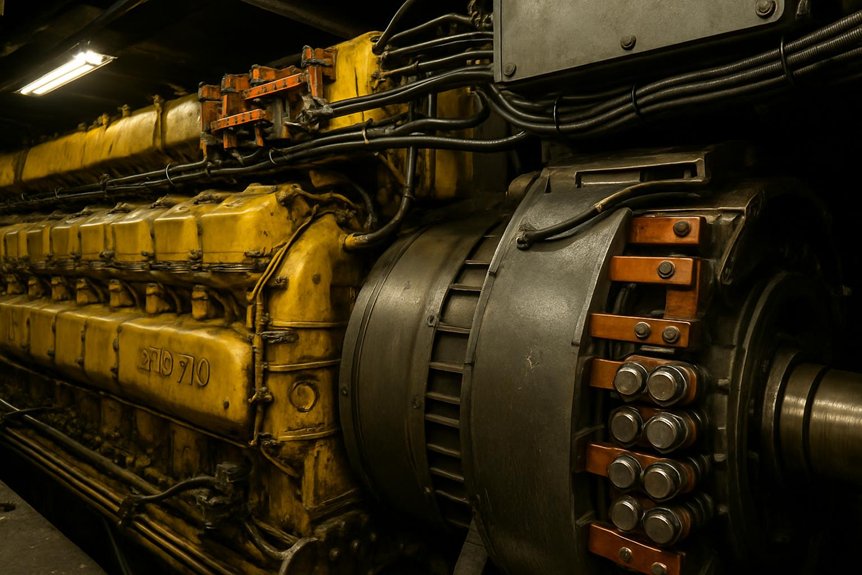
You rely on the load regulator to shape alternator field current precisely. Excitation control strategies map engine torque availability to electrical output across all notch positions. These protective mechanisms prevent thermal and mechanical overload in your SD70 locomotive powertrain.
Role of the Load Regulator
Because the main alternator must never exceed the EMD 710’s available torque, the load regulator serves as the critical intermediary. It interprets engine load demands in real time. Then it adjusts the alternator’s magnetic field accordingly.
Your load regulator performs four essential functions:
- Load demand response — It reads throttle position and engine conditions continuously.
- Field excitation control — It modulates alternator field current to match available torque.
- Thermal protection — It prevents copper windings from exceeding safe temperature thresholds.
- Power matching — It ensures electrical output never surpasses mechanical input limits.
This component doesn’t simply react to conditions. It anticipates load changes across notch changes. You’ll find it prevents engine lugging during heavy-haul startups. Without precise regulation, both engine and alternator face accelerated wear.
Excitation Control Strategies
The excitation control system governs how alternator field current tracks the EMD 710 torque curve. You’ll find sophisticated algorithms modulating field strength across all notch positions. These algorithms respond to throttle changes and wheel slip simultaneously. They prevent voltage overshoot during rapid notch shifts. This protection preserves alternator insulation and traction inverter integrity.
Governor tuning directly influences excitation response accuracy. A well-tuned governor stabilizes engine speed under load transients. You can then map excitation levels precisely to available torque. This coordination prevents engine lugging during high-demand scenarios. The system continuously balances current and voltage within thermal limits. Dynamic adjustment maintains best diesel-electric traction performance consistently. Procurement specialists should verify excitation controller calibration during component sourcing. Mikura International supplies alternator components meeting these critical control specifications.
Protection Against Overload
When the EMD 710 torque curve approaches its mechanical limits, onboard control systems activate protective measures automatically. You’ll find these safeguards prevent damage to both alternator and traction motors. The system continuously monitors electrical parameters against predefined thresholds.
Key protective actions include:
- Excitation reduction — Field current decreases to limit alternator output instantly.
- Current capping — Maximum traction motor protection engages to prevent winding damage.
- Thermal shutdown — Temperature sensors trigger load shedding before insulation degrades.
- Load regulator intervention — The system modulates engine demand to restore safe operating margins.
These protocols ensure you don’t exceed copper or thermal limits. They preserve component integrity during transient overload events. Your SD70’s reliability depends on these layered defenses operating without delay.
Implications for Rail Engineers and Procurement
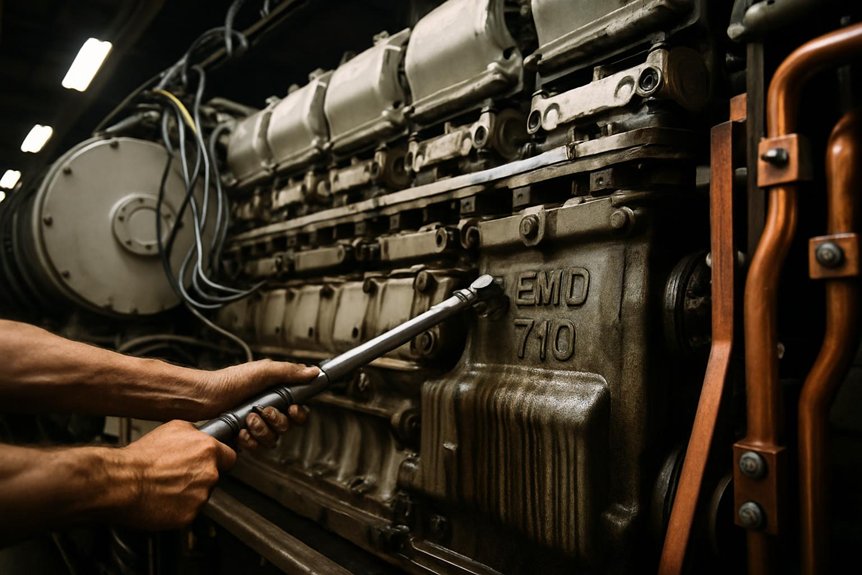
When you evaluate the EMD 710 torque curve, you must assess its direct impact on adhesion management and traction effort delivery. Your maintenance planning should account for alternator thermal limits and excitation system wear patterns. These factors collectively determine fuel efficiency and long-term operational costs across your SD70 fleet.
Adhesion and Traction Management
Because stable torque delivery directly governs wheel-rail interaction, adhesion management becomes a core powertrain function. The SD70’s flat EMD 710 torque curve minimizes erratic wheel slip behavior. You gain predictable traction effort across all operating notches. Traction control logic relies on this consistency for effective modulation.
Stable alternator output supports adhesion management through four mechanisms:
- Consistent current delivery prevents sudden torque spikes at traction motors.
- Rapid excitation adjustment reduces wheel slip response time markedly.
- Predictable power boundaries simplify traction control logic calibration.
- Thermal margin preservation sustains high tractive effort during prolonged demands.
This integration reduces wheel and rail wear measurably. You also achieve higher net hauling capacity per locomotive. Procurement decisions should prioritize components preserving this adhesion-optimized architecture.
Maintenance and Reliability Factors
Predictable torque loading directly extends component life across the SD70 powertrain. You’ll find that the EMD 710’s flat torque curve minimizes cyclic stress on alternator bearings and windings. This reduces lubrication wear on critical rotating assemblies markedly. Stable thermal profiles also prevent insulation degradation over extended service intervals.
When you maintain consistent operating conditions, filter maintenance becomes more predictable. Oil and air filtration schedules align with steady-state loading patterns. You won’t encounter the accelerated contamination rates that erratic power demands create.
For procurement specialists, this reliability translates into lower total cost of ownership. You’re sourcing components that operate within well-defined thermal and mechanical envelopes. Mikura International supplies EMD 710 engine parts engineered for these exact operating conditions. Rail engineers can specify replacements confidently using established performance data from SD70 fleet records.
Fuel Efficiency and Operational Costs
The EMD 710 torque curve’s flat plateau directly reduces specific fuel consumption across operating notches. You’ll find that stable mechanical input minimizes throttle hunting. The alternator converts energy with fewer transitional losses.
Key cost implications you should evaluate:
- Consistent torque delivery lowers fuel burn per gross ton-mile hauled.
- Reduced dynamic wheel slip events decrease rail and wheel wear costs.
- Optimized excitation control extends alternator insulation life, cutting overhaul intervals.
- Compatibility with regenerative braking systems recovers energy during grade descents.
These factors compound across fleet operations. Procurement specialists should model lifecycle costs against torque-alternator efficiency data. You’re not just buying components—you’re investing in sustained operational margins. Mikura International supplies EMD 710 engine parts engineered for these demanding efficiency standards.
Frequently Asked Questions
How Does the EMD 710 Torque Curve Affect Fuel Efficiency in SD70 Locomotives?
The EMD 710 torque curve improves your fuel efficiency by maintaining a flat torque plateau across operating notches. This allows precise fuel mapping that matches diesel injection to actual load demand. You’re avoiding over-fueling because the engine doesn’t chase erratic torque spentials. Your traction control system leverages this stability, reducing unnecessary throttle corrections. Consistent mechanical input means the alternator converts energy predictably, minimizing thermal losses and ensuring you extract maximum tractive effort per gallon consumed.
What Are Common Maintenance Issues Related to the Main Alternator in SD70 Locomotives?
You’ll most commonly encounter brush wear on the exciter and main field circuits, requiring scheduled inspection intervals. Prolonged high-current operation accelerates insulation breakdown across stator windings, especially under heavy-haul thermal cycling. You should also monitor bearing degradation, rectifier diode failures, and excitation winding resistance drift. These issues compound when the load regulator operates near copper thermal limits. Mikura International supplies critical alternator components engineered for SD70 series reliability and extended service life.
Why Is Constant Horsepower Loading Important for Diesel-Electric Locomotive Performance?
Constant horsepower loading prevents up to 15% thermal efficiency loss across operating notches. When you maintain constant loading, your engine operates within its most effective torque-speed envelope consistently. This directly enhances traction stability by ensuring predictable current-voltage relationships at the alternator output. You’re balancing mechanical input against electrical demand seamlessly. Without it, your load regulator can’t map excitation accurately, risking engine lug or alternator overheating during heavy-haul freight operations.
How Do Ambient Temperature Variations Influence Alternator Thermal Limits During Heavy-Haul Operations?
Ambient temperature rises directly reduce your alternator’s heat dissipation capacity, triggering thermal derating of allowable current output. In heavy-haul operations, you’ll see excitation control systems reduce field current to protect copper and insulation limits. Your load management algorithms compensate by adjusting the torque-to-excitation mapping in real time. This prevents thermal runaway while maintaining stable traction effort. You must account for seasonal temperature extremes when specifying alternator cooling margins.
What Spare Parts Should Procurement Specialists Stock for SD70 Alternator Reliability?
You should stock a spare regulator assembly, alternator bearings, rectifier diodes, and excitation field components. These parts directly sustain SD70 main alternator reliability. Prioritize brush holders and insulation kits for thermal protection. Keep voltage regulator cards available for rapid field replacement. Mikura International supplies these critical components with proven compatibility. By maintaining this inventory, you’ll minimize unplanned downtime and preserve consistent diesel-electric traction performance across heavy-haul operations.