

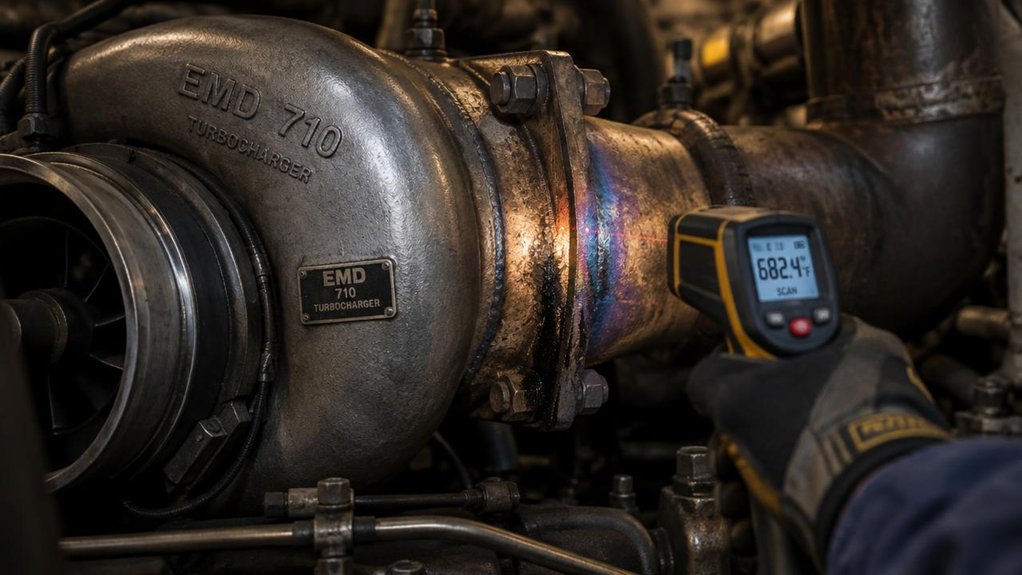
What Are Best Practices for Handling Exhaust Leaks and Hot Spots Around EMD 710 Turbo Housings in Locomotives?
Locomotive teams should treat EMD 710 turbo housing hot spots as serious maintenance signals. These hot spots often reveal exhaust leaks, failed gaskets, or cracked components. Inspect turbo housings during every scheduled locomotive service. Use infrared thermography and visual checks to find abnormal heat. Document all findings in the locomotive maintenance record.
Repair leaks with approved locomotive gaskets, clamps, and high-temperature hardware. Replace warped flanges and damaged expansion joints promptly. Install certified thermal insulation blankets around hot exhaust paths. Keep oil and fuel away from hot surfaces. Verify torque values using EMD 710 service literature.
Procurement specialists should specify rail-grade materials with traceable certifications. Choose suppliers experienced with locomotive turbocharger systems. Stock critical seals, blankets, and fasteners for rapid repairs. Track repeat failures by locomotive unit. Train crews to report unusual heat or exhaust smells. This reduces fire risk and improves fleet reliability. Review warranty data before approving alternate parts. Schedule follow-up inspections after every major repair.
Why EMD 710 Turbo Housing Hot Spots and Exhaust Leaks Matter in Locomotives
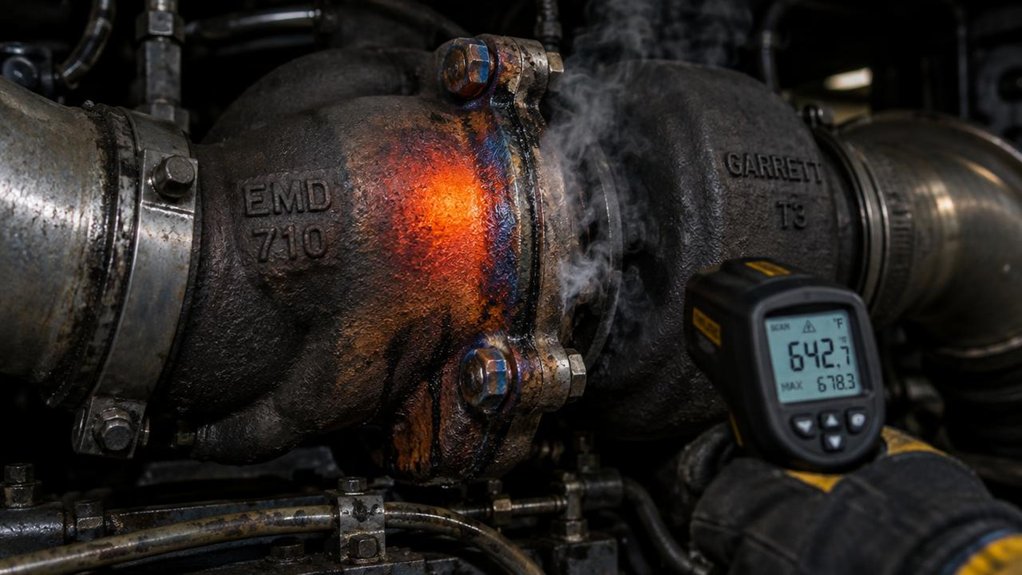
EMD 710 turbo housing hot spots tell you an exhaust leak is already compromising the locomotive. You’ll see how hot spots develop, which leak symptoms to recognize, and what safety, compliance, and downtime risks follow. Understanding these three areas helps you act before a minor leak becomes a fire or a service failure.
How Hot Spots Develop Around Locomotive Turbo Housings
Because the turbocharger sits in the hottest part of the exhaust path, small sealing defects escalate quickly. Thermal cycling drives most of the damage. Every heavy-duty load change makes the housing, manifold, and flanges expand and contract at different rates. That thermal expansion loosens clamps and relaxes bolt preload, so you’ll lose sealing integrity at the joint.
Gaskets then degrade, harden, and crack under repeated heat. Exhaust gas escapes through the gap and erodes the mating surfaces. Cracked manifolds produce the same result, and you’ll often see soot trails first. Failed insulation compounds the problem because it exposes bare metal and traps heat beside the leak. Hot spots form where escaping gas impinges on metal. Don’t ignore localized discoloration; it signals active exhaust leakage.
Common Exhaust Leak Symptoms Rail Engineers Should Recognize
In the engine room, exhaust leaks around the turbocharger usually announce themselves before a failure occurs. Make engine room monitoring part of every locomotive walk-around, and you’ll catch these signs early.
Listen for a high-pitched whistle near the housing joints. Look for soot streaks radiating from flanges, clamps, or gasket edges. Visible heat discoloration, such as blued or flaking paint, marks a developing hot spot. Rising exhaust gas temperatures on a single unit often point to escaping gas.
Don’t skip exhaust odor checks, either. A sharp exhaust smell in the engine room means gas is escaping upstream of the stack.
Report any of these symptoms immediately, and isolate fuel and oil lines from the affected area. Record each finding in the locomotive maintenance record.
Safety, Compliance, and Downtime Risks
When exhaust gas escapes a turbo housing, you’re facing fire, burn, and downtime risks at once. Fire hazards rise when leaking gas heats oil mist, fuel residue, or lagging near the hot surface. Thermal burns risk is just as real for technicians who brush against uninsulated housings during inspection.
Ventilate your shop well, because exhaust leaks also expose crews to fumes. Your FRA safety culture depends on crews reporting heat, soot trails, and exhaust smells immediately. EPA emissions concerns also apply, since unmanaged leaks release exhaust before it reaches the intended path.
Unplanned out of service events cost far more than a scheduled gasket and clamp repair. Inspect, document, and correct every hot spot before the locomotive returns to revenue service, without any exception.
Detection and Inspection Best Practices
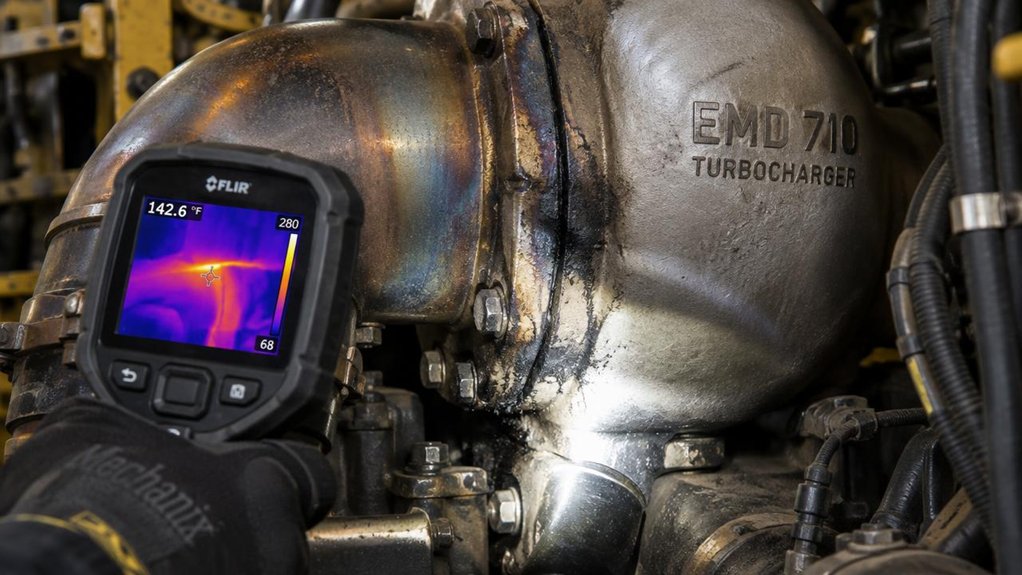
You can’t manage what you can’t find, so detection starts with a disciplined routine. Three methods work together here: scheduled visual inspections of the turbo system, infrared thermography of EMD 710 turbo housing hot spots, and pressure testing to confirm exhaust leaks. Let’s walk through each one so you can catch problems before they become fires or road failures.
Scheduled Visual Inspections for EMD 710 Turbo Systems
Always schedule visual inspections of the EMD 710 turbo system at every periodic locomotive service. Add a walk-around check after any exhaust-related repair or unusual heat report.
Open the engine room access panels, then use a mirror and flashlight to see behind the turbo housing. Look for soot trails, discoloration, and fresh carbon streaks; they’d point to a leak path. Mark each soot trail and compare it with the last inspection record.
Apply Clamp Torque Controls by checking every clamp for looseness, cracking, or witness-mark movement. Verify torque against EMD 710 service literature before you release the unit.
Flange Alignment Checks come next: look for gaps, warping, and uneven gasket compression.
Record findings, photos, and corrective actions in the locomotive maintenance record before departure.
Infrared Thermography for EMD 710 turbo housing hot spots
How do you tell a normal hot turbo from a leaking one? Thermal cameras show you the difference. They map surface temperature, so abnormal patterns stand out immediately.
Start with Baseline Normalization. Scan each EMD 710 turbo housing after the locomotive reaches stable operating load. Record temperatures at the flanges, clamps, and expansion joints. Use the same load notch, ambient conditions, and camera angle every time.
Next, apply Fleet Comparison. Compare your readings against other locomotives with similar load and service hours. A unit running well above its peers likely has a leaking gasket or failed insulation.
Look for sharp, localized gradients rather than uniform heat. Those patterns point to exhaust leaks. Don’t rely on images alone. Confirm findings visually, then log them promptly.
Pressure Testing and Exhaust Leak Detection Methods
Thermal images flag abnormal heat, but they don’t pinpoint the leak path. Confirm the source with pressure testing and targeted detection. Start with a leak-down test on the cooled, isolated exhaust path. Apply regulated air per EMD 710 service literature, then watch the gauge for pressure decay. Introduce smoke or dye at flanges, clamps, and gasket seams to trace escaping air. Ultrasonic detectors catch high-frequency leak noise that you can’t hear in a noisy shop. Compare EGT sensor data across cylinders and locomotives; unexplained drops or drift suggest leakage upstream of the turbine. Perform a pressure wash down only on cooled housings, so fresh soot trails show new leaks. Finish with afterrepair verification: retest, confirm torque, and record results in the locomotive maintenance file.
Repair and Mitigation Techniques
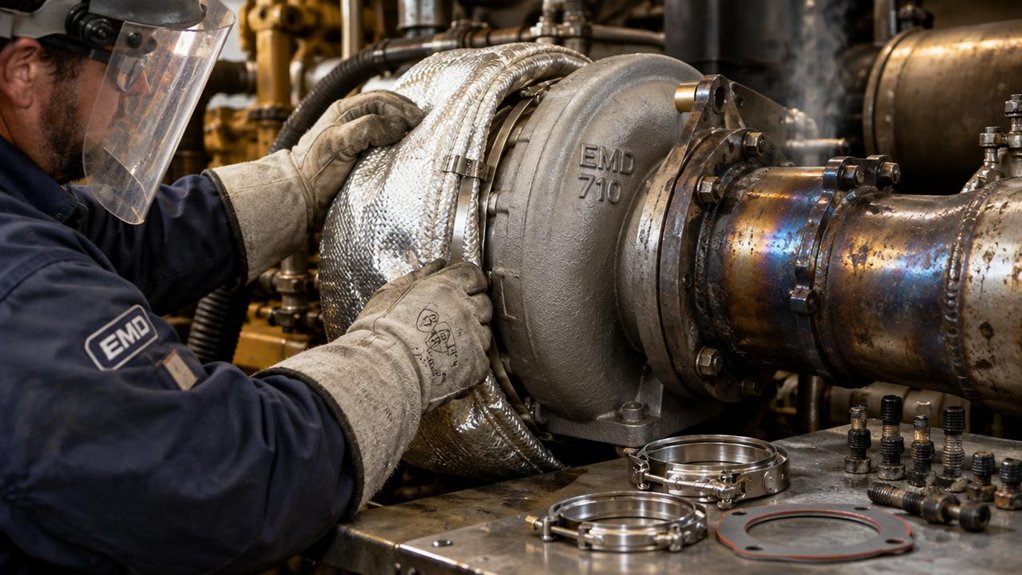
You’ll start by replacing the gasket, clamp, and flange correctly, since seating and torque determine whether the leak stays closed. Next, you’ll apply high-temperature insulation and heat shields to contain radiant heat and protect adjacent components. While managing EMD 710 turbo housing hot spots during service, you’ll verify each repair and keep fuel and oil clear.
Replacing Gaskets, Clamps, and Flanges Correctly
Three details decide whether a turbo housing repair lasts: gasket selection, surface preparation, and torque sequence. Select rail-grade gaskets that match the EMD 710 part number in the service literature. Clean the gasket surface to bare metal, and check flanges for warpage before you fit anything. Replace any flange that won’t seat flat. Apply rail grade torque in the specified sequence, in stages, never in one pass.
Use this checklist during every repair:
| Step | Requirement |
|---|---|
| Gasket | Match the EMD 710 part number |
| Surface | Remove residue; verify flatness |
| Clamp | Replace worn or distorted hardware |
| Torque | Follow the service literature sequence |
Record torque values and gasket lot numbers in the locomotive maintenance record. Then run the unit under load, and scan the joint with infrared thermography.
Applying High-Temperature Insulation and Heat Shields
Once you’ve sealed the joint and verified it by infrared scan, add insulation and heat shields to contain residual heat. Confirm blanket suitability first. Check that the material’s continuous temperature rating exceeds your measured surface temperature, with margin for exhaust transients. Verify clearance distances between the blanket, shield, and adjacent cables, fuel lines, and lube oil piping. Never wrap over oil- or fuel-contaminated surfaces. Eliminate the leak source and clean the area first, because saturated insulation can ignite. Secure blankets with stainless fasteners, and leave inspection access at flanges and clamps. Mount heat shields on rigid brackets so they don’t vibrate loose. Then rescan the housing and log the temperatures in the locomotive maintenance record. You’ll catch residual hot spots before release to service.
Managing EMD 710 turbo housing hot spots During Service
Insulation and shields contain residual heat, but they won’t help when a hot spot appears mid-service. Start your emergency response immediately. Reduce load to lower exhaust gas temperature, then bring the locomotive to a safe stop.
Next, isolate the unit and let it cool. Inspect the housing, flanges, clamps, and expansion joints for soot trails, cracks, or loose hardware. Confirm the hot spot location with an infrared camera.
Repair only after you’ve verified the cause. Replace failed gaskets, correct warped flanges, and torque fasteners to EMD 710 service literature values. Reinstall damaged insulation before returning the unit to service.
Record every step as service documentation. Include temperatures, findings, part numbers, torque values, and technician names. Schedule a follow-up inspection after the next loaded run.
Procurement and Material Specifications
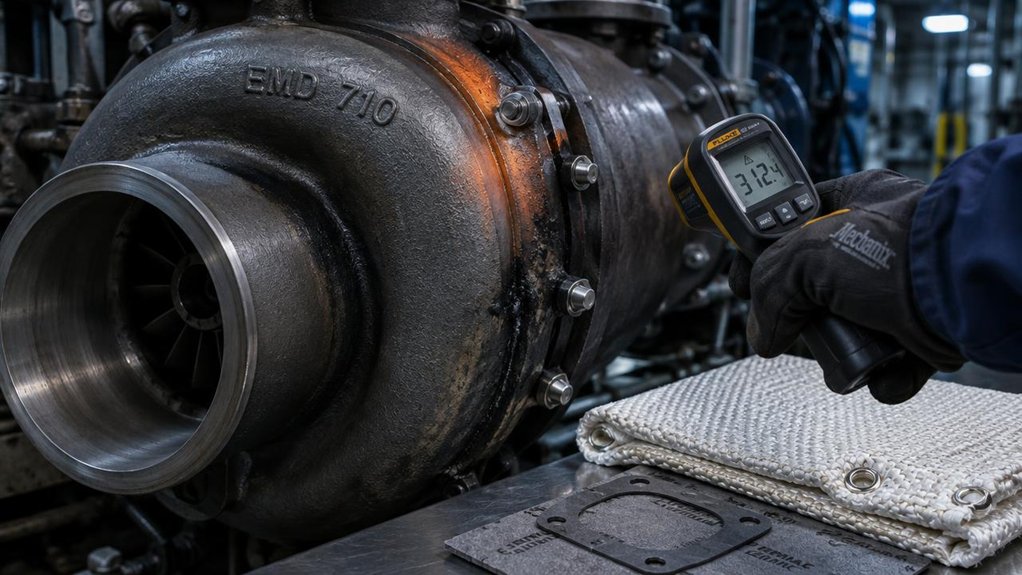
Once you’ve repaired an exhaust leak, the right parts and supply plan keep it from coming back. You’ll need to specify rail-grade turbo housing components, qualify suppliers who can prove material traceability, and plan inventory for leak and heat repairs. Each decision affects fire risk, locomotive availability, and compliance, so treat it with the same rigor as the repair itself.
Specifying Rail-Grade Turbo Housing Components
When you specify turbo housing components for an EMD 710 locomotive, start with verified material data, not unit price. Request material certification for every casting, gasket, and fastener. Each certificate should link to a heat or lot number, so you can trace material through machining and inspection. Confirm temperature ratings exceed your turbo’s peak exhaust gas temperatures, with margin for transient loads. Verify fit against EMD 710 service literature and correct part numbers before you approve any alternate.
Supplier quality depends on documented processes, so schedule documentation audits of inspection records and calibration logs. Don’t skip compliance verification at receiving. Compare each delivered part’s markings and certificates against your purchase specification. Quarantine any component with missing or mismatched records until you’ve resolved the discrepancy.
Qualifying Suppliers for Locomotive Turbo Parts
Clean documentation only helps if the supplier can repeat that quality on every order. Qualify each source before you approve it for EMD 710 turbo housing work. Use this three-step sequence:
- Verify experience and supplier certifications. Confirm the supplier has shipped locomotive turbocharger parts and holds current ISO and material test records.
- Audit quality systems. Review inspection methods, traceability controls, and nonconformance handling on site.
- Compare commercial terms. Check warranty coverage, lead times, and stocking capacity against your downtime exposure.
Weigh aftermarket parts against OEM options using documented field performance, not assumptions. Don’t approve alternates until you’ve reviewed their warranty claim history. A leaking turbo housing can ignite oil or fuel, so you shouldn’t shortcut verification. Record every audit finding in your procurement file.
Inventory Planning for Leak and Heat Repairs
Qualified suppliers only help if the right parts are on your shelf when a leak appears. Strong heat repair planning starts with your failure history. Review which EMD 710 turbo housings leaked, cracked, or overheated, and which parts you replaced. Then set stock levels by unit count and lead time.
Critical spares coverage should include:
- Gaskets and clamps sized for each turbo housing joint.
- Studs and fasteners, with heat-rated specifications.
- Insulation blankets and heat shields cut for your locomotive models.
Verify that every item carries traceable certification before it enters stock. Store seals and blankets dry, clean, and away from oil or fuel. Don’t wait for a stockout to trigger a reorder; set minimum quantities and review them quarterly. Log usage after every repair.
Maintenance Programs and Fleet Reliability
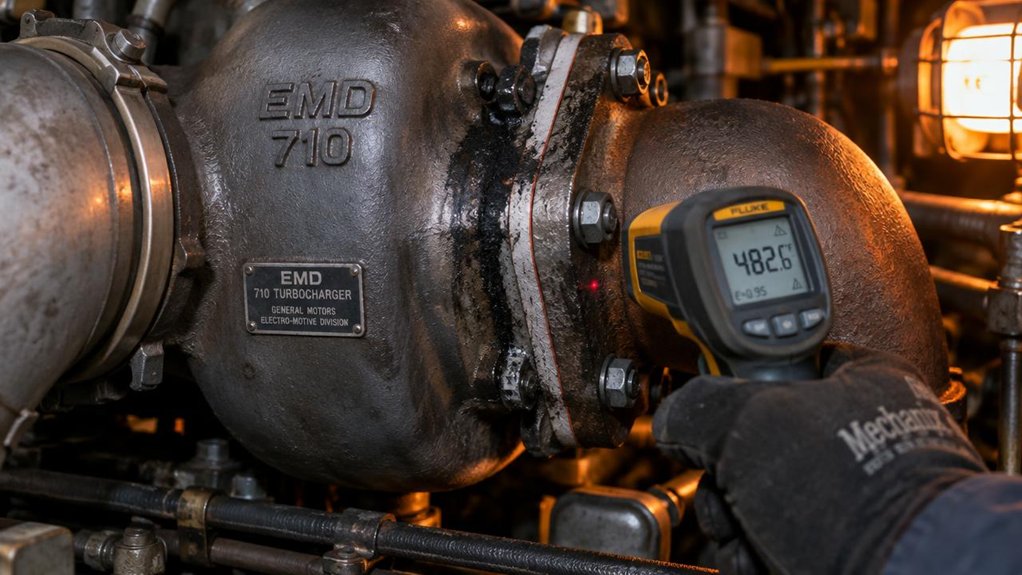
Procurement gets the right parts to your shop, but a disciplined maintenance program keeps EMD 710 turbo housings sealed and cool in service. You’ll set preventive intervals, track trends and repeat failures by unit, and train crews and buyers to report heat early. Together, these steps cut fire risk and protect fleet reliability.
Preventive Maintenance Intervals for EMD 710 Locomotives
You’ll catch most turbo housing problems early when you tie inspections to service hours, not to the calendar. Service hours reflect actual engine wear, while calendar dates ignore how hard a locomotive works. Set your inspection frequency using three inputs:
- Service hours: Follow the EMD 710 service literature for baseline turbo housing, gasket, and clamp checks.
- Duty cycle: Shorten intervals for locomotives that run sustained high notches or frequent load cycling.
- OEM recommendations: Don’t extend intervals beyond OEM limits without documented reliability data.
Perform infrared thermography and visual checks at each interval, and verify clamp torque against specification. Record every finding in the locomotive maintenance record. If you find soot trails or hot spots, shorten that unit’s interval until you correct the root cause.
Trend Tracking and Repeat Failure Analysis
Why do the same locomotives keep returning with the same turbo housing problems? Usually, you’re fixing symptoms and missing the root cause. Start by tracking hot spots by locomotive unit. Record location, thermal image, surface temperature, and repair history after every inspection. Compare each reading against that unit’s thermal baseline. Trending Analysis then shows whether a gasket joint is slowly degrading. A rising delta signals you should act before a leak develops.
When a defect repeats, don’t simply replace the gasket again. Check flange flatness, clamp condition, torque records, and part numbers against EMD 710 service literature. Document your findings and the corrective action. Flag any unit with two failures in one interval for formal review. Schedule a follow-up inspection to confirm the fix.
Training Crews and Procurement Teams on Hot Spot Reporting
When a mechanic spots a hot spot but can’t relay it clearly, the repair stalls before it starts. Strong Crew Communication keeps engineers, mechanics, and procurement aligned on every EMD 710 turbo housing finding. Train everyone to use one standard report format:
- Capture Photo Documentation showing the hot spot, soot trails, and the locomotive number.
- Record location, thermal reading, and suspected cause, such as a gasket leak or loose clamp.
- Specify part numbers, quantities, and urgency so procurement can order correctly.
Follow up after each repair. Mechanics should confirm results with a repeat thermal scan and update the record. Procurement then reviews the report against stocked seals, blankets, and fasteners. You’ll also catch repeat failures sooner, which reduces fire risk and protects fleet reliability.
Frequently Asked Questions
Can a Locomotive Stay in Service With a Minor Turbo Exhaust Leak?
Yes, but only briefly, and only if you’ve verified the leak is minor. Don’t keep it running until you’ve inspected for soot trails, checked turbo cooling, and scanned the housing with infrared thermography. If you see rising hot spots, oil mist, or fuel near the leak, pull the unit. Start leak monitoring at every trip, log the findings, and schedule gasket and clamp repair promptly, before heat damage spreads further.
Do Exhaust Leaks Affect EPA Emissions Compliance on EMD 710 Locomotives?
Yes, they can. Say you’ve got a Tier 2 locomotive with a leaking turbo gasket. Lost boost pressure starves combustion air, so you’ll see more smoke and particulate. Don’t wait for an emissions concern. Run turbo seal testing and leak detection during every service, using soot trails and thermal imaging. Replace failed gaskets, verify torque per EMD 710 service literature, and document results. Keep the unit’s emissions-related maintenance records current.
How Should Technicians Handle Used Insulation Blankets During Turbo Housing Removal?
Inspect blanket removal safely by treating every used blanket as potentially contaminated until you’ve verified its material. Older locomotive insulation may contain asbestos, so you’ll need to manage asbestos exposure with wet methods, respirators, and disposable coveralls. Don’t shake or cut blankets. Bag them in labeled, sealed containers, and log the locomotive unit and location. Dispose of them under your site’s hazardous waste rules. Replace them with certified new blankets.
What Documents Should Accompany Exported EMD 710 Turbocharger Parts at Delivery?
A chain’s only as strong as its weakest link, so you’ll want complete paperwork with every shipment. Include a commercial invoice, packing list, and certificate of origin. You’ll need material certificates and inspection reports to support Turbo Traceability, including part numbers and lot numbers. Attach Packing Instructions that specify handling, corrosion protection, and lifting points. Add a warranty statement and safety data sheets for sealants. Verify the bill of lading.
Does Gasket Shelf Life Matter for Stored EMD 710 Turbo Spares?
Yes, gasket shelf life matters. Seal material can harden, crack, or lose compression recovery in storage. You won’t see it until the joint leaks under heat. Set up storage rotation using first-in, first-out, and label every gasket with its manufacture date. Store spares flat, sealed, and away from ozone, oil, and sunlight. Inspect each gasket before installation, and discard any that’s stiff or damaged. Then verify torque per service literature.