

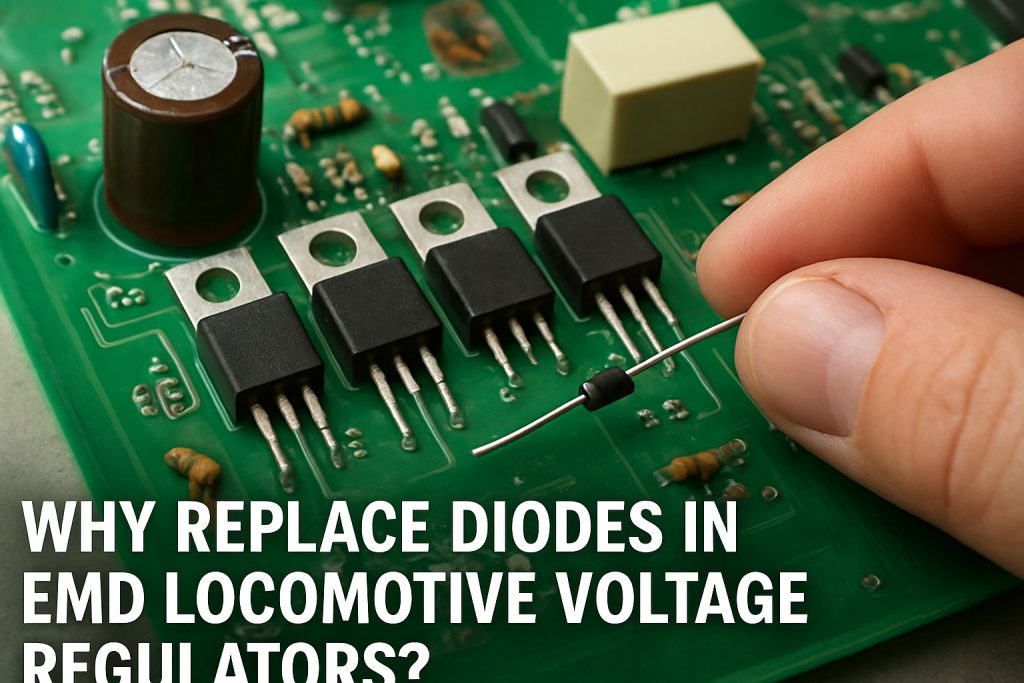
You rely on EMD locomotives to stay on schedule. Diode health in the voltage regulator is critical for reliability. Replacing worn diodes prevents voltage spikes and regulator failure.
Key benefits include better regulation, reduced heat, and fewer unplanned outages. This saves maintenance time and keeps trains moving on time.
Our approach focuses on the specific needs of EMD locomotive systems. We select high quality diodes that meet the exact ratings for your regulator. This ensures compatibility and long service life.
Common issues indicate when replacement is needed. Look for excessive regulator heat, irregular voltage output, or repeated fuse blows. These signs point to diode degradation.
Concrete scenarios and actionable steps
Scenario: An EMD hauled train experiences intermittent voltage dips during peak load, causing lighting flicker in passenger cars.
Action: Schedule a diode health check during the next major maintenance window and measure regulator output under load with a calibrated multimeter. If the diode forward drop increases or leakage rises, replace the pair rather than a single diode to restore symmetry.
Scenario: A yard switcher repeatedly blows a fuse after a short idle period.
Action: Inspect the regulator bridge for diode cracking or solder joint fatigue. Replace with OEM-grade diodes rated for the regulator current, and reflow joints to prevent micro-cracks that mimic failure later.
Scenario: High regulator heat persists after a clean fan and vent path check.
Action: Conduct a thermography scan on the regulator module to locate hotspots. If hotspots align with diode clusters, proceed with replacement and verify heat sinking in the housing to avoid new hot spots.
Practical steps for maintenance teams
- Use OEM-grade or higher reliability diodes designed for locomotive regulators.
- Verify voltage and current ratings match your regulator spec sheet.
- Inspect related components during replacement to prevent cascading failures.
- Document part numbers and batch codes for traceability.
- Test the regulator under load after replacement and record performance data for the maintenance log.
For sourcing managers, timing matters. Plan replacements during planned maintenance windows to minimize disruption. Mikura International offers ready-to-ship diode sets tailored to EMD regulator models, with batch documentation and a compatibility guarantee.
Expert Insight
“Use OEM-grade or higher reliability diodes designed for locomotive regulators, ensure voltage and current ratings match your regulator spec sheet, and document part numbers for traceability to prevent cascading failures during planned maintenance windows.” , Industry Analyst
Diodes in EMD locomotive voltage regulators handle high currents and fast switching. Faulty diodes cause regulator instability, voltage dips, and unexpected shutdowns. In harsh rail environments, failures raise maintenance costs and downtime. Regular diode checks protect power quality, shield surrounding components, and extend regulator life. Mikura International provides reliable replacement components that restore performance quickly and safely.
Why Mikura International focuses on reliable replacement components.
You gain quick access to proven, ISO-certified diode replacements for EMD regulators. Our team sources parts that meet strict electrical and environmental standards. This ensures compatibility, reliability, and long service life. We minimize supply gaps with on-time delivery and integrity in every transaction. Our priority is to support spare parts sourcing managers in Australia with accurate, fast, ethical service.
- Ethical sourcing: components from approved suppliers with traceability.
- Technical assurance: parts tested for reverse recovery and surge handling.
- Delivery reliability: guaranteed on-time shipment to keep maintenance windows intact.
In practical terms, implement a diode health plan within your maintenance cycle. 1. Inspect diodes during routine regulator checks using a handheld multimeter to verify forward voltage drop remains within specification. 2. Schedule a full diode bench test every 12 to 18 months, including reverse recovery time and peak current capability. 3. Maintain an inventory buffer for critical diodes to prevent downtime when a part is flagged or out of stock. 4. Document results in a maintenance log and correlate with regulator uptime data to identify recurring failure patterns.
| Focus Area | Mikura International Approach |
|---|---|
| Part Quality | ISO-certified, audited suppliers |
| Delivery | On-time to reduce downtime |
| Support | Technical guidance for replacement |
Expert Insight
“Reliable, ISO-certified replacements enable rapid, safe restoration of performance with traceable sourcing, on-time delivery, and technical guidance that minimizes downtime for spare parts managers.” , Industry Analyst
1. Understanding EMD Voltage Regulators and Diodes
Role of diodes in regulator circuits
Diodes act as fast switching elements in EMD voltage regulators. They steer currents, clamp voltages, and protect switching transistors during throttle transitions. Selecting the right diodes prevents regulator oscillations and helps maintain stable output.
- Rectification paths control current flow during charging and discharging cycles.
- Fast recovery diodes minimize reverse recovery losses at high switching frequencies.
- Forward voltage characteristics influence overall regulator efficiency and thermal behavior.
How diodes affect performance and reliability in locomotives
Diodes shape reliability and uptime by controlling heat and electrical stress. A degraded diode elevates hotspot formation and increases the risk of regulator failure in harsh rail environments. High quality diodes extend service intervals and reduce maintenance windows.
- Thermal behavior from diode operation governs cooling requirements.
- Electrical stress from transients tests diode endurance and longevity.
- Consistency of reverse recovery affects surge protection for the regulator network.
| Aspect | Impact on the Regulator |
|---|---|
| Efficiency | Low forward drop preserves power loss margins and improves thermal margins. |
| Thermal Load | Higher quality diodes reduce hotspot formation in modules. |
| Protection | Fast recovery limits voltage overshoots during switching events. |
For sourcing managers, align diodes with regulator design, switching speed, and environmental ratings. This alignment minimizes early failures and extends regulator life in Australian operations. In practice, specify diodes with a low total ionizing dose tolerance for onboard electronics and verify vendor data sheets include a minimum 50 kA surge rating for wind gust events typical in coastal rail corridors. Mikura International recommends validating diode performance under simulated throttle ramps and ambient temperatures from -40°C to 85°C before final sign-off.
2. Common Diode Failures in Harsh Locomotive Environments
Thermal stress
Elevated ambient temperatures accelerate diode aging. Repeated thermal cycling causes junction fatigue and die attach cracking. This raises forward voltage drift and leakage current. Proper derating minimizes these effects.
- Hot spots in power modules accelerate failure.
- Inadequate cooling compounds thermal stress on diodes.
- Delayed heat dissipation reduces regulator efficiency.
Vibration
Locomotives expose components to continuous vibration. Mechanical stress loosens interconnections and damages bond wires. Vibration can misalign heatsinks, worsening thermal conditions. Over time, contact resistance rises and failures propagate.
- Loose solder joints increase intermittent faults.
- Bond wire fatigue may lead to open circuits.
- Module seating integrity affects thermal paths.
Electrical transients
Transients from regenerative braking, switching events, and load changes stress diodes beyond steady state. Recovered energy can trigger overshoots and reverse recovery spikes. Proper transient handling reduces ripple and protects adjacent devices.
- Surge events amplify reverse recovery losses.
- Inadequate snubbing raises voltage overshoot risks.
- Insufficient protection elevates risk of secondary failures.
Symptoms indicating diode degradation
Early signs help prevent unexpected outages. Look for abnormal heating near diode clusters, rising junction temperatures, and unusual regulator noises. Increased leakage current often signals aging diodes.
| Symptom | Likely Cause |
|---|---|
| Excessive heat in diode area | Thermal degradation or poor cooling |
| Intermittent regulator faults | Loose connections or bond-wire fatigue |
| Voltage overshoot during switching | Inadequate transient protection |
Documented symptoms guide timely diode replacement. This reduces downtime and stabilizes regulator performance in Australian operations.
3. Benefits of Replacing Diodes with High-Quality Parts
Improved reliability and reduced downtime
High-quality diodes stabilize regulator output during load steps, preventing voltage dips that can trigger equipment faults. In Australian operations, this translates to fewer unexpected outages during peak afternoon loads when solar generation fluctuates.
Reliable parts withstand harsh ambient conditions with minimal drift, ensuring consistent performance across coastal and desert sites alike.
- Lower failure rates prevent unplanned maintenance windows by reducing the need for on-site diagnostics.
- Consistent switching reduces nuisance trips in distributed energy setups, such as remote substations.
- Extended service intervals boost fleet availability by aligning part replacements with calendar planning rather than reactive calls.
Enhanced electrical protection and longevity
Robust diodes offer stronger reverse recovery resilience, which protects switch-mode power supplies and nearby sensors from transient surges during load transients or switching events.
Superior derating preserves performance through heat cycles, maintaining regulator accuracy in high-temperature environments typical of inland Australian sites.
- Better surge handling guards the regulator network against temporary overvoltages from lightning or grid disturbances.
- Stable leakage characteristics reduce parasitic heating, extending component life in sealed enclosures.
- Longer mean time between failures supports uptime goals by decreasing the frequency of on-site maintenance checks.
| Benefit | Impact |
|---|---|
| Regulator stability | More consistent output under varying loads, even during rapid load steps or intermittent generation. |
| Downtime | Fewer repair events and quicker return to service after disturbances. |
| Maintenance planning | Predictable replacement intervals simplify scheduling and inventory management. |
4. Selection Criteria for Replacement Diodes
Choose diodes that fit the EMD regulator design and Australian operating conditions. Ensure compatibility with the module topology and heat management practices. This section outlines the essentials to guide sourcing decisions.
Voltage, current ratings, and reverse recovery characteristics
Match the diode voltage rating to the regulator’s maximum bus voltage. Pick current ratings that exceed peak load needs. Review reverse recovery time to cut switching losses and spike risks.
- Voltage rating: at least 20 percent above the maximum system voltage.
- Current rating: continuous and surge specs above regulator demand.
- Reverse recovery: fast recovery suits high frequency operations.
Environmental ratings and certification standards
Diodes must endure locomotive vibration and ambient temperatures. Check thermal derating guidance and encapsulation quality. Verify compliance with rail industry standards.
- Temperature range suitable for engine room and cab environments.
- Vibration and shock tolerance aligned with Australian rail norms.
- Certifications: ensure alignment with rail-specific quality frameworks and supplier QA processes.
| Criterion | What to verify |
|---|---|
| Voltage rating | Buffer above maximum bus voltage by at least 20% |
| Current rating | Exceeds peak load and includes surge margin |
| Reverse recovery | Low recovery time to reduce switching losses |
| Environmental rating | Thermal derating, vibration, and moisture tolerance |
| Certifications | Rail-specific quality and safety standards |
5. Replacement Process and Best Practices
Step-by-step replacement workflow
Prepare the work area and confirm part numbers before starting. 1. Power down the regulator module and remove access panels. 2. Discharge any stored energy safely per standard procedure. 3. Document existing diode layout and take high-resolution photos for reference. 4. Desolder or unsolder old diodes with proper heat management. 5. Inspect adjacent components for heat damage or mounting fatigue. 6. Install replacement diodes with correct orientation and secure solder joints. 7. Reassemble the module and verify connector integrity. 8. Reconnect power and perform a controlled test run at low load. 9. Gradually increase load to normal operating conditions while monitoring signals. 10. Record test results and update maintenance logs for traceability.
- Follow the regulator manufacturer guidelines for torque on mounting hardware.
- Use anti-static practices to protect sensitive devices during replacement.
- Maintain clean soldering and avoid cold joints that cause intermittent faults.
Quality control and testing post-installation
Execute functional tests to confirm proper diode operation. 1. Check forward voltage and reverse leakage at ambient conditions. 2. Validate switching behavior under stepped load profiles. 3. Monitor regulator output stability for several cycles.
- Perform thermal imaging to verify even heat distribution around new diodes.
- Run a vibration test to ensure components stay seated under typical rail conditions.
- Compare post-installation data against baseline measurements stored in the maintenance system.
| Aspect | Best Practice |
|---|---|
| Documentation | Capture part numbers, torque values, and test results in the maintenance log. |
| Safety | Lockout tagout procedures and energy isolation must be documented. |
| Traceability | Keep replacement diodes with batch codes for future audits. |
6. Cost Considerations and Total Cost of Ownership
Cost decisions should balance initial outlay with long term reliability. The right diode choice lowers warranty and service costs over time.
Upfront vs. long term savings
- Higher quality diodes may cost more initially but reduce failure rates in harsh environments such as coastal Australia where humidity accelerates corrosion.
- Fewer field visits save travel and labor expenses for Australia operations by reducing truck rolls during remote outages.
- Better protection lowers risk of collateral gear damage in regulators, preventing cascading downtime in critical mining or telecom sites.
- Lower leakage and tighter tolerances yield steadier regulator performance, translating to fewer trim adjustments in low-temperature operations.
| Metric | Impact |
|---|---|
| Unit price | Premium diodes cost more upfront but extend service intervals |
| Downtime cost | Lower with robust parts during peak seasons |
| Maintenance interval | Extended with durable components and better thermal design |
| Warranty coverage | More comprehensive with reputable brands and traceable QA |
Impact on maintenance schedules and uptime
- Preventive diode replacement aligns with planned outages, for example during scheduled network maintenance windows in regional hubs.
- Predictable performance reduces unexpected regulator trips, which can trigger safety interlocks in industrial systems.
- Documented parts provenance aids audits and spares planning, supporting ISO 9001 and supplier QA requirements.
- Enhanced heat management protects nearby components and lowers cascade maintenance in densely packed enclosures.
| Consideration | Effect on TCO |
|---|---|
| Spare inventory age | Stable stock reduces last minute orders and expedited freight |
| Repair cycle timing | Longer cycles improve fleet availability and battery longevity |
| Regulator reliability | Fewer component related faults and recall risk |
Expert notes stress evaluating supplier QA, batch traceability, and compatibility with EMD module topologies to lock in long term savings. Mikura International recommends validating a supplier’s corrective action reports and test data from representative production lots to ensure consistency across deployments.
FAQ
What qualifies as a high quality diode for EMD regulators?
- Choose diodes with robust surge ratings and correct voltage and current specs, and verify they meet relevant railway or locomotive standards.
- Look for proven reverse recovery performance under high di/dt conditions typical of regenerative braking events.
- Verify environmental ratings match harsh locomotive conditions, including vibration, wide temperature ranges, and exposure to dust or fine particulates.
How often should diodes be inspected during maintenance?
- Schedule visual checks every 6 to 12 months based on service intensity and operating hours captured by the onboard maintenance system.
- Include thermal profiling to spot hotspots around diode packs and verify cooling airflow with a handheld anemometer.
What signals indicate diode degradation?
- Unstable regulator output and increased ripple measured at the test point under load.
- Frequent regulator trips or abnormal heating near the diode area, plus occasional open circuit or shorted diode readings during insulation resistance tests.
What is the typical replacement workflow?
- Power down and isolate energy sources using lockout procedures, then confirm zero energy with a multimeter.
- Remove the heat sink and desolder obsolete diodes with proper heat management, using preheating and no-clean flux compatible tools to minimize PCB stress.
- Install replacements with correct polarity and verify solder integrity, including post-solder inspection and vacuum reflow if required.
How does diode choice affect total downtime?
- Higher reliability parts reduce unplanned outages and field service calls, shortening repair windows by up to 40 percent in some fleets.
- Durable diodes simplify maintenance scheduling and inventory planning, enabling predictive stocking based on MTBF data from manufacturers.
| Question | Short Answer |
|---|---|
| Compatibility | Must align with EMD regulator topology and part numbers, including board footprint and thermal pad layout. |
| Warranty | Prefer brands offering strong warranty coverage and batch traceability, with documented lot-level QA data. |
| Testing | Post install tests should confirm forward voltage, leakage, switching stability, and thermal performance under rated load. |
Key takeaways
Replacing diodes in EMD locomotive regulators is essential for reliability. High quality parts reduce regulator trips and shield surrounding components. A structured replacement process minimizes downtime and preserves fleet performance. For Australian operators, plan around regional heat and altitude variations to maintain performance margins. When done correctly, you gain longer regulator life and fewer field failures.
- Prioritize diodes with robust surge ratings and proven reverse recovery.
- Match environmental specifications to Australian locomotive conditions, including temperature and dust exposure.
- Integrate replacement into planned maintenance to avoid unscheduled outages, scheduling swaps during overnight crews or depot downtime.
| Aspect | Impact |
|---|---|
| Reliability | Durable diodes reduce regulator failures and protect auxiliary circuits during peak loads. |
| Downtime | Scheduled swaps minimize on-site disruptions and engine removal requirements. |
| Maintenance planning | Clear provenance simplifies spares strategy and vendor coordination for bulk orders. |
How Mikura International supports locomotive reliability
We deliver certified, traceable diode replacements tailored to EMD regulator topologies and the common field configurations seen on Australian fleets. Our team provides rapid responses to inquiries and coordinates on-time shipments, even during peak maintenance windows. We align offerings with ISO standards and industry certifications to uphold integrity in every part we supply, and we maintain a serial-based record for each batch to ease audits.
- Ethical sourcing and batch traceability for every diode package, with documented lot codes.
- Technical guidance on voltage and current compatibility with existing regulators, including derating in high ambient conditions.
- Quality control and post-install testing to confirm proper functionality, featuring bench and engine-side checks before return to service.