

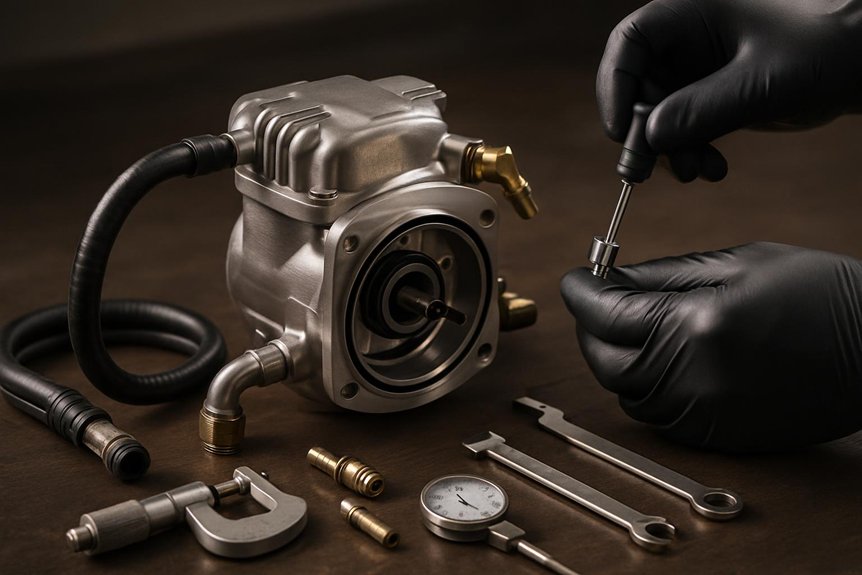
Boost WABCO exhauster performance by proving the pump is actually weak first. Isolate the train pipe with blanking plates, close section cocks, and test vacuum build-up on a calibrated gauge. If the unit passes, find leaks in hoses, reservoirs, cocks, or brake valves. If it fails, clean ports, strainers, and oilways, check vanes and clearances, restore correct lubrication, and verify cut-in/cut-out settings. Next, you’ll see how to confirm faults before tuning.
Key Takeaways
- Confirm true exhauster weakness by isolating train pipe leaks, hoses, reservoirs, cocks, and driver’s brake valve losses.
- Track maximum vacuum, evacuation time, recovery time, current, temperature, vibration, and noise against healthy baseline records.
- Clean ports, strainers, oilways, filters, and suction passages to restore airflow before attempting any adjustment.
- Check worn vanes, scored housings, rotor clearances, lubrication condition, blocked filters, and sticking non-return valves.
- Verify improvement with timed evacuation, ultimate vacuum, load signature, and brake release recovery tests using calibrated gauges.
Understanding WABCO Exhauster Performance in Locomotives
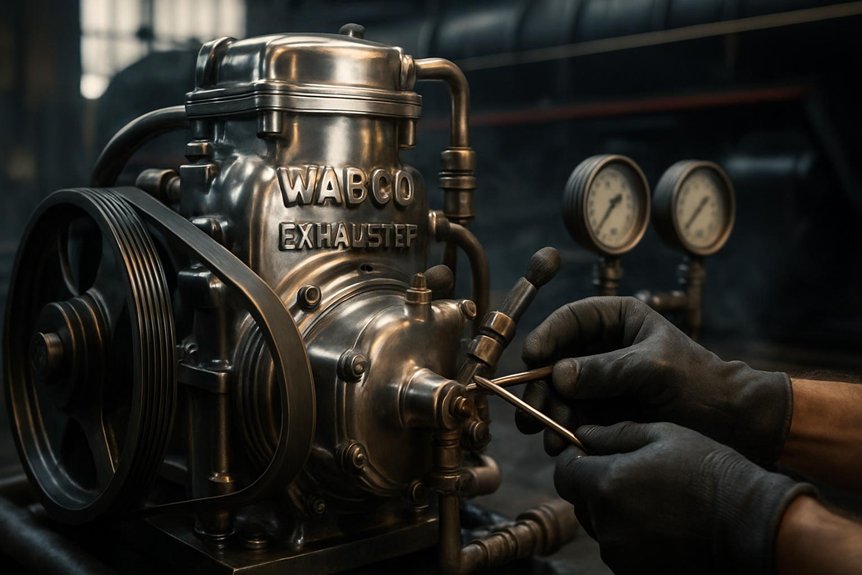
You use a WABCO exhauster to evacuate the train pipe and maintain vacuum brake readiness. Track WABCO exhauster performance through target vacuum, evacuation time, duty cycle, current draw, vibration, and leakage trends. You’ll diagnose brake behaviour better when you match exhauster type, condition, and control response to locomotive vacuum brake system demands.
What a WABCO exhauster does in a locomotive vacuum brake system
When a locomotive uses vacuum braking, the WABCO exhauster creates and maintains the vacuum that keeps the train brake pipe and reservoirs ready for control. You depend on this vacuum to hold brakes released across coaching or freight stock.
- It evacuates air from the train pipe, building the working vacuum.
- Replenishes vacuum losses from leakage, valve movement, and brake operations.
- It supports reservoirs, so each vehicle has stored vacuum for brake response.
- It helps you diagnose weak wabco exhauster performance when release feels slow.
When you admit air through the driver’s brake valve, vacuum falls and brakes apply. When you restore vacuum, brake cylinders release. If the exhauster can’t evacuate fast enough, you’ll see delayed release, uneven train response, and avoidable timetable risk.
Key performance parameters engineers should track
How should you judge WABCO exhauster performance in daily locomotive service? Track numbers that reveal vacuum creation, recovery, and endurance in the locomotive vacuum brake system. Use calibrated gauges and logs; don’t rely on feel.
| Parameter | What you measure | Diagnostic meaning |
|---|---|---|
| Maximum vacuum | Stable peak vacuum | Shows sealing and pump health |
| Evacuation time | Atmosphere to target vacuum | Exposes restriction or internal wear |
| Recovery time | Vacuum rebuild after application | Indicates service readiness |
| Duty capability | Temperature, current, run time | Confirms continuous load margin |
Compare each value with rated data, route duty, and fleet history. Slow evacuation can point to worn vanes, leaks, or blocked filters. Poor recovery may flag tired valves or pipe losses. Rising current, heat, or vibration warns that WABCO exhauster performance is degrading before failure.
How exhauster performance interacts with overall brake behaviour
Although brake rigging often gets the first inspection, WABCO exhauster performance sets the pace for vacuum brake response. In a locomotive vacuum brake system, your exhauster evacuates the train pipe, and distributors then convert vacuum changes into brake cylinder pressure changes through control valves. If evacuation lags, release also lags.
- Check train pipe vacuum recovery after a full service application.
- Compare brake release timing across coaches or wagons.
- Watch for hot wheels, dragging blocks, and high current draw.
- Include valves, leaks, filters, and pipe restrictions in wabco exhauster maintenance.
You can have sound rigging and still suffer poor brake behaviour. Slow vacuum build-up keeps cylinders applied longer, raises wheel and block temperatures, delays departure, and disrupts paths. Treat braking complaints as system diagnostics, not component blame.
WABCO exhauster types commonly used on locomotives
Before you tune WABCO exhauster performance, identify the exhauster configuration fitted to each locomotive. Match tests and settings to the installed design, not assumptions.
| Type | Typical use | Diagnostic focus |
|---|---|---|
| Single-stage, mechanical | Older diesel locomotives | Drive wear, vane sealing |
| Multi-stage, motor-driven | Electric or upgraded fleets | Current draw, staged vacuum build-up |
You’ll usually find mechanical units driven from engine auxiliaries, and motor-driven units powered independently. Single-stage exhausters suit moderate evacuation demand. Multi-stage units support faster train pipe evacuation and heavier duty cycles. Continuous-duty designs run during extended brake control periods. Intermittent-duty designs need cooling margins between cycles. For locomotive brake tuning, record vacuum level, evacuation time, noise, vibration, and load current. This lets you compare similar fleets and target WABCO exhauster maintenance accurately.
Diagnosing Exhauster Issues Before Tuning
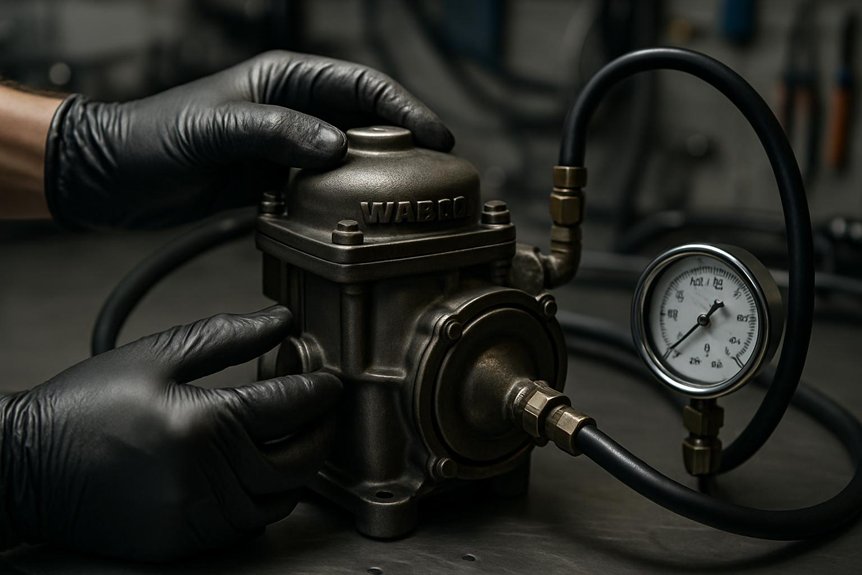
Before you tune WABCO exhauster performance, you need to separate true exhauster faults from locomotive vacuum brake system issues. Start by checking vacuum build-up time, target vacuum, noise, vibration, and current draw against service benchmarks. You’ll often find worn vanes, seal leaks, fouled filters, valve faults, or train pipe restrictions causing similar symptoms.
Recognizing symptoms of underperforming exhausters in service
How can you tell WABCO exhauster performance has started to fall in service? You look for changes crews feel first, then confirm them through operating data from the locomotive vacuum brake system.
- Longer vacuum build-up times show the exhauster can’t evacuate the train pipe at its normal rate.
- Frequent low-vacuum alarms suggest leakage, restriction, worn internals, or weak control response.
- Extended brake release times point to poor train pipe evacuation under real consist conditions.
- Crew reports of sluggish braking often match flattened vacuum curves and higher exhauster duty.
Don’t treat these signs as tuning targets yet. Treat them as warnings. Compare today’s vacuum curve, duty cycle, noise, and current draw against known good service records. That approach keeps WABCO exhauster maintenance disciplined before locomotive brake tuning begins.
Benchmarks and test procedures for exhauster health
Service symptoms only justify action when shop-floor tests confirm the fault. You should benchmark WABCO exhauster performance before any locomotive brake tuning. Use calibrated gauges, a known receiver volume, and logged speed, temperature, current, or torque.
| Test | What you measure | Compare against |
|---|---|---|
| Timed evacuation | Seconds to target vacuum | WABCO datasheet limit |
| Ultimate vacuum | Maximum stable vacuum level | Railway acceptance value |
| Load signature | Current or torque at vacuum points | Baseline healthy unit |
Run each test at specified rpm and operating temperature. Isolate the locomotive vacuum brake system, then test the exhauster and pipework separately when possible. If evacuation time drifts, ultimate vacuum falls, or load rises, don’t tune around it. Record results and verify them against Mikura International-supported maintenance criteria.
Common mechanical causes of performance loss
When WABCO exhauster performance drops, you should first suspect mechanical condition, not control settings. In a locomotive vacuum brake system, small internal faults quickly reduce train pipe evacuation.
Check these mechanical causes before locomotive brake tuning:
- Worn vanes lose sealing contact, reducing swept volume and slowing vacuum build-up.
- Scored housings create bypass paths, so air recirculates instead of leaving the train pipe.
- Incorrect rotor clearances increase internal leakage, especially under hot running conditions.
- Contaminated lubricating oil, blocked filters, or sticking non-return valves restrict flow and raise load.
You’ll confirm these faults through vacuum level, evacuation time, noise, temperature, and current trends. Mikura International recommends correcting wear, lubrication, filtration, and valve movement first. That keeps WABCO exhauster maintenance evidence-based, safe, and within approved locomotive limits.
System‑level issues that mimic exhauster problems
Before you tune the exhauster, prove the fault isn’t elsewhere in the vacuum brake system. Train pipe leaks, cracked flexible hoses, leaking vacuum reservoirs, or passing driver’s brake valves can all mimic weak WABCO exhauster performance. You’ll see slow evacuation, poor vacuum retention, and longer brake release times, yet the exhauster may be healthy.
Isolate methodically. Fit blanking plates at the exhauster suction connection, close section cocks, and test the machine against a calibrated gauge. If vacuum builds quickly and holds, move downstream. Open one section at a time, logging evacuation time and vacuum decay. Check hoses under movement, reservoir drain points, isolating cocks, and brake valve seats. This controlled approach separates machine defects from locomotive vacuum brake system losses, preventing unnecessary WABCO exhauster maintenance and unsafe locomotive brake tuning decisions.
Simple, Safe Tuning Steps to Boost WABCO Exhauster Performance
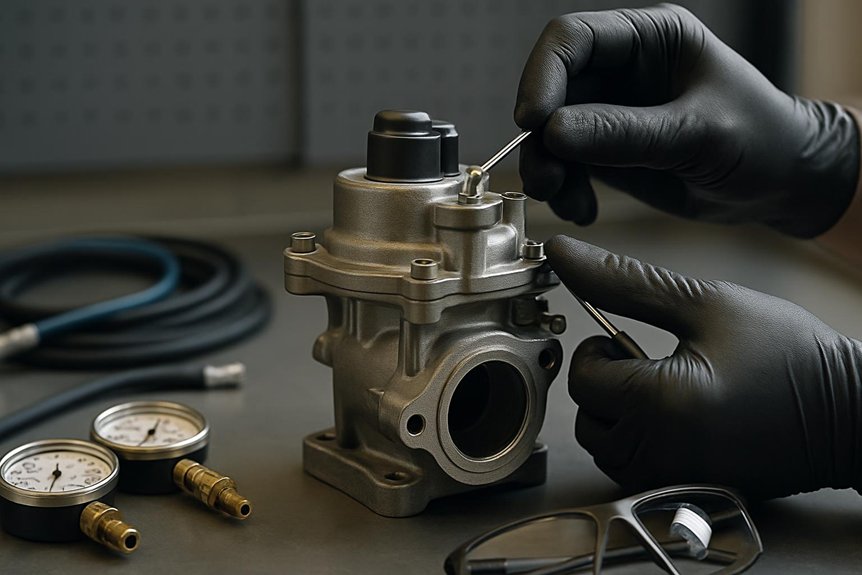
You boost WABCO exhauster performance first by restoring airflow through clean passages, correct clearances, and proper lubrication. Then you optimize locomotive suction and discharge piping, seal vacuum leaks, and tune controls so duty cycles stay safe. You’ll get better diagnostic control by adding instrumentation that tracks vacuum level, evacuation time, current draw, and brake response.
Restoring airflow: cleaning, clearances, and lubrication
Although many teams look for upgrades first, restored airflow often delivers the biggest WABCO exhauster performance gain. You should first return the unit to standard condition before changing settings. Isolate the locomotive vacuum brake system, then verify baseline vacuum and evacuation time.
- Clean internal passages, ports, strainers, and oilways until deposits can’t restrict flow.
- Inspect vanes for wear, sticking, scoring, or edge damage affecting sealing.
- Check vane and end-clearances with calibrated gauges, then reset to WABCO limits.
- Refill with WABCO-specified lubricant, at the correct grade, level, and change interval.
After reassembly, run the exhauster under load and compare vacuum build-up with records. If results improve, you’ve confirmed maintenance condition caused the loss. These back-to-standard steps support reliable WABCO exhauster maintenance without unsafe modifications.
Optimizing suction and discharge piping on the locomotive
On the locomotive, pipe layout can limit WABCO exhauster performance even after overhaul. You should trace suction and discharge runs from the exhauster to reservoirs, control valves, and train pipe. Look for avoidable elbows, flattened sections, mismatched flanges, undersized hoses, and redundant fittings. Each restriction adds pressure loss, so the exhauster works harder to evacuate the locomotive vacuum brake system.
Keep runs short, direct, and correctly supported. Replace sharp bends with swept bends where approved. Match pipe diameter to the rated flow, not convenient stock size. Confirm isolating cocks and strainers don’t reduce bore area. On long rakes, small pressure-loss reductions can cut evacuation time noticeably. Record before-and-after vacuum build-up times, current draw, and noise. That gives you practical evidence for safer locomotive brake tuning.
Tightening the vacuum system: leak detection and rectification
Before you adjust controls or specify overhaul work, confirm the locomotive vacuum brake system isn’t wasting exhauster capacity through leaks. Leakage increases duty, slows train pipe evacuation, and masks true WABCO exhauster performance.
Use a calibrated gauge, isolate the locomotive, and record vacuum decay after shutdown. Then divide the system, so you don’t chase faults blindly.
- Run shutdown leak-down tests at operating vacuum.
- Isolate reservoirs, train pipe sections, cocks, and hoses.
- Check flanges, unions, glands, and valve covers ultrasonically.
- Apply soap solution where access and safety conditions allow.
Rectify hardened hoses, loose joints, damaged seals, cracked pipework, and leaking isolating cocks. Retest after each repair. When you reduce background leakage, you effectively boost exhauster capacity without modifying the WABCO unit or compromising brake certification.
Fine‑tuning control settings and duty management
After you’ve tightened leaks, verify the control circuit that governs WABCO exhauster performance under load. Check control contacts for pitting, sticking, or poor alignment. Confirm pressure or vacuum switches change state at the specified locomotive vacuum brake system values.
Set auto-cut-in and cut-out points to prevent short cycling. If the exhauster starts too often, you’ll raise wear, heat, and power demand. If it cuts out late, it may run against a closed or restricted system. That stresses vanes, seals, and couplings.
Review vacuum reservoir capacity and valve settings. Correctly sized reservoirs smooth demand between brake applications and reduce nuisance starts. During WABCO exhauster maintenance, compare actual switching behavior with approved locomotive brake tuning limits. Don’t bypass safeguards or exceed certified brake timing requirements. Keep records for future diagnostics.
Instrumentation upgrades for performance visibility
If you can’t measure vacuum behavior accurately, you can’t tune WABCO exhauster performance with confidence. Upgrade instrumentation before changing settings. Fit calibrated gauges, pressure transducers, and data loggers across the locomotive vacuum brake system. You’ll see drift before it becomes delay, overheating, or unreliable brake release.
- Measure exhauster inlet vacuum and train pipe vacuum separately.
- Log evacuation time after brake applications and reservoir recovery.
- Trend motor current, vibration, and noise against duty cycle.
- Compare cab gauge readings with depot test instruments regularly.
Place sensors near the exhauster, reservoir, control valve, and train pipe end. That shows restrictions, leakage, or control instability. With better data, your depot can plan WABCO exhauster maintenance proactively, support locomotive brake tuning, and avoid unsafe guesswork.
Procurement and Lifecycle Strategies for High‑Performing Exhausters
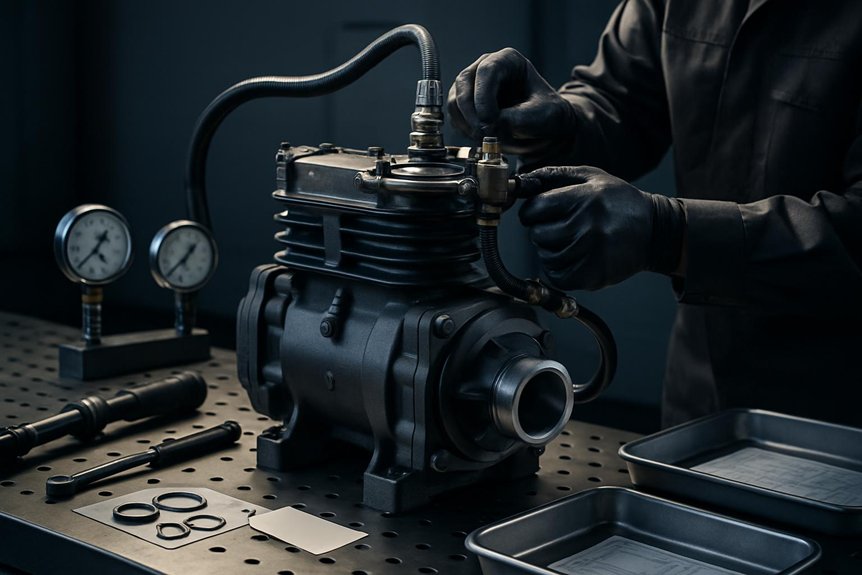
You should specify WABCO exhausters around duty cycle, target vacuum, evacuation time, and approved locomotive brake tuning limits. You’ll need to compare overhaul, upgrade kits, and new units against lifecycle cost, spares commonality, interchangeability, and fleet standardization. You can protect WABCO exhauster performance by building test metrics, maintenance triggers, and safety approval boundaries into every procurement contract.
Specifying WABCO exhausters for new or rebuilt locomotives
When specifying WABCO exhausters for new or rebuilt locomotives, start with the train’s braking duty, not the catalogue rating. You need specs that reflect real vacuum demand, route conditions, and service intensity.
- Define required vacuum volume from train pipe length, reservoir capacity, and brake equipment layout.
- Set target evacuation time for the longest design train, then verify it against brake release rules.
- State duty cycle clearly, including repeated stops, gradients, station spacing, and recovery time.
- Specify ambient limits, filtration needs, mounting interfaces, drive arrangement, and control compatibility.
You’ll improve WABCO exhauster performance when procurement links operating data to measurable acceptance tests. Ask for vacuum level, build-up time, current draw, noise, vibration, and leakage criteria. Mikura International supports clear, compliant specifications that reduce commissioning issues and lifecycle risk.
Choosing between overhaul, upgrade kits, and new units
A clear specification sets the baseline, but lifecycle strategy determines long-term WABCO exhauster performance. You choose between overhaul, approved refurbishment, upgrade kits, or new units by comparing risk, downtime, and duty cycle.
In-house overhaul can control cost, but only if you verify clearances, vanes, seals, lubrication, and test results. Weak documentation can hide repeat failures in the locomotive vacuum brake system. OEM-approved refurbishment costs more, yet it protects approval status, traceability, and warranty support.
Upgrade kits suit exhausters with sound housings but recurring wear or heat issues. They can improve reliability without changing certified brake behavior. New units make sense when cores are cracked, obsolete, inefficient, or failing evacuation-time targets.
Use lifecycle cost, not purchase price. Include warranty, test evidence, compliance, and lost-service exposure in every decision.
Spares, interchangeability, and standardization across the fleet
Although legacy fleets rarely allow perfect commonality, reducing WABCO exhauster variants improves control over performance, spares, and risk. You can standardize around proven ratings that suit each locomotive vacuum brake system, then manage exceptions deliberately.
- Map installed exhausters by class, duty cycle, vacuum rating, and mounting interface.
- Identify interchangeable vanes, seals, bearings, filters, valves, and drive components.
- Keep critical spares aligned with local supplier availability and overhaul lead times.
- Train crews on fewer configurations, so fault reporting becomes faster and clearer.
This approach strengthens WABCO exhauster performance because maintenance teams diagnose known patterns instead of chasing one-off assemblies. You’ll also reduce dead stock and emergency purchases. Where legacy constraints remain, document approved substitutions, fitment limits, and certification boundaries. Mikura International helps you rationalize parts without compromising brake safety.
Building performance metrics into contracts and maintenance plans
Before you issue an overhaul order, define WABCO exhauster performance in measurable service terms. Specify target vacuum, train pipe evacuation time, acceptable leak rate, duty cycle, vibration limits, and mean time between failures. Tie each figure to a test method, calibrated gauge, load condition, and acceptance report.
You should build these values into supply and overhaul contracts, not leave them as workshop assumptions. Link payment milestones or service-level agreements to verified results after installation. For WABCO exhauster maintenance, require trend records for current draw, noise, vacuum build-up, and brake response.
Then use the same data in condition-based maintenance. If evacuation time rises or leak rate drifts, you can inspect valves, seals, filters, or pipework before failures disrupt the locomotive vacuum brake system and locomotive brake tuning plans.
Safety, standards, and approval boundaries for tuning work
Performance clauses only protect your fleet when tuning work stays inside approved safety boundaries. You can improve WABCO exhauster performance, but you can’t bypass braking standards, WABCO design limits, or national approvals. Treat every change as a brake-system risk assessment.
- Confirm target vacuum, evacuation time, and release rate against certified locomotive vacuum brake system data.
- Keep control settings within approved logic; altered cut-in points may change brake response.
- Check added reservoirs, pipe changes, or valve swaps for volume effects and re-verification needs.
- Record gauges, test results, parts, and approvals before releasing locomotives.
If tuning changes exhauster characteristics, control behavior, or system volume, you’ll likely need formal re-testing. Mikura International recommends documenting each decision, so procurement, maintenance, and safety teams protect compliance, reliability, and lifecycle value.
Frequently Asked Questions
How Does Ambient Temperature Affect WABCO Exhauster Performance on Locomotives?
Ambient temperature changes WABCO exhauster performance by altering oil viscosity, clearances, seal behavior, and air density. As the saying goes, “measure twice, cut once.” In cold starts, you’ll see heavier lubrication drag, slower vacuum build-up, and higher current draw. In heat, you may see thinner oil, leakage, and reduced reliability. Track vacuum level, evacuation time, vibration, and temperature. Don’t retune until you’ve verified lubrication, filters, valves, and pipework.
Can Exhauster Performance Data Support Locomotive Brake Tuning Decisions?
Yes, you can use exhauster performance data to guide locomotive brake tuning decisions. Track vacuum build-up time, target vacuum level, duty cycle, current draw, vibration, and brake response. These readings show leaks, restrictions, worn vanes, valve issues, or poor control settings. You’ll tune safely by reducing system leakage, optimizing pipework, and calibrating controls within approved limits. Mikura International helps you match WABCO exhauster performance data with practical maintenance actions.
What Records Should Maintenance Teams Keep After Exhauster Tuning?
You should keep dated tuning reports, baseline WABCO exhauster performance readings, and post-adjustment results. Record target vacuum, evacuation time, duty cycle, current draw, vibration, noise, temperature, and brake response. Note parts replaced, lubrication used, valve settings, leak repairs, pipework changes, and calibrated instruments. Add technician names, locomotive number, load conditions, and compliance sign-offs. You’ll use these records to diagnose drift, prove safe locomotive brake tuning, and plan maintenance.
How Often Should Calibrated Gauges Be Checked for Vacuum Brake Testing?
You should check calibrated gauges before each vacuum brake test, then verify formal calibration at intervals your railway specifies. Typically, you’ll recalibrate gauges every 6 to 12 months, or sooner after shock, damage, abnormal readings, or storage issues. For reliable WABCO exhauster performance checks, compare gauges against a certified reference. Record gauge ID, calibration date, deviation, technician, and test conditions so you can trust evacuation time and vacuum readings.
Can Spares Quality Affect Long-Term WABCO Exhauster Reliability?
Yes. Poor spares can wear like grit in a bearing, slowly stealing WABCO exhauster performance. You need vanes, seals, bearings, filters, valves, and gaskets that match locomotive duty, material grades, and clearances. If you fit substandard parts, you’ll see rising vibration, slow vacuum build-up, oil carryover, and shorter overhaul intervals. Use traceable, specification-matched spares from Mikura International, and you’ll protect reliability, brake response, and lifecycle cost.