


OEM kits usually give you tighter control of alloy behavior, heat treatment, serial traceability, and EMD-specific fitment. Aftermarket kits can work if you verify AAR certification, material test reports, foundry controls, inspection records, and approved 645 or 710 compatibility. You shouldn’t accept visual similarity or unverified parts. Check pistons, liners, heads, rods, seals, fasteners, NDT results, and turbo clearances against standards. Next, you’ll see how to evaluate each kit before committing overhaul budget.
What are the critical differences between OEM and aftermarket component kits for an EMD engine overhaul?
Choosing between OEM and aftermarket kits impacts engine longevity and warranty compliance. OEM parts guarantee exact metallurgical properties specified by Electro-Motive Diesel. This ensures perfect fitment and thermal expansion rates under load.
Aftermarket suppliers often offer cost savings and faster availability. However, material deviations can lead to premature wear in high-stress areas. Procurement specialists must verify that aftermarket components meet AAR quality standards.
The safest path involves sourcing kits from ISO-certified remanufacturers. These providers use reverse-engineered specs matching OEM blueprints. Always request detailed material test reports before approving any purchase order.
Key Takeaways
- OEM kits offer controlled alloy behavior and predictable heat dissipation under sustained heavy locomotive loading.
- Aftermarket kits require verified foundry controls for porosity, grain structure, heat treatment, and material traceability.
- OEM components usually provide stronger warranty support when serial numbers, installation records, and compliance documents are complete.
- Qualified aftermarket parts must show AAR certification, quality system records, and material test reports to avoid rejection.
- Unknown or visually matched components are risky; verify part numbers, engine series compatibility, inspection reports, and dimensional fit.
Decoding the Anatomy of an EMD Engine Rebuild Kit
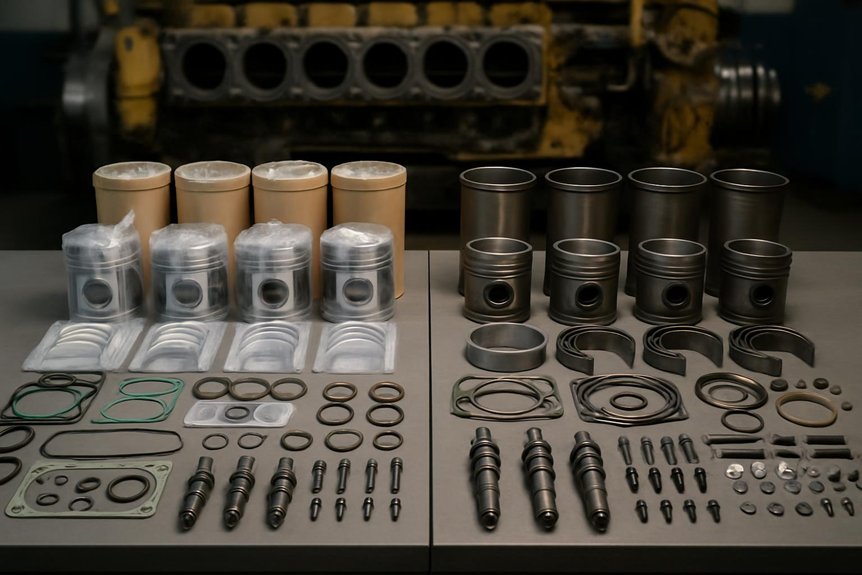
You define a complete EMD Engine Rebuild Kit by matching every included component to the overhaul scope and compliance records and treat the Locomotive Power Assembly as the core package because it controls compression, combustion sealing, and thermal stability. You must separate 645 and 710 series components carefully, since dimensional, timing, and fitment differences affect Diesel Engine Overhaul reliability.
Defining the Scope of a “Complete” Kit
Before approving any EMD Engine Rebuild Kit, define “complete” against the actual overhaul scope. You can’t rely on a generic parts list because 645 and 710 work scopes vary. A true emd engine rebuild kit must include cylinder heads, pistons, liners, and all required gaskets.
You should also verify every seal, O-ring, and fastener listed for the scheduled Diesel Engine Overhaul. Missing small seals can create major oil leaks after commissioning. That failure risks repeat teardown, lost locomotive availability, and warranty disputes.
Check each line item against OEM specifications, AAR quality expectations, and your shop’s inspection findings. If you’re evaluating aftermarket content, require traceable documentation and material confirmation. At Mikura International, we help you match kit content to the real rebuild requirement.
The Critical Role of the Power Assembly
Because combustion loads concentrate here, the Locomotive Power Assembly anchors every reliable EMD Engine Rebuild Kit. You’re evaluating the engine’s heart: piston, rings, liner, and connecting rod. This unit converts combustion pressure into controlled crankshaft force, so dimensional accuracy matters.
During procurement, you should verify liner finish, ring metallurgy, piston crown integrity, and rod inspection records. Small deviations can increase blow-by, oil consumption, and cylinder temperature. In a Diesel Engine Overhaul, those failures become costly downtime fast.
For OEM or aftermarket selection, require documented material conformity, traceable inspection data, and AAR-aligned quality controls. Don’t accept a locomotive power assembly on appearance alone. You need proof that each component can withstand repeated firing loads, maintain sealing, and protect your fleet’s overhaul interval and warranty position under real rail service duty.
Differentiating Between 645 and 710 Series Components
Although 645 and 710 engines share EMD lineage, their components aren’t interchangeable. You must verify series-specific geometry before approving any EMD Engine Rebuild Kit. The 645 and 710 platforms use different bore dimensions, deck heights, liner configurations, and power assembly interfaces.
During a diesel engine overhaul, a mismatched component can disturb compression height, sealing load, and piston travel. Installing a 645 part in a 710 block can cause valve contact, liner failure, or catastrophic crankcase damage.
You should confirm part numbers, serial data, and inspection reports against the locomotive’s engine model. Don’t rely on visual similarity. Mikura International supports procurement teams with standards-focused documentation and verified kit compatibility, helping you protect uptime, warranty position, and rebuild integrity across aging EMD fleets.
OEM vs. Aftermarket: The Procurement Dilemma
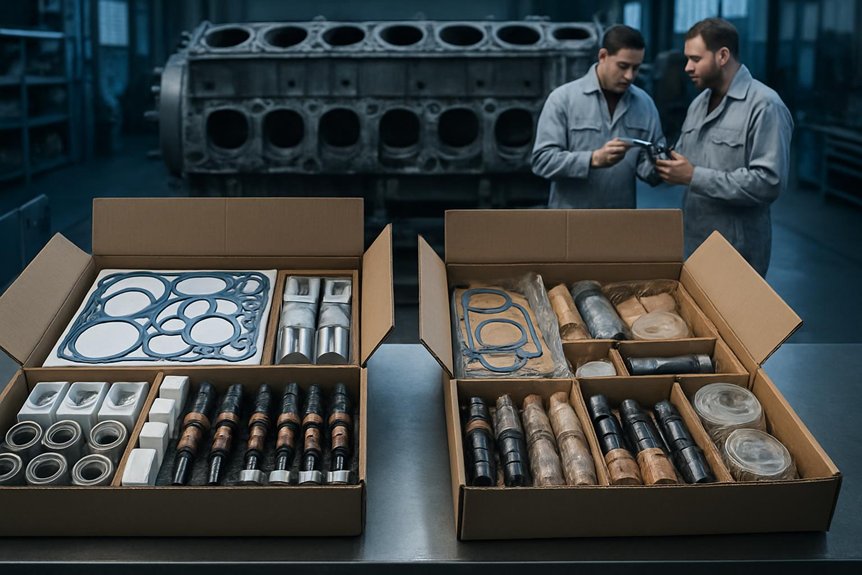
You choose an EMD Engine Rebuild Kit by verifying metallurgical integrity, heat-treatment records, and material traceability. You can’t separate price from warranty exposure, AAR compliance, and documented fitment for each Locomotive Power Assembly. Also you need reliable lead times, because delayed Diesel Engine Overhaul work can idle revenue locomotives.
Metallurgical Integrity and Material Science
Verify metallurgy before approving any EMD Engine Rebuild Kit for locomotive service. You need alloy traceability, hardness data, and casting integrity for every piston, liner, and power assembly component. OEM pistons use controlled aluminum alloys that dissipate combustion heat predictably. That matters during sustained notch-eight loading, where crown temperature rises quickly.
Aftermarket pistons can perform well, but only when the foundry controls porosity, grain structure, and heat treatment. If voids remain in the casting, you risk hot spots, crown melting, skirt scuffing, and liner damage. Those failures disrupt Diesel Engine Overhaul schedules and affect traction motor compatibility through unstable engine output. Mikura International helps you review material test reports, dimensional data, and supplier controls before release. Don’t approve substitutes unless their metallurgy matches EMD 645 or 710 service demands.
Warranty and AAR Compliance Verification
A compliant EMD Engine Rebuild Kit protects both engine reliability and interchange acceptance. You must verify warranty terms against AAR requirements before approving OEM or aftermarket components. OEM coverage usually aligns with published EMD specifications, but you still need traceable documentation, serial numbers, and installation records.
For aftermarket power assembly components, check the supplier’s AAR certification, quality system, and material test reports. Non-compliant parts can void interchange acceptance and expose your fleet to warranty rejection after a Diesel Engine Overhaul. You should confirm that cylinder head assembly, bearing, liner, and gasket records match the purchase order and inspection report.
At Mikura International, we help you document compliance clearly, so your procurement file supports warranty review, audit readiness, and locomotive service approval. Keep records accessible for inspectors.
Lead Times and Supply Chain Reliability
When a locomotive is grounded, each idle day can cost thousands in lost service capacity. You need an EMD Engine Rebuild Kit that arrives when the overhaul window opens, not after crews stand down. OEM lead times can stretch for months, especially for EMD 645 and 710 power assembly components, cylinder head assemblies, or pump assemblies.
Aftermarket availability can reduce downtime, but you must verify stock status. Don’t accept “available” unless the supplier confirms physical inventory, serial traceability, inspection records, and dispatch date. Promised stock isn’t supply chain reliability.
For a Diesel Engine Overhaul, align procurement documentation with AAR quality expectations and your maintenance schedule. Mikura International helps you validate inventory, specifications, and shipment timing before purchase approval, so procurement risk doesn’t become operational failure.
Precision Inspection Before Installation
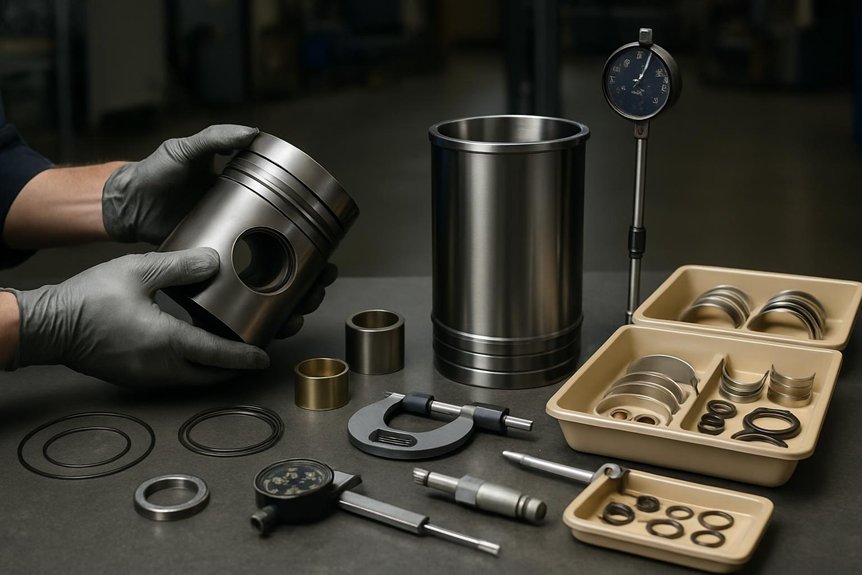
Before you install an EMD Engine Rebuild Kit, you verify every critical tolerance against EMD and AAR standards. You measure liner and piston dimensions, apply NDT to critical castings, and confirm turbocharger rotor clearance. These checks protect Diesel Engine Overhaul quality, reduce failure risk, and support reliable locomotive operation.
Dimensional Checks for Liners and Pistons
Precision liner and piston measurement protects every EMD Engine Rebuild Kit from early scuffing and compression loss. You should verify each liner before installation, not after the power assembly reaches the locomotive. Use calibrated micrometers to measure liner bore concentricity at specified heights and clock positions. Record every reading against the rebuild standard, whether you’re fitting OEM or approved aftermarket components.
You must also measure piston skirt diameter with the same discipline. Compare skirt clearance to the liner bore data before pairing components. A mismatch of even 0.001 inches can disrupt oil film control and start scuffing under load. For EMD 645 and 710 diesel engine overhaul work, dimensional traceability helps protect warranty position, compression balance, and service life. Keep records with your procurement documentation.
Non-Destructive Testing for Critical Castings
Because critical castings carry extreme cyclic loads, you should inspect them before they enter any EMD Engine Rebuild Kit. For locomotive Diesel Engine Overhaul work, cylinder heads and connecting rods need dye penetrant testing. This method exposes hidden fatigue cracks that visual checks can’t confirm. Skipping it risks a dropped valve during the first run.
- Clean casting surfaces until oil, carbon, and scale are gone.
- Apply penetrant across valve bridges, bolt bosses, and rod fillets.
- Watch red indications bleed from tight crack paths.
- Record results against AAR-aligned acceptance criteria.
You should reject questionable castings before assembly, not after load testing. Mikura International treats NDT as procurement control, not paperwork. That discipline protects power assembly components, downtime budgets, and fleet reliability. It also supports traceable OEM or aftermarket acceptance.
Verifying Turbocharger Rotor Clearance
A turbocharger rotor inspection protects every EMD Engine Rebuild Kit from early boost loss and bearing failure. Before installation, you verify that the rotor spins freely without compressor or turbine housing contact. Any rub mark means you stop, measure, and correct the assembly before release.
Check axial and radial play with calibrated indicators, following EMD 645 or 710 overhaul limits. Don’t rely on hand feel alone. Excessive movement indicates worn thrust or journal bearings, and it can quickly damage new power assembly components during a Diesel Engine Overhaul.
When comparing OEM and aftermarket turbocharger rebuild parts, you must confirm documented clearance values. Mikura International recommends recording measurements in procurement documentation, alongside material certificates. That evidence supports quality control, warranty review, and reliable locomotive service after installation.
The Step-by-Step Reassembly Protocol

You start an EMD Engine Rebuild Kit reassembly with verified torque sequences and specified lubricants. You then time the gear train and camshaft to EMD 645 or 710 standards. Finally, you set injector heights and rack settings so each locomotive power assembly fuels evenly.
Torque Sequences and Lubrication Science
When reassembling an EMD Engine Rebuild Kit, torque control protects bearing crush, head gasket sealing, and block integrity. You must follow the approved EMD 645 or 710 torque chart, not generic Diesel Engine Overhaul habits. Head bolts and main bearings demand exact values, staged loading, and documented verification.
- Clean each thread until it looks bright, dry, and gauge-ready.
- Apply oil or anti-seize only where the procedure specifies it.
- Tighten in the required sequence, moving like a controlled spiral across the joint.
- Record final torque, tool calibration, and inspector signoff.
Don’t apply dry torque values to lubricated threads. You’ll over-stretch fasteners and distort clamping force. Mikura International supports standards-focused procurement with traceable components and clear installation documentation.
Timing the Gear Train and Camshaft
Before you close the gear case, verify every EMD gear train timing mark against the approved 645 or 710 service procedure. You can’t treat camshaft alignment as a visual formality during a Diesel Engine Overhaul. One tooth off changes valve events, cylinder scavenging, and combustion timing. The result is black smoke, rough loading, elevated exhaust temperature, and avoidable downtime.
Match the camshaft, idler, and crank gear references before final torque. Rotate the engine through the specified revolutions and recheck mark convergence. If your EMD Engine Rebuild Kit includes aftermarket gears, confirm tooth profile, hardness records, and dimensional compliance before installation. Mikura International recommends documenting each verification step for warranty traceability, AAR quality review, and reliable locomotive service after reassembly. Never close covers until alignment is independently witnessed and recorded.
Setting Fuel Injector Heights and Rack Settings
After verifying gear train timing, set each mechanical unit injector with the specified EMD height gauge and rack procedure. You’re protecting every cylinder from fuel imbalance during the Diesel Engine Overhaul. In any EMD Engine Rebuild Kit, injector consistency matters as much as piston or liner fit.
- Seat the gauge squarely, like a machinist setting daylight to zero.
- Adjust injector height until the contact point feels clean, not forced.
- Set rack travel evenly, watching each lever move like matched valve gear.
- Lock adjustments, then recheck all cylinders before barring the engine again.
Incorrect rack settings create uneven firing, excessive vibration, and crankshaft stress. Mikura International recommends documenting each reading against EMD 645 or 710 specifications before release. That record supports quality audits.
Post-Rebuild Testing and Break-in
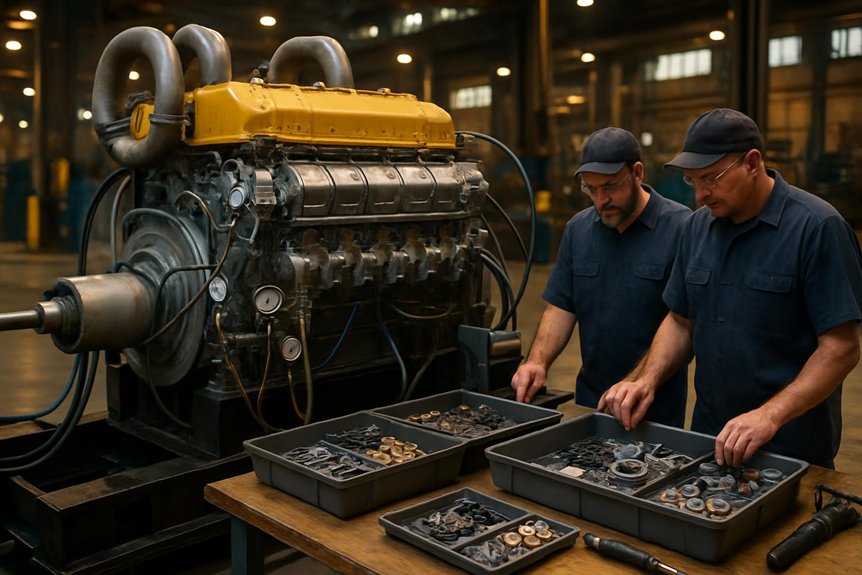
You verify the EMD Engine Rebuild Kit’s integrity at first start by confirming immediate lube oil pressure. You then use load box testing to validate combustion balance, temperature stability, and traction motor compatibility under controlled load. You’ll document all readings, parts traceability, and break-in results for lifecycle management and standards compliance.
The Critical First Start and Lube Oil Pressure
During the first start, pre-lube the EMD Engine Rebuild Kit assembly until oil reaches all critical galleries. You’re protecting main bearings, rod bearings, cam journals, and the Locomotive Power Assembly from dry contact. Don’t crank until your gauge confirms pressure readiness.
- Watch clean oil fill gallery ports like dark glass channels.
- Verify pressure rises within seconds after rotation begins.
- Listen for smooth firing, not bearing knock or gear chatter.
- Shut down immediately if pressure hesitates, drops, or pulses abnormally.
A dry start can destroy bearings instantly, even after a careful Diesel Engine Overhaul. OEM and qualified aftermarket components both need this same disciplined start sequence. Record pre-lube duration, pressure response, oil temperature, and any alarms in your rebuild file for traceability.
Load Box Testing and Data Validation
Once lube oil pressure stabilizes, load box testing proves the rebuild under controlled electrical demand. You verify that the EMD Engine Rebuild Kit performs across stepped load points, not just at idle. Confirm horsepower output against the rated curve, then trend exhaust temperatures by cylinder.
You should monitor each cylinder through the full load sequence. A hot cylinder can indicate a faulty injector, restricted fuel delivery, or a tight piston. Don’t average the readings and miss the fault. Compare temperature spread against your Diesel Engine Overhaul acceptance limits and AAR-aligned procedures.
Validate traction power response without exceeding safe operating limits. If readings drift, stop and correct the cause before break-in continues. This protects the Locomotive Power Assembly and confirms the rebuild is ready for controlled service.
Documenting the Rebuild for Lifecycle Management
After testing confirms stable performance, log every measurement, serial number, and inspection result without delay. You’ll strengthen lifecycle control for every EMD Engine Rebuild Kit and support future Diesel Engine Overhaul decisions.
- Record liner projection, bearing clearances, torque values, and cylinder head assembly data.
- Capture Locomotive Power Assembly serial numbers, injector codes, and turbocharger rebuild references.
- Attach oil pressure, water temperature, and load box readings after break-in.
- File procurement documents, material reports, and AAR compliance records.
This documentation helps you predict wear trends, verify Traction Motor Compatibility impacts, and protect resale value. It also separates verified OEM and qualified aftermarket parts from unknown components. At Mikura International, we recommend controlled records because aging fleets need traceable evidence, not assumptions during audits.
Frequently Asked Questions
What Is Typically Included in a Standard EMD Power Assembly Kit?
Test the assumption that every EMD Engine Rebuild Kit matches your engine’s duty cycle. You’ll typically receive a cylinder liner, piston, piston rings, piston pin, carrier, seals, gaskets, and a cylinder head assembly when specified. Some kits include valves, springs, and fuel injector hardware. You should verify part numbers, EMD 645 or 710 compatibility, inspection reports, and AAR-aligned documentation before release. Mikura International helps you confirm fitment.
How Do I Identify Counterfeit EMD Engine Parts During Procurement?
You identify counterfeit EMD engine parts by verifying traceability, markings, and documentation before approval. Check part numbers, heat-lot codes, casting marks, and packaging against procurement records. Don’t accept missing material test reports, altered certificates, or vague origin claims. Inspect critical EMD Engine Rebuild Kit items for machining quality, coatings, and dimensional compliance. Use ISO-certified sources like Mikura International, and require AAR-aligned documentation for every locomotive Diesel Engine Overhaul purchase.
What Are the Signs of a Failed Camshaft Lobe in an EMD 710 Engine?
Like a flat note in a tuned consist, you’ll spot a failed camshaft lobe through misfiring, low cylinder power, uneven exhaust temperature, and abnormal valve or injector timing. You should inspect for reduced valve lift, damaged roller followers, metallic debris, and lobe pitting or scoring. In an EMD 710 Diesel Engine Overhaul, verify timing against specifications, document findings, and replace affected EMD Engine Rebuild Kit components before return-to-service approval.
Which Procurement Documents Should Accompany an EMD Engine Rebuild Kit?
You should receive a purchase order, packing list, certificate of conformity, material test reports, inspection records, and traceability documents with every EMD Engine Rebuild Kit. You’ll also need part-number cross-references, AAR or ISO quality documentation, warranty terms, and remanufacturing records for critical items. For power assemblies, request cylinder head, liner, piston, and rod documentation. Don’t release payment until serial numbers, quantities, and specifications match your overhaul work scope exactly.
How Does Traction Motor Compatibility Affect EMD Engine Overhaul Planning?
How can you overhaul an EMD engine without confirming load compatibility? You must match rebuilt horsepower, governor settings, alternator output, and excitation curves to traction motor ratings. If you don’t, motors can overheat, flash over, or suffer insulation damage. During EMD Engine Rebuild Kit planning, verify locomotive model, gear ratio, wheel diameter, and control system data. You’ll protect adhesion, current limits, and AAR-compliant reliability after commissioning under load.