How to Detect Train Compressed Air Leaks

How to Detect Train Compressed Air Leaks

You can detect train compressed air leaks using ultrasonic acoustic imaging systems that identify leak signatures in the 30-45 kHz frequency range. These automated systems safely detect leaks from distances up to 130 meters without requiring dangerous manual inspections under moving equipment. Modern acoustic imagers with 64-128 microphones achieve 84.6% detection accuracy while eliminating worker exposure to hazardous rail environments. The technology generates real-time electronic alerts with precise leak locations and severity ratings for immediate maintenance response coordination.

Key Takeaways

  • Use ultrasonic detection equipment to identify acoustic signatures between 30-45 kHz frequencies where compressed air leaks produce distinct sound patterns.
  • Deploy acoustic imager technology with microphone arrays to visually locate leaks from safe distances of 5-10 feet without system shutdowns.
  • Install strategic sensor networks across critical pneumatic components like brake lines, door operators, and suspension systems for continuous monitoring.
  • Implement machine learning algorithms that analyze pressure and acoustic data to distinguish normal fluctuations from anomalous consumption indicating leaks.
  • Combine thermal imaging devices with ultrasonic sensors to detect leaks as small as 0.016 l/min while reducing inspection time by 90%.

Manual Detection Challenges in Railroad Operations

hazardous manual air leak detection

When railroad personnel manually detect compressed air leaks, they’re forced to navigate hazardous environments that expose them to significant safety risks. You’ll encounter moving train components, heavy machinery, and confined spaces around locomotives and rail cars during these inspection procedures. The physical demands of crawling under and between railway vehicles create serious inspection ergonomics challenges that can compromise both safety and detection accuracy.

Traditional detection methods require you to listen for compressed air escape sounds or feel for leaks while positioned in potentially dangerous locations. These time-intensive processes can take hours or days, leading to worker fatigue that further increases safety risks. Your detection accuracy depends heavily on experience and hearing ability, while background noise from train operations often masks smaller leaks. Weather conditions and environmental factors additionally impair your effectiveness, making manual detection both unreliable and hazardous for maintenance personnel. The rail industry loses an estimated 2–3% vehicle efficiency annually due to these undetected air leaks.

Automated Audio Detection Technology Solutions

You’ll find that modern automated audio detection systems leverage sophisticated acoustic imager technology to identify compressed air leaks without requiring manual inspections. These systems integrate machine learning algorithms that analyze frequency signatures between 30-45 kHz, where compressed air leaks produce distinct acoustic patterns separable from background railway noise. Your detection capabilities improve markedly through this technology, achieving detection rates of 11 out of 13 leaks with false positive rates as low as 0.03% during operational testing. The technology addresses significant efficiency losses in the rail industry, where compressed air leaks typically reduce vehicle efficiency by 2% to 3%.

Acoustic Imager Technology

Acoustic imaging technology transforms compressed air leak detection by combining ultrasonic sensors with visual cameras to pinpoint leaks in real-time. You’ll achieve precise acoustic mapping through advanced sensor calibration that eliminates background noise interference common in railway environments.

Equipment ModelSensor CountDetection Range
FLIR Si124124 microphonesUp to 120 meters
CRYSOUND128 MEMS sensorsExtended distance
Standard Units64-96 sensors50-80 meters
Compact Models32-48 sensors25-40 meters

The technology detects leaks as small as 0.016 l/min while overlaying ultrasonic data onto visual images. You’ll reduce inspection time by 90% compared to traditional methods. Equipment operates safely from distances without requiring system shutdowns, making it ideal for continuous railway operations where safety protocols demand non-invasive detection methods. This visual ultrasound approach transforms sound into visual data, enabling inspectors to identify compressed air system inefficiencies that would otherwise remain hidden during routine maintenance checks.

Machine Learning Integration

While traditional acoustic detection relies on manual interpretation, machine learning algorithms now automate compressed air leak identification by processing ultrasonic frequency data in the 30-45kHz range where leaks produce distinct signatures above background railway noise. You’ll train these AI systems using hydrophone recordings with verified leak and non-leak examples, incorporating variables like gun volume, pressure, and depth configurations. The algorithms process incoherent signal distortions that classical methods can’t define effectively.

Your implementation requires robust data governance protocols to guarantee training dataset quality and regulatory compliance. Model explainability becomes critical when justifying maintenance decisions to stakeholders. You’ll integrate these systems with existing flow sensors and control infrastructure, generating real-time electronic alerts with visual documentation. This approach enables continuous monitoring without operational shutdowns while providing predictive maintenance capabilities through IoT connectivity. Advanced systems utilizing 64-microphone arrays can achieve detection rates of 11 out of every 13 leaks on moving trains.

Detection Performance Metrics

Machine learning algorithms require quantifiable performance benchmarks to validate their effectiveness in operational railway environments. You’ll achieve 84.6% accuracy rates when detecting compressed air leaks on moving trains, maintaining false positive rates at just 0.03% during field operations. Your system will identify approximately 11 out of every 13 leaks during moving evaluations, with performance improving through additional data collection.

Proper sensor calibration guarantees detection from 2.5 meters for small leaks up to 130 meters for larger ones. Environmental effects don’t compromise your ability to detect minimum leak sizes of 0.01 liters per minute. You’ll receive confidence ratings for each identified leak location, enabling maintenance personnel to prioritize repairs effectively. Field testing demonstrates successful detection across 30-40 leaks within operational timeframes. The acoustic sensor operates within 30-45 kHz frequencies where compressed air leak signatures are most distinguishable from background noise.

Acoustic Imaging Equipment and Frequency Analysis

ultrasonic acoustic leak imaging

Transform sound waves into precise visual data using acoustic imaging cameras that detect ultrasonic frequencies generated by compressed air leaks on railway equipment. These specialized cameras utilize MEMS arrays containing multiple microphones to capture high-frequency acoustic signals that turbulent air creates when escaping from pneumatic systems.

You’ll achieve peak detection by operating within the ultrasonic bandwidth range where compressed air leaks generate their strongest acoustic signatures. The carefully constructed MEMS arrays provide high sensitivity imaging that overlays ultrasonic information onto visual camera feeds in real time.

Advanced models like the FLIR Si2-LD enable detection from distances up to 130 meters, ensuring safe inspection of energized train systems. The equipment’s noise suppression technology filters background industrial sounds, allowing you to identify leak sources precisely even in noisy rail yards. This acoustic imaging approach reduces inspection time by approximately 90 percent compared to traditional ultrasonic detection methods. Modern acoustic cameras feature onboard analytics that automatically calculate financial losses from each detected leak, enabling immediate cost-benefit analysis for repair prioritization.

Multi-Sensor Integration With Machine Learning

multi sensor machine learning leak detection

Acoustic imaging cameras provide powerful standalone detection capabilities, yet combining multiple sensor technologies with machine learning algorithms creates complete leak detection systems that surpass single-sensor performance. You’ll achieve peak results by integrating ultrasonic sensors, pressure transducers, and thermal imaging devices through strategic sensor placement across critical pneumatic components.

Machine learning algorithms process multi-sensor data streams to identify leak patterns that individual sensors might miss. You can implement data augmentation techniques to expand training datasets, improving algorithm accuracy for detecting subtle pressure variations and acoustic signatures specific to railway compressed air systems.

Smart sensor networks enable real-time monitoring of brake lines, door operators, and suspension systems simultaneously. You’ll benefit from automated alert systems that distinguish between normal operational sounds and actual leaks. Advanced algorithms learn your specific train fleet’s acoustic fingerprints, reducing false positives while ensuring critical safety systems maintain proper pressure levels for reliable braking and door operation.

Establishing a compressed air baseline through thermal mass flowmeters enables precise measurement of your system’s consumption patterns before implementing leak detection protocols. Machine learning models use this baseline data to distinguish between normal operational fluctuations and anomalous consumption indicating potential leaks throughout the pneumatic network.

Performance Metrics and Detection Accuracy Rates

accurate ultrasonic leak detection

When evaluating compressed air leak detection systems for railway applications, you’ll find that current automated technologies achieve an 84.6% overall accuracy rate in identifying leaks on moving trains. These systems successfully identify 11 out of every 13 leaks during operational testing, ensuring regulatory compliance with safety standards while reducing environmental impact through energy conservation.

You can expect detection capabilities ranging from 0.01 liters per minute for small leaks at close range to extensive scanning at distances up to 130 meters. The false positive rate remains exceptionally low at 0.03%, which prevents unnecessary maintenance interventions and maintains operational efficiency. Modern handheld systems utilize 96 ultra-sensitive microphones to capture ultrasonic sound waves that indicate air leaks in railway brake systems.

Machine learning algorithms demonstrate consistent performance in distinguishing actual leaks from background noise across 2 to 100 kHz frequency ranges. Your maintenance teams can identify and repair 30 to 40 leaks within hours using these systems, markedly improving both safety protocols and environmental stewardship through reduced compressed air waste.

Alert Systems for Maintenance Personnel

automated precise leak alerts

Modern compressed air leak detection systems automatically generate and transmit electronic alerts to your maintenance personnel the moment they identify leaks on moving trains. These automated notifications eliminate dangerous manual inspection procedures while providing precise location coordinates and severity assessments through real time dashboards and mobile alerts.

Your alert system delivers thorough data packages containing:

  1. Total leak count per inspection cycle with confidence levels
  2. Precise coordinates and positioning data for each detected leak
  3. Visual documentation from integrated cameras highlighting specific leak locations
  4. Technical specifications including severity ratings and detection frequency ranges

You’ll receive instantaneous notifications through digital communication channels, enabling immediate response coordination without stopping trains. The system integrates seamlessly with existing maintenance workflows, allowing proactive scheduling and targeted interventions. Mobile alerts ensure your personnel can assess situations remotely before on-site inspection, reducing labor requirements and minimizing exposure to hazardous environments while maximizing maintenance efficiency. These autonomous detection systems also contribute to reduced fuel consumption by identifying air leaks that would otherwise force locomotives to work harder to maintain proper air pressure levels.

Field Testing Results and System Validation

high accuracy multi sensor leak detection

Through rigorous field testing protocols, the compressed air leak detection system achieved an 84.6% accuracy rate while maintaining exceptional reliability with false positives occurring in only 0.03% of test scenarios. You’ll find the system successfully identifies 11 out of every 13 leaks during moving train operations, demonstrating operational readiness for regulatory compliance requirements.

The multi-sensor integration combines thermal, acoustic, and visual spectrum imaging with Fluke SV600‘s 64-microphone array detecting frequencies between 30-45kHz. You can detect leaks as small as 0.01 litres per minute from 2.5 meters distance, ensuring all-encompassing coverage across locomotive locations.

Machine learning algorithms filter background noise interference while maintaining detection accuracy during dynamic train operations at various speeds. The system’s long term durability has been validated through extensive environmental condition testing, confirming performance consistency across multiple operational scenarios and supporting deployment readiness for rail yard environments. Detection systems should target maintaining leakage below 10% of total compressed air production to optimize energy efficiency and operational costs.

Implementation Benefits for Rail Yard Efficiency

automated compressed air leak detection

You’ll experience significant operational improvements when implementing automated compressed air leak detection systems in your rail yard operations. Your maintenance teams won’t need to conduct time-consuming manual searches that require dangerous positioning on, under, or between railway vehicles, reducing both labor costs and safety risks. You can respond faster to system issues since real-time detection identifies problems immediately, allowing your crews to address small leaks before they escalate into costly major repairs.

Reduced Labor Requirements

While traditional compressed air leak detection demands significant manual labor from your mechanical staff, automated ultrasonic systems dramatically reduce these workforce requirements by eliminating the need for physical inspections. Your staff reduction becomes immediately apparent when considering that manual detection requires employees to physically search locomotives by going on, under, or between railway vehicles. Workflow optimization occurs through automated detection on moving trains without human intervention.

Key labor reduction benefits include:

  1. Minimal Training Requirements – Only 2 hours needed for ultrasonic detection proficiency
  2. Automated Notifications – Direct alerts to mechanical personnel eliminate manual searching
  3. Remote Detection Capability – 5-10 foot range eliminates close proximity requirements
  4. High Detection Accuracy – 11 out of 13 leaks detected automatically without staff investigation

Faster Maintenance Response

Automated ultrasonic detection systems accelerate your maintenance response times by delivering real-time leak alerts directly to mechanical personnel the moment compressed air leaks occur on moving trains. You’ll receive electronic notifications containing exact leak locations, system confidence levels, and accompanying images that eliminate time-consuming search procedures. This immediate data transmission enables faster dispatch of repair crews to specific problem areas rather than conducting broad inspections across entire systems.

The digital alert system supports priority routing by categorizing leak severity levels, allowing you to allocate resources efficiently based on operational impact. Your maintenance teams can coordinate responses immediately between detection and repair operations, preventing minor leaks from escalating into major system failures that require extended downtime and costly emergency repairs.

You may also like to read – How to Fix Locomotive Air System Gasket Problems

Frequently Asked Questions

What Is the Typical Cost to Install an Automated Air Leak Detection System?

You’ll face installation costs ranging from $2,000-$15,000 for automated air leak detection systems, depending on complexity and integration requirements. Basic semi-automatic platforms start around $2,000, while fully automated systems with custom fixtures, sensors, and control interfaces reach $15,000+. Factor in ongoing subscriptions for software updates, calibration services, and technical support that typically add 10-15% annually to your initial investment for optimal safety performance.

How Long Does It Take to Train Personnel on the New Detection Equipment?

Like mastering a new instrument, you’ll need dedicated practice time to become proficient. Training duration depends on your chosen format—hands on workshops typically require one to two days for thorough equipment mastery, while virtual modules can be completed in six hours for basic competency. Advanced detection systems demand prerequisite training plus hands-on experience. You’ll achieve certification once you pass the 80% assessment threshold.

Can the System Work Effectively in Extreme Weather Conditions Like Snow or Rain?

You’ll need weatherized components for reliable operation in extreme conditions. Cold weather affects seals, requiring low-temperature materials that won’t crack or harden. Install drain heaters to prevent moisture freeze-up in detection lines and instrument housings. You must verify all sensors maintain calibration accuracy below freezing and make certain protective enclosures meet IP ratings for rain penetration. Regular winter maintenance protocols become critical for consistent leak detection performance.

What Maintenance Schedule Is Required to Keep the Acoustic Sensors Properly Calibrated?

Like a finely tuned orchestra requiring regular conductor guidance, you’ll need monthly functional tests, quarterly verification checks, and annual full-system calibrations. You must perform weekly operational checks and daily visual inspections. Temperature compensation occurs every six months, while vibration baselines need monthly updates. Your sensor recalibration intervals depend on environmental exposure severity. Make certain your technician certifications renewal stays current, as proper calibration requires certified personnel following ISO standards for measurement accuracy.

How Does Detection Accuracy Compare Between Stationary Trains Versus Moving Trains?

You’ll achieve higher stationary accuracy rates compared to moving train detection due to controlled environmental conditions. Moving variability introduces background noise, vibrations, and positioning challenges that reduce the current 84.6% accuracy rate. When you inspect stationary trains, you’ll eliminate motion-related interference, allowing closer sensor positioning and more precise leak identification. You’ll experience fewer false readings and improved component-by-component examination capabilities during static inspections.

How to Fix Locomotive Air System Gasket Problems

How to Fix Locomotive Air System Gasket Problems

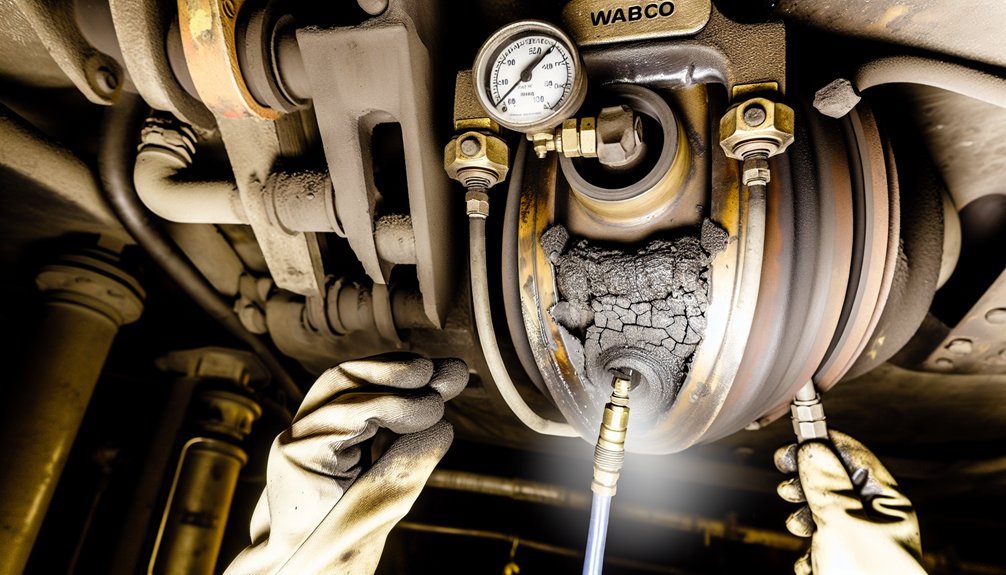
You’ll solve most locomotive air system gasket problems by targeting the gladhand connections and brake pipe assemblies where eighty percent of pressure losses occur within the final thirty feet of your trainline. First, confirm zero system pressure before disconnecting any components, then inspect gladhand gaskets for visible damage or contamination that compromises sealing. Replace deteriorated gaskets using proper torque specifications, clean mating surfaces thoroughly, and hand-tighten connections an additional half-turn after initial seating. Advanced diagnostic techniques and preventive maintenance protocols can further optimize your system’s reliability.

Key Takeaways

  • Replace gaskets immediately when control valve gasket failure is suspected to prevent brake system malfunctions.
  • Focus repairs on gladhand gasket connections, the primary source of pressure loss in locomotive air systems.
  • Ensure proper gasket seating by checking surface contact and hand-tightening connections with a half turn.
  • Inspect and clean gasket surfaces for contamination that could impede proper sealing before installation.
  • Conduct pressure testing to verify brake pipe leakage stays under 5 lbs/min after gasket replacement.

Identifying Natural Leakage Sources in Trainline Connections

gladhand gasket leakage in trainline

When operating locomotive air brake systems, you’ll encounter natural leakage through gladhand gasket connections that represents the primary source of pressure loss in trainline operations. You’ll need to inspect gasket wearpatterns at each connection interface to identify deterioration pathways. Focus your detection efforts on the air brake compartment below the locomotive cab and rear sander magnetic valve areas where eighty percent of leaks occur within the final thirty feet before end-use application.

Check for ambient moisture accumulation around connection points, as this indicates active air escape routes. You’ll find that vibrations and thermal cycling cause fittings to loosen, creating continuous air loss pathways throughout the train consist. Monitor trainline pressure drops when engines shut down—gradual pressure loss below minimum acceptable rates prevents automatic brake application. Leakage rates increase significantly as temperature drops, making cold weather inspections particularly critical. Examine threaded pipe connections more thoroughly than welded systems, as they’re prone to leakage from improper thread sealants and environmental contamination.

Systematic Air Leak Detection and Diagnostic Procedures

automated acoustic thermal leak detection

Although manual detection methods remain standard practice across most rail operations, you’ll achieve superior diagnostic accuracy by implementing systematic leak detection protocols that combine automated sensing technology with structured inspection procedures. Automated detection systems utilizing acoustic imaging technology can identify air leaks with 84.6% accuracy while maintaining false positive rates of only 0.03%. You’ll need to configure acoustic imagers operating at 30-45kHz frequencies, where compressed air leaks stand out distinctly from background machinery noise.

Integrate multi-camera arrays combining acoustic imaging with thermal and visual spectrum cameras to generate composite diagnostic images. The FLIR Si1-LD‘s 96-microphone array detects leaks as small as 0.01 liters per minute from 2.5 meters distance. You should establish standardized inspection sequences that eliminate manual searching procedures, reducing personnel exposure risks while ensuring Federal Railroad Administration compliance. Machine learning algorithms will progressively improve detection accuracy through continued field data collection and system refinement. Implementing these automated systems can reduce the locomotive industry’s fuel consumption by addressing the estimated 2-3% vehicle efficiency loss that occurs annually due to undetected air leaks.

Component-Specific Gasket Failure Analysis

gasket failure from contamination

You’ll encounter three critical failure patterns when analyzing component-specific gasket deterioration in locomotive air systems. Pneumatic valve gaskets fail primarily due to thermal cycling stress and contamination buildup, while cylinder head lacquer deposits indicate oil system contamination that compromises sealing surfaces. Triple valve malfunctions typically result from seal degradation that prevents proper pressure regulation, requiring immediate inspection of gasket integrity and replacement per 49 CFR Part 229 safety standards. Begin inspection with oil hole and journal fillet checks, where 68% of failures occur.

Pneumatic Valve Gasket Deterioration

Since pneumatic valve gaskets endure constant pressure cycling and mechanical stress in locomotive air systems, you’ll encounter specific failure patterns that directly compromise braking performance and operational safety. You must assess material compatibility between gaskets and locomotive operating fluids to prevent chemical degradation. Thermal cycling accelerates elastomer breakdown, reducing sealing effectiveness during temperature fluctuations.

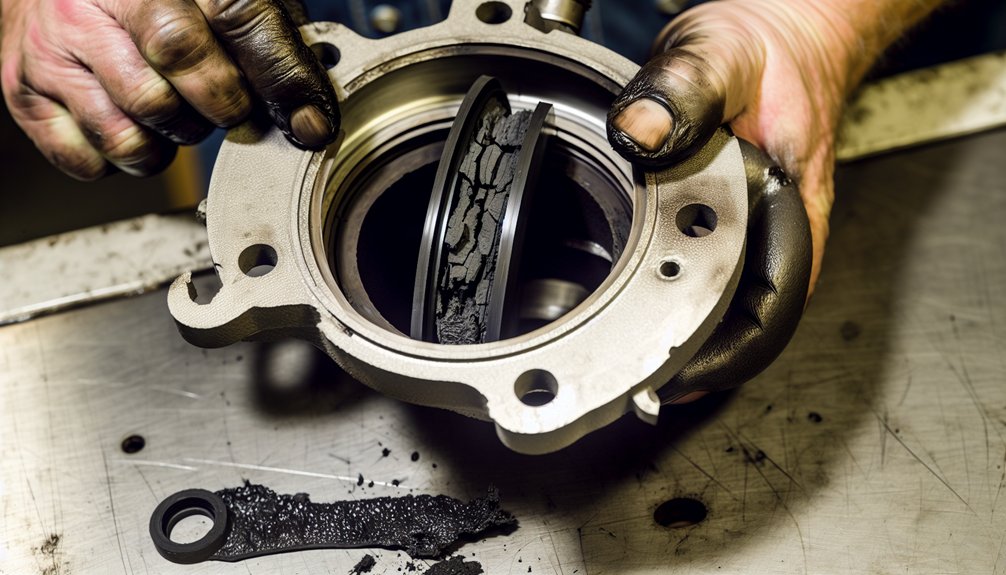
Monitor for hissing sounds near valve connections, which indicate gasket deterioration and air leakage pathways. Pressure drops signal gasket compression failures at suction valve covers. Contamination through inlet, outlet, and vent ports degrades gasket integrity when inadequate filtration allows debris accumulation. Apply soapy solution to suspected leak points and watch for bubbling to confirm gasket failure locations. Implement proper maintenance schedules to prevent harmful substance buildup that accelerates gasket wear patterns and creates valve sealing failures.

Cylinder Head Lacquer Deposits

While pneumatic valve gasket failures present immediate operational concerns, cylinder head lacquer deposits create a different category of gasket deterioration that develops gradually through combustion-related processes. You’ll encounter cylinder lacqueration when partially combusted fuel components condense on liner surfaces, undergoing oxidation that creates hard, sticky residues. These deposits fill honing grooves, creating glazed surfaces that prevent proper gasket sealing.

Monitor oil consumption rates and conduct surface roughness measurements to detect lacquer formation early. For varnish mitigation, implement regular cleaning protocols using correctly-tailored chemistry before deposits harden. When lacquer accumulation compromises gasket integrity, you’ll need complete engine overhaul with liner rehoning for effective restoration. Acid cleaning may provide temporary relief, but remaining deposits often become nucleation sites for renewed formation. Engines operating under mixed load regimes show increased susceptibility to this type of gasket-compromising lacquer development.

Triple Valve Malfunctions

When triple valve gaskets fail, you’re dealing with a critical component that controls both service and emergency braking systems across your entire train consist. Natural leakage through gladhand gasket connections causes trainline pressure drops, preventing automatic brake setting despite pressure loss. Single valve failure compromises your entire train’s stopping power during operation.

You’ll face valve balancing issues when New York Airbrake DB-10 components exceed their useful life. Spring fatigue compounds problems as lubricants dry up and gaskets become brittle. Emergency reservoir pressure drops from 90 psi, affecting both chambers simultaneously.

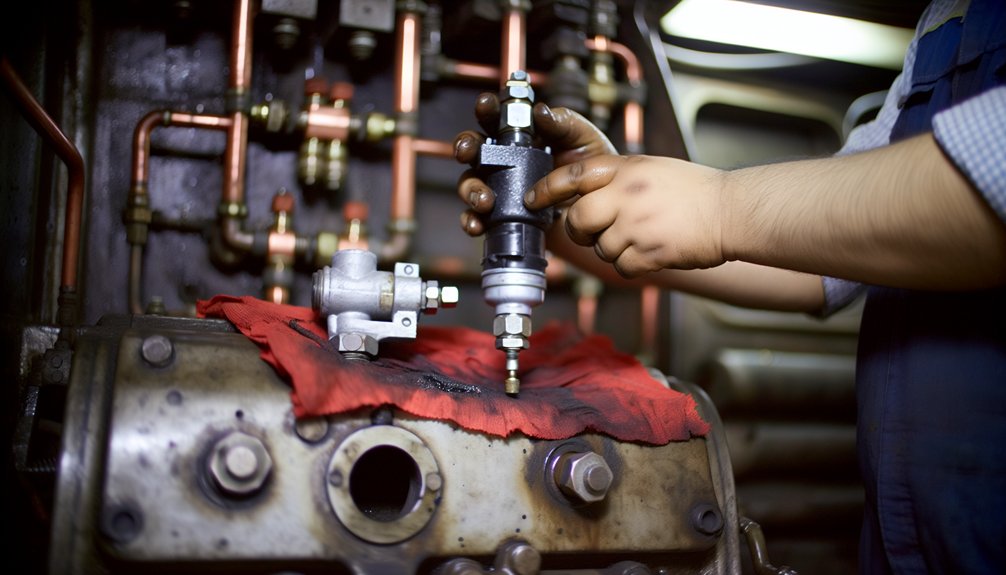
Replace valves every eight years by removing three bolts and installing new gaskets. Clean components with appropriate solvents, apply Rocol 1000 lubricant to slide valves, and use W.H.B. grease on gasket surfaces for peak performance. The triple valve compares brake pipe pressure and reservoir pressure to select RELEASE, APPLY, or LAP positions for proper brake operation.

Inspection Protocols for Critical Pneumatic Components

gasket degradation in pneumatics

Before you commence any pneumatic system maintenance, you must establish rigorous inspection protocols that systematically evaluate each critical component’s operational integrity and safety compliance. During routine inspections, examine air compressor assemblies, reservoir tanks, control valves, and brake chambers for gasket compatibility issues and structural degradation. You’ll need to inspect piston pin bushings, piston rings, cylinder walls, and pistons for lacquer deposits that indicate lubricant breakdown affecting gasket performance.

Check discharge valves for lacquer accumulation and carbon deposits, which compromise gasket sealing effectiveness. Evaluate magnet valves, brake valves, and feed valves for lacquer qualification standards. Document all maintenance activities and component conditions during inspection procedures, noting gasket wear patterns and replacement requirements.

Monitor oily substance formation in feed valves indicating potential oil distillation that can deteriorate gasket materials. Establish inspection intervals consistent with operational demands while maintaining thorough documentation for regulatory compliance and component lifecycle management. Perform comprehensive pressure testing to ensure brake pipe leakage remains under 5 lbs/min and main reservoir leaks stay under 3 lbs/min, as gasket deterioration directly impacts these critical pressure thresholds.

Gasket Replacement and Repair Techniques

locomotive air system gaskets

Execute gasket replacement procedures systematically to maintain locomotive air system integrity and prevent catastrophic pressure failures. You’ll need specialized installation tools including internal pliers for retainer rings and anvil fixtures for proper alignment. Verify gasket materials meet AAR specifications and withstand system pressures up to 550 kPa before installation.

  • Remove clamp assemblies carefully when accessing suction valve gaskets to prevent damage to sealing surfaces
  • Position upper and lower unloader plunger gaskets correctly during valve reassembly using proper torque specifications
  • Press roller bearings into piston assemblies without overcompressing gasket seals that could cause premature failure

When installing new gaskets on cover plates, rotate piston components 180 degrees to make certain even seating pressure. Place piston assemblies over anvil fixtures to maintain proper gasket alignment throughout the process. Remove installation plugs carefully to prevent damage to newly installed gaskets during final assembly procedures. Follow ASME PCC-1 installation procedures and proper bolt-tightening sequences to avoid under- or over-compression that can compromise seal effectiveness.

Preventing Lacquer Deposits and Contamination Issues

prevent lacquer from oil contamination

Why do locomotive air systems fail prematurely despite proper gasket installation? You’re likely dealing with contamination issues that compromise system integrity. Heavy detergent oils form hard lacquer deposits on cylinder heads and walls, causing oil carryover throughout your system. These unsuitable oils contain unstable compounds that distill off and deposit at expansion areas like feed valves.

Focus on proper lubricant selection to prevent lacquer formation. Avoid heavy weight oils that cause excessive piston pin bearing wear and system contamination. When you discover oily substances in feed valves, you’re facing oil distillation issues, not compressor pumping problems. Regular upkeep detects and addresses leaks that could harm engine and structure before they escalate into costly system failures.

Implement rigorous filtration maintenance protocols. Examine magnet valves, brake valves, and discharge valves for lacquer accumulation during qualification testing. Inspect piston pin bushings, rings, cylinder walls, and pistons for deposits. Install efficient filtering systems, dryers, and coolers to maintain contamination-free compressed air essential for tank-car pressurization operations.

Maintaining Optimal System Pressure and Performance

monitor calibrated asme gauges

You’ll need to implement systematic pressure monitoring techniques to ensure your locomotive’s air system operates within manufacturer specifications throughout each service cycle. Start by installing ASME Grade 2A pressure gauges at critical system points and establish regular calibration intervals to maintain measurement accuracy. Focus your performance optimization methods on maintaining continuous flow rates while preventing pressure deviations that could compromise brake cylinder function or overall system integrity. Poor gasket sealing allows contaminated compressed air to enter the system, causing component slowdown and accelerated failure of critical pneumatic functions.

Pressure Monitoring Techniques

Within locomotive air brake systems, you’ll establish proper pressure monitoring through systematic verification of operating parameters and continuous assessment of system integrity. Deploy JUMO MIDAS S19 R pressure transmitters for real time diagnostics of fuel feed pressure and rail pressure systems. These instruments enable predictive maintenance by tracking lubricating oil pressure and turbocharger charge-air pressure continuously.

  • Calibrate testing gauges every 92 days to maintain accuracy within 3 psi of locomotive brake pipe gauge at 90 psi
  • Configure warning devices to activate at 55 psi for immediate low air pressure condition alerts
  • Conduct standard leakage tests using one-minute intervals with maximum allowable rates not exceeding 5 psi per minute

You’ll verify proper charging requires pressure within 15 psi of operating pressure, while cut-out testing ensures maximum thresholds don’t exceed 145 psi.

Performance Optimization Methods

Optimize locomotive air brake system performance by implementing exhaustive energy management strategies that integrate regenerative braking capabilities with intelligent power controls. You’ll achieve maximum efficiency through aerodynamic optimization techniques that reduce system drag and enhance airflow dynamics around critical components. Install high-flow mufflers and properly sized exhaust piping to minimize back pressure throughout your air system network.

Execute regenerative integration protocols by upgrading turbocharger assemblies and exhaust manifolds for improved scavenging efficiency. You must monitor real-time pressure differentials while adjusting automated throttle controls during operational cycles. Implement spiral louvered mufflers to reduce restrictions and boost overall system output. Follow AAR specifications M-60l-7l for air hose performance standards. Maintain proper coupling engagement through systematic inspection procedures to assure reliable connections and prevent catastrophic pressure loss during critical braking operations.

Emergency Brake System Gasket Troubleshooting

brake pipe gasket inspection

Before attempting any emergency brake system gasket repairs, you must establish proper safety protocols and verify complete system depressurization. Emergency diagnostics start with identifying sudden pressure drops that trigger emergency brake applications throughout the consist. When brake pipe pressure drops to zero, you’ll experience a complete dump of all 90psi from charged systems.

Focus your emergency diagnostics on brake pipe connections at hose glad hands, as these flexible connections between cars represent the most common failure points. Examine air hose and coupling assemblies, including hose coupling, clamps, and pipe nipple attachments to car brake pipes.

  • Confirm zero system pressure before disconnecting any air lines or components
  • Inspect brake pipe connections at glad hands for visible damage or contamination
  • Verify proper gasket seating by checking surface contact and hand-tightening half turn

Control valve malfunctions prevent proper brake application and release during emergencies, requiring immediate gasket replacement and surface preparation verification.

Frequently Asked Questions

What Specific Gasket Materials Work Best in Extreme Temperature Railroad Operating Conditions?

Like armor against temperature’s relentless assault, you’ll need specialized materials engineered for extreme conditions. Deploy Viton seals for fuel and hydraulic systems—they’ll withstand chemical aggression and thermal cycling from -20°F to 400°F. Install PTFE gaskets in high-temperature applications where standard elastomers fail. For pneumatic brake systems, you must specify EPDM compounds that maintain sealing integrity through freeze-thaw cycles while ensuring consistent braking performance and operational safety.

How Often Should Locomotive Air System Gaskets Be Replaced During Routine Maintenance?

Replace air system gaskets at scheduled intervals every 368 days during regulatory compliance inspections, but you’ll need condition-based replacement when pressure drops exceed 10 psi or contamination occurs. You must inspect triple valve gaskets during systematic cleaning cycles and replace filter gaskets immediately upon pressure differential indicators. Don’t wait for scheduled intervals if you observe lacquer deposits, moisture damage, or seal degradation during daily brake checks.

Can Temporary Gasket Repairs Be Safely Made During Remote Breakdowns?

You can’t safely perform temporary repairs on locomotive air system gaskets during remote breakdowns. Field improvisation compromises system integrity and violates safety protocols. Instead, you’ll need to depressurize the system, isolate affected sections using cut-out cocks, and transport defective components to authorized workshops. Use wood covers and defective hose material for temporary protection only during transit, never as functional gasket replacements.

What Tools Are Required for Proper Gasket Installation in Locomotive Brake Systems?

You’ll need specialized gasket installation tools including the glad hand gasket 2-in-1 tool and window locking gasket tool set with pry tools. Always follow proper torque sequence specifications when tightening fittings. Clean all mating surfaces with approved cleaning solvents before installation. Don’t use basic hand tools—they’re insufficient for brake work. Make sure you’ve got proper gauges to verify leak-tight installations and maintain system integrity.

How Much Does Professional Gasket Replacement Typically Cost for Locomotive Air Systems?

You’ll typically pay $150-300 for professional gasket replacement, including labor rates of $75-120 hourly and parts markup of 15-25% above wholesale. Basic pneumatic valve gaskets cost under $200 with thirty-minute service intervals. Don’t attempt DIY repairs—improper installation compromises system integrity and FRA compliance. Enhanced sealing solutions carry higher upfront costs but reduce maintenance frequency. Always verify technician certification before authorizing work on critical brake system components.

10 Locomotive Camshaft Bearing Alloy Specifications You Need

10 Locomotive Camshaft Bearing Alloy Specifications You Need

You’ll need aluminum alloys with 200-300 MPa fatigue resistance, copper-based alloys offering 152-227 W/m·K thermal conductivity, and steel-backed tri-metal constructions for EMD applications. Critical specifications include 0.001-0.004″ clearances, babbitt compositions with 88-90% tin content, and thermal expansion coefficients matching camshaft materials. Bi-metal configurations provide enhanced durability over tri-metal overlays, while copper-HCP delivers 98% IACS electrical conductivity correlating with superior thermal transfer. These foundational specifications form the framework for thorough locomotive bearing selection criteria.

Key Takeaways

  • Aluminum alloys require 130-227 W/m·K thermal conductivity with 6061-T6 grade offering 152-154 W/m·K for optimal heat dissipation.
  • Copper-based alloys must maintain 98% IACS electrical conductivity with phosphorous content between 0.002-0.007% for enhanced thermal transfer.
  • Tri-metal construction needs steel backing, copper intermediate layer, and 0.0005-0.0008″ lead-based overlay for high-load applications.
  • Fatigue resistance specifications require 200-300 MPa endurance limits under 10^4 to 10^7 cycle testing protocols.
  • Operating clearances must be 0.0015-0.002 times bearing diameter with EMD minimum recommendation of 0.0025 inches.

Aluminum Alloy Fatigue Strength Requirements for EMD Locomotive Applications

aluminum bearing fatigue requirements

When designing camshaft bearing systems for EMD locomotive applications, you must establish aluminum alloy fatigue strength parameters that withstand the demanding operational cycles inherent in heavy-haul and freight service environments. Your fatigue testing protocols should encompass stress amplitude ranges from 10⁴ to 10⁷ cycles, matching typical locomotive duty cycles. You’ll need to specify minimum endurance limits of 200-300 MPa for aluminum bearing alloys under rotating bending conditions.

Your lifecycle modeling must account for variable loading conditions, including startup torque spikes, thermal cycling, and vibration harmonics from diesel engine operation. Consider implementing accelerated fatigue testing using standardized protocols that replicate field stress patterns. You should evaluate crack propagation rates and establish inspection intervals based on fatigue life predictions.

Material selection requires aluminum alloys with enhanced fatigue resistance, typically achieved through controlled microstructure and heat treatment optimization. Your specifications must define acceptance criteria for fatigue strength verification testing before component approval. Material compatibility considerations are essential to prevent premature failure of bearing assemblies in locomotive service environments.

Copper-Based Alloy Load-Bearing Capacity in High-Performance Locomotive Engines

copper alloy bearing load capacity

Copper-based alloys deliver exceptional load-bearing performance in high-performance locomotive engines through their superior material properties and structural characteristics. You’ll find these alloys maintain stable load capacity under extreme operating conditions due to their inherent fatigue resistance and thermal conductivity properties. The fine microstructure optimization enables enhanced strength under cyclic loading while preventing material failure during repeated stress cycles.

In tri-metal bearing constructions, you’ll benefit from copper intermediate layers that support loads exceeding aluminum alloy alternatives’ fatigue strength limitations. These materials demonstrate superior wear resistance and embeddability properties, accommodating contamination without performance degradation. Their excellent thermal management capabilities dissipate heat generated during high-load cycles, preventing thermal degradation between bearing surfaces and camshaft components.

You’ll also appreciate the superior lubricant compatibility that prevents chemical reactions reducing load capacity. The seizure resistance proves particularly effective with cast iron crankshaft materials, ensuring extended service life in demanding locomotive applications. The precise dimensional stability achieved through copper-based alloys ensures accurate fit tolerances even with temperature fluctuations during operation.

Steel-Backed Composite Material Construction for Extreme Operating Conditions

steel backed tri metal camshaft bearings

Steel-backed composite materials form the structural foundation for locomotive camshaft bearings operating under extreme conditions where single-material solutions can’t maintain performance standards. You’ll find tri-metal configurations incorporating steel backing, copper intermediate layers, and soft overlay materials delivering superior fatigue resilience under cyclic loading conditions. The steel substrate provides dimensional stability during high-speed operation while maintaining load-bearing capacity that exceeds aluminum-based alternatives.

Your composite bearing construction requires precise bonding technologies to prevent delamination. Pure aluminum bonding layers create metallurgical bonds between steel backing and bearing lining, while nickel barrier layers provide corrosion protection by preventing diffusion between copper and overlay materials. You’ll achieve peak performance with overlay thickness ranging from 0.0005″ to 0.0008″ in tri-metal applications.

These composite structures deliver extended service life under contaminated lubrication conditions while maintaining thermal expansion coefficient compatibility. You’ll need specialized installation tooling to preserve oil gallery alignment and bearing orientation during assembly operations. Proper clearance specifications maintain optimal oil film thickness, with typical oil clearance calculated at 0.0015 to 0.002 times the bearing diameter for reliable hydrodynamic operation.

Traditional Babbitt Metal Composition and Contamination Resistance Properties

tin antimony copper babbitt bearings

Although steel-backed composites excel in extreme applications, traditional babbitt metal formulations remain the gold standard for locomotive camshaft bearings requiring superior contamination resistance and embeddability characteristics. You’ll find optimal tin-based compositions contain 88-90% tin, 7-8% antimony, and 3-4% copper for maximum performance reliability.

Antimony increases hardness and fatigue life while forming a strong matrix that resists deformation under load. Copper additions enhance mechanical strength, improve wear resistance, and ensure uniform heat distribution during temperature fluctuations. You’ll benefit from tin’s excellent corrosion resistance against moisture, chemicals, and temperature extremes in harsh locomotive environments.

The embeddability mechanisms allow small particle absorption, protecting rotating camshafts from contaminant-induced scoring. Soft surface characteristics enable conformability to shaft imperfections and misalignment compensation. This contamination resistance prevents damage accumulation while maintaining smooth anti-friction properties throughout extended operating cycles, making babbitt ideal for demanding locomotive applications. Proper temperature control during casting ensures uniform metal structure and prevents the formation of hard and soft spots that compromise bearing performance.

Thermal Conductivity Specifications for Heat Dissipation During Locomotive Operation

thermally optimized bearing alloy

You’ll need to evaluate thermal conductivity specifications when selecting bearing alloys for camshaft applications, as heat dissipation directly impacts bearing longevity and locomotive performance. Aluminum-based alloys provide excellent heat transfer characteristics that complement their lightweight properties, while copper-based compositions deliver superior thermal conductivity under high-load operating conditions. These thermal management capabilities become critical factors in maintaining ideal bearing temperatures during extended locomotive operations where heat build-up can compromise component integrity. Proper oil film thickness ensures effective heat transfer away from bearing surfaces while maintaining the lubrication barrier essential for preventing metal-to-metal contact during high-temperature operating cycles.

Aluminum Heat Transfer Properties

When selecting aluminum alloys for locomotive camshaft bearing applications, you’ll find thermal conductivity values ranging from 130 W/m·K to 227 W/m·K depending on the specific grade and temper condition. These properties directly impact heat dissipation performance during high-speed operation.

Alloy GradeThermal Conductivity (W/m·K)
1050227
1100222
6061-T6152-154

You’ll need to take into account thermal expansion compatibility with steel backing substrates, as aluminum bearings maintain interference fit through heating cycles. Surface emissivity characteristics enhance radiative heat transfer under loads up to 69 MPa. The heat capacity of aluminum at 0.90 J/g·°C enables rapid temperature equilibration during locomotive operational cycles. Aluminum’s weight advantage—three times lighter than copper alternatives—combined with superior thermal management capabilities makes it ideal for locomotive camshaft bearing specifications requiring sustained performance at surface speeds reaching 84 m/s.

Copper Thermal Conductivity Performance

Copper alloys deliver thermal conductivity values that markedly exceed aluminum’s performance range, with high purity copper (Cu-HCP) achieving 223 Btu/sq ft/ft hr/°F at 20°C. You’ll find beryllium copper provides 3-5 times greater thermal conductivity than tool steel, combining exceptional heat transfer with tensile strengths from 60-220 ksi for demanding camshaft applications.

Thermal diffusion remains consistent across 20°C to 300°C operating ranges, while microstructural effects from residual phosphorous content (0.002-0.007%) optimize conductivity without compromising dissipation performance. Cu-HCP‘s 98% electrical conductivity (IACS) correlates with superior thermal transfer potential. The coefficient of thermal expansion ranges 9.4-9.8 x 10^-6 per °C, ensuring dimensional stability during locomotive operation while maintaining efficient heat management capabilities. These copper alloys demonstrate low friction coefficients that reduce energy consumption while supporting extended service life requirements in high-performance locomotive applications.

Wear Resistance and Chemical Compatibility Standards for EMD Camshaft Bearings

wear resistant chemically compatible bearings

EMD camshaft bearings must meet stringent wear resistance standards that guarantee reliable operation under the extreme conditions found in locomotive diesel engines. You’ll need bearings that demonstrate exceptional durability against metal-to-metal contact during startup sequences and high-load operations. These specifications assure your bearings maintain dimensional stability throughout extended service intervals.

Chemical resistance becomes critical when you’re selecting bearing alloys for EMD applications. Your bearings must withstand exposure to diesel fuel contaminants, combustion byproducts, and acidic compounds that can migrate through the lubrication system. Lubrication compatibility standards confirm proper interaction between bearing materials and specified engine oils.

Key performance requirements include:

  • Minimum wear rate specifications under boundary lubrication conditions
  • Chemical compatibility with synthetic and mineral-based locomotive engine oils
  • Resistance to corrosion from sulfur compounds and acidic combustion residues

You’ll find these standards essential for preventing premature bearing failure and maintaining peak camshaft timing accuracy throughout the bearing’s operational lifecycle. The cam follower assemblies incorporate roller bearing systems that work in conjunction with camshaft bearings to ensure precise valve timing control.

Clearance Tolerances and Installation Requirements for Locomotive Engine Applications

precision bearing clearance specifications

Proper bearing alloy selection pairs directly with precision clearance specifications to achieve peak camshaft performance in locomotive applications. You’ll need to maintain EMD factory clearance specifications ranging from 0.001 to 0.004 inches for standard applications, with a minimum 0.0025 inches recommended for enhanced reliability.

Apply the general bearing clearance rule of 0.00075 to 0.0010 inches per inch of shaft diameter as your baseline calculation. For high-performance applications, you’ll add an additional 0.0005 inches to maximum calculated clearance values. Your vertical measurement must be taken at 90 degrees to the split line for accurate specifications.

Use dial bore gauges when bearings are installed at specified torque without the shaft present. Your installation checklist should include measurements at front, center, and rear positions of each bearing location. Account for housing bore variations of plus or minus 0.0005 inches and crankshaft journal tolerances of plus or minus 0.0003 inches during final clearance calculations. Compensate for tolerance variations by mixing half shells of bearings in incremental thicknesses from bearing manufacturers to achieve your target clearance specifications.

Tri-Metal Vs Bi-Metal Construction Performance Characteristics

While both tri-metal and bi-metal bearing constructions serve locomotive camshaft applications effectively, their fundamental structural differences create distinct performance profiles that’ll directly impact your engine’s reliability and maintenance intervals.

Tri-metal bearings feature steel backing, copper-lead intermediate layer, and lead-based overlay measuring 0.0005-0.0008″ thick. However, overlay vulnerability represents their primary weakness—once this thin surface layer wears through, anti-friction properties deteriorate dramatically. You’ll find tri-metal construction rarely specified for camshaft applications due to this critical limitation.

Bi-metal bearings eliminate overlay vulnerability through aluminum alloy lining approximately 0.010″ thick bonded to steel backing. This construction provides superior misalignment tolerance and accommodates geometric defects that would compromise tri-metal performance. The aluminum alloy lining delivers improved conformability characteristics that enhance bearing performance under varying operating conditions.

  • Bi-metal bearings offer virtually identical load capacity with enhanced durability
  • Aluminum construction tolerates far greater wear than tri-metal overlay systems
  • Mixed lubrication conditions favor bi-metal designs over vulnerable tri-metal overlays

Surface Finish and Journal Specifications for Optimal Bearing Performance

polished camshaft journals precise clearances

Since bearing performance depends critically on surface interactions between journal and bearing materials, achieving ideal camshaft journal surface finish becomes paramount for locomotive applications. You’ll need polishing to 10 micro-inches Ra or better for peak performance, with superfinished surfaces reaching Ra 0.01 for maximum hardness and minimum friction in high-performance applications.

Your polishing direction must match the camshaft’s operational rotation in the engine for proper surface preparation. You should avoid honing bearing inner diameters since this process will embed grit particles that cause shaft wear. Instead, you’ll achieve better results grinding journal diameters to reach proper clearances.

For locomotive applications, you’ll require clearances spanning .003″ to .004″ for best results. Your surface finish directly impacts bearing fatigue strength under high loading conditions. You can utilize three-stage superfinishing processes with ceramic chippings and progressively finer grinding pastes for competition-level applications requiring maximum performance characteristics.

Material Stability Requirements Under High-Temperature Locomotive Operating Conditions

thermally stable bearing alloys

When locomotive engines operate at elevated temperatures exceeding 200°F, you’ll find that bearing alloy stability becomes the determining factor between reliable performance and catastrophic failure. Your material selection must prioritize microstructural stability to prevent grain boundary degradation and dimensional changes during thermal cycling.

Copper-based alloys deliver exceptional thermal conductivity while maintaining structural integrity under extreme heat conditions. Steel-backed copper-plated configurations combine high-strength frameworks with superior wear characteristics, ensuring oxidation resistance throughout extended operation cycles. You’ll need materials that demonstrate consistent thermal expansion coefficients to maintain critical bearing clearances.

Key stability requirements include:

  • Thermal expansion compatibility – Materials must match camshaft expansion rates to prevent clearance deviations
  • Chemical inertness – Alloys require resistance to lubricant degradation and corrosive byproducts at elevated temperatures
  • Microstructural integrity – Grain structure stability prevents material property changes during temperature fluctuations

Lead-based babbitt overlays with tin content provide self-compensating properties essential for locomotive temperature variations.

Frequently Asked Questions

What Are the Typical Replacement Intervals for Locomotive Camshaft Bearings?

You’ll replace locomotive camshaft bearings at 80% of their calculated service life, typically coinciding with major engine overhauls every 3,000 hours. This preventive approach proves effective against catastrophic failures. Your routine inspections during 750-hour oil changes detect early wear indicators, while continuous load cycling from varying operational demands accelerates degradation patterns. Temperature monitoring and vibration analysis provide critical data for optimizing replacement timing based on actual bearing condition rather than fixed schedules.

How Do You Properly Measure Bearing Clearances During Installation?

You’ll measure bearing clearances using a dial bore gauge at vertical positions 90 degrees from the split line. Position the crankshaft at bottom dead center, then insert telescopic gauges between crank webs and bearing keeps. Take readings at front, center, and rear positions, accounting for thermal expansion effects. Standard clearance ranges from 0.00075 to 0.0010 inches per shaft diameter inch, with high-performance applications requiring additional 0.0005-inch tolerance.

Which Bearing Alloy Offers the Best Cost-To-Performance Ratio for EMD Engines?

Like striking gold in engineering economics, babbitt alloy delivers your ideal cost-to-performance ratio for EMD engines. You’ll find it outperforms expensive nickel chrome alternatives while maintaining superior self-compensation characteristics. Unlike costly titanium aluminide options, babbitt’s tolerance management capabilities reduce installation precision requirements, lowering labor costs. You’re getting enhanced load capacity, wear resistance, and manufacturing variance accommodation at fraction of premium alloy pricing.

What Causes Premature Bearing Failure in Locomotive Camshaft Applications?

You’ll encounter premature bearing failure primarily from oil contamination carrying abrasive particles that score bearing surfaces and inadequate lubrication creating metal-to-metal contact. Thermal expansion from excessive operating temperatures accelerates bearing material deterioration, while poor installation practices misalign components. Contaminated oil systems, blocked oil passages, and insufficient oil film thickness destroy bearing integrity. High-performance diesel loading exceeds material fatigue limits, causing catastrophic failure.

Are Aftermarket Bearing Brands Compatible With OEM Locomotive Engine Specifications?

Yes, aftermarket bearing brands demonstrate full compatibility with OEM locomotive engine specifications through direct cross-reference part numbers and engineered tolerances. You’ll find aftermarket compatibility maintained via precise dimensional matching and metallurgical standards that meet or exceed original specifications. However, warranty implications may vary between manufacturers, so you should verify coverage terms before installation to make certain your locomotive’s powertrain protection remains intact.

Why Do Locomotive Camshaft Bearings Fail Prematurely?

Why Do Locomotive Camshaft Bearings Fail Prematurely?

Your locomotive camshaft bearings fail prematurely due to oil starvation (causing over 60% of failures), installation errors creating misaligned oil holes, and excessive thermal stress from high-performance operations. Contamination introduces abrasive particles that destroy bearing surfaces within minutes, while mechanical misalignment accounts for 12.6% of failures through bore distortion and improper clearances. Heavy-duty overloading compounds these issues, preventing adequate cooling and accelerating material fatigue that systematically compromises bearing integrity before reaching designed service intervals.

Key Takeaways

  • Oil starvation from pump failures, blocked passages, or misaligned oil holes causes over 60% of premature bearing failures.
  • Installation errors like flipped bearing halves and misaligned oil holes block lubrication and create stress concentrations.
  • Mechanical misalignment and bore distortion prevent proper oil film formation and create uneven load distribution.
  • Contaminated oil loses protective properties, leading to metal-on-metal contact that destroys bearings within minutes.
  • Debris particles as small as 10 microns from contaminated assembly procedures cause catastrophic surface damage immediately.

Lubrication System Breakdowns That Destroy Camshaft Bearings

oil starvation destroys camshafts

Beyond mechanical stress and manufacturing defects, lubrication system breakdowns represent the primary destroyer of locomotive camshaft bearings, with oil starvation alone accounting for over 60% of premature bearing failures in diesel engine applications.

You’ll encounter several critical failure modes that systematically destroy bearing integrity. Oil pump malfunctions and pressure relief valve failures prevent adequate circulation, while pump cavitation reduces effective oil delivery to bearing surfaces. Dry starts without pre-lubrication systems expose bearings to immediate metal-to-metal contact damage.

Your engine’s oil delivery system becomes compromised when suction screens block or filters clog, restricting flow rates under operating loads. Blocked oil passages from misassembled components prevent proper lubrication flow to critical surfaces. Oversized bearing bores create excess clearance that allows harmful camshaft movement and reduces effective lubrication support. When oil film breaks down between bearing and journal, you’ll see distress starting at the bearing center and progressing outward, ultimately causing wiping action and hot short failure.

Installation Errors That Lead to Bearing Failure

You’ll encounter bearing failures when installation procedures compromise critical alignment specifications and contamination control protocols. Misaligned oil holes block lubrication passages by up to 50%, while improper bearing orientation creates stress concentrations that exceed material limits within 200 operating hours. Contaminated assembly procedures introduce abrasive particles that accelerate wear rates and prevent proper oil film formation between camshaft journals and bearing surfaces. Incorrect bearing size results in poor fit and excessive camshaft movement that compromises the structural integrity of the entire bearing system.

Misaligned Oil Holes

Installation errors can wipe out even the highest-quality locomotive bearings when oil holes don’t align properly between the bearing and engine block. You’ll see catastrophic lubrication failure when oil hole orientation prevents adequate flow to camshaft journals during operation. Misaligned passages create localized overheating that extends from bearing journals onto the camshaft itself, while bearing overlay mismatch compounds the problem by disrupting oil distribution patterns.

Partial blockage reduces oil volume reaching critical bearing surfaces, and complete blockage eliminates lubrication entirely. You’ll notice bearing journal discoloration indicating insufficient lubrication from blocked passages. The increased friction accelerates bearing wear exponentially, creating uneven wear patterns that signal distortion. Excessive clearance space allows camshaft movement, reducing lubrication and support while contributing to bearing journal damage. Precise alignment during installation avoids these failures and guarantees proper camshaft lubrication throughout operation.

Improper Bearing Orientation

When locomotive camshaft bearings aren’t oriented correctly during installation, you’re setting up a cascade of failures that’ll destroy even premium bearing materials within hours of operation. Incorrect orientation disrupts the critical oil film formation between bearing and journal surfaces, creating metal-to-metal contact that generates excessive heat and wear particles.

Flipped halves represent the most catastrophic orientation error you’ll encounter. When bearing shells are reversed, oil holes misalign with housing passages, starving lubrication systems and preventing proper oil distribution. This misalignment also affects bearing crush specifications, reducing the interference fit that maintains bearing stability under dynamic loads. You’ll observe accelerated journal scoring, bearing material transfer, and complete lubrication breakdown when orientation errors compromise the hydrodynamic lubrication envelope essential for camshaft bearing longevity. These installation errors often result from over-tightened bearing caps, which compound the orientation problems by creating uneven stress distribution across bearing surfaces.

Contaminated Assembly Procedures

Contaminated assembly procedures destroy locomotive camshaft bearings faster than any other installation error, with debris particles as small as 10 microns creating catastrophic surface damage within the first operating cycle. You’ll compromise bearing integrity when compressed air blowing pushes contaminants deeper into surfaces instead of removing them. Assembly airflow systems must maintain positive pressure while filtering particles to prevent contamination introduction.

Tooling contamination transfers metal particles directly onto bearing journals during installation. You’re creating abrasive conditions when dirt embeds in bearing material, causing immediate surface scoring. Blocked oil passages result from misaligned holes during improper installation, preventing lubrication flow. Impact guns distort bearing housings, affecting oil film thickness. You’ll guarantee bearing longevity by implementing thorough cleaning protocols, proper torque specifications, and contamination-free assembly environments.

Contaminated oil immediately loses its ability to provide adequate lubrication protection, leading to metal-on-metal contact that destroys bearing surfaces within minutes of operation.

Mechanical Misalignment and Structural Support Defects

camshaft bearing structural failure

When you’re diagnosing camshaft bearing failures, you’ll find that mechanical misalignment creates direct friction damage that accounts for 12.6% of premature failures across engine applications. Your bearing bore distortion prevents adequate oil film formation between surfaces, while camshaft support misalignment blocks critical lubrication passages and generates excessive heat buildup. These structural defects compromise load distribution across bearing surfaces, creating the foundation for accelerated wear patterns that’ll ultimately destroy your locomotive’s camshaft system. The babbitt overlay construction used in many cam bearings lacks the tri-metal design found in rod and main bearings, making them more susceptible to delamination under mechanical stress.

Bearing Bore Distortion

Beyond surface contamination issues, bearing bore distortion represents one of the most complex failure mechanisms affecting locomotive camshaft systems. You’ll encounter progressive block deformation that allows camshafts to gradually adapt before complete failure occurs. When bearing housing bores become undersize, oversize, or out-of-round, they create immediate operational problems requiring bore annealing and thermal relaxation procedures.

Engine blocks sometimes utilize oversize OD bearings as salvage operations, though replacement parts become difficult to obtain. Excessive clearance space allows damaging camshaft movement within bores, while steel backing yields during installation in undersize holes. You can identify distortion through uneven wear patterns and “X”-shaped contact marks. Polymer liners and composite sleeves offer solutions for correcting bore irregularities and restoring proper bearing support geometry. Finished-In-Place bearings require precision machining during rebuilding, introducing variables not present in original assembly configurations.

Camshaft Support Misalignment

Structural support defects compound the challenges you face with bearing bore irregularities by introducing systematic misalignment throughout the camshaft assembly. When bearing supports lack proper positioning, you’ll observe shaft wobble that creates concentrated stress points on journal surfaces. This misalignment disrupts load distribution patterns and generates excessive heat buildup.

Misalignment EffectResulting Damage
Concentrated stress pointsJournal scoring
Disrupted oil flow patternsBearing blackening
Excessive clearancesAccelerated wear

Installation errors worsen these conditions by blocking oil holes and creating inconsistent support structures. You’ll notice journal scoring develops rapidly when misaligned bearings concentrate loads on specific contact areas. Temperature-related expansion differences between components further amplify existing alignment problems, creating cascading failure effects that compromise valve timing precision. The resulting timing disruption significantly impacts locomotive power output and operational efficiency across the entire assembly.

Excessive Operating Loads and Harsh Service Conditions

excessive loads degrade bearings

Although locomotive camshaft bearings are engineered to withstand substantial operational forces, excessive loading conditions and harsh service environments consistently push these critical components beyond their design thresholds. When you operate locomotives under heavy-duty conditions, overloading accounts for 8.1% of premature bearing failures, while insufficient lubrication contributes another 11.4%. These concentrated mechanical stresses create uneven load distribution across bearing surfaces, accelerating material breakdown beyond designed service life.

You’ll encounter elevated operating temperatures that break down lubrication systems, causing catastrophic failures when lead content melts and damages shaft surfaces. Thermal expansion creates improper clearances, while hot short conditions result in surface wiping. Continuous high-load operations prevent adequate cooling periods, and severe duty cycles exceed normal design parameters. The disrupted timing mechanisms cause engine misfires that further compromise locomotive performance and accelerate component deterioration. Marine and heavy-duty applications subject your bearings to extreme environmental stress, where contaminants combined with excessive loads markedly reduce service life expectancy. Effective overload mitigation and strategic duty cycling become essential for maintaining bearing integrity.

Contamination Sources and Engine Cleanliness Issues

contamination driven camshaft bearing failures

Within locomotive engine systems, contamination represents the primary threat to camshaft bearing longevity, accounting for the majority of premature failures through multiple pathways that compromise bearing surface integrity. You’ll encounter hard particles creating sharp-edged dents with concentrated stress points, while polymer particles extrude under 200,000 psi contact pressures, forming shallow surface damage. Metallic debris acts like grinding wheels against journal surfaces when protruding from embedded positions.

Your engine block cleaning protocols directly determine bearing survival rates. Inadequate cleaning practices allow debris accumulation, while compressed air redistribution worsens particle embedding during assembly. You must maintain extremely clean conditions throughout installation procedures.

Oil system contamination introduces wear fragments from other components, particularly when you neglect filter replacement or extend change intervals. Environmental contaminants enter through compromised air filtration systems, embedding road dirt and sand particles into bearing linings, creating metal-to-metal contact and accelerated wear patterns. Iron particles released from cast engine blocks can accelerate oil oxidation and create secondary lubrication problems that further compromise bearing performance.

Design Specifications and Clearance Problems

precise clearances prevent failures

Beyond contamination factors, your bearing failures often stem from fundamental design specification mismatches and clearance control deficiencies that create destructive operating conditions. Locomotive applications demand precise bearing clearances between .003″ to .004″ for peak performance, yet tolerance stack-up from block machining, shaft diameter variations, and bearing manufacturing creates compounded errors that push clearances beyond acceptable limits.

Your material selection directly impacts failure rates. Aluminum alloy bearings lack the self-compensation properties of softer materials, requiring stricter clearance control. Copper-based alloys provide superior fatigue resistance under locomotive’s extreme loads, while steel-backed copper-plated materials handle the most demanding applications.

Specification ParameterCritical Requirement
Minimum Clearance.003″ locomotive applications
Surface Finish10 micro-inches Ra maximum
Material SelectionCopper alloys for high loads
Measurement ProtocolVerify at installation
Temperature StabilityAccount for thermal expansion

You must measure clearances at installation since manufacturing tolerances compound unpredictably, creating bearing distortion that mirrors block bore irregularities.

Oil Quality Degradation and Viscosity Breakdown

viscosity breakdown causing bearing failure

Degraded oil destroys your camshaft bearings through viscosity breakdown that eliminates the protective hydrodynamic film essential for preventing metal-to-metal contact. When you operate locomotives under high-load conditions, oil temperature spikes accelerate molecular breakdown, reducing viscosity below critical thresholds required for bearing protection.

Oxidation products form when oil molecules react with oxygen at elevated temperatures, creating acidic compounds that corrode bearing surfaces and thicken remaining oil. You’ll notice sludge formation as these oxidation products accumulate, restricting oil flow through critical bearing passages.

Additive depletion occurs simultaneously as anti-wear agents, viscosity improvers, and antioxidants become exhausted through normal operation. Without these protective additives, your oil can’t maintain stable viscosity under thermal stress. The resulting thin oil film collapses under bearing loads, causing direct metal contact that generates heat, accelerates wear, and ultimately leads to catastrophic bearing failure in your locomotive’s camshaft system.

thermal degradation of camshaft bearings

Temperature spikes from viscosity breakdown create a cascade of thermal damage that systematically destroys your locomotive’s camshaft bearings through multiple failure mechanisms. High-performance engines generate excessive cylinder pressures that compound thermal stress effects, while thermal gradients across bearing surfaces create stress concentration points that accelerate material fatigue.

Thermal SourceTemperature ImpactFailure Mechanism
Engine OperationElevated bearing tempsMaterial fatigue acceleration
Manufacturing GrindingResidual thermal stressReduced operational lifespan
Adjacent Motor Components66.9% stress increaseNon-uniform heat distribution
Cyclic LoadingTemperature fluctuationsDimensional tolerance changes

Your bearing overlay materials lose critical strength properties at elevated temperatures, while thermal expansion differentials between components create internal mechanical stresses. Manufacturing processes introduce additional thermal damage through grinding operations and heat treatment cycles. When traction motor heating combines with operational loads, you’ll experience maximum stress concentrations that systematically compromise bearing integrity before visible symptoms appear.

Frequently Asked Questions

How Often Should Locomotive Camshaft Bearings Be Inspected for Early Wear Signs?

You should inspect locomotive camshaft bearings every 750 hours for oil changes and conduct thorough assessments at 3,000-hour intervals. Implement monthly inspections focusing on visual examination of raceways, manual rotation testing, and systematic mounting alignment checks. Integrate vibration monitoring systems with daily component inspections to detect early wear indicators like cracking, flaking, or smearing. Document all findings for regulatory compliance and performance tracking.

What Specific Tools Are Needed to Properly Measure Camshaft Bearing Clearances?

You’ll need micrometers for precise journal measurements, dial bore gauges with dial indicator attachments for actual clearance calculations, and plastigage measurement strips for quick visual verification. Calibrate all precision instruments before use, ensuring you follow EMD-specific torque specifications during assessment. Clean all surfaces thoroughly before applying plastic gauges across the entire journal surface. These tools provide thorough data for accurate bearing clearance analysis and preventive maintenance decisions.

Can Rebuilt Camshaft Bearings Perform as Well as New OEM Bearings?

You’ll find rebuilt camshaft bearings can achieve performance parity with OEM units when properly reconditioned using precision machining and OEM specifications. However, you’re facing warranty concerns since rebuilt bearings typically offer shorter coverage periods and may lack thorough failure protection. You’ll need to verify the rebuilder’s quality control processes, material specifications, and dimensional tolerances match OEM standards. Performance depends on the rebuilding facility’s technical capabilities and adherence to manufacturer specifications.

Which Bearing Materials Work Best for High-Mileage Locomotive Engine Applications?

Like a marathon runner needs endurance gear, you’ll find aluminum-based bi-metal bearings excel in high-mileage locomotive applications. Their 0.010″ thickness tolerates extensive wear while superior conformability accommodates misalignments that develop over time. Bronze alloys deliver exceptional fatigue resistance for heavy loads, though polymer composites show promise in specific applications. You’ll achieve peak performance by selecting aluminum bi-metal construction over tri-metal alternatives for extended service intervals.

How Much Does Premature Camshaft Bearing Failure Typically Cost in Repairs?

You’ll face repair costs ranging from $15,000 to $45,000 per locomotive when camshaft bearings fail prematurely. Engine teardown, bearing replacement, and associated component damage drive these expenses higher. You’re looking at 3-7 days downtime, compounding operational losses. Insurance claims typically cover catastrophic failures but exclude wear-related issues. Factor in secondary damage to camshafts, cylinder heads, and timing systems when calculating total repair costs for your fleet maintenance budget.

Why Should You Monitor Locomotive Bearing Wear?

Why Should You Monitor Locomotive Bearing Wear?

You should monitor locomotive bearing wear because catastrophic failures cost an average of $1.7 million per incident through derailments, emergency response, and cascading network disruptions. Early detection at 10-20% remaining bearing life prevents expensive crankshaft replacements and months of downtime. Modern vibration analysis and wireless sensor networks provide 1-3 months of lead time, enabling scheduled maintenance that reduces unplanned failures by 75%. Discover how condition-based monitoring transforms your fleet’s reliability and operational efficiency.

Key Takeaways

  • Catastrophic bearing failures cause immediate operational shutdowns, derailments, and cascading network disruptions costing millions in damages and repairs.
  • Early detection through vibration analysis identifies defects at 10-20% remaining bearing life, preventing costly crankshaft and bedplate damage.
  • Multi-parameter monitoring provides 1-3 months lead time for scheduled maintenance compared to traditional imminent-failure hotbox alarms.
  • Predictive maintenance strategies can prevent up to 80% of unplanned locomotive service interruptions through data-driven bearing replacement protocols.
  • Fire and explosion risks emerge when bearing temperatures reach 253°F above ambient, creating environmental liability and safety hazards.

Catastrophic Bearing Failures Lead to Costly Locomotive Downtime

catastrophic locomotive bearing failures

When locomotive bearings fail catastrophically, you’re facing immediate operational shutdowns that cascade into massive financial losses across your entire rail network. Recent derailments like East Palestine demonstrate how bearing failures create devastating consequences—that bearing traveled 26 miles while “on fire,” passing through three hot bearing detectors before causing a $258.3 million incident.

You’ll absorb approximately $31,000 per derailed car, plus $1,572,000 in downstream disruptions per incident. Emergency response costs hit $60,000, with additional operating expenses of $73,000. Your dead trains create bottlenecks that damage customer perception and trigger regulatory penalties.

Recovery operations demand specialized equipment and personnel, straining your spare management systems. Service interruptions reduce schedule reliability and revenue generation capacity. With North Carolina experiencing $2.4 billion in rail incident costs over ten years, thorough crew training and proactive bearing monitoring become essential for protecting your operational continuity and financial stability. Bearing failures can occur in less than 3 minutes, making real-time monitoring systems critical for preventing catastrophic incidents.

Early Detection Prevents Expensive Crankshaft and Bedplate Damage

early bearing detection prevents damage

When you implement early bearing detection systems, you’ll prevent catastrophic failures that can destroy expensive crankshaft and bedplate components costing hundreds of thousands in repairs. Vibration analysis detecting defects at 10-20% remaining bearing life gives you sufficient lead time to schedule maintenance before secondary damage occurs to these critical engine components. Your proactive monitoring strategy transforms potentially devastating equipment failures into manageable, cost-effective bearing replacements that keep locomotives operational and maintenance budgets under control. Combining multiple sensor types with vibration monitoring improves accuracy and reliability of fault identification across all bearing conditions.

Catastrophic Failure Consequences

Although locomotive bearing failures may seem isolated to wheel assemblies, catastrophic consequences cascade throughout your entire drivetrain system when detection systems fail to provide adequate warning. When bearings disintegrate at operational speeds, you’re facing multi-million dollar crankshaft replacements and extensive bedplate damage that can sideline locomotives for months.

The East Palestine derailment demonstrates how bearing failures create catastrophic chain reactions:

  1. Fire and explosion risks – Bearing temperatures reaching 253°F above ambient trigger immediate fire hazards requiring emergency response
  2. Environmental liability exposure – Hazardous material releases create long-term cleanup costs and community health impacts exceeding operational losses
  3. Complete drivetrain destruction – Heat-related failures propagate through connected systems, destroying crankshafts, bedplates, and transmission components simultaneously

Current detection thresholds provide insufficient warning time for prevention. Advanced detection systems have proven effective, with hotbox detectors contributing to a 59% decline in bearing-related accidents over nearly three decades.

Cost-Effective Prevention Strategies

Beyond traditional hotbox detection systems that trigger alarms only during imminent failure, you can implement multi-parameter monitoring strategies that detect bearing degradation one to three months before catastrophic damage occurs. Temperature-based early warning systems identify bearing defects through statistical analysis of thermal patterns, while vibration analysis using accelerometers detects amplitude changes indicating misalignment or damage. You’ll achieve optimal results by combining oil analysis, current signature monitoring, and acoustic emission testing for comprehensive condition assessment. This multi-parameter approach enables predictive financing by forecasting maintenance costs months ahead, while supporting inventory optimization through accurate spare parts planning. FFT-based algorithms and VRMS calculations provide quantifiable data that prevents expensive crankshaft and bedplate damage through timely intervention.

Wireless Sensor Networks Enable Real-Time Temperature Monitoring

real time wireless bearing temperature

Wireless sensor networks transform locomotive bearing monitoring by delivering real-time temperature data through sophisticated multi-component architectures that eliminate traditional wiring constraints. You’ll benefit from continuous temperature monitoring through wireless detection modules that communicate with gateway data collectors, enabling immediate identification of bearing overheating conditions before catastrophic failures occur.

Key advantages of wireless bearing temperature monitoring:

  1. Real time telemetry – Temperature data transmits continuously via Zigbee modules and 4G/LTE gateways, providing instant alerts when bearing temperatures exceed safe operating thresholds
  2. Mesh resilience – Ad hoc wireless sensor networks create redundant communication paths, ensuring data transmission even if individual nodes fail during critical monitoring periods
  3. Energy efficiency – Power management systems activate monitoring equipment only during train movement, extending battery life while maintaining all-encompassing coverage

Gateway systems store data locally and transmit remotely in near-real-time, associating temperature measurements with GPS positioning for complete fleet monitoring capabilities throughout your entire train consist. The system employs GPRS wireless communication to enable remote monitoring capabilities from centralized control centers.

Vibration Analysis Techniques Identify Bearing Defects Before Failure

envelope analysis detects bearing faults

While temperature monitoring provides crucial thermal data, vibration analysis delivers the most all-encompassing diagnostic capability for detecting bearing defects before they cause catastrophic locomotive failures. You’ll achieve superior detection using envelope analysis, which stands as the most effective technique for identifying bearing faults across rotating machinery.

High frequency envelope analysis isolates specific bearing defect signatures by targeting Ball Pass Frequency Outer race (BPFO) and Ball Pass Frequency Inner race (BPFI) frequencies. BPFO typically ranges from 3-8 times rotational frequency, while BPFI exceeds BPFO due to load zone effects.

You can enhance your diagnostic accuracy through probability density functions that reveal statistical changes in vibration patterns as bearing condition deteriorates. Root-mean-square measurements provide speed-dependent thresholds to differentiate between healthy and defective bearings, while crest factor analysis identifies impulsive characteristics from surface defects. Since Stage I defects remain undetectable through conventional noise or temperature monitoring, high-frequency vibration techniques become essential for identifying bearing problems in their earliest development phase.

Strategic Maintenance Scheduling Reduces Unplanned Service Interruptions

data driven bearing replacement scheduling

Through systematic maintenance scheduling, you’ll prevent up to 80% of unplanned locomotive service interruptions by implementing data-driven bearing replacement protocols.

Effective maintenance prioritization transforms reactive repairs into strategic interventions. You’ll establish ideal monitoring intervals using historical failure data, enabling your teams to predict bearing deterioration before catastrophic events occur. This approach requires thorough documentation of oil changes, temperature readings, and inspection results to identify trending issues.

Your strategic framework should integrate three critical components:

  1. Oil analysis every 60-90 days to detect metal particles and contamination before bearing failure
  2. Quarterly bearing assessments combined with 3,000-hour inspection cycles for camshaft bearings
  3. Predictive scheduling algorithms that optimize maintenance timing during planned downtime windows

Resource allocation becomes more efficient when you base decisions on condition predictions rather than arbitrary schedules. You’ll minimize emergency repairs by replacing bearings at 750-hour oil change intervals, maintaining peak locomotive performance while reducing costly service disruptions through well-structured preventive maintenance timing.

Temperature monitoring protocols establish baseline readings that enable early detection of bearing issues before they escalate into temperature spikes requiring immediate shutdown procedures.

On-Board Vs Wayside Monitoring System Options

onboard continuous ai diagnostics

Locomotive bearing monitoring systems fall into two primary categories: on-board devices that travel with your equipment and wayside installations positioned along track segments. On-board systems integrate thermal, vibration, and acoustic technologies with embedded AI circuits, providing continuous diagnostic data regardless of route changes. These systems sample wheels every minute initially, increasing frequency when parameters indicate potential failure. Sensor miniaturization enables contactless positioning 20-30 centimeters from targets while maintaining 2-year battery life.

Wayside systems use Hot Axle Box Detection with infrared sensors monitoring bearing temperatures as vehicles pass. However, they monitor only during passage, missing intermittent issues between detection points. While wayside installations require fewer initial units, they need permanent infrastructure and regular calibration. Wayside measurements can be compromised by solar reflection, braking sparks, and other nearby heat sources that interfere with accurate temperature readings.

Temporary On-board Monitoring necessitates battery swapping and equipment transfers between rail cars, creating service downtime. Permanent systems eliminate infrastructure maintenance but increase fleet instrumentation costs, making strategic selection critical for your operational requirements.

Safety Systems Automatically Protect Engines During Bearing Wear Events

automated bearing overheat shutdown system

As bearing wear progresses beyond acceptable thresholds, automated safety systems activate protective protocols that prevent catastrophic engine damage. Your locomotive’s integrated monitoring network employs redundant sensing technology to guarantee reliable fault detection across all critical bearing locations. When temperature sensors detect overheating conditions, automated shutdowns immediately halt engine operation before thermal damage occurs to crankshafts or other major components.

Modern safety systems protect your investment through three critical mechanisms:

  1. Real-time thermal monitoring triggers protective shutdowns when bearing temperatures exceed safe operating limits
  2. Multi-parameter detection systems utilize vibration, acoustic, and position sensors for thorough bearing health assessment
  3. Automated alert protocols deliver immediate notifications to operators and Central Train Control via SMS, email, or direct messaging

These systems eliminate human error in critical failure detection scenarios while providing continuous surveillance without manual intervention. Your engine protection system prevents bearing damage from progressing to catastrophic failure, guaranteeing operational safety and equipment longevity. Advanced bearing technologies require ongoing maintenance activities despite their sophisticated design capabilities.

Fleet-Wide Reliability Improvements Through Condition-Based Maintenance

predictive maintenance boosts fleet reliability

Modern condition-based maintenance (CBM) strategies consistently deliver fleet-wide reliability improvements by shifting your maintenance approach from reactive repairs to predictive interventions. You’ll achieve optimal resource allocation through predictive prioritization, enabling maintenance teams to address critical bearing wear before failures impact operations.

Asset pooling strategies maximize locomotive availability by redistributing workloads across your fleet based on real-time bearing condition data. This approach extends Mean Time Between Failure (MTBF) intervals while optimizing Expected Useful Life (EUL) calculations.

CBM MetricTraditional ApproachCBM ApproachImprovement
Unplanned Failures15-20% fleet downtime3-5% fleet downtime75% reduction
Maintenance Costs$500K annually$320K annually36% savings
Asset Utilization65% operational88% operational35% increase
Safety Incidents12 per year2 per year83% reduction

Your maintenance teams can implement data-driven decisions that prevent catastrophic bearing failures while optimizing locomotive deployment across routes. Automated alarm thresholds eliminate the need for specialized user knowledge in interpreting complex bearing condition data, making advanced monitoring accessible to all maintenance personnel.

Frequently Asked Questions

What Is the Typical Service Life of Locomotive Bearings Under Normal Operating Conditions?

You’ll find locomotive bearings typically achieve 20,000 to 27,000 hours of L10 rated service life under standard operating conditions. Your typical lifespan extends to approximately 94,000 miles with proper maintenance protocols. Industry-standard service intervals recommend replacement at 80% of calculated life to prevent catastrophic failures. You’ll maximize bearing longevity through specialized lubrication, temperature monitoring, and contamination control while maintaining strict 92-day oil change schedules for peak performance.

How Much Does Bearing Replacement Cost Compared to Preventive Monitoring System Installation?

You’ll find bearing replacement cost markedly exceeds monitoring system investment. New railway bearings cost approximately $400 per unit, while remanufacturing saves over half that expense. However, you’re still facing substantial replacement costs versus preventive monitoring installation. The monitoring ROI becomes evident when you consider new bearings experienced 27 failure sets compared to 42 for overhaul units, demonstrating how early detection prevents costly emergency replacements and operational disruptions.

Which Bearing Materials Perform Best in Different Climate and Operating Environments?

Ironically, you can’t simply pick one “best” bearing material—your choice depends entirely on environmental demands. Ceramic hybrids excel in high-temperature applications up to 600°C with superior corrosion resistance, while corrosion resistant alloys like enhanced aluminum perform optimally in moderate conditions. You’ll need bronze for heavy-duty locomotive applications requiring excellent heat dissipation, and M50NiL steel for extreme temperature ranges exceeding 400°C with maximum durability.

How Often Should Bearing Condition Data Be Collected for Optimal Monitoring Effectiveness?

You should implement daily sampling during normal operations, then shift to event-driven monitoring when fault indicators emerge. Start with 1-minute intervals during startup, increasing frequency as thermal or acoustic data suggests bearing degradation. Stage II defects require continuous high-frequency monitoring at 5kHz+ ranges. You’ll need real-time analysis when vibration levels exceed RMS velocity limits, ensuring immediate detection before critical failure occurs.

What Backup Systems Activate if the Primary Bearing Monitoring System Fails?

You’re flying blind without proper backup systems, but most modern locomotives deploy redundant sensors and secondary backup diagnostics when primary bearing monitoring fails. You’ll typically find acoustic sensors as secondary monitors, temperature-based backup systems, and manual inspection protocols that activate automatically. These redundant sensors guarantee you’re never completely without bearing condition data, though you’ll need immediate primary system repairs to maintain peak safety margins and prevent catastrophic bearing failures.

Key Indicators of Connecting Rod Bearing Failure in EMD Locomotives

Key Indicators of Connecting Rod Bearing Failure in EMD Locomotives

You’ll identify connecting rod bearing failure in EMD locomotives through five critical warning signs: distinctive metal-to-metal contact acoustics in the 25-100 kHz frequency range, oil pressure drops accompanied by copper-lead contamination in analysis, visible surface wear patterns showing edge cocking or diagonal scoring, temperature spikes exceeding 180°F baseline measurements, and engine performance degradation including reduced horsepower output. These indicators often appear progressively, with all-encompassing monitoring techniques revealing additional diagnostic insights for maintenance planning.

Key Takeaways

  • Oil pressure drops below normal range with metal contamination showing copper/lead particles from bearing overlay degradation.
  • Oil temperature spikes above 180°F indicate imminent bearing failure, with baseline deviations of 10-20°F signaling early problems.
  • Distinctive knock patterns create sharp acoustic spikes in 25-100 kHz range, intensifying under high-power load conditions.
  • Physical wear shows edge cocking, diagonal scoring, fatigue cracks, and surface progression from shiny to blackened material.
  • Crankshaft journals exhibit surface burning, scoring, material transfer, and geometric deviations exceeding 0.001-inch out-of-roundness.

Physical Wear Pattern Recognition on Bearing Surfaces

bearing surface failure patterns

Examining connecting rod bearing surfaces reveals critical failure patterns that directly indicate specific mechanical problems within your engine. Edge cocking produces distinctive wear concentrations on opposite ends of upper and lower bearing shells, creating metal-to-metal contact along bearing edges due to misaligned bore positioning. You’ll observe fatigue cracks developing in these localized excessive wear areas.

Diagonal scoring appears when bent or twisted connecting rods create wear patterns running from one edge to the opposite edge in diagonal configurations. Cross-hatched wear marks indicate rod distortion during operation, while heavy wear on diagonally opposite shell sides confirms bent rod conditions.

Surface deterioration progresses from shiny appearances to blackened, partially melted overlay material. Severe cases show torn surfaces with missing overlay and lining material, exposing underlying bronze in advanced failures. Foreign contamination creates distinctive impression patterns matching debris shape and size, producing irregular surface textures distinct from standard wear characteristics.

Cavitation erosion creates erosion-damaged areas when vapor cavities form in the oil film due to high-frequency bearing load fluctuations at elevated RPM conditions.

Oil System Warning Signs and Contamination Indicators

bearing wear indicated by contamination

Oil pressure anomalies signal the earliest stages of connecting rod bearing deterioration, often appearing weeks before visible physical damage occurs. You’ll notice pressure drops below normal operating ranges, extended prelube times, and fluctuations at scavenging pump outlets. These symptoms indicate compromised bearing clearances allowing internal leakage.

Metal contamination provides critical diagnostic evidence through oil analysis. Copper and lead particles from bearing overlay material, combined with ferrous debris from crankshaft journals, confirm bearing deterioration. Contaminant source tracing helps identify specific failure locations before catastrophic damage occurs.

Warning SignIndicatorAction Required
Pressure DropBelow normal rangeImmediate inspection
Metal ParticlesCopper/lead presenceOil analysis trending
Filter CloggingPremature replacementSystem contamination check
Oil DegradationViscosity breakdownOxidation stabilization review

Monitor filter bypass valve activation and accelerated oil blackening, as these indicate advancing bearing material loss requiring immediate attention. Establishing conservative thresholds for pressure and temperature alarms prevents catastrophic bearing failures that can destroy the entire crankshaft assembly.

Acoustic Signatures and Vibration Analysis for Bearing Diagnosis

high frequency connecting rod bearing diagnostics

You’ll detect connecting rod bearing failures most effectively by analyzing acoustic signatures in the 25-100 kHz frequency range, where bearing wear patterns create distinct vibration fingerprints. Your knock pattern recognition becomes critical at the prime diagnostic speed of 1800 r/min, as this operating point provides the clearest separation between normal operation and fault conditions. You must combine frequency domain analysis with time-based vibration monitoring techniques to isolate bearing-specific signatures from the complex noise environment of diesel engine operation. The variational mode decomposition method provides superior noise robustness compared to traditional empirical mode decomposition when processing these multi-component, nonstationary vibration signals from connecting rod bearing faults.

Knock Pattern Recognition

When bearing failures develop in EMD locomotives, they’ll generate distinctive acoustic signatures that you can identify through systematic knock pattern recognition. You’ll observe metal-to-metal contact creating sharp acoustic spikes during crankshaft rotation, with bearing localization techniques helping isolate specific failure points from overlapping engine noise. Edge-loaded bearings produce intermittent frequency bursts when surfaces contact journals irregularly.

Monitor knock intensities under varying load modulation conditions—patterns intensify during high-power operations and reduce at idle. You’ll detect cyclic irregularities corresponding to crankshaft position from out-of-round connecting rod bores. Progressive deterioration creates evolving signatures that track damage severity over time. Foreign material generates distinct impact patterns, while oil film breakdown shifts acoustic characteristics from lubricated to metal-contact signatures during thermal cycles. Spun connecting rod bearings will produce catastrophic acoustic changes when proper lubrication is lost, leading to complete bearing seizure.

Frequency Analysis Methods

Building on these knock pattern observations, advanced frequency analysis methods provide quantitative diagnostic capabilities that transform raw acoustic and vibration data into actionable bearing condition assessments. You’ll need sophisticated analysis techniques to identify bearing deterioration before catastrophic failure occurs.

Essential frequency analysis methods for EMD connecting rod bearing diagnosis include:

  1. FFT parameters – Configure spectral analysis windows between 0-5kHz to capture bearing-specific frequencies and harmonic content
  2. Cepstral analysis – Detect periodic impulses in complex frequency domains that indicate bearing race defects and cage irregularities
  3. Order tracking – Synchronize measurements with crankshaft RPM to isolate bearing signatures from engine noise
  4. Envelope detection – Extract modulated signals that reveal early-stage bearing deterioration patterns

These methods enable you to establish baseline signatures and track progressive bearing wear through quantifiable frequency domain changes. Implementing regular frequency analysis protocols helps prevent catastrophic failures by detecting metal-to-metal contact conditions before complete bearing destruction occurs.

Vibration Monitoring Techniques

Modern vibration monitoring techniques consistently outperform traditional visual inspections by detecting connecting rod bearing deterioration weeks before physical symptoms appear. You’ll achieve superior diagnostic accuracy using real time sensing systems that continuously monitor bearing vibration signatures throughout locomotive operations. Wireless telemetry enables immediate data transmission to maintenance centers, eliminating delays in failure detection.

Monitoring ParameterFailure Threshold
Peak Velocity>15 mm/s
RMS Acceleration>5g
Frequency Bands1-10 kHz
Temperature Rise>50°F baseline

Your vibration analysis should focus on bearing-specific frequency ranges where connecting rod defects generate distinctive acoustic signatures. Deploy accelerometers at crankcase positions adjacent to suspected bearing locations. Monitor amplitude increases exceeding baseline measurements by 200% as primary failure indicators requiring immediate maintenance intervention. EMD signal processing isolates defect-specific frequencies from background noise, achieving superior fault feature extraction through vibration signal decomposition.

oil temperature indicates thermal damage

You’ll detect temperature-related bearing failures through systematic oil temperature monitoring and careful assessment of bearing material degradation patterns. Oil temperatures exceeding manufacturer specifications indicate thermal stress conditions that accelerate overlay material breakdown and compromise lubrication film stability. Monitor bearing surfaces for blackening, partial melting, or shiny wear patterns that signal heat-induced damage before catastrophic failure occurs. Damage typically appears opposite rod cap only on affected bearings, indicating localized stress concentration from thermal expansion and misalignment forces.

Oil Temperature Monitoring

Temperature monitoring serves as your primary defense against connecting rod bearing failure, with baseline deviations of 10-20°F signaling early degradation in EMD locomotives. You’ll detect critical thermal conditions when temperatures suddenly spike above 180°F, indicating imminent bearing failure. Wireless telemetry systems using Surface Acoustic Wave radar technology provide real-time data transmission from sensors positioned millimeters from bearing surfaces.

Your oil temperature monitoring protocol should include:

  1. Continuous thermal surveillance – Monitor temperature trends during normal operational cycles
  2. Automatic load reduction – Implement immediate power reduction when thresholds exceed safe parameters
  3. Predictive algorithms – Analyze historical thermal data for maintenance scheduling
  4. Emergency shutdown procedures – Execute automatic engine shutdown when thermal limits breach safety margins

Direct temperature measurement delivers more accurate assessments than conventional oil analysis methods. Advanced monitoring systems enable proactive maintenance decisions through comprehensive analysis of measured trends and historical data patterns.

Bearing Material Degradation

Bearing overlay materials begin deteriorating when operational temperatures exceed design thresholds, creating cascading failures that compromise your locomotive’s reliability. You’ll observe visible discoloration and surface roughening as the overlay chemistry breaks down under thermal stress. This microstructural evolution disrupts oil film formation, accelerating metal fatigue in underlying bearing structures.

Thermal cycling creates expansion-contraction patterns that weaken bearing assemblies, particularly at edges and high-load zones. You’ll notice progressive crack development spreading toward the back layer, eventually causing material peeling. Bronze lining exhibits characteristic fatigue patterns under repeated thermal loading.

Monitor clearances carefully—thermal expansion reduces effective gaps between bearing and shaft surfaces, creating feedback loops of increasing temperatures that accelerate degradation. Poor embeddability capacity allows foreign particles to remain on bearing surfaces rather than being trapped, which generates additional heat through increased friction and surface damage.

Engine Performance Degradation and Efficiency Loss Patterns

bearing induced engine efficiency loss

When connecting rod bearings begin to deteriorate, you’ll notice a cascade of performance issues that directly impact your locomotive’s operational efficiency. Bearing degradation creates increased friction that forces your engine to work harder while delivering less power. This mechanical stress disrupts ideal fuel mapping and combustion tuning, leading to measurable efficiency losses.

You’ll observe these critical performance indicators:

  1. Power Output Decline – Gradual horsepower reduction under normal loads, with decreased traction motor performance during heavy operations
  2. Fuel Consumption Increase – Elevated fuel flow rates required to maintain equivalent power levels, especially during acceleration phases
  3. Engine Irregularities – Misfiring, rough idling, and hesitation during throttle shifts affecting overall locomotive performance
  4. Thermal Efficiency Loss – Elevated exhaust temperatures and increased bearing temperatures indicating friction losses

These symptoms compound quickly, transforming minor bearing wear into significant operational deficiencies that compromise your locomotive’s reliability and economic performance. Implementation of performance monitoring programs that track power output, energy consumption, and operating temperatures becomes essential for identifying bearing deterioration before complete failure occurs.

Visual Inspection Techniques for Bearing Condition Evaluation

visual bearing surface defects

Beyond monitoring performance metrics, direct visual examination provides the most reliable method for evaluating bearing condition and determining serviceability. You’ll need to focus on identifying cracks, scoring, and surface irregularities that indicate potential failure modes. Check for exposed bronze detection, as this condition immediately disqualifies bearings from continued service.

Examine the overlay material carefully for flaking, relocation, or channeling patterns. Loss of surface gloss often indicates overlay material migration into the copper/lead underlayment, creating a rough granular appearance. Look for discoloration patterns that may correspond to packaging materials or operational stress.

Inspect bearing edges for edge burrs and dimensional irregularities. Document contamination evidence including water damage, dirt scratches, and embedded particles. Compare observed wear patterns against established photographic examples from maintenance manuals. Normal wear after 100 hours shows predictable patterns, while irregular wear indicates misalignment or improper installation requiring immediate attention.

Crankshaft Journal Surface Condition and Damage Identification

crankshaft journal surface damage

Turning your attention to the crankshaft journals themselves reveals critical damage patterns that directly correlate with bearing failures you’ve already identified. Surface metrology measurements will document the extent of wear and geometric deviations that compromise bearing performance.

You’ll encounter these primary damage indicators during journal inspection:

  1. Surface burning and discoloration – Grey welded material from bearing inserts and bluish thermal stress patterns indicate severe lubrication breakdown
  2. Scoring and material transfer – Contaminated oil creates gouging while bearing material buildup requires machining removal
  3. Geometric deviations – Out-of-roundness and eccentricity exceeding 0.001-inch tolerances between consecutive main journals
  4. Heat-affected zones – Color progression from straw to purple indicates thermal damage requiring microhardness testing

Connecting rod journals typically show more severe wear than main journals due to higher loads. Maximum wear positions on main journals occur closest to connecting rod sides, revealing load concentration patterns that guide your failure analysis.

Bearing Clearance Measurements and Tolerance Specifications

precise bearing clearance measurements

After you’ve documented journal surface damage, precise bearing clearance measurements become your primary diagnostic tool for determining rebuild specifications and preventing future failures. You’ll need to establish proper bearing tolerances using the standard .001-inch clearance per inch of journal diameter formula, though EMD specifications may require adjustments based on operating conditions.

Your measurement techniques should utilize a dial bore gauge at 90 degrees to the split line with bearings torqued to specification. Take readings at front, center, and rear positions for complete assessment.

Measurement TypeSpecification RangeTechnique
Radial Clearance.0015-.0020″ (2″ journal)Dial bore gauge
Side Clearance.005-.013″Feeler gauge
Surface Finish60-90 microinchProfilometer
Out-of-round0.001″ maximumMultiple positions
Bore Tolerance±0.0005″Precision measurement

Document all measurements against EMD tolerance specifications to determine bearing serviceability and establish proper clearances during reassembly.

Frequently Asked Questions

How Often Should Connecting Rod Bearings Be Replaced in EMD Locomotives?

You should replace connecting rod bearings in EMD 710-series locomotives every 1,000,000 miles during scheduled intervals that coincide with power assembly overhauls. You’ll need to assess bearing condition based on operational hours, engine service type, and operating environment. Don’t perform standalone bearing maintenance – replace them during thorough overhauls when you’ve got specialized tools for proper clearance measurement and fitting procedures.

What Are the Typical Repair Costs for Connecting Rod Bearing Failure?

You’ll face connecting rod bearing repair costs ranging from $15,000-$40,000 depending on your EMD engine series and damage extent. Labor costs consume 100-200 hours requiring specialized two-person teams, markedly impacting your budget. Parts availability affects pricing, with OEM components costing more than aftermarket alternatives. Your 645 and 710 engines have different specifications, influencing total repair expenses. Complete power assembly replacement increases costs substantially beyond basic bearing work.

Can Connecting Rod Bearing Failure Cause Permanent Crankshaft Damage?

Yes, connecting rod bearing failure can cause catastrophic crankshaft damage you can’t reverse. When bearings fail, you’ll experience metal-to-metal contact creating crank scoring that cuts deep grooves into journal surfaces. Journal deformation occurs from excessive heat generation and uneven loading patterns. You’ll face crankshaft replacement costs when scoring exceeds machining limits or when thermal damage reduces surface hardness below operational specifications.

Which EMD Locomotive Models Are Most Susceptible to Bearing Failures?

You’ll find older SD40s and rebuilt GP38s are most susceptible to bearing failures due to their 645-series engines and outdated bearing designs. These units lack modern monitoring systems and operate with higher bearing temperatures from less efficient cooling. The 567-series engines in older GP units also experience frequent failures. Heavy freight operations and extended idle periods greatly increase failure rates in these legacy models compared to newer 710-series locomotives.

What Preventive Maintenance Schedules Help Avoid Connecting Rod Bearing Problems?

Want to prevent costly connecting rod bearing failures? You’ll need rigorous 92-day oil changes with 15-20% interval reductions in extreme conditions. Implement predictive monitoring through weekly vibration checks and temperature baseline tracking at 1500 RPM minimum. Conduct quarterly lubrication audits alongside Plastigage clearance testing during overhauls. Replace all lower main bearings when any single unit’s disqualified, and perform thorough oil analysis every 90 days.

5 Signs Your EMD Locomotive Alternator Diodes Failed

5 Signs Your EMD Locomotive Alternator Diodes Failed

You’ll notice five key signs when your EMD locomotive’s alternator diodes fail: voltage spikes reaching 20V with excessive AC ripple contaminating sensor signals, grinding or whining noises from the alternator assembly with thermal hotspots, transmission systems entering limp mode due to corrupted control circuits, unbalanced rectification causing voltage drops during acceleration cycles, and erratic auxiliary equipment operation with dashboard warning lights. These electrical signatures create cascading failures throughout your locomotive’s systems, and understanding each symptom’s root cause will help you diagnose problems before they escalate into costly repairs.

Key Takeaways

  • Voltage spikes exceeding 20V and unstable alternator output with excessive AC ripple contamination in sensor waveforms
  • Grinding, whining, or growling noises from alternator assembly with increased vibration and thermal hotspots around housing
  • Transmission entering limp mode and traction motor controllers receiving corrupted signals affecting locomotive responsiveness
  • Unbalanced rectification causing voltage drops during acceleration and reduced efficiency under heavy electrical loads
  • Dashboard warning lights for charging system faults with erratic auxiliary equipment operation and fluctuating gauge readings

Electrical System Voltage and Current Irregularities

alternator diode failure symptoms

When EMD locomotive alternator diodes begin failing, you’ll notice immediate voltage and current irregularities that compromise your electrical system’s stability. You’ll observe voltage spikes reaching 20V when diodes fail in the bridge configuration, creating dangerous fluctuations that damage sensitive components. The alternator’s output becomes unstable without properly functioning avalanche diodes, preventing consistent AC to DC conversion.

Failed diodes allow excessive AC ripple contamination in your DC circuits, appearing in sensor voltage waveforms and creating interference throughout the electrical system. You’ll detect uneven current distribution across the system when one or more diodes fail, causing amperage output to vary unpredictably with engine speed.

Check for loose connections or damaged wiring that contribute to voltage irregularities. Forward voltage drop increases in degraded diodes, reducing current flow efficiency. Your electrical energy conversion efficiency drops markedly, making proper diode bridge operation critical for maintaining stable locomotive performance. Professional diagnosis using specialized diagnostic tools can accurately identify which specific diodes have failed in the alternator assembly.

Unusual Noises and Overheating From the Alternator Assembly

diode induced alternator overheating and noise

Failed alternator diodes kick off a cascade of mechanical and thermal problems that you’ll hear and feel long before complete system failure occurs. You’ll notice grinding and high-pitched whining noises from the alternator assembly as internal components wear under electrical stress. Growling sounds persist when diodes malfunction, creating system imbalances that intensify under load conditions.

Overheating becomes your primary thermal concern as failed diodes force excessive current flow through remaining components. You’ll detect thermal hotspots around the alternator housing when diodes can’t properly convert AC to DC. Bearing failure compounds these issues, generating distinctive noise patterns while alternator vibration increases due to unbalanced electrical loads.

Multiple shorted diodes create more severe conditions than single failures. You’ll hear different sound characteristics as remaining diodes become overloaded. Monitor your cooling system closely—proper ventilation becomes critical when diode failures reduce efficiency and spike heat production throughout the alternator assembly. Failed diodes also produce electrical ripple that can interfere with sensitive electronic sensors throughout the locomotive’s control systems.

Control System Malfunctions and Transmission Problems

alternator diode induced electrical ripple

Control system electronics become vulnerable targets once alternator diode failures introduce AC ripple into your locomotive’s electrical network. You’ll notice transmission systems entering gearbox limp mode when electrical interference corrupts control circuits. Speed sensors generate false readings due to AC ripple, creating sensor corruption that affects positioning data and wheel slip detection accuracy.

Your electronic control units face immediate risk from shorted diodes that reflect high voltage ripple throughout electrical systems. Traction motor controllers receive corrupted command signals, making acceleration and deceleration responses unreliable. Dynamic braking systems malfunction when diode failures disrupt regenerative power conversion circuits.

Digital communication networks experience data corruption from electrical interference. CAN bus systems become unreliable, and diagnostic communications fail when AC ripple affects low-voltage circuits. Power management systems generate false alarms due to voltage irregularities, while electronic governors malfunction from voltage fluctuations in sensor power supplies. The voltage regulator struggles to maintain stable output voltage within the desired range when diode failures compromise the rectification process.

Generator Performance Degradation and Voltage Regulation Failures

alternator diode failure effects

As alternator diodes deteriorate, your locomotive’s generator loses its ability to maintain stable DC voltage output across varying load conditions. Failed diodes create unbalanced rectification that compromises voltage regulation during high-demand operations, directly affecting your traction motor performance and overall locomotive efficiency.

You’ll notice these critical performance indicators when diode failures occur:

  1. Voltage drops during acceleration cycles – Poor load regulation causes insufficient power delivery when you need maximum traction
  2. Reduced efficiency under heavy loads – Generator output capacity decreases markedly, limiting your locomotive’s hauling capability
  3. Unstable charging system performance – Battery charging becomes inconsistent, affecting electrical system reliability

Diode bridge failures also compromise ripple mitigation, allowing excessive AC content to contaminate your DC power supply. This creates electromagnetic interference with control systems and sensors. When multiple diodes fail, you’ll experience dramatically reduced efficiency and may need complete alternator replacement to restore proper generator performance. Since diodes are responsible for converting the generator’s AC output into usable DC power, their failure prevents alternator operation entirely in severe cases.

Secondary Equipment Failures and Dashboard Warning Indicators

alternator diode failure cascade

When alternator diode failures cascade through your EMD locomotive’s electrical system, secondary equipment begins malfunctioning in predictable patterns that you’ll recognize through specific dashboard indicators. You’ll notice auxiliary load systems experiencing erratic operation as voltage regulation becomes unstable. Battery charging circuits struggle to maintain proper levels, triggering low battery warnings on your control panel.

Indicator illumination patterns reveal the progression of diode failure. Your ammeter will show irregular charging rates, while voltage gauges display fluctuating readings that deviate from normal operating parameters. Engine cooling fans may cycle unpredictably due to inconsistent power delivery, and lighting systems often dim or flicker intermittently. A portable oscilloscope can reveal diode faults through distinctive ripple patterns in the electrical output.

Critical dashboard warnings include alternator fault lights, charging system alerts, and battery discharge indicators. You’ll observe that auxiliary systems like air compressors and dynamic brake grids respond sluggishly or fail to engage properly. These secondary failures create a diagnostic trail that helps pinpoint diode degradation before complete alternator failure occurs.

Frequently Asked Questions

How Much Does It Cost to Replace Failed Alternator Diodes in EMD Locomotives?

You’ll face $300-$1,200 in total replacement costs for EMD locomotive alternator diodes, depending on your specific model requirements. Labor costs range substantially based on facility capabilities and testing procedures needed. Complete rectifier assembly replacement includes new bus bars, diodes, and fuses rather than individual components. Consider upgraded components with extended parts warranty coverage, as they’ll reduce future failure rates and provide 12+ year service life versus standard 10-year intervals.

Can You Temporarily Operate a Locomotive With One or Two Failed Diodes?

You can temporarily operate with one failed diode under light loads, but you’ll experience reduced charging capacity and uneven output that stresses remaining components. Two failed diodes create dangerous conditions with excessive excitation current that’ll likely damage your exciter rotor within seconds. You must immediately reduce load and head for repairs – don’t risk progressive failures that’ll cascade through your voltage regulator and electrical system.

What Tools Are Needed to Properly Diagnose Alternator Diode Failures?

You’ll need a digital multimeter with diode test function, AC/DC voltmeter, and continuity tester for basic diagnosis. Add an insulation tester to check diode isolation from ground and housing. A thermal imager identifies overheating diodes under load conditions. Use specialized alternator diode testers with rheostat controls for thorough testing. Include insulated test probes, proper disconnection tools, and cleaning materials for accurate measurements and safe electrical work.

How Long Do EMD Locomotive Alternator Diodes Typically Last Before Failing?

Coincidentally, your EMD locomotive alternator diodes typically last 20,000 to 120,000 hours depending on insulation class and operating conditions. You’ll find Class H systems at 180°C achieve roughly 2.3 years, while Class F systems at 155°C extend service intervals to 13.7 years. Environmental factors like excessive heat, poor ventilation, voltage fluctuations, and contamination markedly reduce lifespan, making regular monitoring essential for peak performance.

Should Locomotive Operators Attempt Field Repairs of Failed Alternator Diodes?

You shouldn’t attempt field repairs of failed alternator diodes. These repairs pose significant safety risks including electrical shock and cascading system damage. Field modifications will void your locomotive’s warranty and violate manufacturer specifications. Diode replacement requires specialized training in high-voltage AC/DC conversion systems, professional diagnostic equipment, and knowledge of excitation circuits. Instead, contact certified EMD technicians who possess proper tools and expertise for safe repairs.

Why Do Diesel-Electric Locomotives Need Heavy-Duty Rectifiers?

Why Do Diesel-Electric Locomotives Need Heavy-Duty Rectifiers?

You’ll need heavy-duty rectifiers in diesel-electric locomotives because they convert the main alternator’s three-phase AC output into stable DC power for your traction motors. These robust systems handle continuous electrical loads exceeding 3,000 amperes while withstanding extreme temperatures from -40°F to 185°F and severe mechanical vibrations. They enable precise speed and torque control across multiple motors simultaneously, ensuring consistent power delivery during dynamic load changes. Understanding their complete integration reveals why they’re absolutely critical for locomotive performance.

Key Takeaways

  • Rectifiers convert the alternator’s three-phase AC output to stable DC power required for precise traction motor control and operation.
  • Locomotives demand continuous power conversion up to 3,000 kW with currents exceeding 3,000 amperes during peak operational scenarios.
  • Heavy-duty rectifiers withstand extreme temperatures (-40°F to 185°F), vibration loads exceeding 5G, and harsh environmental conditions including diesel exhaust.
  • Rectifiers enable coordinated power distribution to four or six traction motors simultaneously while maintaining consistent torque output around 60,000 lb-ft.
  • Solid-state rectifier technology provides superior reliability and ruggedness compared to mechanical alternatives while supporting advanced electronic control systems.

Converting AC Power to DC for Optimal Traction Motor Control

heavy duty rectified dc traction

Within the heart of every diesel-electric locomotive, the main alternator converts the diesel engine’s rotational energy into three-phase AC power, but this raw electrical output can’t directly control traction motors with the precision modern rail operations demand. You’ll find that heavy-duty rectifiers function as electrical check valves, converting this AC power into pulsating DC through full-wave rectification. This process captures both positive and negative sine wave alternations, eliminating AC’s 60-times-per-second directional reversals.

The resulting DC power provides superior speed and torque control compared to AC systems. You’re able to achieve precise starting torque characteristics essential for heavy freight applications. Modern solid-state rectifiers integrate with synchronous excitation systems and support regenerative braking capabilities, allowing energy recovery during deceleration. These rectifier banks handle extreme electrical stresses while maintaining continuous operation under harsh railway conditions, directly impacting your locomotive’s overall efficiency and performance. The circuit breakers integrated within these systems provide critical protection against electrical overloads that could damage expensive traction motor components.

Managing High-Current Electrical Loads in Railway Operations

high power traction motor management

When you’re operating diesel-electric locomotives, you’ll encounter continuous high-power demands that can reach 3,000 kW, requiring rectifiers capable of handling sustained electrical loads without thermal failure. Your traction motors draw massive current levels that vary constantly based on speed and load conditions, making precise current management critical for preventing motor damage. You’ll need robust multi-motor load distribution systems that can regulate power flow to four or six traction motors simultaneously while maintaining stable performance under extreme operational conditions. The diesel engine’s mechanical energy must be efficiently converted through the alternator to meet these demanding electrical requirements while supporting both propulsion and auxiliary systems.

Continuous High-Power Demands

As diesel-electric locomotives traverse thousands of miles under continuous operation, their rectifier systems must handle sustained high-current electrical loads that can exceed 3,000 amperes during peak performance scenarios. You’ll find these heavy-duty rectifiers processing continuous power conversion from diesel generators rated between 2000-4000 HP throughout extended railway journeys. The constant electrical flow creates significant thermal fatigue within power electronics components, requiring robust cooling systems and advanced materials.

Your locomotive’s rectifier system experiences demanding duty cycling as it alternates between acceleration, grade climbing, and heavy cargo transport. This continuous service generates thermal stress from frequent load variations, making standard rectifiers inadequate. Heavy-duty rectifiers incorporate IGBT modules and SiC power electronics to maintain consistent voltage levels while managing the thermal cycling inherent in railway operations. Modern locomotives integrate digital technologies to enable real-time monitoring of rectifier performance and reduce operational downtime.

Multi-Motor Load Distribution

Beyond sustaining continuous power conversion, heavy-duty rectifiers must efficiently manage the complex distribution of electrical loads across multiple traction motors that can draw up to 4,700 amperes collectively. You’re dealing with sophisticated power distribution systems that accommodate varying motor requirements caused by axle imbalance from different driving wheel weights. Your rectifiers coordinate with electronic control systems to maintain consistent total traction torque across all motors, delivering approximately 60,000 lb-ft of combined force.

When operating conditions prevent individual motors from delivering designed output, you’ll need torque redistribution capabilities. Your load regulation systems continuously monitor real-time demands, adjusting generator output while preventing wheel slip through precise power delivery modulation. The compression ignition diesel engine provides the reliable mechanical energy foundation that powers the entire electrical generation system. Advanced predictive algorithms enable preemptive load distribution adjustments, maximizing fuel efficiency by matching generator output to actual distributed power needs across multiple coordinated traction motors.

Solid-State Rectification Technology for Enhanced Performance

solid state alternator rectifier technology

Since EMD’s introduction of the AR10 Alternator Rectifier system in 1966, solid-state silicon diode technology has revolutionized locomotive power conversion by delivering superior performance characteristics that mechanical systems couldn’t match. You’ll find that silicon reliability guarantees consistent operation despite harsh vibrations and temperature extremes encountered in locomotive environments. The diode ruggedness withstands demanding operational conditions while maintaining voltage drops of only fractions of a volt through the rectifier.

You’re benefiting from full-wave rectification that converts AC sine waves to pulsating DC, enabling precise motor speed and torque control. The technology eliminates shifting requirements, improving overall system reliability while providing faster response times than mechanical switching. External mounting on traction alternators gives you accessible maintenance access, reducing downtime.

Modern rectifiers expand alternator output capacity beyond previous limitations, delivering consistent power regardless of engine speed variations. You’ll experience optimized efficiency through advanced electronic control systems that regulate power flow across varying operational demands. Heavy-duty rectifiers handle the substantial current loads required by DC traction motors that provide the high starting torque essential for locomotive operation.

Strategic Placement and Physical Integration Within Locomotive Systems

rectifiers integrated within locomotive systems

You’ll find rectifiers strategically positioned in auxiliary cab sections where they’re protected from operational hazards while maintaining ideal access to high-voltage distribution networks. The placement directly influences high-voltage cable routing efficiency, as shorter runs between alternators and traction motors reduce power losses and improve system response times. Your locomotive’s cooling system integration becomes critical at this junction, since rectifier positioning must balance thermal management requirements with the need for environmental protection of sensitive solid-state components. These rectifiers must handle the conversion from AC to DC while managing electrical faults through integrated protective devices that safeguard the entire power distribution system.

Auxiliary Cab Positioning

Strategic placement of auxiliary cab components hinges on achieving peak integration between operator accessibility and system performance requirements. You’ll find NSW signalling standards mandate left hand seating configuration with observer placement on the right side during forward travel. This positioning optimizes your access to angled control stands preferred by operators over European desk-type layouts. You can effectively manage diesel engine controls and electrical systems through this strategic arrangement.

The auxiliary generator’s voltage regulator sits in the upper left corner of equipment cabinets, while electronic controls cluster near the cab for maintenance accessibility. Single cab configurations work in US structure gauge environments, but you’ll need dual control stands for narrow body locomotives requiring bidirectional operation, each oriented for left-hand running.

Modern locomotives utilize hydraulic governance systems alongside electronic controls to ensure optimal engine speed regulation for varying power demands. This integration allows for precise coordination between the auxiliary cab positioning and the engine control mechanisms that maintain appropriate performance levels across different operational scenarios.

High-Voltage Cable Routing

Mapping out high-voltage cable pathways demands precise coordination between electrical safety requirements and mechanical constraints within locomotive systems. You’ll need to establish dedicated conduit segregation for 2000V maximum power leads, keeping them isolated from auxiliary circuits to prevent electromagnetic interference. Your DLO cables require stranded tinned copper conductors with EPR insulation and CPE construction for optimal jacket durability in harsh locomotive environments.

You must route these cables through independent pathways connecting traction motors to rectifier assemblies. The +90°C temperature rating ensures reliable operation in engine compartments, while UL Type RHH/RHW-2 approvals maintain safety compliance. Your cable management system should accommodate both fixed installations and flexible locomotive movement, utilizing organized raceway systems that protect against mechanical damage while maintaining proper voltage separation throughout the entire diesel-electric power distribution network. Modern compact power electronics have simplified the construction requirements for these high-voltage routing systems, reducing space constraints while improving overall reliability.

Cooling System Protection

When rectifier assemblies convert high-voltage AC power to DC within your locomotive’s electrical system, they generate substantial heat that demands strategic cooling integration to prevent thermal failures. Your cooling system must effectively manage temperatures across multiple heat sources while maintaining peak performance.

Critical cooling protection components include:

Coolant routing circuits that connect rectifier assemblies to main radiator networks

  • Thermostat calibration systems that regulate flow based on thermal load requirements
    • Thermal overload sensors monitoring ambient inlet air and component temperatures
    • Water pumps circulating 265-530 gallons through integrated cooling networks
    • Circuit breaker integration preventing electrical overloads that generate excessive heat
  • Your locomotive’s thermal protection calculates traction motor current limits using temperature data, ensuring rectifiers operate within safe parameters while maintaining constant horsepower output during demanding operations. Proper coolant formulations with corrosion inhibitors create protective films that safeguard rectifier housing and heat exchanger metal surfaces from rust and chemical damage.
  • Withstanding Environmental Stresses and Operational Vibrations

rugged high vibration rectifiers

  • Operating in harsh railroad environments, heavy-duty rectifiers must endure extreme temperature fluctuations ranging from -40°F to 185°F while maintaining precise voltage conversion performance. You’ll find these components undergo rigorous environmental qualification protocols that test moisture resistance, dust ingress protection, and thermal cycling endurance. The rectifiers face constant mechanical stress from track irregularities, coupling forces, and engine vibrations that can exceed 5G acceleration loads.
  • Your locomotive’s rectifier assemblies require specialized vibration testing to validate structural integrity under continuous operational stresses. The mounting systems incorporate shock-absorbing materials and reinforced housing designs that prevent component fatigue and electrical connection failures. You’re dealing with power electronics that must function reliably despite exposure to diesel exhaust, corrosive elements, and electromagnetic interference from traction motors. These environmental challenges demand robust semiconductor packaging, conformal coatings, and hermetic sealing techniques that guarantee consistent electrical performance throughout extended service intervals. Modern diesel-electric locomotives have evolved significantly since the early 20th century when various countries first introduced these revolutionary rail vehicles.
  • Maximizing Energy Efficiency Through Advanced Power Conversion

diesel electric locomotive energy optimization

  • Through sophisticated power conversion technologies, diesel-electric locomotives transform raw fuel energy into precisely controlled electrical output with remarkable efficiency gains that you’ll find essential for modern rail operations.
  • Advanced rectifier systems enable diesel-electric locomotives to achieve substantial energy improvements through optimized conversion processes. You’ll benefit from these efficiency-maximizing technologies:
  • Dynamic braking recovery – Captures 12-33% of operational energy through regenerative strategies during deceleration phases

  • Waste heat utilization – Recovers up to 437.6 kW from exhaust gas thermal optimization, representing 18% of maximum engine power

  • Precision power management – Controls timing and delivery of electrical energy to traction motors with minimal conversion losses

  • Advanced rectification – Converts AC to DC electricity while reducing mechanical component wear through efficient power handling

  • Integrated electronics – Adapts power delivery based on operational demands for peak performance across varying conditions
  • These systems deliver $54,000 to $140,000 annual fuel savings per locomotive while maintaining the robust power conversion capabilities essential for heavy-duty rail operations.
  • Supporting Multiple Traction Motors Across Locomotive Configurations

modular redundant traction power

  • Scaling up from single motor operations, diesel-electric locomotives distribute power across multiple traction motors through sophisticated rectifier systems that must handle the full electrical load of the entire propulsion system. You’ll find that heavy-duty rectifier banks process the complete alternator output before distribution, creating modular scalability that adapts to different locomotive configurations. Multiple rectifier units work together, establishing redundant pathways that guarantee reliable power delivery even if individual components fail.
  • Your locomotive’s electrical architecture varies by manufacturer—GM uses one inverter per truck while GE employs one inverter per motor. Each inverter contains six gated turn-on devices and high-power thyristors that manage power flow to individual traction motors. The rectification stage precedes these inverter systems, smoothing uneven alternator output into stable DC power. This coordinated approach eliminates external power supply dependencies while supporting simultaneous motor operation across the entire locomotive fleet.
  • Integration With Modern Electronic Control and Monitoring Systemsintelligent real time rectifier monitoring
  • Modern diesel-electric locomotives integrate sophisticated electronic control systems that continuously monitor and regulate rectifier performance across all operational parameters. These microprocessor-based controllers deliver precise voltage and current regulation while providing real time diagnostics for peak power conversion efficiency.
  • Advanced solid-state rectifier technology incorporates intelligent monitoring capabilities that track critical performance metrics:
  • Temperature monitoring and thermal management across semiconductor components

  • Current load analysis with automatic compensation for varying electrical demands

  • Conversion efficiency tracking with integrated feedback loop adjustments

  • Fault detection algorithms that enable predictive maintenance scheduling

  • Harmonic reduction control through precise switching frequency management

  • You’ll find these control systems automatically adjust rectifier operations during dynamic load changes, ensuring consistent power delivery to traction motors. The integrated diagnostic capabilities detect potential failures before they occur, reducing downtime and maintenance costs. Electronic protection algorithms coordinate with circuit breakers to isolate faults instantly, maintaining system integrity while maximizing locomotive performance under demanding operational conditions.

Frequently Asked Questions

  • How Much Do Heavy-Duty Rectifiers Cost Compared to Standard Electrical Components?
  • Like Hercules bearing Atlas’s burden, you’ll find heavy-duty rectifiers commanding premium pricing over standard components. Your material costs escalate markedly—locomotive rectifiers range $15,000-$45,000 versus $500-$2,000 for standard units. However, your lifecycle pricing analysis reveals compelling economics: heavy-duty systems deliver 20-year operational lifespans with minimal degradation, while standard components require frequent replacement. You’re investing in robust silicon-controlled rectifier technology that withstands extreme thermal cycling and vibration demands.

  • What Happens When a Rectifier Fails During Locomotive Operation?
  • When your rectifier fails, you’ll experience immediate power conversion disruption that cuts DC electricity flow to traction motors. Your locomotive loses consistent power supply, causing reduced mechanical output and potential engine stall. You’ll face irregular voltage distribution throughout electrical systems, leading to axle overheating from uneven power delivery. Complete operational shutdown occurs as your engine control systems can’t manage power timing effectively.

  • How Often Do Heavy-Duty Rectifiers Require Replacement or Major Maintenance?
  • “An ounce of prevention’s worth a pound of cure” applies perfectly to rectifier maintenance. You’ll need diode replacements every 15,000-25,000 hours, while complete module overhauls occur every 50,000-75,000 hours. Service intervals tighten to 500-750 hours under high-amperage conditions. Monitor forward voltage drops and harmonic distortion levels—these failure modes signal imminent replacement needs. Environmental factors reduce standard intervals by 20-30%, demanding vigilant condition-based monitoring.

  • Can Older Locomotives Be Retrofitted With Modern Solid-State Rectifier Systems?
  • You can retrofit older locomotives with modern solid-state rectifier systems, though legacy compatibility requires careful evaluation of existing electrical infrastructure. Installation challenges include adapting mounting configurations, upgrading control systems, and ensuring proper integration with original traction motors. You’ll need to modify wiring harnesses and potentially replace associated power electronics components. These retrofits deliver significant performance improvements, extending locomotive service life by 25 years while achieving substantial efficiency gains.

  • Do Different Locomotive Manufacturers Use Compatible Rectifier Technologies?
  • You’ll find that different locomotive manufacturers don’t use compatible rectifier technologies despite similar functional requirements. While EMD, GE, and other builders all adopted solid-state rectification by the mid-1960s, manufacturer compatibility remains limited due to proprietary designs. Each company developed distinct technology standards for voltage ratings, cooling systems, and control interfaces. You can’t easily interchange rectifier units between EMD and GE locomotives without significant electrical system modifications.

How to Replace Brake System Membranes in Locomotives

How to Replace Brake System Membranes in Locomotives

You’ll start by applying spring brakes and conducting safety briefings before removing the triple valve cover and extracting piston assemblies in precise sequence. Clean all components with approved brake cleaner, inspect membranes for damage, and verify material compatibility with housing specifications. Position new membranes with sealing lips facing correctly, apply recommended lubricants sparingly, and torque retaining rings to 45-65 ft-lb. Complete pressure testing within regulatory parameters and document everything on Form F6180-49A. Mastering these systematic procedures guarantees peak brake performance and regulatory compliance.

Key Takeaways

  • Apply spring brakes, place wheel chokes, and conduct safety briefing before beginning membrane replacement procedures.
  • Identify membrane type (triple valve, pneumatic seal, or brake cylinder) using part numbers and dimensional specifications.
  • Remove triple valve cover first, then extract piston assembly following precise sequence to protect machined surfaces.
  • Select compatible membrane materials (NBR, Viton, EPDM) based on operating temperature and fluid compatibility requirements.
  • Test system pressure build-up from 80-100 psi within two minutes and verify cut-out pressure stays below 145 psi.

Pre-Replacement Inspection and System Preparation

thorough locomotive brake system inspection

Before replacing locomotive brake membranes, you must conduct thorough system verification to guarantee safe working conditions and identify potential complications that could affect the replacement process. Start with vehicle securing by applying spring brakes and placing wheel chocks on level ground surfaces. Verify complete brake release functionality through pull-by inspection procedures performed by certified car inspectors.

Conduct an all-inclusive safety briefing covering system isolation procedures and emergency protocols. Complete your tool inventory, making certain testing gauges meet 92-day calibration requirements with 3 psi tolerance accuracy. Perform visual inspection of brake cylinders, checking for damaged or loose components requiring immediate correction. Execute systematic audible leak detection by listening for air escape from brake cylinder components. Document locomotive number, component listing, and inspection dates with locations in air records. Verify brake pipe integrity and continuity to guarantee complete system operational readiness before beginning membrane replacement procedures.

Ensure cut-out pressure does not exceed 145 psi during your pre-replacement system pressure verification to maintain safe operating parameters throughout the membrane replacement process.

Membrane Component Identification and Classification

brake membrane identification protocols

You’ll encounter three primary membrane categories during brake system maintenance: triple valve diaphragms that control air pressure shifts, pneumatic seal components that prevent pressure loss at connection points, and brake cylinder membranes that convert pneumatic force into mechanical braking action. Each membrane type requires specific identification procedures based on valve assembly location, operating pressure range, and physical dimensions. Proper classification guarantees you select correct replacement parts and follow appropriate installation torque specifications for each membrane application. Modern systems often utilize distributors instead of traditional triple valves, providing enhanced membrane functionality with additional control capabilities for improved brake system performance.

Triple Valve Membrane Types

When examining triple valve membrane configurations, you’ll encounter distinct classification systems that determine brake performance characteristics and maintenance requirements. Modern systems like ABDX valves represent advanced freight applications, while KE and WF 5 types serve specific regional networks. Material compatibility becomes critical when selecting replacement membranes, as incompatible materials can compromise seal integrity and acoustic damping properties.

Valve TypeApplication
ABDXContemporary freight systems
KEModern brake applications
WF 5Australian railway operations
KAB60Russian railway configurations

You’ll identify three primary membrane actions: release, brake, and lapping functions. Emergency applications utilize 600 kPa pressure reductions, while service operations range from 50-170 kPa. These membranes respond to brake pipe pressure variations, controlling air flow between reservoirs and brake cylinders through diaphragm-operated mechanisms. Proper maintenance of these systems requires pressure transducers to provide accurate feedback for fault detection and pressure monitoring throughout the pneumatic circuit.

Pneumatic Seal Components

Proper identification of pneumatic seal components forms the foundation of effective brake membrane maintenance and guarantees system reliability throughout locomotive operations. You’ll encounter several critical seal classifications during replacement procedures. Piston seals function as high-quality radial seals within brake cylinder heads, preventing air loss in single or double-acting applications. Rod seals install between the rod and gland as unidirectional components featuring sealing lips and dust wipers. Guide rings reduce wear between sliding surfaces using low-friction design to support smooth piston motion.

Essential component categories include:

  1. Static seals – maintain tight seals between stationary brake components
  2. Wiper seals – prevent contaminant ingress into pneumatic cylinders
  3. Composite seals – combine PTFE rings with elastomer rings for enhanced performance

Understanding material composition—NBR, Viton, EPDM—ensures proper compatibility with brake system fluids and operating temperatures. Modern locomotive brake systems require minimal lubrication while maintaining completely airtight performance during high-frequency operational cycles.

Brake Cylinder Membranes

Brake cylinder membranes operate as flexible rubber diaphragms that replace traditional piston seals in modern locomotive air brake systems. You’ll encounter three primary classifications: single-acting membranes for standard service applications, double-acting membranes for emergency brake functions, and composite membranes featuring reinforced fabric layers. Identify membrane types through molded part numbers and dimensional specifications embossed on the outer rim.

Material composition varies between nitrile rubber compounds for standard service and EPDM formulations for extreme temperature operations. Membrane material innovations include synthetic elastomers with enhanced fatigue resistance and improved chemical compatibility. Monitor for electrochemical degradation mechanisms that compromise membrane integrity through galvanic corrosion between metal mounting surfaces and rubber compounds, particularly in high-moisture environments where electrical conductivity accelerates deterioration. These membrane assemblies function within brake cylinders that develop operating pressures up to 3.8 kg/cm² during standard braking applications.

Triple Valve Disassembly and Removal Procedures

triple valve disassembly procedure

Before you begin triple valve disassembly, you must complete daily air brake system checks to ensure peak function and establish that components can’t be practically serviced in place. Start your pre-disassembly cleaning by thoroughly removing all foreign matter from external surfaces and clearing any obstructions from feed grooves using pointed wood or brass wire tools. You’ll then proceed with systematic component removal, beginning with the triple valve cover extraction as your first critical step in the disassembly sequence. When removing stubborn components, use a custom flat piece made from metal stock to provide adequate leverage where standard tools prove insufficient.

Pre-Disassembly Cleaning Requirements

When you initiate pre-disassembly cleaning procedures, you’ll establish the foundation for safe and effective triple valve maintenance. Daily inspections guarantee peak system performance before beginning any disassembly work. Clean the triple valve cover and face thoroughly using compressed air or brake cleaner to remove all dirt and debris.

Follow these critical cleaning steps:

  1. Remove contamination from all valve surfaces using approved cleaning agents
  2. Dry components completely before applying lubricants or proceeding with disassembly
  3. Inspect gaskets for wear patterns or defects requiring replacement

Replace damaged gaskets immediately and apply a small amount of W.H.B. grease on both sides for proper sealing. Store replacement gaskets in clean, contamination-free gasket storage containers. Complete drying prevents moisture-related failures during reassembly procedures. Document all cleaning and repair activities on Form F6180-49A to maintain proper maintenance records as required by federal regulations.

Component Removal Procedures

After completing the pre-disassembly cleaning requirements, you’ll begin the systematic removal of triple valve components following a precise sequence that prevents damage to precision-machined surfaces. Start by removing the triple valve cover, then extract the piston assembly. For improved triple valve designs, remove the bulb and regulating valve next. Access the graduating valve and pin after slide valve removal. Clean each component thoroughly during extraction—rotate piston rings in grooves and free with kerosene if necessary. Use only pointed wood or brass wire for feed groove cleaning. Proper operator training guarantees you’ll inspect slide valve faces, springs, and pin integrity systematically. Maintain inventory tracking of all removed components to prevent reassembly errors and guarantee complete documentation.

Cleaning and Solvent Application Techniques

membrane compatible solvent cleaning procedures

Systematic pre-cleaning preparation establishes the foundation for successful locomotive brake membrane maintenance and prevents costly system failures. You’ll need to remove dirt and debris using compressed air or brake cleaner before accessing membrane components. Protect surrounding areas with wood covers and defective hose shields while ensuring proper ventilation when handling cleaning solvents.

Select solvents based on chemical compatibility with membrane materials to prevent degradation or swelling. Consider temperature optimization when choosing cleaning agents for various operating conditions. Apply brake cleaner solutions through controlled spray or brush techniques, focusing on:

  1. Exhaust nipples – Clean carefully to prevent blockages affecting membrane operation
  2. Sealing surfaces – Remove accumulated contaminants from membrane mating areas
  3. Relay valve portions – Conduct systematic cleaning as part of level two maintenance

Clear all cavities thoroughly and perform soap suds testing to detect porosity issues before proceeding with drying procedures. Ensure compressed air systems maintain adequate pressure levels throughout the cleaning process to support effective membrane operation during testing phases.

Membrane Installation and Assembly Standards

torque alignment compatibility testing

Proper membrane installation requires adherence to precise torque specifications and alignment protocols that guarantee peak brake system performance throughout the locomotive’s operational lifecycle. You’ll need to verify material compatibility between the membrane compound and brake cylinder housing before proceeding with installation.

Position the membrane carefully within the cylinder bore, ensuring the sealing lip faces the correct direction according to manufacturer specifications. Apply the recommended lubricant sparingly to prevent contamination while facilitating proper seating. Install the retaining ring using the specified torque specification—typically between 45-65 foot-pounds depending on your locomotive model.

Check membrane alignment by rotating the assembly manually and confirming smooth operation without binding. Verify that all mounting surfaces are clean and free from debris that could compromise the seal integrity. Document installation torque values and membrane part numbers for maintenance records. Complete a pressure test before returning the brake system to service operation. After installation, verify that the locomotive maintains emergency application capability to ensure the brake system can provide an irretrievable stop when required.

Lubrication Requirements and Application Methods

meticulous targeted brake lubrication

While membrane installation sets the foundation for brake system reliability, you’ll achieve peak performance only through meticulous lubrication practices that protect critical components from premature wear and failure.

Begin with thorough surface preparation by removing all dirt and debris using compressed air or brake cleaner. You’ll need to make certain complete dryness before applying any lubricants. Use files or grinding tools for rust removal, then clean surfaces with soft cloths and brake cleaner.

Apply appropriate lubricants based on component requirements:

  1. Silicone-based lubricants for hydraulic components and piston seals
  2. High-temperature brake lubricant for valve applications requiring heat resistance
  3. Rocol 1000 for piston and slide valve assemblies per manufacturer specifications

Focus your preventive lubrication efforts on metal-to-metal contact surfaces and critical points like wheel cylinders. Apply thin, even coats only to moving parts—never friction surfaces. Avoid over-lubrication to prevent brake pad contamination. Make certain proper environmental disposal of used cleaning solvents and excess lubricants following regulatory guidelines.

The dynamic braking grid generates significant heat during operation, requiring additional attention to lubrication points in surrounding brake components that may experience elevated temperatures.

Testing and Verification Protocols

pressure leakage timing documentation

Once you’ve completed membrane replacement and lubrication, thorough testing protocols guarantee your brake system meets all operational safety standards and regulatory requirements. Begin with pressure verification by charging the system within 15 psi of operating pressure using a properly calibrated gauge. Conduct leakage monitoring over a one-minute duration, ensuring pressure drop doesn’t exceed the 5 psi per minute maximum threshold.

Perform the pressure build-up test, confirming completion within two minutes from 80 psi to 100 psi. Verify cut-in pressure maintains the minimum 80 psi requirement and cut-out pressure doesn’t exceed 145 psi. Test warning device activation at the 55 psi threshold. Complete visual verification of piston travel and brake indicator displacement during application cycles. Document all test results and retain records for the mandatory ninety-two day period, reporting any defects to the train brake status system immediately.

Maintenance Intervals and Regulatory Compliance

regulated locomotive brake maintenance

Federal regulations mandate specific maintenance intervals for locomotive brake membranes that you must follow to guarantee operational safety and legal compliance. Under 49 CFR 238.309, you must adhere to specific regulatory intervals based on your equipment type and brake system configuration.

Federal regulations under 49 CFR 238.309 require strict adherence to locomotive brake membrane maintenance intervals for safety and legal compliance.

Your maintenance schedule depends on these critical factors:

  1. Equipment Type: DMU and MU locomotives without air dryers require brake maintenance every 736 days, while air dryer-equipped units extend to 1,104 days
  2. Brake System Configuration: Advanced systems like CCB-1, CCB-2, and EPIC series allow 1,840-day intervals
  3. Air Dryer Status: Locomotives with 100% air dryer-equipped fleets gain extended maintenance windows

You must maintain thorough documentation compliance by recording all membrane replacements on Form F6180-49A and generating detailed maintenance records. During each interval, you’ll systematically remove, disassemble, clean, and lubricate pneumatic components while replacing age-deteriorated parts. Remember that you can petition FRA’s Associate Administrator for alternative procedures under § 238.21 if you can demonstrate equivalent safety standards.

Frequently Asked Questions

What Are the Most Common Signs That Brake System Membranes Need Replacement?

You’ll detect failing brake membranes through audible air leaks during service intervals, visible cracks from material degradation, and pressure fluctuation in brake cylinders. Listen for hissing sounds during brake application and watch for oil contamination on diaphragm surfaces. Check for excessive brake pipe leakage exceeding system tolerances. Monitor for reduced braking effectiveness requiring increased application pressure. Perform leak detection tests when you notice rapid pressure drops during static holding periods.

How Much Does It Typically Cost to Replace All Membranes in One Locomotive?

You’ll face costs ranging from $2,000 to $8,000 for complete locomotive membrane replacement, but here’s what determines the final bill. Labor cost typically accounts for 30-40% of total expenses, while parts sourcing from certified suppliers like WABCO drives material costs up markedly. Your specific locomotive model, brake system type (CCB-26 versus legacy 26L), and membrane quality specifications will ultimately dictate whether you’re closer to minimum or maximum pricing ranges.

What Safety Equipment Is Required When Working With Brake System Solvents?

You’ll need protective gloves to prevent chemical contact with your skin when handling brake cleaners. Safety glasses are mandatory to shield your eyes from solvent splashes. Respiratory protection is essential, especially in enclosed spaces where vapor concentration increases. You must wear non-slip footwear on wet surfaces and use chemical-resistant aprons during extended exposure. Make sure proper ventilation systems operate continuously throughout your work.

Can Different Membrane Brands Be Mixed Within the Same Brake System?

Mixing membrane brands is like crossing electrical wires—you’re asking for trouble. Don’t mix different membrane brands within the same brake system due to brand compatibility issues with varying materials, tolerances, and performance specifications. You’ll face warranty implications since manufacturers won’t honor coverage on mixed installations. Stick to single-brand membranes throughout each brake system to guarantee proper sealing, consistent performance, and maintained warranty protection for your locomotive’s critical braking components.

How Long Does a Complete Membrane Replacement Job Usually Take?

You’ll typically need 6-8 hours for a complete membrane replacement job, though complex systems can extend to 12 hours. The average duration depends on locomotive type, system accessibility, and membrane quantity. Plan your shift accordingly, allowing extra time for pressure testing and system verification. Don’t rush critical safety checks – proper bleeding and leak testing can’t be compromised for schedule constraints.

Essential Storage Guidelines for Railway Diaphragm Parts

Essential Storage Guidelines for Railway Diaphragm Parts

You’ll need precise temperature control between -10°C and 50°C with continuous monitoring systems and humidity maintained at 50-60% using compressed air drying units. Store materials based on shelf life specifications: natural rubber lasts one year, nitrile two years, and EPDM three years under proper conditions. Implement FIFO inventory rotation, maintain air-tight containers with desiccants, and prohibit heat-generating operations near storage areas. Daily inspections and systematic documentation guarantee regulatory compliance and operational safety throughout your storage operations.

Key Takeaways

  • Maintain temperature between -10°C and 50°C with continuous monitoring systems and remote sensors for material integrity.
  • Store in airtight containers with 50-60% humidity using desiccants and dew-point sensors to prevent moisture damage.
  • Implement FIFO inventory rotation based on manufacturing dates; shelf life ranges from 1-3 years depending on material.
  • Use vertical storage layout with heavier assemblies on lower shelves and maintain proper spacing from heat sources.
  • Prohibit open flames, welding, and heat-generating equipment in storage areas to prevent fire hazards and material damage.

Temperature Control and Monitoring Requirements

continuous temperature monitoring and control

When storing railway diaphragm parts, you must maintain precise temperature control to preserve material integrity and guarantee operational reliability. Different diaphragm materials demand specific temperature ranges: NBR requires storage above +12°C, while PTFE tolerates -40°F to 400°F. FKM operates between -10°F to 400°F, and EPDM functions from -25°C to 90°C.

You’ll need continuous monitoring systems with remote sensors positioned throughout storage areas to track temperature variations. These sensors should connect to centralized control systems that provide real-time data and alert notifications when temperatures approach critical thresholds.

Implement predictive analytics to identify potential temperature excursions before they compromise material properties. Your monitoring equipment necessitates regular calibration to maintain accuracy within manufacturer specifications. Document all temperature readings for quality assurance and material certification compliance.

Install adequate ventilation systems while maintaining controlled environments. Shield diaphragm inventory from direct heat sources and make certain consistent spacing from heating equipment to prevent localized overheating that accelerates material degradation.

Shelf Life Specifications by Material Type

material specific diaphragm shelf life

Railway diaphragm materials exhibit distinct shelf life characteristics that directly impact your inventory management and replacement scheduling protocols. Natural rubber and SBR components maintain one-year shelf life specifications under proper storage conditions, requiring identical monitoring procedures throughout their storage duration. Synthetic elastomers including nitrile and polychloroprene achieve extended two-year shelf life capabilities with superior aging resistance characteristics.

Advanced materials like EPDM, fluorocarbon, and silicone rubber demonstrate three-year storage capability under recommended protocols. However, thin-layer diaphragm construction reduces shelf life to one year maximum regardless of base material composition analysis results. You must calculate storage duration from manufacturing date rather than installation date for accurate inventory control.

Extended storage periods decrease material performance characteristics across all rubber types. Regular composition analysis helps determine material viability, while proper documentation supports quality control requirements. Consider recycling options for materials exceeding recommended shelf life specifications to maintain safety standards. Temperature exposure during storage significantly affects flex life capabilities and overall diaphragm longevity performance.

Environmental Storage Conditions

strict controlled temperature and moisture

You must maintain strict environmental controls when storing railway diaphragm parts to preserve their structural integrity and service readiness. Temperature stabilization between -10°C and 50°C prevents permanent damage, while proper moisture prevention methods protect against corrosion and material degradation. Clean storage areas with classification C environmental specifications guarantee your diaphragm components meet regulatory compliance standards throughout extended storage periods. Storage operations extending beyond 48-hour threshold require additional regulatory considerations to ensure proper classification and handling procedures remain in effect.

Temperature Control Requirements

Although railway diaphragm materials exhibit varying operational temperature ranges, proper storage temperature control remains critical for maintaining their structural integrity and performance characteristics. You must maintain storage temperatures at minimum +12°C to prevent elastomer degradation and preserve material flexibility. Install monitoring systems with alarm thresholds to alert when temperatures drop below specifications or exceed maximum limits for PP control blocks at 60°C.

Shield diaphragm products from direct heat sources in heated storage areas, as proximity causes premature aging. Implement thermal cycling protocols to verify material performance under temperature fluctuations. You’ll need consistent ventilation systems ensuring uniform temperature distribution throughout storage facilities. Strategic positioning away from heat sources, combined with continuous temperature monitoring, extends service life and maintains the reliability required for critical railway braking applications. Properly stored diaphragms with special elastomers continue to maintain elasticity essential for consistent braking performance in extreme conditions.

Clean Storage Areas

Maintaining sterile storage environments prevents contamination that compromises railway diaphragm performance and extends storage life up to seven years under classification C equipment standards. You’ll need clean benches and dust free zones to protect components from particulate contamination during extended storage periods. Environmental conditions must not exceed classification C specifications, requiring controlled atmospheres that maintain component integrity.

  1. Clean Benches: Install HEPA-filtered workstations for handling diaphragm components during storage preparation and inspection procedures
  2. Dust Free Zones: Establish positive pressure environments with controlled air filtration systems to prevent particulate settlement on stored parts
  3. Surface Contamination Control: Implement regular cleaning protocols using approved solvents that won’t damage protective coatings or underlying materials

Document environmental monitoring data to guarantee traceability throughout storage duration and maintain compliance with federal regulations.

Moisture Prevention Methods

Controlling moisture levels stands as the most critical factor in preventing railway diaphragm degradation during long-term storage. You’ll need to maintain optimality humidity between 50-60 percent using compressed air drying units with membrane or pressure-swing adsorption technologies. Install dew-point sensors at dryer outlets to monitor air quality and equipment efficiency continuously.

Deploy effective desiccants including silica gel sachets, calcium chloride, and specialized absorbent media within packaging. These sorption indicators provide visual confirmation of moisture absorption capacity. Implement humidity mapping throughout storage areas using rail-approved sensors meeting EN50155 and 50121-3-2 standards for outstanding accuracy.

Store diaphragms in air-tight containers to prevent circulating air exposure. Temperature differences between storage environments and ambient conditions can accelerate condensation formation on railway diaphragm surfaces. Regular monitoring with indoor humidity sensors prevents ice formation, corrosion, and material deterioration that compromises braking system integrity.

Material Handling and Movement Procedures

high capacity safe material handling

When implementing material handling and movement procedures for railway diaphragm parts, you’ll need to coordinate equipment capabilities with strict safety protocols to guarantee efficient operations. Your material handling systems can deliver up to 2,000 tons per hour with 50-foot boom reach from track center, while discharge conveyors feature positive lock mechanisms preventing inadvertent movement to live track areas. You must make certain operator ergonomics through single-technician management capabilities and camera systems providing unobstructed operational views.

Coordinating high-capacity material handling systems with stringent safety protocols ensures efficient railway operations while maintaining operator safety and operational precision.

Critical movement procedures include:

  1. Air Brake Testing Compliance – Perform Class 1 Air Brake Tests for car additions and repositioning, with specific testing required for cars off air over 4 hours
  2. Emergency Staging Protocols – Maintain pinpoint accuracy delivery systems enabling material placement up to 52 feet from track centerline with 45-degree discharge capability
  3. Safety Inspection Requirements – Verify angle cock positioning, assess air hose conditions, and conduct system leakage inspections before movement operations

Automated plow systems allow direct material unloading without tie pushing procedures. Equipment operators should maintain ergonomic positioning using air suspension seats and pilot controls to ensure safe material handling during extended work periods.

Protection From Hazardous Operations

fire and electrical safety

You must implement strict fire operation prohibitions and electrical safety protocols when storing railway diaphragm parts in maintenance environments. These protective measures become critical in ATEX-certified facilities where explosive atmospheres can develop during routine storage and handling operations. Your compliance with electrical safety standards and fire prevention protocols directly prevents catastrophic incidents that could compromise both personnel safety and stored diaphragm components. All diaphragm materials must meet EN45545 requirements as this European standard became mandatory throughout the continent in 2016 for railway vehicle components.

Prohibited Fire Operations

Although railway diaphragm parts may appear fire-resistant during normal operations, you must strictly prohibit all open flame activities, welding operations, and heat-generating processes within designated storage areas. These materials require ASTM E162 flame propagation testing and must maintain heat release rates below 140 kW/sq. m under ASTM E1354-99 standards. Any ignition source can compromise their fire performance characteristics and create catastrophic safety hazards.

Critical prohibited operations include:

  1. Open flame activities – torches, lighters, gas burners, and smoking materials that exceed safe heat flux thresholds
  2. Welding operations – arc welding, gas welding, and cutting processes generating temperatures above material safety limits
  3. Heat-generating equipment – grinding, hot work permits, and electrical equipment producing sparks near storage zones

Electrical Safety Protocols

Beyond fire prevention measures, electrical hazards pose equally severe risks to personnel handling railway diaphragm components in storage facilities. You must implement all-encompassing electrical lockout procedures before accessing any storage areas containing energized equipment. Voltage between rail sections shouldn’t exceed 25-50 volts AC to maintain worker safety thresholds.

Safety ProtocolEquipment RequiredMonitoring Frequency
Live conductor identificationAugmented reality systemsContinuous
Voltage monitoringISOMETER devicesReal-time
Ground-fault detectionCircuit protection relaysAutomated
Isolation verificationClass-A grounding sticksBefore each access

Your facility needs ground-fault monitoring devices that detect cable faults quickly during operations. Install measuring relays for continuous monitoring without disconnection requirements. Confirmed operation of circuit main earths prevents inadvertent re-energization risks during diaphragm component handling. Storage areas near transmission lines require surge suppressors to protect equipment from fault-induced electrical damage.

Inventory Tracking and Rotation Systems

serialized fifo inventory tracking

Setting up effective inventory tracking and rotation systems guarantees railway diaphragm parts maintain their operational integrity while minimizing storage-related deterioration. You’ll need serialized tracking capabilities that enable individual component identification throughout the supply chain, assuring compliance with railway industry standards. Implementing automated low-stock alerts prevents critical shortages while maintaining ideal inventory levels.

Your inventory rotation protocol should follow these essential practices:

  1. First-In-First-Out (FIFO) Implementation – Track manufacturing dates and shelf life to ensure older diaphragm components are used before newer stock
  2. Real-Time Status Monitoring – Deploy automated systems that identify non-movement periods and component deterioration risks
  3. Historical Usage Analytics – Analyze consumption patterns to detect maintenance inefficiencies and optimize reorder points

Cloud-based inventory management solutions accommodate rail industry requirements while providing multi-user tracking capabilities across railroad lines. You’ll achieve thorough visibility into part movement between warehouses, enabling data-driven forecasting that supports seasonal demand adjustments and budget planning for diaphragm component procurement. Barcode data sharing with component suppliers enhances traceability and enables faster identification of affected parts during safety recalls.

Storage Layout and Space Management

systematic vertical storage management

When designing storage layouts for railway diaphragm parts, you’ll maximize operational efficiency by implementing systematic space management strategies that accommodate component dimensions, handling requirements, and accessibility needs. Configure vertical zoning systems to separate components by size and frequency of use, placing high-turnover items at accessible heights while utilizing ceiling space for slower-moving inventory.

Implement weight stacking protocols that position heavier diaphragm assemblies on lower shelving levels to maintain structural integrity and worker safety. Your mobile shelving systems should compress storage density by 50-100% through track-mounted carriages that eliminate permanent aisles. Plan strategic placement of different diaphragm categories near designated access points to reduce handling time and prevent cross-contamination.

Install space control monitoring systems that track utilization rates and alert you when areas approach capacity limits. Maintain clear aisle designations with adequate safety clearances for personnel movement and handling equipment operation, ensuring compliance with storage standards. Consider implementing vertical lift systems for efficient housing and retrieval of smaller diaphragm components that require frequent access but occupy minimal floor space.

Inspection and Quality Assurance Protocols

diaphragm inspection and documentation

Proper storage layout establishes the foundation for maintaining diaphragm component integrity, but systematic inspection protocols guarantee these parts meet stringent safety requirements throughout their service life. You’ll need to implement thorough quality assurance procedures that align with federal transportation safety regulations.

Systematic inspection protocols ensure diaphragm components meet stringent federal safety requirements throughout their operational service life.

Your daily inspections must focus on three critical assessment areas:

  1. Visual Component Analysis – Examine diaphragms for structural defects, mounting integrity, and wear plate deterioration that could compromise operational safety
  2. Documentation Compliance – Record all findings systematically, ensuring defect documentation includes component identification, location details, and corrective action requirements
  3. Technology Integration – Utilize automated inspection systems including laser scanning and optical detection devices to enhance traditional visual assessment methods

You’re responsible for maintaining inspection records that demonstrate equipment conformance to established safety standards. Qualified personnel must perform pre-departure inspections when certified inspectors aren’t available, ensuring continuous compliance with regulatory requirements and preventing equipment failures during service operations.

You may also like to read – 7 Signs Your WABCO Locomotive Brake Diaphragm Needs Replacement.

Frequently Asked Questions

What Specific Insurance Requirements Apply to Railway Diaphragm Storage Facilities?

Railway diaphragm storage facilities require $5 million minimum liability insurance coverage per occurrence, representing a 400% increase from standard warehouse requirements. You’ll need all-encompassing liability insurance including XCU coverage for explosion and collapse risks, plus specialized cargo insurance protecting stored diaphragm components. Coverage must extend to all contractors working within 50 feet of track centerline, with additional insured endorsements naming railway companies as protected parties.

How Do Seasonal Weather Changes Affect Storage Building Ventilation Requirements?

You’ll need adaptive ventilation strategies as seasons change your storage environment’s thermal dynamics. Temperature control becomes critical during summer months when you should utilize nighttime cooling to prevent heat accumulation in building mass. Moisture management requires increased mechanical backup during humid periods when natural ventilation can’t maintain proper relative humidity levels. You must adjust cross-ventilation timing and implement mixed-mode systems for consistent environmental conditions.

Which Certifications Must Storage Facility Personnel Obtain Before Handling Components?

Better safe than sorry when handling critical railway components. You’ll need thorough safety training covering proper lifting techniques, chemical handling protocols, and emergency procedures before touching any diaphragm parts. Quality certification in materials handling and storage best practices is essential. You must complete specialized training on railway component specifications, contamination prevention, and documentation requirements to guarantee compliance with industry standards and protect component integrity.

What Emergency Response Procedures Apply When Diaphragm Materials Become Contaminated?

You must immediately implement spill containment measures and establish contamination isolation zones around affected diaphragm materials. Don’t handle contaminated components without proper PPE and follow your facility’s hazmat protocols. You’ll need to notify emergency response teams, document the incident per regulatory requirements, and secure the area until decontamination specialists arrive. Always prioritize personnel safety and prevent contamination spread to adjacent storage areas.

How Should Damaged Packaging Be Disposed of According to Environmental Regulations?

Like Pandora’s box releasing unforeseen consequences, you must handle damaged packaging with strict adherence to EPA regulations. You’ll classify materials as hazardous waste if they’re contaminated with chemicals or biohazardous substances, requiring specialized disposal through licensed Treatment Storage and Disposal Facilities. Follow established recycling protocols for non-contaminated materials, converting paper, plastics, and metals into reusable components while wearing proper safety equipment throughout handling procedures.

Translate »