10 Best EMD Power Assembly Rebuild Kits

10 Best EMD Power Assembly Rebuild Kits

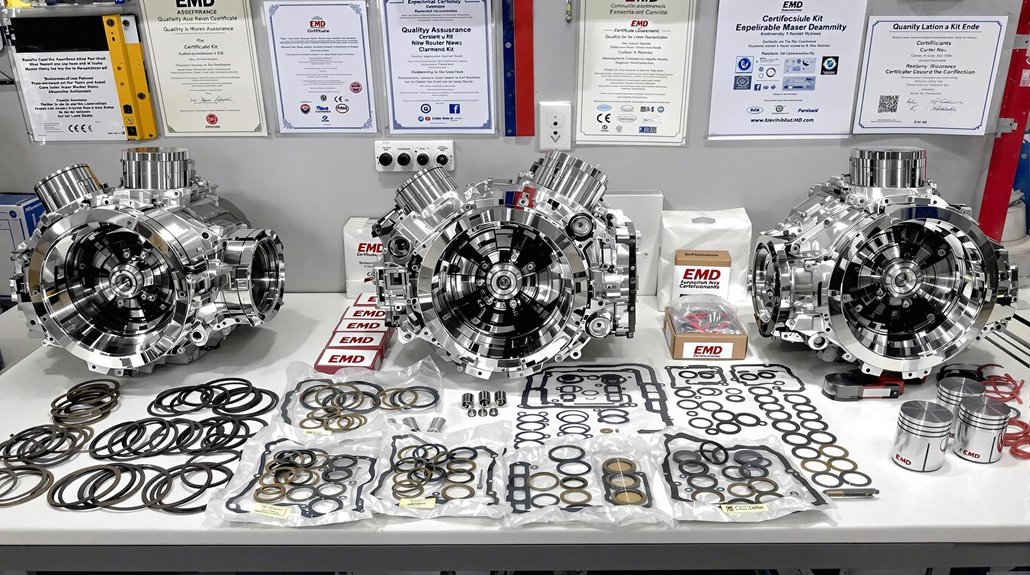
The top EMD power assembly rebuild kits include Premium 645E Series Overhaul Kits, 16-645E3 Power Assembly Solutions, and EconoLife kits for aging locomotives. You’ll find extensive options with enhanced gaskets, temperature-resistant materials, and specialized lubrication systems. Look for kits offering extended warranty protection, single-SKU inventory solutions, and factory-certified installation packages. The best rebuilds feature diagnostic compatibility and exceed OEM standards for performance. Continue for detailed comparisons of each solution’s unique advantages.

Key Takeaways

  • Premium EMD 645E Series Overhaul Kits provide all-inclusive components for locomotive power assembly rebuilds with enhanced cooling passages.
  • Top-performing 16-645E3 Power Assembly Solutions offer extended warranty protection packages covering parts and labor for up to 36 months.
  • EconoLife Power Assemblies deliver cost-effective alternatives for aging locomotives while maintaining required performance standards.
  • Advanced gasket technologies feature high-temperature resistant materials that maintain thermal stability up to 427°C.
  • EMD’s UL Power Assemblies achieve 50% lube oil savings with dual-stage centrifugal filtration systems.

Premium EMD 645E Series Overhaul Kits

high quality engine overhaul kits

Premium EMD 645E Series Overhaul Kits deliver extensive solutions for your locomotive power assembly rebuilds. These all-inclusive packages contain precisely engineered components for the critical power assembly elements: cylinder heads, liners, and pistons. Each component is manufactured to exacting specifications, guaranteeing peak engine performance after installation.

You’ll appreciate the durability these kits provide, extending intervals between maintenance schedules while maintaining operational reliability. The cylinder heads feature enhanced cooling passages and reinforced valve seats, while the liners incorporate improved wear surfaces to resist scuffing and scoring. Understanding the different cooling system configurations is essential when selecting the appropriate overhaul kit for your specific EMD model.

When selecting these kits, you’re investing in components designed specifically for the EMD 645E platform. This compatibility eliminates guesswork during rebuilds and guarantees proper fit and function. The pistons include advanced ring technology that reduces oil consumption and improves compression, directly contributing to better fuel economy and reduced emissions throughout your locomotive’s service life.

Top-Performing 16-645E3 Power Assembly Solutions

high performance power assembly solutions

You’ll maximize fleet uptime with our top-performing 16-645E3 power assemblies that include extended warranty protection packages covering parts and labor for up to 36 months. Our streamlined inventory management system guarantees critical components arrive just-in-time, eliminating costly parts shortages during scheduled maintenance events. Each assembly features enhanced durability components, including high-temperature resistant gaskets and precision-machined pistons that greatly extend service intervals beyond standard OEM specifications. These assemblies are specifically designed for switch duty service where maintenance cost reduction is the primary focus.

Ultimate Warranty Protection Packages

Three distinct warranty tiers form the foundation of our Ultimate Protection Packages for 16-645E3 power assemblies, each designed to match your operational requirements. The EconoLife package provides basic coverage for tie-on exempt engines, ideal when you’re prioritizing cost-effective solutions for older fleets.

For maximum warranty benefits, choose our OEM-backed packages that guarantee emissions and performance compliance—crucial if you’re operating Tier 0/0+-certified equipment. PowerRail’s quality assurance ensures all power assemblies exceed OEM standards for reliable performance. These premium protection strategies guarantee your power assemblies work seamlessly with calibrated fuel injectors and turbochargers.

Unlike third-party options with undefined performance parameters, our warranties cover complete system integration without compromising emissions standards. You’ll receive full documentation supporting your compliance requirements, whether for Rail (E4/E4B/E10B) or Marine applications, eliminating the risk of EPA Part 1033 violations.

Streamlined Inventory Management

While maintaining an ideal inventory of EMD power assembly components presents significant challenges for fleet managers, our streamlined 16-645E3 solutions eliminate common supply chain bottlenecks. Our EconoLife™ power assemblies in fork, blade, and partial pack configurations reduce your storage requirements while simplifying handling operations.

Our inventory optimization system incorporates multi-layered part numbering that distinguishes between OEM (9580770), Dinex (DE13018), and HP codes for thorough tracking. You’ll benefit from standardized packaging with pre-assembled kits for both old and new CTVS styles, reducing installation time. Our comprehensive inventory includes various turbocharger part numbers specifically designed for EMD locomotive applications.

Cost analysis demonstrates significant savings with our unit exchange programs that provide instant availability of critical components. PowerRail’s M-1003 certified components guarantee interchangeable parts with OEM quality while our conditional inventory management anticipates your needs based on locomotive duty cycles.

Enhanced Durability Components

Our advanced Swellex Enhanced Material Solutions deliver exceptional service life for EMD 16-645E3 power assemblies under demanding operational conditions. You’ll benefit from multi-layer gasket kits with integrated seals for critical engine interfaces, including head-to-liner configurations that incorporate grommet seals for superior thermal resistance.

Choose from Swellex+ and HP variants specifically engineered through rigorous durability testing to withstand high-pressure applications. These components demonstrably extend component longevity in heavy-duty service environments. For retrofit applications, our CTVS-style power assembly kits support both old and new installation configurations.

The complete solution includes specialized lube oil strainer replacements with element and suction strainer kits. All components offer compression ratio flexibility of 16 and can be configured in fork, blade, or partial pack arrangements.

Cost-Effective Rebuild Options for Aging Locomotives

affordable locomotive refurbishment solutions

When maintaining aging locomotive fleets with tightening operational budgets, finding cost-effective power assembly rebuild options becomes essential for extending service life without capital replacement. EconoLife™ Power Assemblies offer practical cost saving alternatives for older EMD® 645E switch duty applications where premium performance isn’t required. Modern data engineering practices incorporate ETL processes to automate and streamline equipment maintenance tracking across large fleets.

Component TypeBudget OptionMid-Tier Solution
Power AssembliesEconoLife™ (16:1 ratio)Clark Industrial Compatible
Complete KitsPartial PacksTurbo Parts World Bundled Kits
Pistons/LinersStandard ReplacementPremium Laser-Hardened Liners

These efficient repair strategies include choosing appropriate compression ratios (14.5:1 with rocking pins can replace 645E3 assemblies) and pre-packaged thorough overhaul kits that minimize bespoke procurement. While these options aren’t typically certified for EPA Tier compliance, they provide economical solutions for non-exempt engines requiring running repairs of individual failures.

Heavy-Duty Gasket Sets for Extended Service Life

durable gasket sets available

When rebuilding EMD power assemblies, you’ll need heavy-duty gasket sets that incorporate specialized composite materials like thermoplastic elastomers for superior sealing performance. Temperature-resistant sealing solutions, including stainless steel components and heat-resistant rubber compounds, help maintain integrity through the extreme thermal cycling common in locomotive operations. Strategic compression designs featuring zero-gap fitment and anti-condensate properties guarantee your rebuild maintains proper sealing under the high-pressure conditions of extended service life. Similar to the LifePlus Gaskets, these specialized gaskets offer longer life span than traditional alternatives, providing exceptional value for power assembly rebuilds.

Specialized Composite Materials

Engineered for extreme pressures and thermal cycling, EMD Power’s heavy-duty gasket sets incorporate advanced composite materials that dramatically extend service intervals. You’ll find these material innovations deliver superior sealing under the most demanding conditions, with composite advantages including enhanced crush resistance and zero torque loss. These specialized materials guarantee your EMD power assemblies maintain seal integrity throughout demanding operational cycles. The comprehensive material technology ensures optimal sealing performance under varied operational conditions.

Material TypeTemperature RangeApplication Benefits
MLS with Polymer CoatingsUp to 1500°FPrevents fluid seepage, reduces bore distortion
Aramid-NBR BlendsUp to 800°F27.59 psi crush resistance in TN-9005/TS-9016
Graphite-ReinforcedUp to 1800°FNo creep under extreme temperatures
Enhanced NBRUp to 300°FSuperior fuel/oil resistance in transmission systems
Reinforced CelluloseUp to 500°FIdeal compressibility with 1.33-1.36 density

Temperature-Resistant Sealing Solutions

The specialized composite materials in EMD’s kits reveal their true value when facing extreme thermal challenges. You’ll find high-performance polymers like silicone and PTFE gaskets maintaining thermal stability solutions up to 427°C, while ceramic fiber materials handle temperatures exceeding 1260°C in critical sealing zones. These materials are carefully selected for their durability and heat resistance, matching the same qualities found in cylinder liner construction.

For superior seal integrity technologies, look for DRI-ETG SWG gaskets with serrated grooves that enhance radial strength at high temperatures. The HT1000 gaskets utilize dual-layer design with mica-loaded surfaces to limit heat transfer, preventing adjacent component failures. VPS YellowSeal™ gaskets incorporate Viton® compounds with collared I.D. rings that stabilize sealing faces during thermal cycling. EMD’s controlled swell technology guarantees these gaskets expand when exposed to media, effectively sealing micro-imperfections without compromising long-term performance.

Strategic Compression Designs

Strategic compression designs in EMD’s heavy-duty gasket sets deliver exceptional service life through innovative material layering and stress distribution. You’ll achieve ideal sealing with multi-layer constructions that combine full-hard stainless steel facings and elastomeric materials, balancing structural integrity with compression resilience. Regular inspection of these gaskets helps detect visible flattening that could indicate potential failure.

Advanced gasket optimization incorporates LaserWeld™ stopper layers and hourglass-shaped reinforcements that distribute clamp loads evenly across flange surfaces, preventing localized deformation. Pre-molded reinforcement rings effectively prevent over-compression during installation.

For maximum effectiveness, implement compression techniques like sequential bolt tightening and torque control systems. These guarantee uniform stress distribution while maintaining proper compression limiters that preserve the gasket’s elastic recovery capacity. Follow surface preparation standards with Ra finishes ≤80 µin for elastomeric-coated gaskets to ensure ideal sealing performance in your EMD rebuild.

Specialized Lubrication System Enhancement Packages

lubrication system improvement solutions

While conventional lubrication systems provide basic protection, specialized lubrication system enhancement packages deliver measurable performance improvements across multiple critical parameters. IOW Group’s advanced lubrication technology combines dual-stage centrifugal filtration with automatic backflush systems to remove contaminants traditional filters miss.

You’ll achieve 50% lube oil savings through EMD’s UL Power Assemblies with their hardened upper bore liners and advanced ring designs. The integration of tin-plated pistons with hardened ring grooves dramatically reduces scuffing while preventing oil breakdown.

For enhanced performance, consider upgrading to VPS YellowSeal Technology with Viton® gaskets that resist contamination and fracturing. Pair this with pressurized drain systems that accelerate oil return to sumps, preventing sludge buildup. The IOW MP600 centrifuge effectively removes sub-micron level contaminants that would otherwise cause long-term wear and reduce engine lifespan. These thorough upgrades extend component life while considerably reducing maintenance intervals—a critical advantage for high-demand operations where unscheduled downtime isn’t an option.

Advanced Diagnostic-Compatible Rebuild Components

rebuild components for diagnostics

Your EMD rebuild kit’s diagnostic compatibility enables real-time engine performance monitoring through integrated sensor ports and calibrated measurement points. Modern kits feature centralized error reporting systems that consolidate fault codes from multiple subsystems into standardized diagnostics displays. These advanced components allow you to identify potential failures before they occur, greatly reducing downtime and extending the service life of your EMD equipment.

Real-Time Performance Monitoring

Modern EMD power assembly rebuild kits now incorporate sophisticated real-time performance monitoring capabilities that transform maintenance from reactive to predictive. These systems track critical parameters including active energy, power, voltage, current, and power factor through customizable sensor arrays that support 4-12 analog/digital inputs.

You’ll benefit from real-time analytics that stream performance metrics via cellular or Wi-Fi connectivity to cloud platforms, where data is aggregated into actionable categories. The replaceable sensor modules attach quickly to EMD assemblies, minimizing downtime during rebuilds. For performance optimization, these systems employ fault detection algorithms that analyze operational patterns against millions of hours of baseline data. The health scoring systems provide numerical reliability indices, helping you identify gradual degradation in components before catastrophic failures occur. This intelligent monitoring guarantees maximum uptime while reducing overall maintenance costs.

Centralized Error Reporting

Advanced EMD rebuild kits now feature extensive centralized error reporting systems that dramatically enhance diagnostic capabilities across platforms. You’ll benefit from native UDS integration and OBD-II/CAN compliance, guaranteeing your diagnostic tools interface seamlessly with rebuilt components.

These kits implement sophisticated error classification systems with tiered severity levels, optimizing your troubleshooting workflow. The centralized diagnostics capture environmental data alongside error events, providing context-specific metrics critical for precision repairs. DTC standardization follows the 24-bit format with status masks per UDS specifications, making error interpretation consistent.

What sets premium rebuild components apart is their fault memory structures designed for AI-ready analysis. Error aggregation algorithms automatically consolidate recurring faults, helping you quickly identify systemic issues rather than chasing symptoms. This centralized error reporting architecture guarantees compatibility with AUTOSAR diagnostic systems for thorough oversight.

Complete Power Assembly Restoration Systems With Warranty Coverage

power assembly restoration warranty

Complete power assembly restoration systems offer three essential benefits for EMD operators: pre-packaged component inclusion, customizable configurations, and extensive warranty protection. You’ll avoid costly downtime with thorough kits containing all bearings, gaskets, seals, and fasteners needed for your specific engine compatibility.

Technical sales managers will collaborate with you to design rebuild solutions tailored to your exact specifications and maintenance schedules, ensuring peak performance and warranty benefits.

FeatureBenefitImpact
Pre-packaged componentsZero missing partsEliminates rebuild delays
Application-specific kitsSingle SKU simplicityReduces inventory complexity
Adjustable configurationsMeets unique requirementsMaximizes operational efficiency

These systems include end-to-end technical support with transportation, installation supervision, and SCADA integration options. High-strength materials improve structural lifespan while reducing your overall maintenance costs, all backed by extensive warranties that protect your investment throughout the restoration lifecycle.

Single-SKU Solutions for Streamlined Inventory Management

streamlined single sku inventory management

Single-SKU management revolutionizes EMD power assembly rebuilds by eliminating the complexity that plagues traditional multi-component ordering systems. With attribute-based SKU design, you’ll track all variations—whether piston rings, liners, or injector components—under one parent identifier while maintaining visibility into each sub-component.

Implementing inventory consolidation strategies through unified catalog management allows seamless integration between your FBA/FBM fulfillment methods and warehouse operations. Your team can instantly identify which rebuild kit components need replenishment through real-time tracking systems with automated alerts when stock levels drop below predetermined thresholds.

The SKU standardization benefits extend beyond organization—they directly impact profitability. Advanced forecasting algorithms analyze historical EMD kit sales data, automatically adjusting reorder points based on seasonality and demand patterns. This eliminates redundant parts while ensuring you maintain ideal stock levels of high-turn components.

With centralized data analysis across sales channels, you’ll gain unprecedented visibility into which power assembly configurations deliver the highest margins and customer satisfaction rates.

Material-Optimized Seal Kits for Extreme Operating Conditions

extreme condition seal kits

Extreme environmental challenges demand seal kits specifically engineered for EMD power assemblies operating in harsh conditions. When selecting rebuild components, your material selection strategy must prioritize high-temperature resistance and radiation tolerance. Our material-optimized seal kits feature fluoroelastomer (FKM) compounds and composite-enhanced PTFE with carbon fiber and graphite additives for superior thermal conductivity.

Our seal design innovations directly address extreme operating environments through:

  1. Adaptive sealing structures that dynamically adjust sealing force under fluctuating pressures and temperatures
  2. Wide-temperature compensation using corrugated PTFE structures capable of maintaining integrity from -196°C to 320°C
  3. Hybrid PTFE/elastic systems combining glide elements with specialized energizers for multi-condition compatibility

For critical applications, we incorporate Inconel alloys in metal O-ring configurations, achieving nanoleakage capacities of 1×10⁻¹⁰ cc/sec—essential for maintaining system integrity under extreme pressure differentials. Every kit undergoes rigorous testing protocols to guarantee dimensional accuracy and material conformance.

Factory-Certified Installation Fixture Packages

certified installation fixture packages

Factory-Certified Installation Fixture Packages represent the foundation of proper EMD power assembly rebuilds. These packages deliver substantial factory certified benefits through components exclusively sourced from OEM supply chains, ensuring authenticity and compatibility with your equipment. You’ll receive parts with guaranteed long-term availability—most components remain accessible for 15+ years.

When you choose certified packages, you’re accessing installation expertise developed through rigorous technician screening and specialized training at manufacturer headquarters. This technical proficiency translates to precision diagnostics and seamless integration of components.

Your investment is protected with an additional year of warranty coverage and extensive replacement guarantees covering both labor and materials. The certification program includes customized pre-installation consultations to assess site requirements and minimize operational disruptions during service.

For complex rebuilds, you’ll appreciate the dedicated project managers overseeing the integration process, complete with thorough post-installation verification to confirm peak functionality of your power assembly.

Frequently Asked Questions

How Do EMD Power Assembly Kits Perform in Extreme Temperature Environments?

EMD power assembly kits excel in extreme temperature environments through their advanced thermal management. You’ll benefit from multi-pass aftercoolers and enhanced cooling passages that maintain temperature resilience in high-heat conditions. The corrosion-resistant materials withstand thermal stress while optimized surface finishes minimize thermal resistance. These assemblies perform consistently in extreme conditions from sub-zero to intense heat, maintaining efficiency and reliability without compromising operational integrity or component longevity.

Can Rebuild Kits Be Custom-Configured for Unique Locomotive Operating Profiles?

Like a bespoke suit tailored to your measurements, EMD power assemblies can be custom-configured to match your locomotive’s unique operating profile. You’ll find custom assembly options based on your specific locomotive specifications, including compression ratios adjusted for elevation, fuel injector patterns for load profiles, and bearing configurations for stress patterns. Your rebuild kit can incorporate specialized turbocharger options and cooling systems calibrated for your exact duty cycle and environmental conditions.

What Training Is Required for Technicians Installing These Kits?

You’ll need extensive technician certification through EMD technical courses covering engine systems and major components. Your training must include hands-on experience with installation techniques for power assembly change-outs, using torque screwdrivers and dial indicators precisely. You’ll practice disassembly/reassembly under supervision and learn troubleshooting procedures. PPE compliance is mandatory, and you’ll undergo periodic competency assessments while maintaining access to updated EMD maintenance documentation for continued skill development.

How Do Aftermarket Kits Compare to OEM Parts for Reliability?

While some aftermarket kits claim equivalent performance, they typically lack the precision engineering that guarantees OEM longevity. You’ll find aftermarket quality varies considerably—some components may achieve 60-70% of OEM lifespan, but critical elements often miss proprietary features like EMD’s induction-hardened valve seats or optimized cooling configurations. Your most reliable option remains genuine OEM assemblies, which deliver verified material quality, consistent dimensional tolerances, and manufacturer-backed warranties that protect your substantial investment.

Are There Environmentally Sustainable Components Available in Modern Rebuild Kits?

Yes, modern rebuild kits now incorporate green materials and eco-friendly practices. You’ll find carbon fiber components that reduce weight and fuel consumption. Additive manufacturing minimizes material waste during production. EPA-certified emissions kits decrease NOx and particulate matter while optimizing fuel efficiency. These kits also reduce lube oil consumption, minimizing environmental impact. High-strength alloys extend component life, reducing the frequency of rebuilds and associated resource consumption.

How to Fix EMD Power Assembly Failures

How to Fix EMD Power Assembly Failures

To fix EMD power assembly failures, first identify warning signs like coolant leaks, abnormal vibrations, or unusual engine sounds. Inspect components with diagnostic tools and borescopes. Check bearing clearances (0.003″-0.005″) and follow proper torque specifications—1,800 ft-lbs for cylinder head crabs on 567-series engines. Implement regular oil analysis to track contamination trends. Verify master/slave rod configurations for proper load distribution. These systematic procedures will considerably extend your power assembly’s service life.

Key Takeaways

  • Monitor for early warning signs including pressurized coolant leaks, metallic knocking, and lube oil contamination.
  • Implement regular oil analysis to track contamination trends, viscosity shifts, and particulate counts.
  • Verify proper torque specifications when reinstalling components, especially cylinder head crab nuts and bearing caps.
  • Use calibrated diagnostic tools including borescopes, vibration analysis equipment, and emissions testers.
  • Ensure correct bearing clearances (0.003″-0.005″) and lubrication with OEM-specified SAE 40 oil at 15-20% capacity.

Common Causes of Power Assembly Degradation

power assembly degradation factors

When maintaining EMD power assemblies, understanding degradation root causes enables effective preventive measures. Inspect regularly for conductor fractures resulting from mechanical stress exceeding bend specifications or excessive vibration. Monitor insulation wear patterns, particularly where components experience repeated motion or abrasion from environmental factors.

Thermal expansion differentials between materials commonly compromise solder joint integrity. Implement proper strain relief and temperature-compensating design layouts to mitigate this risk. Protect your assemblies from voltage surges with appropriate suppression devices; transients frequently cause dielectric breakdown in power capacitors and control circuitry. Operating components above their glass transition temperature can lead to permanent damage through component burning and material degradation.

Chemical corrosion accelerates when assemblies encounter industrial contaminants or salt environments. Apply conformal coatings where appropriate. Prevent moisture ingress through proper sealing techniques—humidity promotes conductive anodic filament formation between traces and accelerates connector degradation. Maintain environmental control systems to minimize condensation cycles that drive water absorption into insulating materials.

Early Warning Signs to Watch For

recognizing potential warning signs

Recognizing deteriorating EMD power assemblies before catastrophic failure requires vigilant monitoring of key indicators. You’ll need to establish systematic inspection protocols focusing on three primary diagnostic categories: cooling system integrity, mechanical vibrations, and fluid characteristics.

Warning CategoryKey IndicatorsAction Required
Cooling SystemPressurized coolant leaks, level fluctuationsPressure test system, inspect cylinder linings
Vibration PatternsMetallic knocking, lateral oscillationsConduct vibration analysis at variable RPMs
Fluid IntegrityLube oil contamination, blow-by gasSample oil for coolant presence, measure crankcase pressure
Thermal PerformanceLow cooling pressure, heat exchanger efficiencyEvaluate thermal gradients across components
Auditory SignalsGrinding noises, harmonic resonancesUse acoustic monitoring during load shifts

When you detect coolant leaks combined with visual staining on crankcase components, immediately investigate liner integrity. Implement vibration analysis during speed changes – increased lateral movement typically indicates bearing wear or piston carrier damage. Consider implementing a performance monitoring program that tracks power output and operating temperatures to identify failing power assemblies before they cause operational disruptions.

Essential Tools for EMD Engine Diagnostics

emd engine diagnostic tools

Building upon effective detection methods, proper EMD engine diagnostics require specialized equipment for accurate fault isolation and repair. You’ll need advanced diagnostic software like Jaltest or Roadwarrior Diesel Decoder that provides real-time parameter monitoring and actuator testing capabilities.

Essential tools include calibrated torque wrenches for precise component assembly and ultrasonic cleaners for parts restoration. Implement vibration analysis tools to detect rotating component imbalances before catastrophic failure occurs. Recent diagnostic trends emphasize emissions testing equipment integration for thorough performance evaluation. Technicians should incorporate data analysis techniques to utilize historical engine performance for more informed diagnostic decisions.

Precision diagnostics demand calibrated tools, from torque wrenches to vibration analyzers, preventing failures before they cascade into costly repairs.

Software advancements now enable VIN-specific data tracking and system configuration adjustments for peak performance based on operating conditions. Your diagnostic workflow should incorporate live data streaming to compare current readings against established baselines. Fault code interpreters translate cryptic alphanumeric sequences into actionable repair procedures.

For thorough power assembly diagnostics, combine these digital tools with physical inspection equipment like specialized mirrors for hard-to-reach visual assessments of critical components.

Step-by-Step Inspection Procedures

inspection procedure guidelines

Thorough inspection of EMD power assemblies demands systematic procedures to identify failure points before catastrophic breakdown occurs. Begin by removing airbox and crankcase covers to access critical components, then deploy fiber optic borescopes to examine internal surfaces without full disassembly. Pressurize cooling systems to reveal hidden leaks at cylinder block seals and manifold sleeves. Using a specialized turning jack allows for efficient and safe inspection of moving engine components during the evaluation process.

Comprehensive failure diagnosis requires sequential verification:

  1. Test cylinder compression to assess ring sealing efficiency and detect breech leaks
  2. Verify cooling system integrity through pressure testing and contaminant analysis
  3. Evaluate gear train component alignment, checking backlash between camshaft, idler, and crank gears

Document all inspection findings meticulously, prioritizing repair actions based on severity. After completing repairs, conduct verification testing—particularly cooling system re-bleeding and lateral play assessment—to ascertain proper assembly. These inspection techniques establish a methodical approach that prevents catastrophic failures before they occur.

Oil Analysis and Lubrication Management

oil analysis for lubrication

Effective oil analysis serves as the cornerstone of EMD power assembly reliability, revealing internal component conditions before catastrophic failures occur. Implement quarterly sampling protocols to track contamination trends and lubricant degradation rates specific to your operational environment.

Proactive oil sampling reveals hidden engine conditions, preventing failures before they manifest in your EMD power assemblies.

Deploy high-efficiency filtration systems to remove metal particles and contaminants that accelerate component wear. Your oil analysis program should monitor viscosity shifts, TBN/TAN values, and particulate counts to establish baseline parameters and detect deviations requiring intervention. Asking the repetitive why when interpreting oil analysis results helps uncover hidden causes of contamination rather than just addressing symptoms.

Integrate lubrication strategies that address EMD-specific requirements, including proper oil change intervals based on operating conditions rather than fixed schedules. Maintain strict documentation of all oil analysis results for pattern recognition across your fleet. When analysis indicates elevated metal content, promptly investigate potential component failures within the power assembly.

Correlate oil sample data with operational metrics to develop predictive maintenance protocols that extend power assembly service life while minimizing downtime.

Proper Bearing Replacement Techniques

bearing replacement best practices

Maintaining proper EMD bearing performance requires precise lubrication with OEM-specified SAE 40 oil applied at 15-20% capacity to prevent overheating and guarantee ideal clearance. You’ll need to follow the manufacturer’s torque sequence chart, applying 85-95 ft-lbs to main bearing caps and 45-55 ft-lbs to connecting rod bearings using a calibrated torque wrench with 2% accuracy. When installing new bearings, ensure that proper tooling is used to prevent damage to components. Verify bearing alignment using a dial indicator to measure crankshaft runout (maximum 0.002″ tolerance), then conduct clearance checks with Plastigage strips across each bearing surface to confirm the 0.003″-0.005″ specification.

Bearing Lubrication Requirements

When replacing bearings in EMD power assemblies, proper lubrication serves as the foundation for operational reliability and extended service life. Select appropriate lubricant based on operating conditions—grease types for low-speed applications, oil with correct viscosity for high-temperature environments exceeding 70°C.

Initial greasing requirements demand careful calculation:

  1. Fill 30-100% of bearing volume depending on application specifics
  2. Confirm lubrication holes direct grease directly to bearing surfaces without detours
  3. Verify material compatibility between grease base and bearing components

For EMD applications with high loads or temperatures, implement circulating oil systems to transfer heat away from critical components. Monitor oil levels at 50-80% submergence for vertical shafts. Track temperature fluctuations and adjust relubrication intervals accordingly—reduce intervals by half for every 15°C rise above 70°C. Synthetic oils are recommended when operating in extreme conditions as they offer superior performance at temperature extremes and specific environmental challenges.

Installation Torque Specifications

Beyond proper lubrication, precise torque application represents the cornerstone of successful EMD power assembly bearing replacement. You’ll need to maintain torque accuracy across all critical components to guarantee peak performance.

Apply 1,800 ft-lbs to cylinder head crab nuts on 567-series engines, exercising extreme caution to prevent bearing damage. Main bearing nuts require 500-800 ft-lbs with subsequent retightening after thermal cycling for assembly precision. Fork rod capscrews demand 190-200 ft-lbs, with verification through serration inspection.

Don’t overlook split basket bolts, which require 75 ft-lbs for bottom bolts in multi-piece assemblies. When working with cramped F-units, proper torque wrench positioning becomes especially challenging. For flywheel couplings, maintain 295 ft-lbs on all 3/4″ x 16 bolts. Your adherence to these specifications directly correlates with component life expectancy and system reliability.

Alignment Verification Methods

Proper alignment verification stands as the foundation of successful EMD power assembly bearing replacement. When installing components, you’ll need specialized alignment tools to guarantee critical fits meet specifications and prevent premature failures.

Key verification techniques include:

  1. Crankcase serration measurement – Utilize gauge #8177167 to verify distortion remains within ±0.003″ tolerance, guaranteeing proper bearing cap seating and frame alignment.
  2. P-pipe alignment verification – Insert the specialized checker tool into the cooling nozzle during carrier descent to confirm proper oil passage alignment; replace misaligned pipes immediately.
  3. Shaft-to-bearing fit confirmation – Compare outside shaft diameter to bearing inner diameter using calibrated micrometers to validate proper interference fit before final assembly.

Monitor vibration patterns post-installation to detect any residual misalignment issues that might compromise long-term power assembly performance. Implementing vibration analysis techniques during initial operation provides early detection of potential bearing failure modes.

Master/Slave Rod Configuration Considerations

rod configuration guidelines explained

When configuring master/slave rod assemblies, you’ll need to guarantee equal spacing between slave rods to maintain proper load distribution across the banjo connections. Position slave rod pins with precise angular offsets around the master rod to prevent stress concentration during reciprocating cycles under high loads. Verify dimensional compatibility between master rod bores and slave rod housings, maintaining zero lash while guaranteeing adequate travel characteristics for full actuation. The slave rod pins are typically arranged along a radial line from the master crank pin center, which significantly influences the overall engine geometry and timing.

Rod Alignment Essentials

Master/slave rod configurations present unique alignment challenges that directly impact EMD power assembly reliability. When servicing these assemblies, you’ll need to verify proper rod geometry to maintain cylinder balance across all opposed pairs. Critical articulation points must maintain precise dimensions to prevent elliptical trajectory deviations that introduce harmful vibrations.

During reassembly, confirm:

  1. Big-end bearings exhibit uniform clearance with replaceable caps properly torqued to specification
  2. Master rod bearing surfaces show no signs of scoring that could compromise slave rod articulation
  3. Offset measurements between master/slave stroke lengths remain within 3% tolerance across banks

Check that master rods align precisely with the crankshaft at TDC/BDC positions while slave rods maintain proper angular displacement. This alignment prevents oscillatory stresses that lead to premature failure in high-load conditions.

Load Distribution Mechanics

Understanding load distribution mechanics forms the foundation of reliable EMD power assemblies where fork-blade rod arrangements create unique force transmission challenges. Your fork (master) rod bears primary loads through its basket structure, while the blade (slave) rod functions within this guided mechanism.

During load testing, monitor for improper fitment causing uneven journal wear. The fork rod’s ability to maintain alignment directly affects the blade rod’s operational integrity. Always verify torque sequencing on basket bolts per manufacturer specifications to prevent warped joints.

Rod materials considerably impact durability—inspect fork rod baskets for preload loss and blade journals for alignment shift during maintenance. Document load cycles to identify fatigue-prone configurations. Remember that coolant ingression often precedes catastrophic failures, so prioritize cooling system integrity checks when troubleshooting power assembly issues.

Replacement Compatibility Guidelines

Selecting compatible replacement components for EMD power assemblies requires precise attention to master/slave rod configurations. When sourcing replacement parts, distinguish between straight-pin (master) and rocking-pin (slave) assemblies to maintain proper load distribution across your engine. Compatibility verification must include checking compression ratios before installation.

  1. Verify pin configuration – Confirm whether you need straight pins (16:01 compression) or rocking pins (14.5:1) based on your EMD model specifications.
  2. Cross-reference part numbers – Match OEM designations between 645E, 645E3, or 710 series components for proper fitment.
  3. Check supplier documentation – Ascertain vendor materials explicitly state master/slave compatibility with your specific rod types (fork, blade, or partial pack).

Never intermix incompatible configurations without recalibrating governor settings and fuel injection timing.

Preventive Maintenance Scheduling for Longer Assembly Life

scheduled maintenance for longevity

Implementing a structured preventive maintenance schedule dramatically extends EMD power assembly life while reducing catastrophic failures and unplanned downtime. Your preventive strategies should align with operational demands and manufacturer specifications, incorporating daily fluid checks, weekly electrical inspections, and monthly traction motor diagnostics.

Maintenance IntervalCritical TasksComponent Focus
Daily/WeeklyFluid level monitoring, filter inspectionsLubrication systems, air intakes
Monthly/QuarterlyTraction motor diagnostics, EMD power metricsDrive components, coolant systems
Biannual/AnnualComponent replacement, turbocharger maintenanceFilters, seals, bearings

Maintenance frequency optimization requires balancing operational demands with component lifecycle assessments. Conduct coolant condition analysis weekly, perform electrical component cleaning monthly, and execute power assembly diagnostics quarterly. You’ll achieve maximum reliability when integrating EMD diagnostic software utilization with physical inspections, particularly when validating turbocharger efficiency and braking system functionality.

Frequently Asked Questions

Can Power Assemblies From Different EMD Engine Series Be Interchanged?

Limited power assembly compatibility exists between EMD engine series. You’ll find 645-series assemblies can sometimes replace 567D turbocharged units, but you must verify critical dimensions like bore size and head bolt patterns. Consider camshaft counterweight adjustments when interchanging components. Engine series differences in cylinder liner designs, piston ring specifications, and bearing configurations will restrict direct substitutions. Always check OEM specifications before attempting cross-series installations to prevent operational failures.

How Does Ambient Temperature Affect Power Assembly Failure Rates?

Ambient conditions greatly influence power assembly failure rates. In high-temperature environments, you’ll experience accelerated electrolytic capacitor deterioration, reducing lifespan by 50% per 10°C above rating. Temperature effects include PTC-induced efficiency losses in MOSFETs and dielectric breakdown under thermal stress. Conversely, cold ambient conditions decrease capacitance, compromising ripple voltage regulation and increasing inrush current limiter resistance, potentially preventing startup below minimum operational temperatures.

Is Ultrasonic Testing Effective for Detecting Internal Power Assembly Cracks?

Ultrasonic testing detects cracks as small as 30 µm deep—superior to alternative NDT methods. You’ll achieve ideal ultrasonic sensitivity through waveform analysis rather than relying solely on time-of-flight measurements. Deploy longitudinal waves for transverse crack detection and transverse waves for longitudinal defects. Phased array technology, particularly Fermat spiral probes, greatly enhances crack detection precision while requiring appropriate coupling media for maximum effectiveness during your power assembly inspections.

What Emission Modifications Impact Power Assembly Reliability?

Emission modifications greatly impact your power assembly reliability when they alter combustion characteristics. When retrofitting for emission standards, you’ll face increased thermal cycling and cylinder pressures. Monitor fuel injection timing closely as retarded timing reduces NOx but increases thermal stress. Enhanced SCR systems require power assembly design adjustments to handle altered exhaust backpressure. Always recalibrate injectors after modifications to prevent uneven combustion that accelerates component fatigue.

How Do Aftermarket Components Compare to OEM for Power Assembly Longevity?

When comparing aftermarket components to OEM parts, you’ll find significant longevity differences. OEM durability stems from precision engineering, rigorous testing protocols, and material quality standards exceeding aftermarket alternatives. Aftermarket reliability varies substantially between suppliers, with most components utilizing inferior materials that accelerate wear patterns. While initially cost-effective, aftermarket parts typically require 2-3x more frequent replacement cycles and lack warranty protection that OEM components provide, ultimately compromising your power assembly’s operational lifespan.

Why Replace EMD Engine Components By Guidelines?

Why Replace EMD Engine Components By Guidelines?

Following EMD engine component replacement guidelines is critical for avoiding 3-4.7x higher emergency repair costs and preventing $4,200-$7,800 daily revenue losses from unplanned downtime. You’ll maintain EPA certification with proper Tier-compliant component cycles while preserving operational efficiency. Non-OEM parts compromise safety parameters and accelerate deterioration. Regular maintenance, including DPF regeneration and 7-year systematic replacements, maximizes component longevity through engineered lifecycles. The subsequent sections explore specific maintenance protocols essential for your equipment.

Key Takeaways

  • Following manufacturer guidelines prevents costly emergency repairs that are 3-4.7 times more expensive than scheduled maintenance.
  • Properly maintained EMD components ensure emission compliance with EPA standards, avoiding substantial regulatory fines.
  • Regular replacement cycles maintain operational efficiency, preventing 10-25% performance degradation that impacts fuel costs.
  • OEM-specified maintenance intervals reflect engineered lifecycles that prevent catastrophic failures and cascading system damage.
  • Component replacements integrated with inspection cycles minimize unscheduled downtime, preventing revenue losses of $4,200-$7,800 daily.

The Critical Maintenance Timeline for EMD Power Assemblies

To guarantee peak performance of EMD locomotives, you must adhere to the stringent maintenance timeline established for power assemblies. Begin with 92–184 day inspections that evaluate fluid integrity and component functionality through critical performance metrics. Your power assembly inspections should then integrate with 24-month refuel intervals, when connecting rod and crankshaft examinations become mandatory.

Critical Maintenance Timeline

Maintain vigilance regarding the 5-year EPA compliance threshold, as Tier 0 emissions regulations activate once all power assemblies undergo replacement within this period. The EMD 710 series engines demand systematic component replacement every 7 years to fulfill their projected 1 million mile lifespan.

Your maintenance scheduling must incorporate biennial component checks, including Megger testing for lube oil pumps and TDR relay calibration. Implement endoscopic inspections and pressurized coolant testing before replacements to detect potential internal failures that could compromise operational integrity. Regular documentation of maintenance activities is essential for compliance tracking and establishing a comprehensive service history that validates adherence to manufacturer specifications.

Financial Impacts of Deferred Component Replacements

When you postpone scheduled EMD component replacements, you’ll incur exponentially higher repair costs when emergency failures occur mid-operation—typically 3.2-4.7 times the planned maintenance expense. Your operational revenue suffers immediate impact through unscheduled downtime, with Class 1 railroads documenting average losses of $4,200-$7,800 per locomotive per day during unplanned outages. Statistical analysis demonstrates that components operated beyond recommended service intervals reduce locomotive lifespan by 15-22%, considerably diminishing your fleet’s long-term profitability metrics. Investing in high-quality cylinder heads and liners results in significant maintenance savings due to their enhanced reliability and extended service intervals compared to standard components.

Cost of Emergency Failures

Four primary financial impacts emerge when EMD engine component replacements are deferred beyond recommended guidelines. Emergency costs escalate exponentially, requiring unscheduled mobilization of specialized crews and expedited parts procurement at premium rates. Downtime penalties accrue rapidly, disrupting operational continuity and violating contractual obligations with cargo clients. Regulatory non-compliance triggers substantial fines, particularly when engines exceed EPA NSPS requirements, necessitating mandatory equipment upgrades beyond routine replacement costs.

Cost of Emergency Failures

Implementing strategic maintenance strategies mitigates these financial risks. Components operating beyond service intervals (turbochargers, DPF systems) frequently initiate cascading failure sequences, compounding repair costs. Degraded engines increase fuel and lubricant consumption by 15-35%, perpetuating operational inefficiencies until component replacement occurs. Regular maintenance schedules are essential for extending locomotive lifespan and preventing costly unplanned repairs. Predictive analytics identify ideal replacement intervals, avoiding the exponential cost curve of emergency failures.

Revenue Impact Analysis

Although preventative maintenance incurs immediate capital expenditures, deferred EMD component replacements generate substantial revenue degradation through multiple operational pathways.

Revenue Impact Analysis

When conducting revenue forecasting activities, quantify the financial implications across these critical metrics:

  1. Fuel Consumption Penalties – Degraded fuel injection systems and turbochargers reduce operational efficiency by 10-25%, directly impacting fuel expenditure allocations against revenue generation targets. Investing in high-quality EMD fuel injectors delivers tangible benefits through improved combustion processes and operational efficiency.
  2. Regulatory Compliance Costs – 645E emissions requirements necessitate specialized calibration protocols that impact performance parameters while increasing operational costs
  3. Component Optimization Deficits – Sub-optimal power assemblies (such as EconoLife substitutions) fail to achieve Tier 0+ compliance specifications, creating measurable performance degradations that compromise revenue-to-cost ratios throughout operational cycles

Lifespan vs. Profitability

The financial equilibrium between component lifespan and operational profitability represents a critical calculation in EMD maintenance economics. Your lifespan analysis must account for non-linear degradation rates—turbochargers operating beyond prescribed intervals consume 15-20% more fuel while delivering diminished power output.

Lifespan vs. Profitability

When executing profitability assessment protocols, quantify how emergency replacements typically extend downtime threefold compared to scheduled maintenance windows (72 hours versus 24 hours). Regular inspection of braking components prevents costly emergency replacements and ensures safety compliance across all EMD models. Consider that armature rewinding at 30-40% of replacement cost preserves operational budget while maintaining performance parameters. Turbocharger rebuilds similarly offer substantial cost advantages versus complete replacement.

The empirical data demonstrates that adherence to EMD Owners Group replacement intervals optimizes the cost-benefit ratio, as component-specific microwear inevitably progresses to catastrophic failure when maintenance is deferred beyond OEM-specified thresholds.

Technical Risk Factors in Operating With Worn Engine Parts

Operating with worn engine components exposes systems to cumulative degradation vectors that substantially elevate failure probabilities across multiple mechanical interfaces. When adhesive and abrasive wear mechanisms converge, you’ll experience accelerated deterioration of essential surfaces, particularly evident through power reduction and abnormal vibration patterns that manifest as primary wear indicators.

Technical Risk Factors in Operating With Worn Engine Parts

The technical risks present three significant vulnerability pathways:

  1. Lubrication starvation leading to component seizure when engine seals deteriorate beyond operational tolerances
  2. Catastrophic timing belt failure triggering immediate power loss and potential valvetrain damage
  3. Thermal breakdown acceleration when normal cooling parameters cannot be maintained due to fluid pathway compromise

Maintenance strategies must prioritize early detection of component fatigue wear signatures before performance impact indicators manifest. The progression from micro-abrasion to complete mechanical failure follows predictable deterioration curves that, when properly monitored, provide vital intervention opportunities before critical systems experience complete functional compromise. Environmental factors such as extreme temperature variations can significantly accelerate the rate of material degradation in engine components.

Emission Compliance Through Proper Part Replacement Cycles

emission compliance via replacement

You must adhere to strict replacement cycles for Tier-compliant components to maintain EPA certification, including ECU calibrations and complete emissions systems. DPF maintenance requires prescribed regeneration intervals (active: 250-500 hours; passive: 100-150 hours) and ash cleaning at manufacturer-specified thresholds to prevent backpressure violations. Aftertreatment components (SCR catalysts, DOC units, NOx sensors) possess documented service lifespans that, when exceeded, constitute tampering under 40 CFR §1068.240 and necessitate complete system replacement rather than individual component servicing. Understanding regional emissions regulations is essential as some areas mandate stricter requirements than federal EPA standards for continued equipment operation.

Tier Compliance Part Cycles

Four critical compliance factors drive EMD engine part replacement cycles to maintain Tier certification standards. Your adherence to OEM-specified intervals guarantees continuous emission compliance across Tier 0-4 parameters while preventing operational penalties during Not-To-Exceed (NTE) monitoring events.

Tier Compliance Part Cycles

When executing component replacement:

  1. Implement certified emissions kits (urea-SCR, DPF) at mandated intervals to maintain 90% PM/NOx reduction effectiveness for Tier 4 compliance
  2. Replace fuel injectors per OEM guidelines to preserve combustion efficiency metrics required during certification testing cycles
  3. Upgrade non-compliant assemblies (e.g., EconoLife) when shifting between Tier standards to guarantee continuous regulatory adherence

Failure to maintain proper part cycles will compromise steady-state emission profiles, potentially triggering automatic engine de-rating or disabling advanced control functionalities required for Tier compliance certification. Commercial engines must meet stringent useful life requirements ranging from 5,000 to 20,000 hours depending on power category to remain compliant with emissions standards.

DPF Maintenance Timeframes

Diesel Particulate Filter (DPF) maintenance operates under strict time-based parameters that directly impact your emission compliance profile. Your maintenance intervals must align with manufacturer guidelines—typically every 100K–125K miles for 2007+ trucks or 75K miles for pre-2007 models, with annual cleaning as the minimum standard.

DPF Maintenance Timeframes

Your operational context necessitates adjustment to these baselines. Urban driving patterns and cold weather accelerate soot accumulation, requiring more frequent DPF cleaning. Track your maintenance through documented serial numbers and cleaning dates to maintain regulatory conformity.

Implement proactive inspections before backpressure alerts trigger mandatory servicing. Poor quality diesel fuel with higher sulfur content significantly increases the rate of soot buildup in your DPF system. Remember that ash accumulation beyond six months can cause irreversible substrate damage, resulting in complete replacement costs exceeding $5,000 rather than routine maintenance expenses.

Aftertreatment Component Lifespans

While maintaining emission compliance standards, aftertreatment component replacement must follow precise lifecycle parameters to prevent performance degradation and regulatory violations. Critical aftertreatment efficiency metrics correlate directly with component longevity and require systematic monitoring to guarantee ideal exhaust gas purification. Poor maintenance of these systems can lead to reduced efficiency and expensive damage to emission components.

Aftertreatment Component Lifespans

Your compliance strategy should incorporate:

  1. DOC replacement protocol – Implement at 8,000-10,000 operating hours or when conversion efficiency drops below 85% to prevent cascading DPF overloading
  2. SCR catalyst renewal – Schedule at manufacturer-specified intervals (typically 10,000-15,000 hours) to maintain NOx reduction requirements
  3. DPF service intervals – Monitor differential pressure readings; perform ash cleaning at 4,000-6,000 hours dependent on duty-cycle severity

Premature aftertreatment component failures considerably impact operational costs through unscheduled downtime and potential regulatory penalties, necessitating adherence to prescribed maintenance schedules.

Performance Optimization Through Manufacturer-Specified Maintenance

manufacturer maintenance enhances performance

Adhering to manufacturer-specified maintenance protocols establishes the foundation for ideal EMD engine performance. You’ll achieve significant performance enhancement by implementing periodic replacement strategies rather than waiting for component failure. Integrating EMD’s diagnostic software guarantees real-time monitoring of critical systems, enabling preemptive interventions.

ComponentMaintenance IntervalPerformance Impact
Fuel Injectors8,000-10,000 hoursCombustion efficiency
Piston RingsPer wear indicatorsCompression integrity
Oil FiltersBimonthlyContamination control
Cylinder Liners15,000-20,000 hoursThermal management
Governor SystemsAnnual calibrationTiming precision

Your maintenance strategies should incorporate Ultra Low Lute Oil Power Assemblies to reduce consumption by 50% while utilizing genuine EMD parts for system compatibility. Certified technicians must follow OEM torque specifications during component installation to prevent premature wear. Thorough documentation of maintenance activities facilitates trend analysis, supporting optimization of replacement intervals while validating post-maintenance efficiency gains.

Reliability Engineering Behind EMD Replacement Guidelines

Through extensive reliability modeling and empirical data collection, EMD’s replacement guidelines reflect engineered lifecycles that maximize component longevity while minimizing catastrophic failures. When you adhere to these intervals, you’re leveraging decades of reliability metrics that quantify mean time between failures across diverse operational environments.

Reliability Engineering Behind EMD Replacement Guidelines

The engineering standards behind these guidelines incorporate:

  1. Bathtub curve modeling that identifies ideal replacement timing before wear-out phase acceleration
  2. Component-specific degradation analyses determining when turbocharger efficiency drops below acceptable thresholds
  3. Statistical failure distribution mapping that prioritizes critical path components (e.g., fuel system injector o-rings)

You’ll notice predictive maintenance integration complements these fixed intervals. Your vibration analysis results should inform traction motor maintenance scheduling, while oil analysis data calibrates lubrication change frequencies. When combined with standardized replacement schedules, this dual approach guarantees your equipment maintains peak performance while preventing the cascading failures that frequently accompany component deterioration.

Case Studies: Failures From Exceeding Component Lifespan

component lifespan exceeded failures

Each year, our engineering analysis team documents dozens of catastrophic failures directly attributable to exceeded component lifespans. Failure analysis consistently demonstrates that deferring prescribed maintenance protocols directly correlates with accelerated deterioration and system-wide cascading failures.

ComponentExpected LifespanObserved Failure ModeCost Implication
Traction Motor Brushes2,500 hoursCommutator scoring, thermal runaway$8,400-12,700
Fuel Injectors (B20 exposure)3,800 hoursCalcium carboxylate deposits, spray pattern degradation$4,200-6,300
EMD 710 Bearings14,000 hoursExcessive clearance, metal migration$17,800-22,500
Turbocharger Assembly7-11 yearsShaft oscillation, boost pressure decline$38,400-52,000

Your operational reliability hinges on adherence to replacement schedules. When you extend EMD 710 engine overhaul beyond 15,000 hours, you’ll experience exponential increases in piston/cylinder wall damage. Non-OEM components further exacerbate these timelines, introducing unplanned downtime and compromising operational safety parameters.

Modernization Benefits When Replacing Legacy Components

When locomotive operators upgrade from legacy to modernized EMD components, they’ll experience substantial operational dividends across multiple performance vectors. Implementation of strategic modernization strategies yields quantifiable improvements in emissions compliance, operational efficiency, and component longevity—addressing legacy component challenges through engineered solutions.

Modernization Benefits When Replacing Legacy Components

EMD component modernization delivers measurable improvements in emissions, efficiency, and longevity through strategic engineering solutions.

  1. Combustion Optimization: Genuine EMD 710 cylinder heads and liners deliver up to 15% fuel consumption reduction while simultaneously achieving ~90% PM reduction, facilitating compliance with EPA Tier 4 Final and IMO III regulatory frameworks.
  2. Traction Enhancement: Advanced cylinder head designs optimize airflow dynamics and fuel atomization, resulting in superior torque delivery and improved grade-handling capabilities across challenging operational terrains.
  3. Lifecycle Extension: Enhanced wear-resistant materials and integrated corrosion protection systems extend service intervals by 10-20%, while predictive diagnostic capabilities minimize unscheduled maintenance events through real-time performance monitoring.

Frequently Asked Questions

How Do Aftertreatment Systems Impact Locomotive Weight Distribution?

Aftertreatment systems substantially alter your locomotive’s weight distribution parameters. Reactor/SCR catalyst banks positioned above engines shift mass upward, while DEF tanks create variable longitudinal loading. You’ll encounter approximately 10-15% additional mass from emissions control modules requiring compensatory locomotive design adjustments. To maintain operational stability, implement reinforced mounting points and reconfigured axle load distribution during weight management protocols. Track structural modifications become necessary when integrating SCR catalyst blocks and regenerative components.

Can Third-Party Components Void EMD Warranty Coverage?

Third-party components will void your EMD warranty coverage when they create component compatibility issues that breach contractual terms. Non-OEM parts trigger immediate warranty implications through documented alterations to the validated system architecture. Per established protocols, any deviation from specified assemblies constitutes a material breach of warranty provisions. You’re required to maintain OEM-specified component interfaces to preserve warranty claim eligibility throughout the designated coverage period.

What Tools Are Essential for Proper Power Assembly Replacement?

For proper power assembly replacement, you’ll need calibrated torque wrenches, precision micrometers, and specialized extraction tools. You’ll need alignment fixtures, depth gauges, and cylinder bore gauges. You’ll need thread cleaning taps and EMD-specific socket sets. These engine tools guarantee critical clearances, proper torquing sequences, and accurate measurements. Always follow OEM replacement techniques, utilizing component staging areas and cleanliness protocols to prevent contamination during the rebuilding process.

How Does Altitude Affect EMD Component Replacement Intervals?

At higher elevations, you’ll need to considerably reduce EMD component replacement intervals. Engine performance degrades as atmospheric pressure decreases, increasing thermal loads and mechanical stress. You must adjust maintenance schedules by 15-20% for every 3,000ft elevation gain. Specifically, monitor crankshaft dampers, cylinder liners, and fuel system components more frequently. Altitude considerations necessitate accelerated inspection protocols for turbocharger assemblies and lubrication systems to mitigate premature wear under reduced air density conditions.

Do Digital Monitoring Systems Reduce Physical Inspection Requirements?

Like silent sentinels standing guard, digital monitoring systems greatly reduce your physical inspection requirements. You’ll experience enhanced inspection efficiency as these systems provide real-time parameter tracking, automated anomaly detection, and predictive maintenance capabilities. Your maintenance protocol can shift from time-based to condition-based intervals, with nanobots and AI-enabled tools cutting inspection times from hours to minutes while simultaneously improving defect identification in inaccessible engine zones.

How to Properly Overhaul EMD Power Assemblies

How to Properly Overhaul EMD Power Assemblies

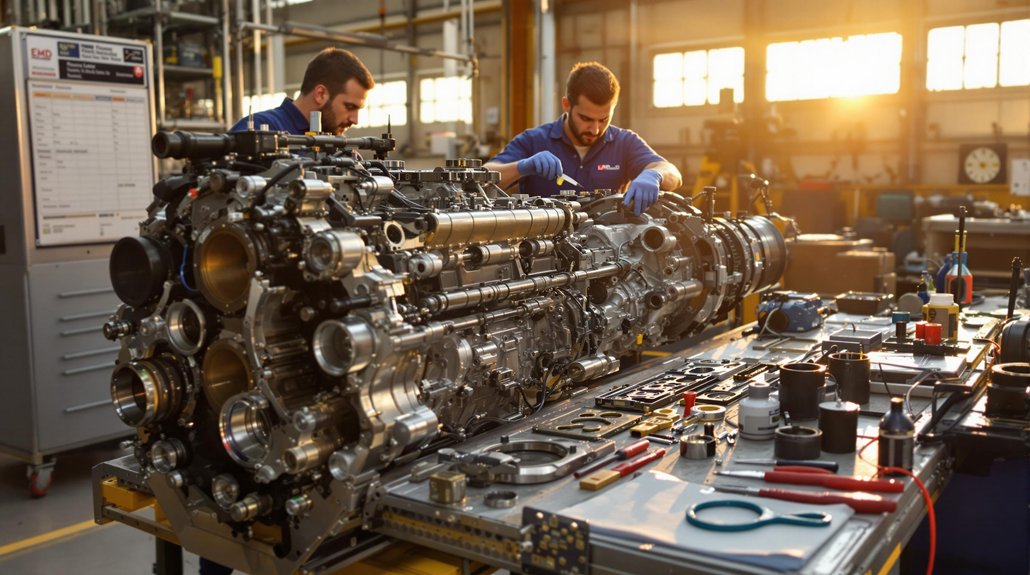
Properly overhauling EMD power assemblies requires strict attention to safety and precise technique. First, implement lockout/tagout procedures and gather specialized tools. Carefully disassemble components in sequence, documenting positions and inspecting for wear. Use fiber optic endoscopes to evaluate cylinder liners and pistons for damage. Select quality replacement parts meeting AAR M-1003 certification. Follow manufacturer torque specifications during reassembly. The following detailed steps will guarantee your overhaul meets OEM standards.

Key Takeaways

  • Implement strict lockout/tagout procedures to isolate all energy sources before beginning the EMD power assembly overhaul.
  • Organize specialized EMD tools and document component positions before disassembly to ensure proper reassembly.
  • Carefully inspect cylinder liners, piston crowns, and rings for scoring or wear using endoscopic inspection techniques.
  • Remove rocker arms by relieving valve train pressure and properly supporting shafts to prevent damage.
  • Install replacement components according to manufacturer specifications and follow structured break-in procedures after reassembly.

Understanding EMD Power Assembly Components and Function

emd power assembly components explained

Power assemblies form the core of EMD diesel engines, consisting of several critical components that work together to convert fuel energy into mechanical power. Your engine’s performance relies on the precise component interaction between the cylinder head assembly, cylinder liner, piston and rings, connecting rods, and piston carrier.

The cylinder head contains valves, springs, and keepers that manage combustion, while the cylinder liner provides the bore for piston movement. In two-stroke configurations, these liners incorporate intake and exhaust ports instead of traditional intake valves. The connecting rod system uses a unique blade and fork rod design, with both sharing a common journal. This sophisticated arrangement enables performance optimization while maintaining alignment through the piston carrier.

Understanding these components’ functions helps you maintain peak efficiency, as they’re engineered for rapid replacement without complete engine disassembly, considerably reducing maintenance downtime in demanding industrial and marine applications. Regular inspection using fiber optic endoscopes can help identify potential failures before they lead to catastrophic damage.

Essential Safety Protocols and Pre-Overhaul Preparations

Before starting any power assembly overhaul, you must implement proper lockout/tagout procedures to isolate all energy sources and prevent accidental startups. Your required safety equipment includes ANSI-compliant PPE such as safety glasses, cut-resistant gloves, steel-toed boots with non-slip soles, and appropriate respiratory protection for insulating materials. When working with EMD components, establish clear emergency response procedures to address potential hazards that may arise during the overhaul process. Conduct a thorough pre-use inspection of all PPE and tools, ensuring everything meets safety standards and is in peak working condition.

Lockout/Tagout Procedures

When working with EMD power assemblies, implementing proper lockout/tagout (LOTO) procedures forms the cornerstone of a safe overhaul process. Proper lockout importance cannot be overstated as these powerful diesel engines contain multiple energy isolation points that require systematic securing before maintenance. The established energy control program must be followed meticulously to prevent unexpected startup or energy release during maintenance activities.

Lockout/Tagout Procedures
LOTO StepCritical Action
NotificationInform all affected personnel of planned power assembly overhaul
Energy IsolationDisconnect electrical systems, fuel lines, and air supply
VerificationTest for zero energy state by attempting to operate controls
DocumentationRecord all lockout points and personnel involved on standardized forms

Before applying locks, conduct a thorough walk-through to identify all potential energy sources including hydraulic, pneumatic, and mechanical. Apply individual locks to each isolation point and verify complete energy dissipation before beginning disassembly work.

Required Safety Equipment

Guaranteeing adequate safety equipment stands as the foundational requirement for any EMD power assembly overhaul operation. Your protective measures must include heat-resistant gloves, insulating sleeves, and welding helmets with ANSI Z87.1 rated lenses for component handling. Always wear N95 respiratory protection when disassembling parts that may release emissions or dust.

Required Safety Equipment

Safety gear requirements extend to your work environment—install explosion-proof lighting where fuel vapors may be present and guarantee NFPA-compliant fire suppression systems are active in repair zones. Before beginning work, verify you’ve established proper vacuum containment systems and installed thermally insulated barriers for exposed fuel lines. Regular use of torque wrenches ensures fasteners are tightened to the manufacturer’s exact specifications, preventing component failures during reassembly.

Don’t overlook specialized equipment safety—only use ISO-certified lifting fixtures with properly rated hoisting equipment for power assembly extraction and implement proper grounding straps when handling electronic components.

Step-by-Step Disassembly of EMD Power Assemblies

disassembling emd power assemblies

Proper disassembly of EMD power assemblies requires methodical preparation of your workspace with specialized tools such as torque machines (EMD 8417881) and appropriate thread protectors. You’ll need to start by loosening rocker arm lock nuts and carefully removing the assemblies, ensuring all components are labeled for precise reassembly. After securing connecting rods with clamps to prevent liner damage, extract the piston components using the correct lifting devices—fork rod assemblies at a 22.5° angle and blade rods with dedicated piston holding tools (EMD 8417859). Remember that the complete power assembly is quite heavy, weighing approximately 440 pounds with a fork rod configuration.

Prepare Tools and Workspace

A well-organized workspace forms the foundation for successful EMD power assembly overhaul operations. Begin by ensuring proper engine immobilization—disconnect all power sources and drain coolant and oil systems. Your tool organization should prioritize EMD-specific tools within easy reach, including the injector holder (8431626), connecting rod clamp (8417881), and lifting clamp (8417858).

Prepare Tools and Workspace

Arrange your workspace layout with clear vertical clearance for hoists and lifting operations. Position designated containers for discarded components and prepare surface areas by removing all debris before new liner installation. Working with EMD F-units requires additional planning due to the cramped working conditions that can be particularly challenging for taller technicians. Verify electrical isolation by confirming all battery switches and circuit breakers are in the “off” position. Always have proper PPE ready—eye protection, gloves, and industrial footwear. Keep torque specifications accessible, especially for critical joints requiring precise settings like 200 ft-lbs.

Remove Rocker Arm Assemblies

Begin the power assembly disassembly by systematically removing the rocker arm assemblies. First, relieve valve train pressure by loosening the adjustment screws and backing off locknuts completely. This critical step prevents component damage during rocker arm maintenance. Remember that the configuration includes an outer rocker for exhaust and middle rocker for the injector mechanism.

Remove Rocker Arm Assemblies

Next, disconnect all injector oil supply lines after relieving system pressure. Extract fuel lines from the rocker assemblies to prevent contamination during the disassembly process.

ComponentRemoval MethodInspection Point
Rocker ShaftSupport with clamps before extractionCheck for scoring/wear
Bearing CapsRemove after marking positionsExamine for cracks
Spring WashersNote orientation during removalInspect for deformation

Once the shaft is free, carefully separate individual rocker arms from pedestals. Label all components to maintain assembly alignment during reassembly. Store removed parts in labeled containers to prevent mixing and guarantee proper pairing later.

Extract Piston Components

Extracting piston components requires methodical preparation and precise execution to avoid damage to critical engine parts. Begin by gathering your specialized tools, including piston lifting tools and ring expanders, while reviewing the EMD technical documentation.

Extract Piston Components

For piston extraction, rotate the crosshead to bottom dead center for ideal access. Remove any locking mechanisms securing cylinder components, then attach your lifting tool to the crown groove. When hoisting the piston upward, use distance pieces to maintain stuffing box alignment. For blade/fork assemblies, position the piston at a 22.5° angle relative to TDC.

During ring removal, carefully expand each piston ring with the proper tool to prevent cylinder bore damage. Remember that EMD’s two-stroke design requires special attention to the piston and liner relationship during disassembly. Measure all components for wear using micrometers and gauges, ensuring they meet EMD specifications before proceeding.

Critical Inspection Points and Failure Analysis

inspection and failure assessment

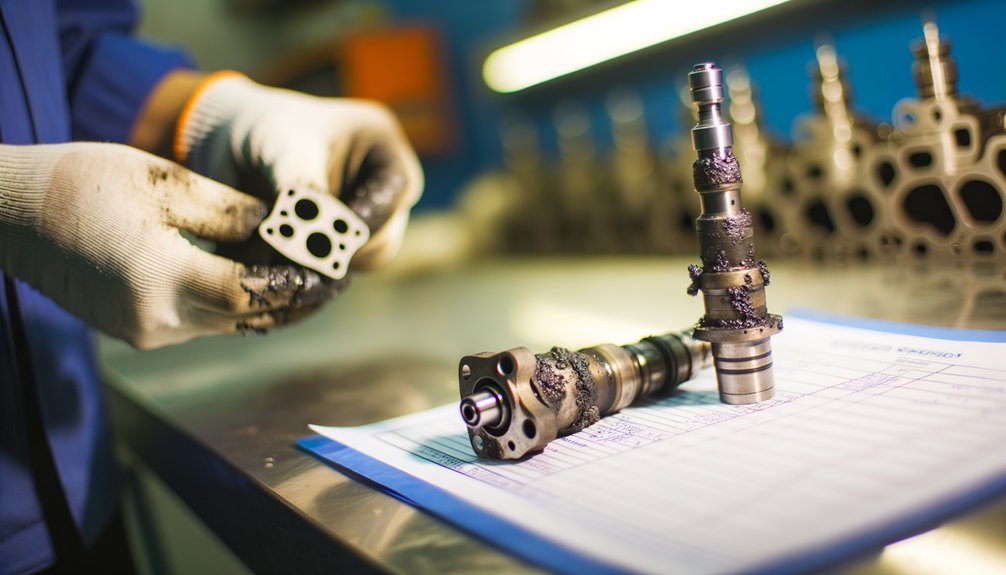
Thorough inspection represents the cornerstone of any EMD power assembly overhaul process. You’ll need to visually examine cylinder liners, piston crowns, and rings for scoring or wear while also checking connecting rod alignment. Document all failure modes including coolant leakage from deteriorated head gaskets or cracked liners.

Apply proper inspection techniques by pressure testing the cooling system to detect leaks in gaskets or lower liner seals. Measure gear train backlashes against manufacturer specifications and assess main bearing wear patterns for failure indicators. Look for dropped valves, broken pistons, or evidence of hydro-locking incidents where coolant entered cylinders.

Don’t overlook camshaft and bearing surfaces for scoring or premature lobe wear. Implement endoscopic inspection using borescopes for non-destructive evaluation of internal surfaces. Record findings in a detailed maintenance log to maintain comprehensive service records for future reference. Remember to quarantine damaged components for metallurgical analysis, which provides valuable insight into the root cause of failures.

Selecting the Right Replacement Parts and Upgrade Options

Selecting the right replacement parts for EMD power assemblies involves maneuvering a complex landscape of OEM and aftermarket options. You’ll need to choose between new, unit exchange (UX), or remanufactured components that meet AAR M-1003 certification standards.

When considering aftermarket compatibility, remember that 645 assemblies can replace 567C variants, but only when all assemblies are replaced simultaneously. This upgrade requires camshaft and blower gear adjustments to accommodate increased airflow demands. Don’t mix assembly types within the same engine block.

Selecting the Right Replacement Parts and Upgrade Options

For emissions upgrades, EPA-certified Tier 0+ assemblies allow you to meet current standards while using your existing engine design. Modern injector kits can improve combustion efficiency while reducing emissions. PowerRail offers raw materials that meet or exceed OEM specifications, ensuring optimal performance when upgrading.

Evaluate warranty coverage carefully—suppliers like Hatch & Kirk offer two-year warranties on remanufactured parts. Always verify that replacement components match OEM specifications for dimensional tolerances and material quality, especially for critical components like chrome-lined versus cast-iron liners.

Precision Reassembly Techniques and Torque Specifications

reassembly methods and specifications

Reassembling EMD power assemblies demands five critical precision techniques that separate professional rebuilds from amateur attempts. Proper snap ring installation requires consistent tension using all-thread and thrust washers to prevent displacement during operation. When torquing components, follow manufacturer’s specifications—wrist pin bolts need 200 ft-lbs in pairs, while cylinder head studs demand sequential stepped tightening.

  • Piston carrier assembly requires calibrated extraction tools for snap ring removal and proper spacing for secure reinstallation
  • Cylinder liner insertion needs ring compressors or modified tooling to prevent damage
  • Head installation demands sequential torque calibration (200 ft-lbs in specified increments)
  • Connecting rod alignment must be verified through gap checks before snap-ring engagement
  • Alignment validation using dial gauges to verify concentricity within ±0.001″ tolerance

Always use specialized tooling including hydraulic torque multipliers for high-torque applications to maintain precision and prevent component damage during power assembly reassembly.

Post-Overhaul Testing and Performance Verification

After completing a power assembly overhaul, you’ll need to implement rigorous testing protocols to verify operational integrity before returning the EMD engine to service. Begin by validating system integration and compatibility, ensuring upgraded components align with existing engine systems and EPA Tier 0 emissions compliance standards.

Prime the fuel system to eliminate air pockets, adjust valve lash clearances, and verify injector spray patterns. Conduct cooling system pressure tests to identify potential leaks in liners, heads, or gaskets. Check alignment of fork rods and basket assemblies to prevent gear mismatches.

Post-Overhaul Testing and Performance Verification

Implement a structured break-in procedure with varied speed and load conditions to properly seat new piston rings. Monitor oil pressure, turbocharger boost, and exhaust temperature throughout testing. Document performance metrics including compression readings, vibration levels, and response times during load changes. Test emissions output with opacity meters to confirm regulatory compliance before finalizing your overhaul certification.

Documentation and Preventative Maintenance Scheduling

maintenance documentation scheduling process

Proper documentation and maintenance scheduling represent the backbone of any successful EMD power assembly overhaul program. Following established documentation standards guarantees critical information like torque specifications, component interchangeability, and fuel system reset procedures are properly recorded and accessible for future maintenance.

Documentation and Preventative Maintenance Scheduling

Implement these maintenance tracking essentials:

  • Maintain block history records to identify recurring issues and establish wear patterns that inform preventative scheduling
  • Align major component replacements with the 12-year replacement cycle for critical items like liner seals and head gaskets
  • Schedule filter changes and turbocharger maintenance to coincide with regular 18-24 month inspection intervals
  • Document post-overhaul break-in procedures to guarantee proper component seating and prevent premature wear
  • Implement condition-based monitoring through differential pressure readings to potentially extend maintenance intervals

After documenting your overhaul, schedule the next maintenance based on nuclear standby application standards or your specific operational parameters.

Frequently Asked Questions

How Long Should EMD Power Assemblies Last Between Overhauls?

The million-year reliability of EMD power assemblies is legendary, but you’ll still need to plan your overhaul frequency strategically. Your power assemblies should last 5 years between overhauls to maintain Tier 0 compliance, though manufacturer guidelines suggest up to 12 years for other major components. Performance longevity depends on operating conditions, but regulatory standards define useful life as 10 years or 750,000 miles, whichever comes first.

Can I Mix OEM and Aftermarket Components During an Overhaul?

Mixing OEM and aftermarket components generally compromises OEM compatibility and introduces significant aftermarket risks. You’ll potentially face issues with precise tolerances, material specifications, and engineered integration. While aftermarket parts might reduce initial costs, they can void warranties and lead to premature failures. For critical components like connecting rods or pistons, maintain matched sets. If you must use aftermarket parts, verify dimensional accuracy and perform enhanced post-installation monitoring.

What Causes Abnormal Water Test Failures in Power Assemblies?

Abnormal water test failures typically stem from component degradation like worn impellers or faulty seals. You’ll encounter failures when water contamination introduces particles that clog pathways or corrode surfaces. Improper test procedures, including bypassed safety circuits or unvalidated configuration changes, also cause failures. Don’t overlook maintenance deficiencies such as insufficient lubrication or incorrect part installation. Always verify proper torque specifications and conduct thorough pre-test inspections to prevent unexpected failures.

When Should I Consider Upgrading Versus Standard Replacement?

Consider upgrading to 645 power assemblies when you’re facing multiple failures, need long-term parts availability, or can benefit from economies of scale. Upgrade benefits include improved performance and reduced future maintenance. Opt for standard 567 replacement when you’re dealing with isolated failures, need to avoid emission recertification, or can’t justify full overhaul costs. Your decision should balance immediate cost considerations against long-term operational needs and regulatory requirements.

How Do Ambient Conditions Affect Power Assembly Maintenance Intervals?

Like a thermometer constantly shaping our behavior, ambient conditions directly dictate your maintenance schedule. High ambient temperature (35°C-45°C) accelerates wear, reducing intervals by up to 50%. Humidity levels exceeding 80% promote corrosion, necessitating more frequent inspections. In severe environments (industrial, marine), you’ll need maintenance every 1-2 years, while controlled environments permit 2-6 year intervals depending on criticality and load factors.

Translate »